China Auto Thread

China Topples Japan as Global Auto Leader

China Topples Japan as Global Auto Leader

Source:Shutterstock

March 25, 2026 -- Today’s top stories: China Topples Japan as Global Auto Leader, Japan Taps Oil Reserves Amid Middle East Crisis, and EU Warns Vietnam Over Chinese 5G Tech.

2026-03-25

Chinese automakers overtake Japanese counterparts to lead global sales for 1st time

Chinese automakers have surpassed their Japanese counterparts in global vehicle sales for the first time, according to a report by Nikkei.

Japanese automakers fell slightly to around 25 million units in 2025, causing Japan to lose its long-held top position for the first time since 2000.

Meanwhile, Chinese car manufacturers recorded nearly 27 million units in global sales last year, rising to the top spot worldwide.

BYD surpassed Ford to rank sixth globally in 2025, while Geely overtook Honda to secure eighth place.

Six Chinese automakers entered the global top 20 rankings, outnumbering Japan's five. In the electric vehicle segment, BYD also exceeded Tesla to become the world's leading EV seller, it added. Tang Jin, a senior researcher at Japan's Mizuho Bank and an expert in the automotive sector, noted that China's rise to the top is more than a simple change in rankings.

It signals a restructuring of the global automotive landscape, driven by China's strengths in advanced technology, cost efficiency, and rapid research and development.

He added that Japan needs to reassess its strategies in vehicle electrification and global market positioning in response to the evolving competition.


BYD Overtakes Tesla in February 2026 European Registrations, Intensifying EV Battle

Last updated: 2026/3/25

BYD's car registrations in the broader European market (EU, EFTA, and UK) reached 17,954 units in February 2026, marking an impressive 162.3% year‑over‑year increase. This figure narrowly outpaced Tesla's 17,664 units, which rose by a modest 11.8% YoY.

While the overall European new car market sees slow growth, BYD continues to expand rapidly with its electrified lineup, posing significant competition to Tesla. Data from the European Automobile Manufacturers' Association (ACEA) highlights a growing BEV market share as EV rivalry heats up.

Introduction​

The European electric vehicle (EV) market has witnessed a dramatic shift in recent months, marked by an intense rivalry between BYD and Tesla. In February 2026, BYD overtook Tesla in new car registrations across Europe, narrowly claiming the top spot. According to CnEVPost, BYD's registrations surged to 17,954 units, a significant increase from previous figures, and outpaced Tesla's 17,664 units. This surge highlights BYD's rapid expansion in a market that continues to grow despite overall subdued car sales.

The competition between these two giants is indicative of broader trends in the EV sector. With battery electric vehicles (BEVs) occupying a larger share of the market, traditional automotive leaders are feeling the pressure from these new powerhouses. BYD's growth, in particular, reflects an aggressive strategy of expanding their model offerings and boosting manufacturing capabilities, such as their upcoming facilities in Turkey and Hungary. On the other hand, Tesla, although experiencing more modest growth, has been bolstering its efforts by refining its existing models and expanding its global sales reach.

These developments not only reflect a shift within the market dynamics but also point to the increasing competitiveness of Chinese manufacturers like BYD. Their penetration into European markets, marked by high growth percentages, signals a shifting power balance in the global automotive industry. As BYD continues to enhance its market presence, strategic moves like local manufacturing to circumvent tariffs are crucial. Meanwhile, Tesla remains a formidable player, with its strong brand and commitment to innovation, keeping it in close competition with BYD.

BYD's Surge in Europe​

BYD, a Chinese electric vehicle (EV) manufacturer, is riding a wave of success in the European market, rapidly gaining ground against established players like Tesla. February 2026 was a particularly momentous month for the company, as its new car registrations in Europe soared to 17,954 units. This impressive figure represents a year‑over‑year (YoY) increase of 162.3%, up from 6,844 units the previous year. Notably, BYD has managed to surpass Tesla, which stood at 17,664 units, marking a significant milestone in their ongoing rivalry. This surge in registrations highlights BYD's aggressive market expansion and underscores its strategic efforts to capture a larger share of the growing European EV market. For more details, you can view the full article on BYD's success here.

The European market context adds another layer to BYD's surge. While EU new car registrations fell overall by 1.2% year‑to‑date (YTD), battery electric vehicles (BEVs) have increased their market share to 18.8%, reflecting the rising consumer demand for electric alternatives even when the broader market recedes. According to the European Automobile Manufacturers' Association, this puts BYD in an advantageous position, especially considering its aggressive deployment of new models that cater to this burgeoning demand for BEVs in Europe. With continuous innovation and strategic investments in local European markets, BYD seems poised to sustain its momentum and competitive edge against other EV giants. More insights are available here.

While Tesla has shown modest recovery with a 11.8% YoY increase to 17,664 units, it is the robust growth of BYD that has caught the attention of the automotive industry. This rapid rise, fueled by new and appealing models like the BEV and PHEV, and bolstered by strategic international partnerships, underscores the dynamic and competitive nature of the EV market in Europe. BYD’s strength not only lies in its rising sales figures but also in its expanding manufacturing bases across Europe, aimed at enhancing production efficiency and circumventing EU tariffs. These developments have been pivotal in establishing BYD as a formidable player in the competitive EV landscape. Explore the detailed impact of these strategic moves here.


US car buyers eye cheaper Chinese EVs they cannot access

Anabelle Colaco
26th March 2026, 02:32 GMT+11

DETROIT, Michigan: For some U.S. consumers, the search for an affordable electric vehicle is leading to a frustrating conclusion: the most appealing options are out of reach.

Sooren Moosavy, a 28-year-old from Baltimore, wants an electric car for environmental reasons and a smoother driving experience. But the models he prefers are made by Chinese automakers and are not available in the United States.

"I would love the opportunity to be able ‌to get one in or even test-drive one," said Moosavy, who has narrowed his wish list to three models from BYD, Geely, and Zeekr, attracted to their compactness, plush interiors, and above all, the price.

Moosavy's dilemma reflects a broader sentiment among U.S. car buyers. As the average price of a new car nears US$50,000, interest in more affordable Chinese-made EVs is growing, even as political and industry opposition keep them out of the market. While these vehicles are sold widely across Europe, Latin America, and Canada, U.S. tariffs exceeding 100 percent have effectively blocked their entry, citing concerns over data security and domestic jobs.

In other regions, some Chinese EVs are priced below $30,000 and offer features such as advanced driver assistance, built-in mini fridges, and even karaoke systems.

"The technology they offer for those lower price tags was astounding," said Clint Simone, senior features editor for car-shopping website Edmunds, who drove several Chinese vehicles while at the CES trade show earlier this year.

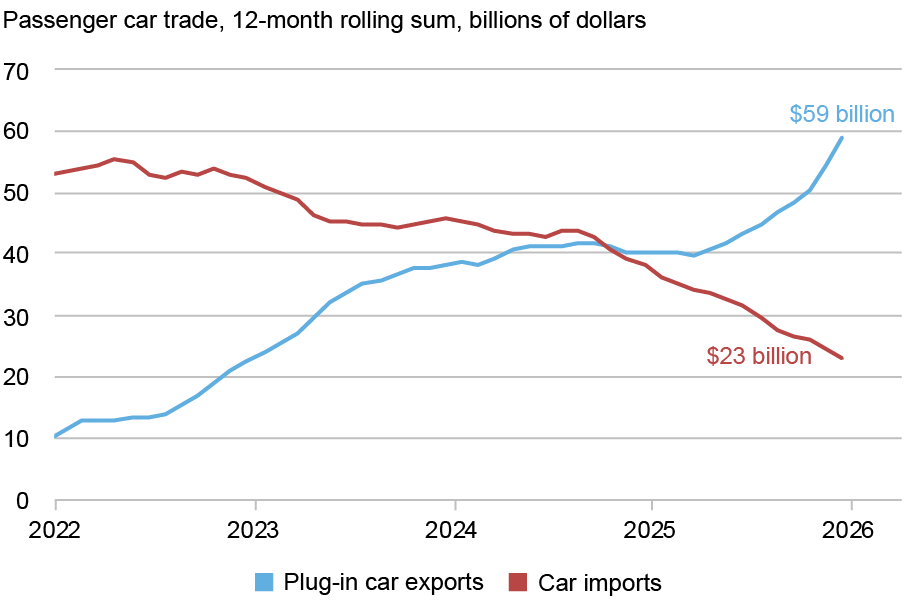
China has overtaken Japan as the world's largest vehicle exporter, with shipments expanding rapidly across global markets. Canada recently agreed to lower tariffs on a limited number of Chinese EV imports, while exports to Mexico are already significant.

In the United States, policymakers remain cautious. President Donald Trump has said he would consider allowing Chinese automakers to set up factories in the U.S. if they create American jobs. However, industry groups have urged the government to maintain restrictions, citing competitiveness concerns. Republican Senator Bernie Moreno of Ohio said in January at an event at a Ford Motor plant that "as ⁠long as I have air in my body, there will not be Chinese vehicles sold in the United States of America."

China's embassy in Washington has pushed back against criticism, saying the cars' popularity stems from their quality and innovation.

Among U.S. consumers, attitudes are mixed. Surveys by The Harris Poll and Cox Automotive show concerns about data security and the protection of the domestic industry, as well as a strong interest in value.

Dealers are similarly divided. Just 15 percent support allowing Chinese brands into the U.S., and only 26 percent trust they would meet safety standards, according to a Cox survey.

Still, curiosity remains high. Nearly half of surveyed consumers rated Chinese vehicles as offering very good or excellent value, and 40 percent said they support their entry into the U.S. market.

Rich Benoit, a car enthusiast who reviews Chinese EVs on YouTube, said price is the main draw. "That's what a lot of people are looking for: efficient, quiet, and low cost," he said. "They want to get to work – not everyone is a car enthusiast."

He is even considering buying one in Mexico and bringing it across the border. "That's the only way to get one," Benoit said. "They've been selling in Mexico for years... I want to own a Chinese EV in America."

 
China’s Electric Passenger Car Exports Have Soared
LSE_2026_china-green-trade_klitgaard_ch1.png


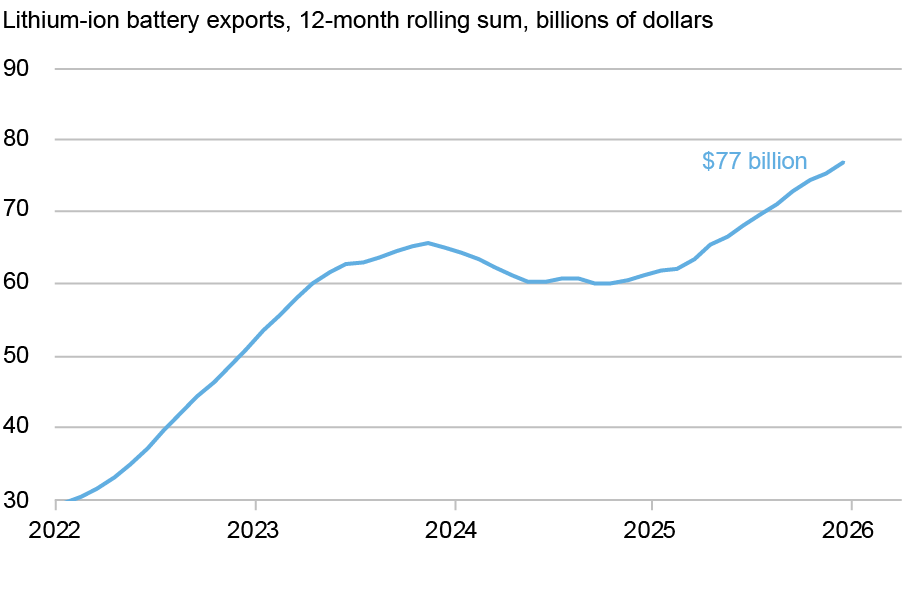
China’s Battery Exports Are Trending Higher
LSE_2026_china-green-trade_klitgaard_ch2.png
 

BYD Overtakes Tesla in February 2026 European Registrations, Intensifying EV Battle

Last updated: 2026/3/25

BYD's car registrations in the broader European market (EU, EFTA, and UK) reached 17,954 units in February 2026, marking an impressive 162.3% year‑over‑year increase. This figure narrowly outpaced Tesla's 17,664 units, which rose by a modest 11.8% YoY.

While the overall European new car market sees slow growth, BYD continues to expand rapidly with its electrified lineup, posing significant competition to Tesla. Data from the European Automobile Manufacturers' Association (ACEA) highlights a growing BEV market share as EV rivalry heats up.

Introduction​

The European electric vehicle (EV) market has witnessed a dramatic shift in recent months, marked by an intense rivalry between BYD and Tesla. In February 2026, BYD overtook Tesla in new car registrations across Europe, narrowly claiming the top spot. According to CnEVPost, BYD's registrations surged to 17,954 units, a significant increase from previous figures, and outpaced Tesla's 17,664 units. This surge highlights BYD's rapid expansion in a market that continues to grow despite overall subdued car sales.

The competition between these two giants is indicative of broader trends in the EV sector. With battery electric vehicles (BEVs) occupying a larger share of the market, traditional automotive leaders are feeling the pressure from these new powerhouses. BYD's growth, in particular, reflects an aggressive strategy of expanding their model offerings and boosting manufacturing capabilities, such as their upcoming facilities in Turkey and Hungary. On the other hand, Tesla, although experiencing more modest growth, has been bolstering its efforts by refining its existing models and expanding its global sales reach.

These developments not only reflect a shift within the market dynamics but also point to the increasing competitiveness of Chinese manufacturers like BYD. Their penetration into European markets, marked by high growth percentages, signals a shifting power balance in the global automotive industry. As BYD continues to enhance its market presence, strategic moves like local manufacturing to circumvent tariffs are crucial. Meanwhile, Tesla remains a formidable player, with its strong brand and commitment to innovation, keeping it in close competition with BYD.

BYD's Surge in Europe​

BYD, a Chinese electric vehicle (EV) manufacturer, is riding a wave of success in the European market, rapidly gaining ground against established players like Tesla. February 2026 was a particularly momentous month for the company, as its new car registrations in Europe soared to 17,954 units. This impressive figure represents a year‑over‑year (YoY) increase of 162.3%, up from 6,844 units the previous year. Notably, BYD has managed to surpass Tesla, which stood at 17,664 units, marking a significant milestone in their ongoing rivalry. This surge in registrations highlights BYD's aggressive market expansion and underscores its strategic efforts to capture a larger share of the growing European EV market. For more details, you can view the full article on BYD's success here.

The European market context adds another layer to BYD's surge. While EU new car registrations fell overall by 1.2% year‑to‑date (YTD), battery electric vehicles (BEVs) have increased their market share to 18.8%, reflecting the rising consumer demand for electric alternatives even when the broader market recedes. According to the European Automobile Manufacturers' Association, this puts BYD in an advantageous position, especially considering its aggressive deployment of new models that cater to this burgeoning demand for BEVs in Europe. With continuous innovation and strategic investments in local European markets, BYD seems poised to sustain its momentum and competitive edge against other EV giants. More insights are available here.

While Tesla has shown modest recovery with a 11.8% YoY increase to 17,664 units, it is the robust growth of BYD that has caught the attention of the automotive industry. This rapid rise, fueled by new and appealing models like the BEV and PHEV, and bolstered by strategic international partnerships, underscores the dynamic and competitive nature of the EV market in Europe. BYD’s strength not only lies in its rising sales figures but also in its expanding manufacturing bases across Europe, aimed at enhancing production efficiency and circumventing EU tariffs. These developments have been pivotal in establishing BYD as a formidable player in the competitive EV landscape. Explore the detailed impact of these strategic moves here.


The European Resurgence: Analyzing Tesla's 12% February Growth and the Battle with BYD

Today’s news was met with sensationalist headlines claiming that BYD has officially beaten Tesla in Europe. While the raw registration numbers show BYD at 17,954 units (290 more than Tesla), a technical audit of the data reveals a much more nuanced reality.

3.1 The PHEV Caveat

BYD’s European volume is heavily bolstered by its Plug-in Hybrid (PHEV) models, such as the Seal U DM-i. Tesla, conversely, remains a 100% Battery Electric Vehicle (BEV) manufacturer.
  • Pure BEV Leadership: When isolating pure electric sales, Tesla remains the undisputed leader in Europe.
 

Sodium-ion EV battery breakthrough delivers 11-min charging and 450 km range​

Mar 25 2026 - 9:58 am PT

The next generation of electric vehicle batteries is arriving, promising to be more efficient, safer, and lower cost. After another breakthrough, sodium-ion batteries for passenger EVs are nearing mass production.

Sodium-ion EV batteries begin rolling out in China

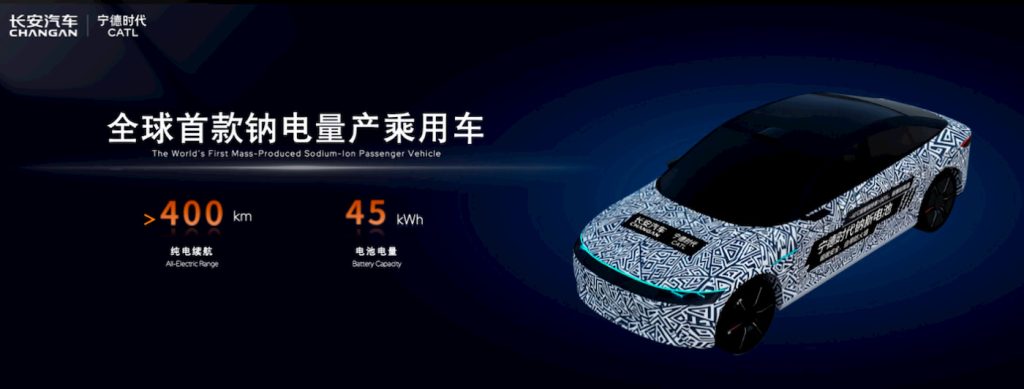
Just over a month after CATL and Changan Automobile unveiled the world’s first mass-produced EV with a sodium-ion battery, another “breakthrough” was announced this week.

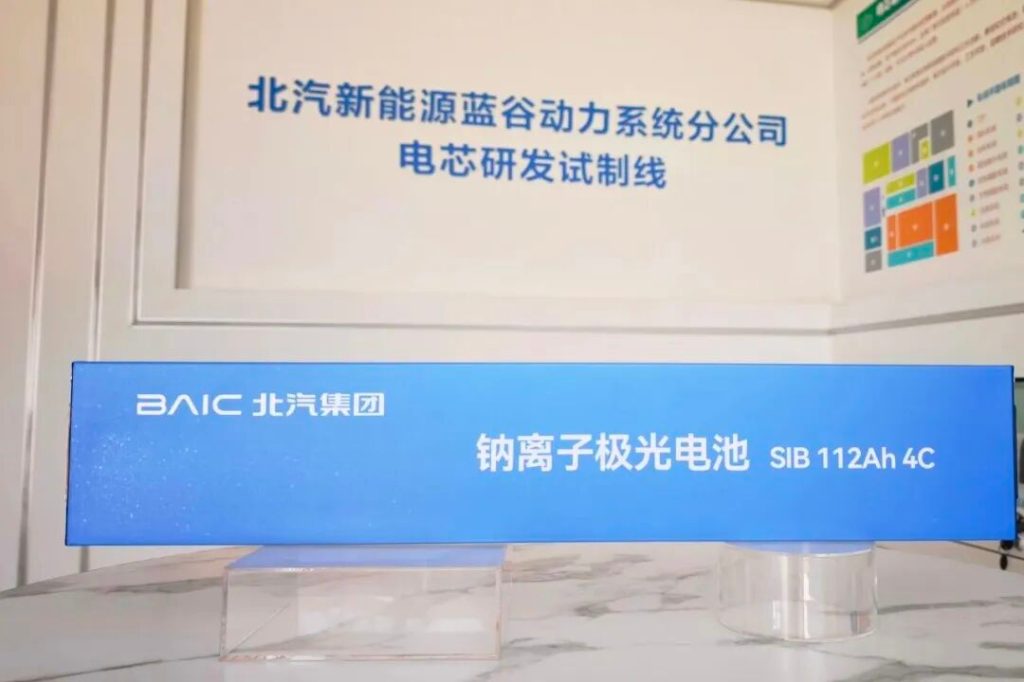
China’s Beijing Automotive Group (BAIC Group) revealed its latest progress with the new battery tech this week. The company’s R&D unit (BAIC R&D) shared on its WeChat account that it had achieved a “significant breakthrough,” completing its first sodium-ion battery prototype.

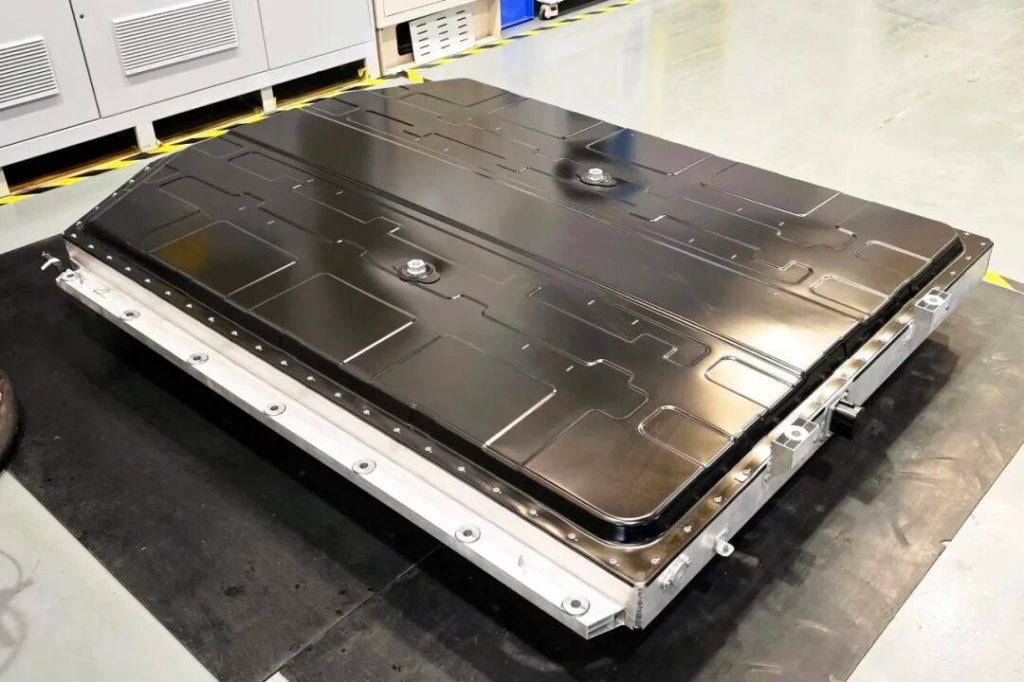
BAIC’s Aurora battery series now spans lithium-ion, solid-state, and sodium-ion batteries. The sodium-ion battery pack features prismatic cells with an energy density of over 170Wh/kg, placing it among the best in the industry.

In an update on Tuesday, BAIC Group revealed that the sodium-ion EV battery can achieve a CLTC driving range of 450 km (280 miles), again among the industry’s best.

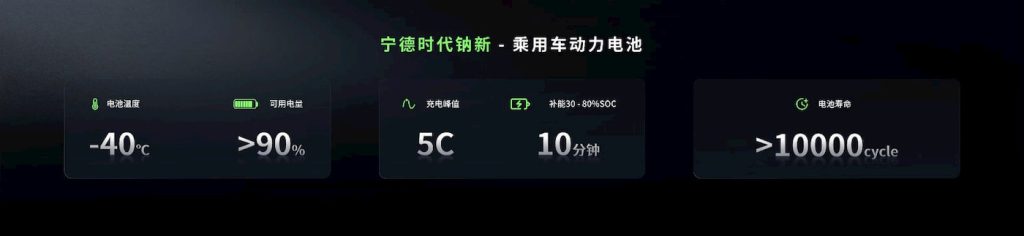
With 4C ultra-fast charging, the sodium-ion battery can fully recharge in about 11 minutes. One of the biggest takeaways is that the battery maintains performance across a wide temperature range, from -40°C (-40°F) to 60°C (140°F).

Sodium-ion-EV-battery-breakthrough

Sodium-ion-EV-battery-breakthrough


BAIC said the sodium-ion battery maintained an energy retention rate of over 92% at -20°C (-4°F). The company announced on March 19 that it had completed a sodium-ion battery prototype and established a mass-production method for prismatic batteries.

The achievement comes just over a month after CATL showcased its sodium-ion batteries in the Changan Nevo A06.

World-first-sodium-ion-battery-EV
(Source: CATL)
“The breakthroughs in sodium-ion technology bring greater resilience, a wider operating temperature range, and more sustainable growth to electrification,” CATL’s chief tech officer, Gao Huan, said during a press conference in February.

CATL’s “Naxtra” sodium-ion batteries achieve an energy density of up to 175 Wh/kg, the company said, putting it on par with lithium iron phosphate (LFP) batteries.

World-first-sodium-ion-battery-EV
(Source: Changan Automotive)

Passenger EVs will draw power from a 45-kWh sodium-ion battery pack, providing up to 400 km (248 mi) of range under CLTC conditions. As battery technology advances over the next few months and years, CATL expects that range to increase to around 500-600 km (310-372 miles).

Sodium offers a lower-cost, less price-sensitive alternative to lithium. For that reason, CATL, BYD, and several other leading Chinese battery manufacturers are betting on sodium-ion batteries to combat rising lithium prices.

Last year, global sodium-ion battery shipments reached 9 GWh, up 150% from 2024. Over the next four years, that number is expected to reach over 1,000 GWh.
 
The European Resurgence: Analyzing Tesla's 12% February Growth and the Battle with BYD

Today’s news was met with sensationalist headlines claiming that BYD has officially beaten Tesla in Europe. While the raw registration numbers show BYD at 17,954 units (290 more than Tesla), a technical audit of the data reveals a much more nuanced reality.

3.1 The PHEV Caveat

BYD’s European volume is heavily bolstered by its Plug-in Hybrid (PHEV) models, such as the Seal U DM-i. Tesla, conversely, remains a 100% Battery Electric Vehicle (BEV) manufacturer.
  • Pure BEV Leadership: When isolating pure electric sales, Tesla remains the undisputed leader in Europe.
The article says BYD, meaning all cars of BYD brand, it's about the company.
 

China EV exports jump 120% in February as global demand accelerates

March 25 2026

china%20ev%20export%2026%20March%202026_id_f4043a94-bbc7-48c3-8cec-031f1cac1e70_size900.jpeg

  • Supports China growth and industrial momentum, while increasing pressure on global automakers and raising the likelihood of trade protection measures, particularly in Europe.

China EV exports surge as global demand accelerates despite trade risks.

Summary:

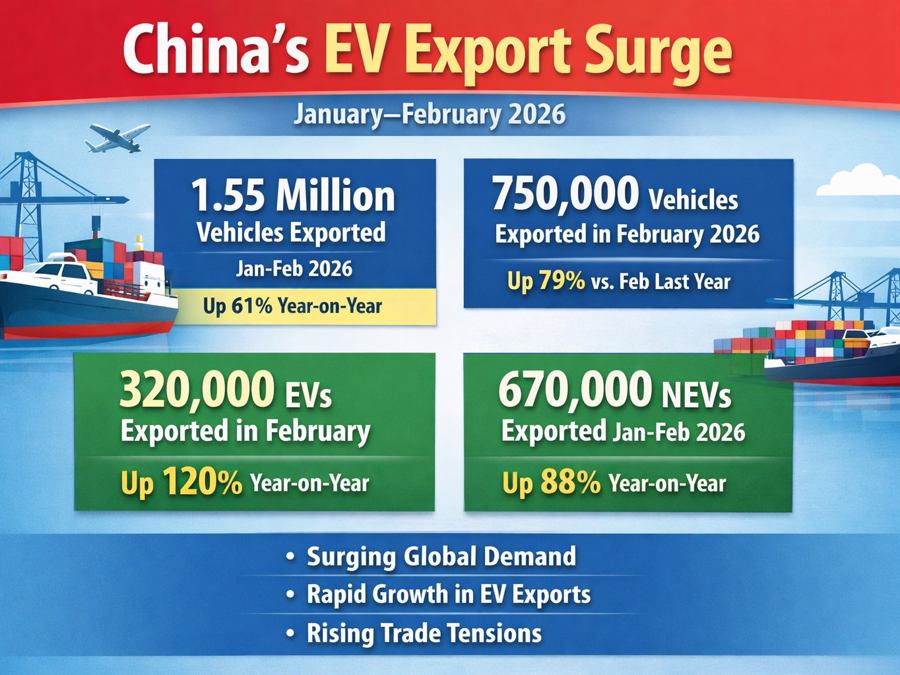
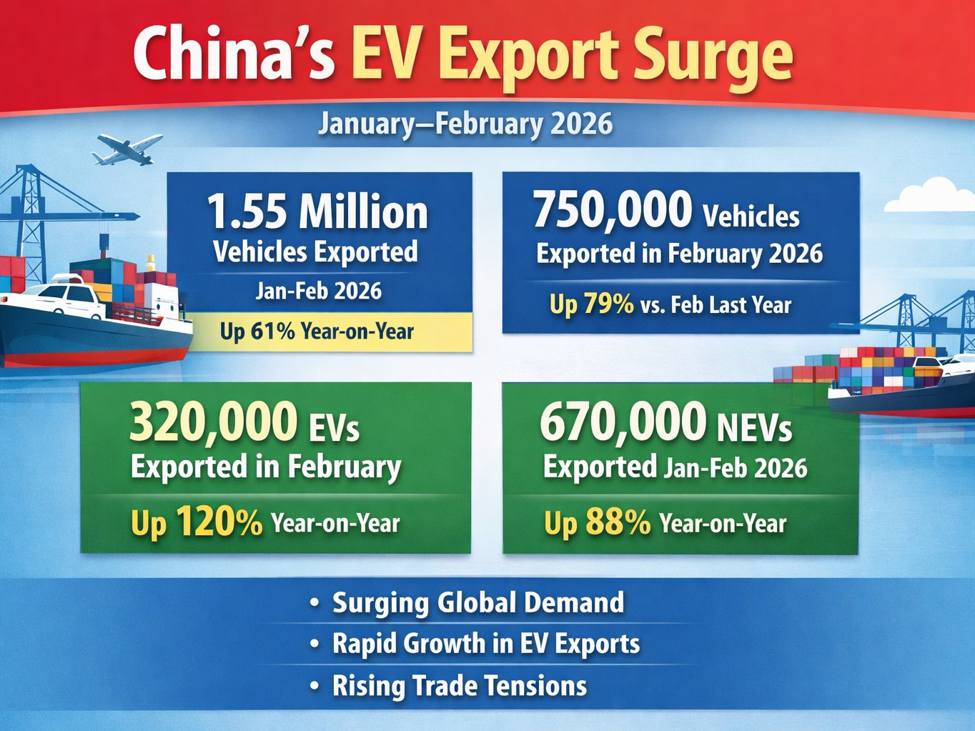
  • China vehicle exports up 61% YoY in Jan-Feb
  • February exports rise 79% YoY to 750,000 units
  • NEV exports surge 120% YoY in February
  • 320,000 EVs exported in February alone
  • Jan-Feb NEV exports reach 670,000 (+88% YoY)
  • Strong global demand for Chinese EVs
  • Competitive pricing and scale key drivers
  • Trade tensions risk rising globally
China’s vehicle exports surged at the start of 2026, driven by a sharp acceleration in electric vehicle shipments, reinforcing the country’s growing dominance in global auto markets.

According to data from the China Passenger Car Association, total vehicle exports reached 1.55 million units in January and February combined, representing a 61% increase from a year earlier. February alone saw 750,000 vehicles shipped overseas, up 79% year-on-year, although slightly lower on a monthly basis compared to January.

The standout driver of growth was the new energy vehicle (NEV) segment, which includes battery electric and plug-in hybrid models. NEV exports reached 320,000 units in February, marking a 120% increase from the same period last year. Over the first two months of the year, NEV exports totalled 670,000 units, up 88% year-on-year.

The surge underscores China’s rapid expansion in the global EV market, supported by competitive pricing, strong domestic supply chains and continued policy backing. Chinese automakers have increasingly targeted overseas markets as domestic competition intensifies, particularly in Europe, Southeast Asia and emerging markets.

The data also highlights a broader structural shift in global auto trade, with electrification playing a central role. China’s scale advantages in battery production and EV manufacturing have enabled it to gain market share at a time when many international competitors are still ramping up capacity.

However, the strong export growth comes amid rising trade tensions. Several regions, particularly in Europe and the United States, have expressed concerns over the influx of lower-cost Chinese EVs, raising the risk of tariffs or other protective measures.

Looking ahead, momentum in NEV exports is expected to remain strong, though volatility in global demand and potential policy responses from key markets could shape the trajectory. For now, China’s EV export surge is reinforcing its position as a central player in the global transition toward electrified transport.


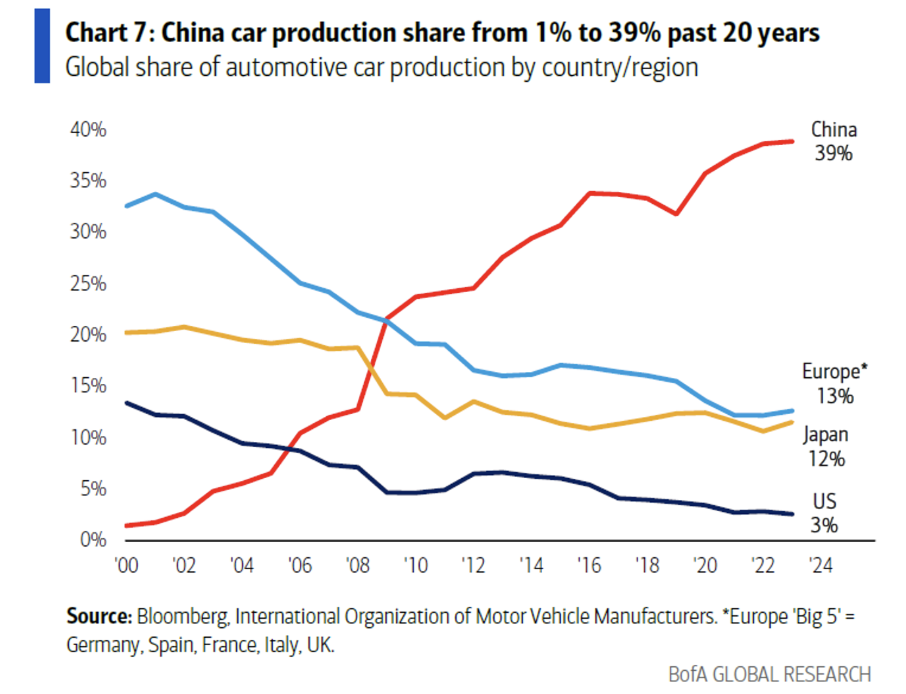
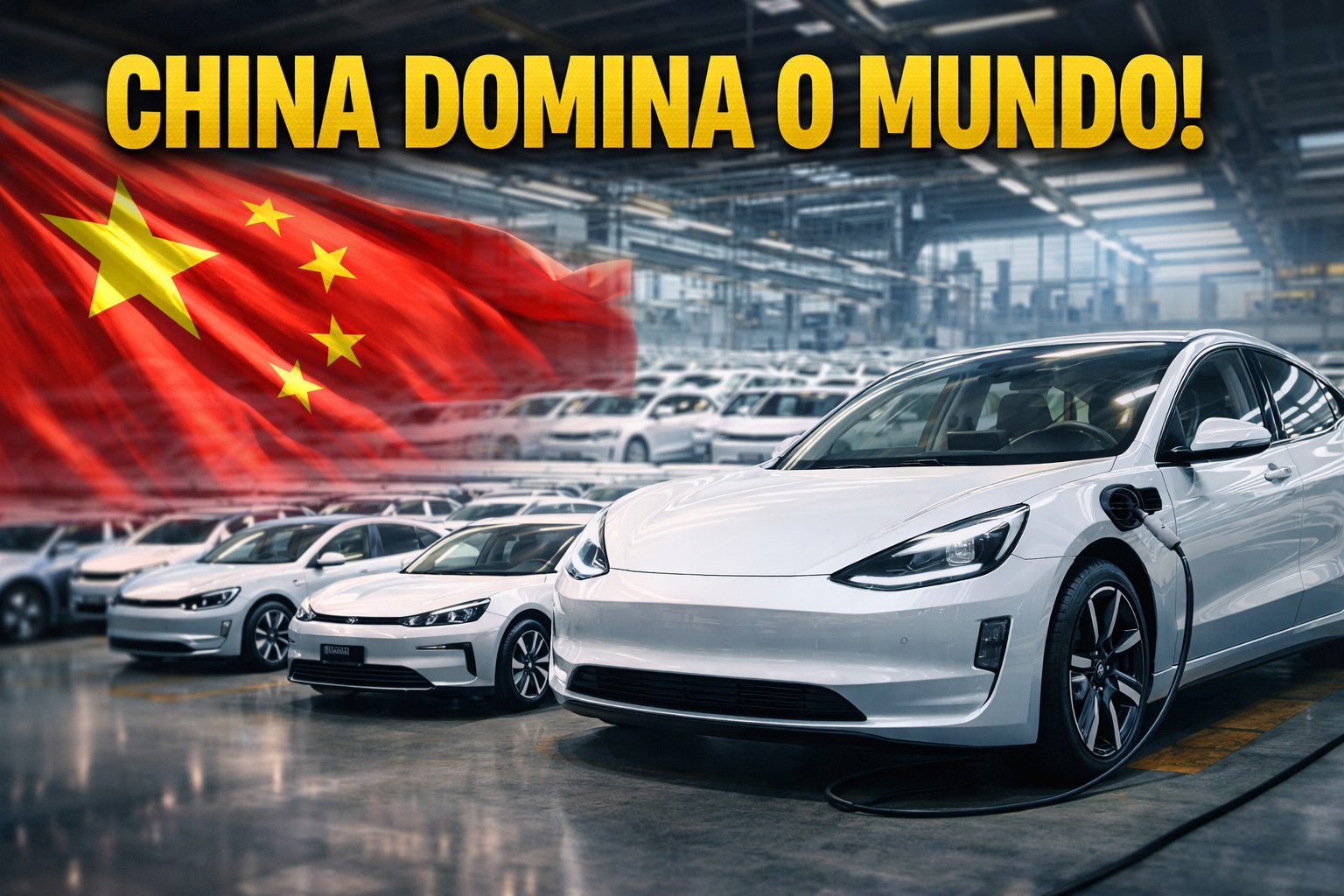
While Japan and Germany lose ground, China surges ahead and becomes the world's largest vehicle manufacturer with over 30 million units per year, dominating global production and leading the electric car revolution.​


Written byDeborah Araújo
Published25/03/2026 às 14:23

While Japan and Germany lose ground, China surges ahead and becomes the world's largest vehicle manufacturer with over 30 million units per year, dominating global production and leading the electric car revolution.
China becomes the world's largest vehicle manufacturer with over 30 million vehicles produced annually and leads the electric car revolution on a global scale.

China becomes the world's largest vehicle manufacturer with over 30 million vehicles produced annually and leads the electric car revolution on a global scale.

In 2023 and 2024, data consolidated by global industry associations and widely disseminated by outlets such as... Reuters and Bloomberg They confirmed a historic turning point in the automotive industry: China not only maintained its position as the world's largest vehicle manufacturer, but also surpassed Japan and became the largest global exporter in the sector. With annual production exceeding 30 million vehiclesThe country accounts for approximately one third of all world productionconsolidating a leadership that began in 2009, when it surpassed the United States in total volume. This transformation is not merely quantitative. It marks a structural shift in the center of power of the global automotive industry.

hqdefault.webp

The second is the domestic market. China has the largest consumer market for automobiles on the planet, which guarantees constant and predictable demand. The third is industrial policy. The Chinese government has strongly incentivized the sector with subsidies, financing, and long-term planning.

This combination created an environment where mass production, innovation, and competitiveness developed simultaneously.

Production exceeding 30 million vehicles per year.​

The number that defines Chinese leadership is volume. With more than 30 million vehicles produced annuallyChina is far ahead of any other country. For comparison:

  • Japan produces around 8 to 10 million;
  • Germany is at a similar level;
  • The United States is also below the Chinese mark.
This difference in scale is not marginal. It is structural.

The recent turning point: China also becomes the largest exporter.​

While until a few years ago China primarily dominated its domestic market, the scenario has changed rapidly. In 2023, the country surpassed Japan and became the world's largest exporter of vehicles. This means that it not only produces more, but also sells more abroad. This progress indicates industrial maturity and global competitiveness.

China's biggest advantage lies not only in the quantity of vehicles, but in the type of technology it leads in. The country dominates the electric vehicle segment. Companies like BYD have become global leaders, producing complete electric cars, batteries, and electronic systems.

China controls a large part of the production chain, especially in the manufacture of batteries, which are the most critical component of electric vehicles.

Why Japan and Germany lost their leadership in volume.​

Japan and Germany remain benchmarks in automotive quality and engineering. However, they have lost their leadership in volume for several reasons:

  • Smaller scale of production;
  • Focus on higher value-added vehicles;
  • Slower transition to electric vehicles.
These factors do not diminish its importance, but they do explain the change in the global ranking.

The Chinese model: scale, speed, and integration.​

China's success can be summarized in three pillars:

  • Scale: Mass production with reduced costs;
  • Velocity: Ability to adapt quickly to new technologies;
  • Integration: Control of the production chain, especially in batteries.
This model allows the country to advance faster than traditional competitors.

Global impact of Chinese leadership​

China's rise is redefining the global automotive market. Key effects include increased international competition, lower prices in some segments, and accelerated electrification. Automakers in other countries are being pressured to adapt.

While Japan and Germany lose ground, China surges ahead and becomes the world's largest vehicle manufacturer with over 30 million units per year, dominating global production and leading the electric car revolution.
China becomes the world's largest vehicle manufacturer with over 30 million vehicles produced annually and leads the electric car revolution on a global scale.

The trend suggests that Chinese leadership will continue in the short and medium term, especially in the electricity sector. The competition now is not just about volume, but about technology. In this scenario, the ability to innovate will be as important as the ability to produce.

A structural shift at the heart of the automotive industry.​

China has not only taken the lead in vehicle production, it has redefined the global balance of power in the sector.
Autos & Vehicles

With scale, technology, and integration, the country has consolidated a position that goes beyond the automotive industry and connects directly to the global energy transition.

The result is a new market configuration, where the leading role is no longer exclusive to Japan, Germany, and the United States, and a new center of gravity has emerged.

 
..and I was simply posting about how Tesla is still far ahead of BYD in BEV sales in Europe.
BYD have many models, in terms of BYD cars, it beats Tesla, yet it is being challenged by several other equally good Chinese EV making companies, US only has Tesla and most Tesla cars are made in China.
 

Automotive Revenue Exceeds 100 Billion Yuan for the First Time! Xiaomi Group 2025 Financial Report Released​

Edited by Taylor From Gasgoo|March 25 , 2026 21:20 BJT

Gasgoo Munich-Xiaomi Group released its full-year financial report for 2025 on March 24.

Over the past year, Xiaomi's businesses pressed ahead steadily, driving performance to yet another record high:

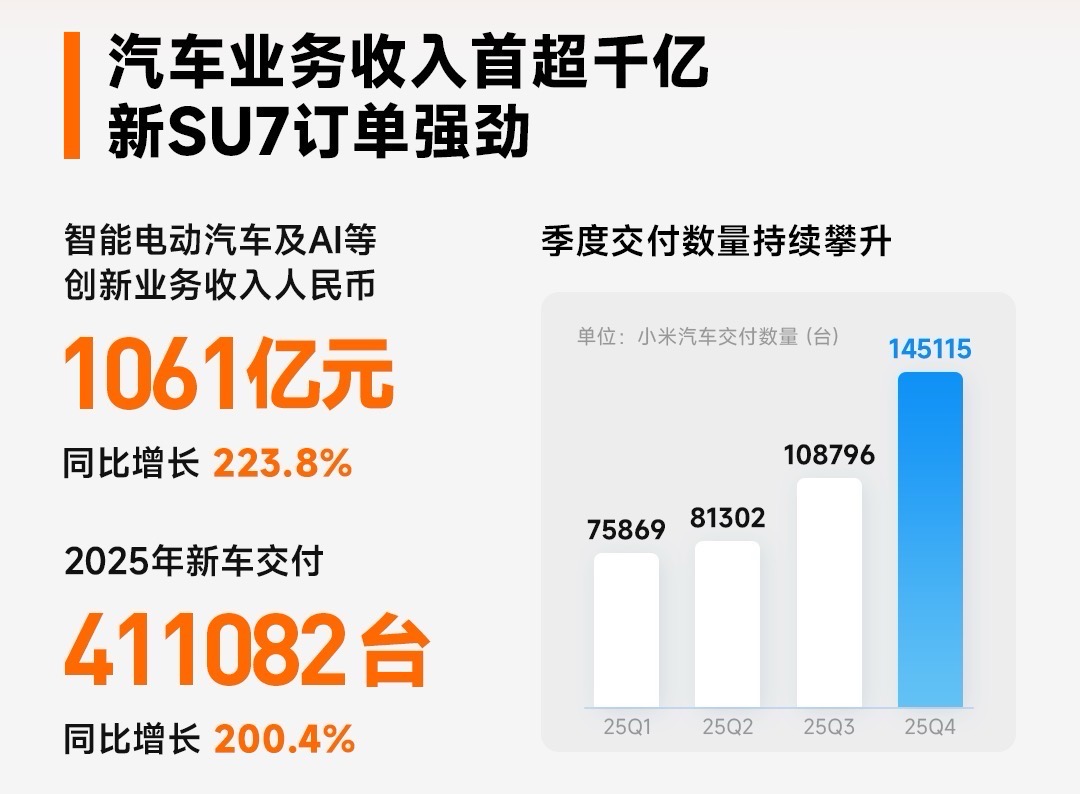
Total revenue climbed 25.0% to 457.3 billion yuan, while adjusted net profit surged 43.8% to 39.2 billion yuan. Revenue from smart electric vehicles and other innovative businesses, including AI, jumped 223.8% to 106.1 billion yuan.

The results show automotive revenue has crossed the 100 billion yuan threshold for the first time.

New vehicle deliveries for 2025 hit 411,082 units — a 200.4% surge. The Xiaomi SU7 claimed the top spot in domestic sedan sales above 200,000 yuan, while the Xiaomi YU7 led the mid-to-large SUV segment for seven consecutive months.

WechatIMG10508.jpg

Image Source: Xiaomi

Just days ago on March 19, Xiaomi EV unveiled the next-generation SU7. The lineup includes three variants: the Standard at 219,900 yuan, the Pro at 249,900 yuan, and the Max at 303,900 yuan — representing a 4,000 yuan increase across the board compared to the first-generation SU7.

Marking Xiaomi EV's first major update, the new SU7 brings upgrades to the powertrain, chassis, smart cockpit, and driver-assistance systems. It retains the classic proportions — nearly 5 meters long, a 3-meter wheelbase, and nearly 2 meters wide — while offering 9 exterior colors, 5 interior trims, and 6 wheel designs. The model also features a fresh intake grille and a new 4D millimeter-wave radar.

Lei Jun previously stated during a livestream that the company's delivery target for 2026 is 550,000 units. With orders for the new SU7 growing steadily, Xiaomi is well-positioned to hit that annual goal.

Demand for the new SU7 has been robust: over 15,000 units were locked in just 34 minutes, and that figure surpassed 30,000 within three days of the launch.

Two years ago, the first-generation SU7 launched to immediate acclaim, securing 80,000 firm orders within 24 hours. To date, Xiaomi EV has delivered over 600,000 vehicles in total, with the SU7 accounting for 381,000 of those.

On the research front, Xiaomi Group pushed R&D spending to a record high in 2025, propelling its large language model into the domestic first tier. Full-year R&D investment reached 33.1 billion yuan, bringing the five-year cumulative total to 105.5 billion yuan.

Additionally, the proprietary Xiaomi MiMo-V2-Pro large model was officially released, ranking eighth globally and second domestically on the Artificial Analysis intelligence index. The company plans to invest 60 billion yuan in the AI sector over the next three years.
 
BYD have many models, in terms of BYD cars, it beats Tesla,
ok, but even Ford outsells BYD in Europe if you want to go that route..but most people are thinking about battery powered cars not "all models" which for BYD includes cars with gasoline engines.

most Tesla cars are made in China.

Well this is Europe (which believe it or not is not China) and Tesla has a factory in Germany making most of their cars for the European market.

To view this content we will need your consent to set third party cookies.
For more detailed information, see our cookies page.

Giga Berlin Fly Through 2.0 | Tesla

Unless you now think Berlin is somehow in China too.. :rolleyes:

To view this content we will need your consent to set third party cookies.
For more detailed information, see our cookies page.

On we go! Tesla Full Self Driving (Supervised) test in Berlin, Germany
 
Last edited:

Users who are viewing this thread

Pakistan Defence Latest

Country Watch Latest

Back
Top