China Auto Thread


Neta claims top spot for overseas sales of Chinese EVs​


Reading Time: 2 minutes

Mark Andrews

July 16, 2024


1


News like this to your inbox or phone?​


Weekly summary to your inbox
I want this

Never miss and important news
Get Instant notification once the news is published.
Follow Us

Chinese brand Neta says that overseas sales in the first half of 2024 reached 17,687 cars. This performance has led Neta to claim that it is the leader among Chinese start-up new energy vehicle producers.

The January to June figure represents a 154% year-on-year increase. It should be noted that the sales are not necessarily exports, as some major outlets are saying. Neta currently has factories producing cars in both Thailand and Indonesia. These factories are likely producing cars from knocked-down kits. The Thai factory initially has a capacity of 20,000 units per year, and the Indonesian factory 27,000 units.
Neta claims to be ranked second in the Thai new energy vehicle market this year, behind BYD, with a market share of nearly 20%. This has almost single-handedly been down to the locally produced Neta V-II, which is known in the Chinese market as the Neta Aya (see specs).

As of June 2024, the Neta brand’s cumulative overseas sales exceeded 35,000 units. However, Neta plans to enter over fifty markets by the end of the year and has a 100,000 unit sales target in them this year.
Initial production at the Neta factory in Thailand began on 30 November 2023. However, certification from the Thai government allowing full mass production at the Bangkok plant was only received in March of this year. Currently, only the Neta V (see specs) and Neta V-II are available in the Thai market, and the Indonesian market also only offers these two models.

Editor’s note:​

In China, Neta has a rapidly expanding model lineup, and the newer models, such as the S, L, and GT, are quite impressive. So far, it seems that Neta’s foray into overseas markets has largely been based on its original small SUV models, the U and V.

The 100,000 target for 2024 looks pretty ambitious, especially seeing that so far this year, the brand has yet to achieve one-fifth of that total. That said, if Neta does expand into so many markets and offers the brand’s newer models, then it can certainly achieve greater overseas sales, but it is unlikely to meet anywhere near the target. In November last year, Neta displayed the S and GT cars in the United Arab Emirates, announcing that the brand would enter the UAE market. Currently, it is unknown whether sales have actually commenced in the UAE.
Sources: Fast Technology, Neta, PR Newswire,
 

Zeekr X launches in Thailand with two right-hand drive versions​


Reading Time: 3 minutes

Mark Andrews

July 16, 2024


1
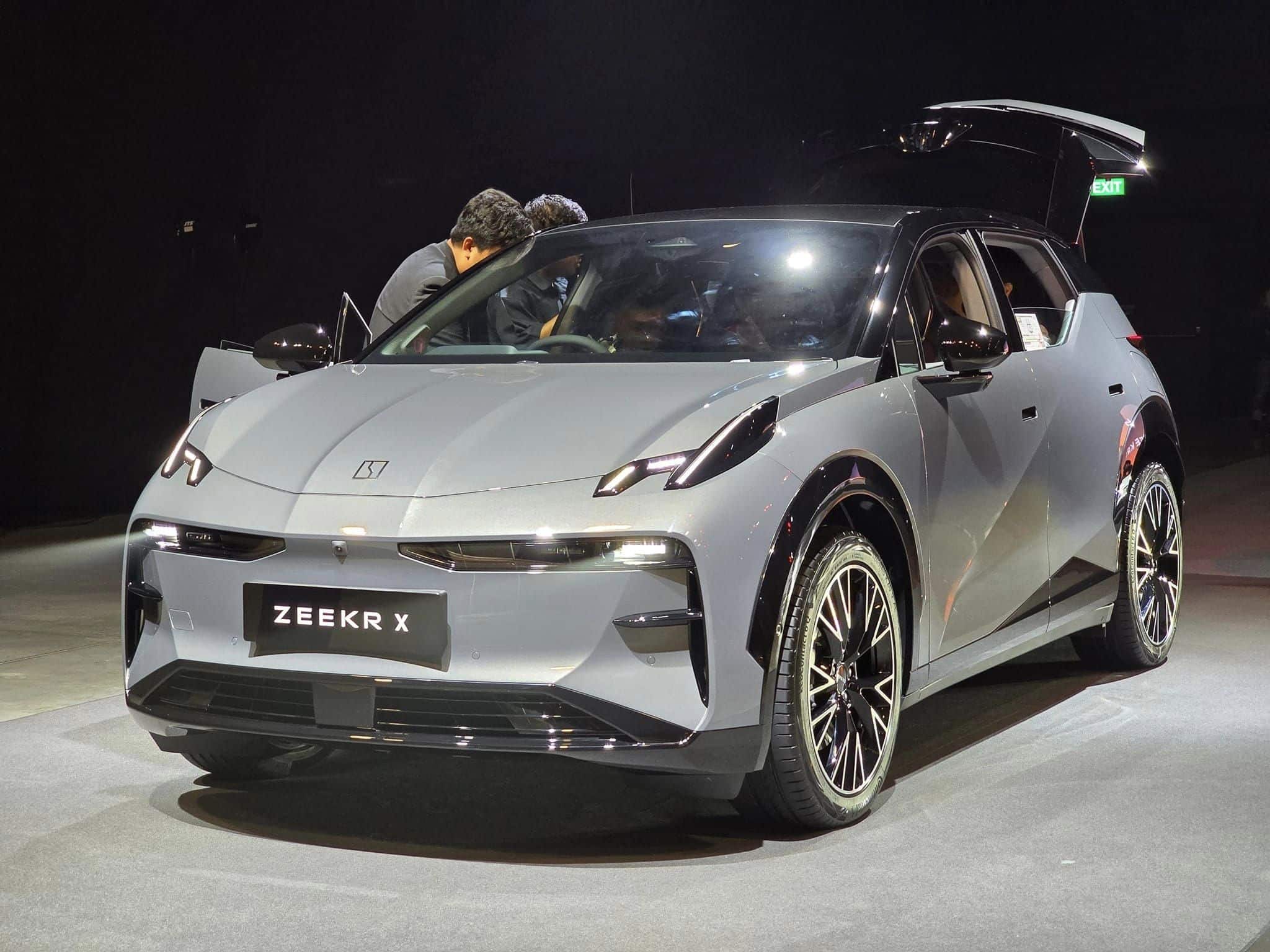
Zeekr X at the Thai launch. Picture courtesy of Ting.

News like this to your inbox or phone?​


Weekly summary to your inbox
I want this

Never miss and important news
Get Instant notification once the news is published.
Follow Us

Geely is busy in Thailand, and not just with the Riddara pickup truck brand. On July 11, Zeekr launched the right-hand drive version of the Zeekr X in Thailand, but it does not seem to have made Zeekr Global’s website or even Zeekr Thailand’s Facebook page yet!

At the event in the Thai capital Bangkok two versions were launched, the Zeekr X Standard (RWD) and the Zeekr X Flagship (AWD) priced at 1.199 million (33,200 USD) and 1.349 million baht (37,350 USD) respectively. The right-hand drive version launched in Thailand has the same styling as the facelift version launched earlier this month. Thai buyers have a choice from five colors, namely Athens Cloud White, Paris Rice Black, Hangzhou Green, Suzhou Ink Grey, and Berlin Silver Grey. With the localization of in car functions, the Zeekr X adopts local entertainment streaming so that Thai customers can experience the same Internet car experience as in China. Both versions of the Zeekr X available in Thailand are five-seater cars, as so far have all exported Zeekr X models.
Pictures taken by Ting at the event
Presales for the Zeekr X began on March 25 at the Bangkok International Motor Show. Zeekr has four pop-up stores in Bangkok, and it is expected that by the end of 2024, there will be 14 stores in Thailand, providing a full set of services for Thai customers.

Thailand is the latest Southeast Asian market for the Zeekr brand to enter. So far this year, the brand has already entered the Philippines, Laos, and Myanmar. It is expected to add Cambodia, Indonesia, Singapore, Malaysia, and Vietnam this year.
In the European market, Zeekr has already established itself in Sweden, the Netherlands, and Germany. By the end of this year, it’s expected that Zeekr will operate in 50 markets across Asia, Europe, Oceania, and Latin America.
The 2025 Zeekr X (see specs) measures 4450, 1836, 1572 mm (l/w/h), and has a wheelbase of 2750 mm. In the Chinese market, it is available in rear-wheel drive and all-wheel drive and in 4-seater and 5-seater versions.

Using five cameras, five millimeter-wavelength radars, and 12 ultrasonic radars the car has Zeekr AD driving assistance which includes functions such as adaptive cruise control and lane change assist.
Inside there is a 8.8-inch LCD instrument panel which is backed up by a 24.3-inch head-up display. Additionally, there is a sliding 14.6-inch central infotainment screen which can move from the center position to in front of the passenger.
The Zeekr X uses a 66 kWh ternary lithium battery pack. For the Thai market the Standard version is a single motor while the Flagship version is the all-wheel drive version. Single motor versions of the Zeekr X use a rear-mounted 200 kW electric motor with 343 Nm of torque giving a cruising range of 560 km CLTC. The dual motor version adds a 115 kW electric motor to the front axle with an additional 200 Nm of torque. Cruising range for the all-wheel drive is 500 km, and the acceleration time is reduced from 5.8 seconds down to 3.8 seconds.

Editor’s note:​

The information coming out of Thailand about the event has been appalling. Chinese media only seems to have picked up the story today and the details are sparse. As said earlier even Zeekr Thailand’s Facebook page doesn’t mention the event and Zeekr Global’s website has no press release about the launch. Many of the details, along with pictures, I have got regarding the launch were from my friend Ting who runs a YouTube channel in Thai about Chinese cars who attended the launch.
Another strange thing about the event is that all the written information was either in Chinese or English rather than Thai.
Source: Autohome
 

Deepal S07 SUV with Huawei Qiankun ADS opens reservation​


Reading Time: 4 minutes

Dong Yi Chen

July 16, 2024


0


News like this to your inbox or phone?​


Weekly summary to your inbox
I want this

Never miss and important news
Get Instant notification once the news is published.
Follow Us

On July 16, Deepal opened its Deepal S07 SUV, which is an upgraded version of the Deepal S7, for reservation. Consumers who pay the 520 yuan (71 USD) deposit can get a free insulation film worth 2,399 yuan (331 USD). The new car is expected to be launched at the end of July, available in EV and EREV variants. For reference, the price range of the Deepal S7 is 149,900 – 217,900 yuan (20,700 – 30,000 USD).

Currently, Deepal’s product offering includes the Deepal SL03, S7, and G318.

Seven exterior paints are available for consumers to choose from: black, white, grey, orange, yellow, green, and blue. A major highlight of the Deepal S07 is the Huawei Qiankun ADS SE version, which adopts the vision solution and can realize intelligent assisted driving in scenarios such as highways and urban expressways, according to the brand. Its capabilities include lane change assist, obstacle avoidance, and parking assist in vertical/parallel/diagonal parking spots.

As an upgraded version of the Deepal S7 (see spec here), the appearance of the Deepal S07 remains largely unchanged. The angular front face adopts a closed structure with intelligent interactive lights composed of 696 LED units, which support animations and driving status reminders. The rear adopts a through-type taillight design.
At the same time, the D-pillar is equipped with a charging status display.
In addition, hidden door handles and frameless electric suction doors are present, contributing to the car’s drag coefficient of 0.258Cd. The car also runs on 255/45R20 tires. The size of the Deepal S07 measures 4750/1930/1625 mm, and the wheelbase is 2900 mm.

The EREV powertrain system still uses a 1.5L engine (JL473QJ) as a range extender that outputs a maximum power of 70 kW (94 hp), paired with a 175 kW (235 hp) electric motor and a 39.05 kWh ShenXing battery pack from CATL, offering two pure electric cruising range options of 215 km and 285 km. The comprehensive range is 1,200 km. Furthermore, the EV variant is equipped with a 160 kW electric motor. Under fast charging, the battery can be replenished from 30% to 80% in 15 minutes.
The interior is offered in green, black, and orange, featuring a hidden air-conditioning outlet, a double-spoke D-shaped multi-function steering wheel, a floating 15.6-inch central control screen with a built-in Deepal OS operating system powered by a Qualcomm Snapdragon 8155 chip, an AR-HUD, and a 12.3-inch co-pilot screen that hangs from above.
Other configurations include 64-color ambient lights, 50W (previously was 40W) wireless mobile phone charging, rear privacy glass, 14 speakers, headrest audio on the driver seat, a 1.9 square meter panoramic sunroof, 16-way electric adjustment 8-point massage driver seat, and 14-way electric adjustment for the co-pilot seat that comes with a leg rest.
Source: XChuXing, ITHome
 

BYD controls nearly 3% of the Japanese EV market​


Reading Time: 2 minutes

Mark Andrews

July 15, 2024


1


News like this to your inbox or phone?​


Weekly summary to your inbox
I want this

Never miss and important news
Get Instant notification once the news is published.
Follow Us

Today, it was reported that BYD sold 1,084 cars in Japan in the first half of this year. What was not so widely reported is that BYD now has a 2.7% share of the Japanese EV market.

The Japan Automobile Importers Association (JAIA) figures show that imports were 113,887 units in the first half of 2024, down 7% year-on-year. Sales of BEVs, however, were up and now account for nearly 9.5% of the total, up by two percentage points from last year, with a total of 10,785 cars. This means BYD has 10% of the total number of imported EVs.
BYD booth at Tokyo auto show 2023. Credit: BYD
These sales may not sound much, but domestic Japanese car companies are not strong with their EV offerings. Sales of domestic EVs during the same period amounted to 29,282, according to preliminary data from the Automobile Dealers Association, the Japan Light Motor Vehicle and Motorcycle Association, and the Japan Automobile Importers Association (JAIA). This was a 39% year-on-year decline. That decline was largely because of a 38% drop in the sales of the Nissan Sakura, a five-door micro EV somewhat similar to the Wuling Hongguang Mini EV. Light EVs such as the Sakura make up 13,540 units of the total sales – the Sakura itself amounts to 90% of light passenger EV sales.

EVs accounted for 1.6 percent of Japan’s passenger car market during the first half of 2024, a decrease of 0.7 percentage points from a year earlier. While imports generally account for a very small percentage of the Japanese car market, they hold an almost 27% share of the BEV market.
Argus, a market intelligence agency, claims foreign brands dominate the Japanese EV market. They quote a representative of the Japan Automobile Importers Association (JAIA) saying that foreign companies offer a wider range of models than domestic producers.
BYD began selling in Japan on January 31, 2023 with the Atto 3 SUV. Since then, BYD has introduced the Dolphin hatchback in September last year and the Seal sedan in June of this year.

BYD’s sales in Japan in the first half of this year increased by 88% year-on-year. This increase helped BYD move from nineteenth place to fourteenth place in the sales rankings of importers to Japan. Sales in June were 149 units, a 60% year-on-year increase, showing that momentum is continuing. BYD aims to have 90 sales outlets in Japan by the end of the year, up from the current 55. Furthermore, as we have previously reported, BYD aims to storm Japan with sales of 30,000 in 2025.
Sources: Fast Technology, Argus
 

Official picture of Li Auto ‘M8’ all-electric SUV​


Reading Time: 3 minutes

Mark Andrews

July 15, 2024


1


News like this to your inbox or phone?​


Weekly summary to your inbox
I want this

Never miss and important news
Get Instant notification once the news is published.
Follow Us

Today, Li Auto released a picture of one of its M series all-electric SUVs. Ben Baum, senior design director of Li Auto, revealed the picture, which is believed to be of the new M8. Although it’s still a camouflaged picture, it gives us a much better idea of what the future SUV will look like than the previous spy shots.

Previous plans called for the release of four all-electric cars this year and one extended-range SUV. One of the all-electric cars is the Mega which has already been released, and the others were three all-electric SUV models, believed to be called M9, M8, and M7. Subsequently, the M series of SUVs has been postponed until next year.
M8 or not, we can see from the picture that it is not a typically designed SUV. Positioning wise, the car will be marketed similarly to the Tesla Model X, which targets families. From the official shot, we can see that there is a definite influence from the Li Mega (see specs). The roof has a slip-back style, and the tail is unique, but overall, the car has a simple and integrated look about it. We can also see that the new car has lost some of the ungainly bulk of the Mega and so should be more pleasing to the eye.

As previously reported, one of the reasons for the delay in rolling out the M series has been the supercharging network. As of July 14, Li Auto has 635 supercharging stations in operation and the plans call for over 2000 by the end of the year. Like the Mega, the new M series will have 5C charging, meaning that they can charge at up to five times the speed of other EVs.
Previous spy shots of Li Auto all-electric SUV
Earlier this year, a video showed a Li Mega charging from 10 to 80% in 10 minutes and 36 seconds. However, for cars to take advantage of such fast charging speeds, they need access to 5C chargers, and currently, there simply aren’t enough around. One of Li Auto’s key aims from the new supercharging network is to give customers a better charging experience. It provides 5C chargers that are strategically placed across the country, including on highway routes. Therefore, Li wants to delay the launch of the new SUVs until the supercharger roll-out is complete. Currently, the 635 charging stations have a total of 2,848 chargers spread across 26 provinces and 151 cities. They also cover four highway routes. Superchargers are viewed by Li Auto in a similar way to the Tesla Superchargers.
The company has also given another reason for the delay: it needs multiple models to occupy space. This leads to the question of whether Li Auto is thinking of separating the sales channels of the EREV and all-electric models. One other likely reason, but one that Li Auto will admit, is the poor sales figures of the Mega.

Source: Fast Technology
 

Spain, Hungary or the Czech Republic? SAIC to decide by the end of September for new factory​


Reading Time: 2 minutes

Mark Andrews

July 15, 2024


3


News like this to your inbox or phone?​


Weekly summary to your inbox
I want this

Never miss and important news
Get Instant notification once the news is published.
Follow Us

Chinese media reports that SAIC is negotiating with Spain’s Ministry of Industry to build a factory in the country to produce MG cars. Reports claim that SAIC Motors will make a decision by September 30. Other countries still in the running include Hungary and the Czech Republic, which have lower labor costs.

SAIC intends to make the decision soon so that construction of the plant can begin, with plans calling for the first vehicles to be produced in the fourth quarter of 2027. The decision is a direct result of the EU’s investigation into Chinese subsidies of EVs, which hit SAIC with the highest temporary tariff of 37.6%.
Although SAIC cooperated with the investigation, it still received the highest tariff rate, which is equal to that of companies that did not cooperate with the investigation. While some claim the rate is because SAIC has the largest import volume to the EU, the more plausible reality is that SAIC did not release core information, including battery data, in accordance with the EU’s requirements.

Previously while the EU investigation was underway, SAIC Chairman Wang Xiaoqiu said at the 2023 shareholders meeting that SAAC would not give up the EU market. By building a factory in an EU member state, SAIC will no longer be affected by tariffs.
Last year, SAIC’s MG 4 was the sixth best-selling BEV within the EU, selling 72,421 cars. This model will almost certainly be produced at the new factory in Europe, along with possibly the recently declared MG S5 SUV. Another likely car to be produced in the EU is the successor to what is known as the MG 5 in Europe (Roewe Ei5 in China).
The EU tariffs were announced in June and commenced on July 4. There was a slight decrease in the level of tariffs from the level initially announced in June with the rate for SAIC dropping from 38.1% to 37.6%. The tariffs introduced earlier this month are meant to be a temporary measure until more permanent tariffs are introduced in November this year. Under the current tariffs, BYD is subject to 17.4%, Geely 19.9%, companies that cooperated but didn’t receive an individual figure 20.8%, and 37.6% for those who did not cooperate.

MG recently celebrated its centenary at the Goodwood Festival of Speed, in the UK with much fanfare. It is a further blow to British industry that a brand with such British heritage will site its European production plant outside the UK.
Source: Fast Technology
 

Chery’s iCar 03T an electric SUV with off-road design readies for sales​


Reading Time: 3 minutes

Mark Andrews

July 15, 2024


0


News like this to your inbox or phone?​


Weekly summary to your inbox
I want this

Never miss and important news
Get Instant notification once the news is published.
Follow Us

Earlier this year, just as Apple decided to stop working on its car, the so-called iCar, Chery unveiled its own iCar—the iCar 03. At the Beijing Auto Show, Chery showed a new version of the iCar 03 called the iCar 03T. Major differences to the car included a general chunkier off-road look. Now, with an MIIT listing, it looks like Chery is getting the iCar 03T ready for the beginning of sales, which are likely to commence in the next few months.

Ministry of Industry and Information Technology (MIIT) listings consist of two for the rear wheel drive and two for the all-wheel drive versions. Registration information includes two lengths for the car 4433 and 4380 mm with the difference accounted for by the optional rear-mounted saddle box. Other dimensions are width 1916 and height 1741 mm and the wheelbase is 2715 mm. Weight for the single motor version is 1817 kg while for the dual motor versions the weight is either 1914 or 1935 kg, the heavier weight being with the traction system. Purchasers have a choice between 18 and 19-inch wheels.
The angle of approach and departure on the single motor versions are 26 and 28°, which is the same for all-wheel drive versions that are not equipped with the traction system. For those equipped with such a system, the angles are 26 and 21 degrees, respectively. Ground clearance is 200 mm. All-wheel drive versions are rated with a towing capacity of 750 kg for trailers without brakes and up to 1600 kg with brakes.

A five-seater SUV, the iCar 03T uses lithium ion phosphate batteries produced by CATL. Currently, the battery capacities are unknown; however, the car is believed to have a range of more than 500 km. Only the 4WD versions of the iCar 03 (see specs) achieve such a range using a 69.77 kWh battery, meaning that the battery of the iCar 03T will be either the same capacity or bigger.
Single motor versions are equipped with a 112AA5 electric motor from Chery New Energy Automobile Company, which can deliver a peak power of 135KW. All-wheel drive versions add a 112AA3 electric motor with 70KW of power. This version gets iWD intelligent electric 4-wheel drive, which provides a variety of driving modes
Options for the Chery iCar 03T, AWD version on the right featuring tow hooks
It should be noted that there are considerable differences between the iCar 03T and the iCar 03. First off the only dimension that is precisely the same is the wheelbase, all others are slightly different. The styling is also different, although similar to a large extent. Most notable at the front are the two air intakes on the outside of the lights, but even the logo positioning is different. It has a much more low-key badging than on the iCar 03. The front fender also looks more off-road than with the regular car. This is echoed at the rear which also features similar air vents like protrusions at either side. Notably, the declared iCar 03T differs somewhat from the version that was shown at the Beijing Auto Show, gone is the roof rack with integrated LED lights.

Source: MIIT
 

Aito M9 from Huawei & Seres becomes the safest car in China​


Reading Time: 2 minutes

Denis Bobylev

July 15, 2024


1


News like this to your inbox or phone?​


Weekly summary to your inbox
I want this

Never miss and important news
Get Instant notification once the news is published.
Follow Us

An all-electric variant of the hot-selling Aito M9 crossover (see specs) backed by Huawei and Seres scored five stars in the C-NCAP safety and crash test. Its overall performance is higher than the M9’s major competitor Li Auto L9 (see specs). It makes Aito M9 the safest car evaluated in China.

The Aito M9 is a full-size SUV developed jointly by Huawei and Dongfeng’s Seres. It boasts 5230/1999/1800 mm dimensions with a wheelbase of 3110 mm. Inside, the Aito M9 has six with a 2+2+2 layout. The BEV variant of this crossover offers two e-motors for 390 kW (523 hp) mated to a 100 kWh battery pack, suitable for 630 km CLTC. The EREV version generates 365 kW (489 hp) and has an electric range of 225-275 km CLTC. The Aito M9 has a price range of 469,800 – 569,800 yuan (64,700 – 78,500 USD).
C-NCAP safety and crash performance program was formed in 2006 under the China Automotive Technology and Research Center (CATARC). It was criticized for awarding five stars to cars with poor safety due to soft crash tests. However, the C-NCAP program changed, becoming quite close to the Euro NCAP assessment program. As we have seen previously, various cars scored the same in C-NCAP and Euro-NCAP, including the Nio ET7 electric sedan (see specs).

Aito M9 crash test results​

The tested Aito M9 is a Max BEV trim level priced at 509,800 yuan (70,200 USD). The evaluation agency bought it anonymously at a random dealer with its own money on May 24. This variant is an entry-level modification of the M9 BEV. Its main differences compared to the top-trim variant are the absence of smart headlights, an intelligent LiDAR system, and zero-gravity seats.
The Aito M9 scored a total rating of five stars in the C-NCAP with the exact performance of 93.9%. It is 11.2% higher than the average performance of models that participated in the 2021-year C-NCAP safety test. Moreover, it is 2.6% higher than the performance of the Li Auto L9 EREV crossover. It makes the Aito M9 the safest car tested by CATARC.
In the occupant protection segment, the Aito M9 scored 96.98%. Pedestrian protection is the weakest category of the M9 with a performance of 75.38% (still 3.2% higher than average). On the contrary, the M9 scored highest in the active safety segment with 97.79%.

The Aito M9 started sales in China in February this year. In February-July 2024, its cumulative sales reached 58,823 units.
Source: CATARC
 

BYD Seal 07 with e-Platform 3.0 Evo to unveil in early August​


Reading Time: 3 minutes

Adrian Leung

July 15, 2024


3


News like this to your inbox or phone?​


Weekly summary to your inbox
I want this

Never miss and important news
Get Instant notification once the news is published.
Follow Us

BYD’s Zhang Zhuo, the General Manager responsible for the Ocean series, announced on social media that the upcoming release of the Seal 07 (previously the BYD Seal) will be unveiled in early August. The Seal 07 will be built on BYD’s e-Platform 3.0 Evo, featuring an 800-volt high-voltage system that enhances motor speed and charging efficiency.

While retaining its sleek exterior, the Seal 07 flaunts E-shaped front headlights, sharp cooling vents, and a striking through-type taillight accented with chrome. Its dimensions continue to offer a perfect blend of style and substance, measuring 4800mm in length, 1875mm in width, and 1460mm in height, with a wheelbase of 2920mm.
Notable changes in the Seal 07 include a new rear badge, redesigned wheels, and a roof-mounted lidar for advanced intelligent driving capabilities. Intelligent driving versions will feature added cameras. Standard models can have optional body radars, skylights, silver side window trim, and new wheel options.

Inside, the Seal 07 will see updates to the dashboard, center console, and air vents. It will feature a new sporty steering wheel, a fully digital instrument panel, a wireless charging pad, hidden air vents, and an integrated center console armrest. The center control area and door panels will retain physical buttons for frequently used functions and offer a panoramic sunroof with an electric sunshade.
The Seal 07, in its rear-wheel-drive version, will offer motors with maximum power outputs of 170 kW and 230 kW, with top speeds of 220 km/h and 240km/h, respectively. These will be paired with 61.44 kWh and 80.64 kWh Blade batteries, providing CLTC ranges of 510 km and 650 km. The all-wheel-drive version will maintain the same motor power as the current model, paired with Blade batteries for a CLTC range of 600 km. These improvements in performance and range are designed to provide you with a reliable and efficient driving experience.
The current BYD Seal EV is priced between 179,800 and 249,800 yuan (24,750 to 34,400 USD), competing with the Tesla Model 3, Xpeng P7, and Zeekr 007. This revamp is expected to address previous shortcomings in intelligent driving features and vehicle dimensions, potentially improving sales in the domestic market. As we tested the BYD Sea Lion 07 (see specs)with e-Platform 3.0 Evo, the updated Seal 07 is a car we are looking forward to.
 

All-new Zeekr 009 model scheduled for launch in Hong Kong adding a new 7-seater version​


Reading Time: 3 minutes

Lawrence Ho

July 15, 2024


0


News like this to your inbox or phone?​


Weekly summary to your inbox
I want this

Never miss and important news
Get Instant notification once the news is published.
Follow Us

Zeekr has been officially announced the launch of its updated all-electric MPV, the new Zeekr 009, scheduled for July 19 in Hong Kong. The car is expected to fall in the same price range as the current model, around 500,000 yuan (68,950 USD) for the standard trim and up to 789,000 yuan (108,803 USD) for the high-end Grand model.

Zeekr is a Chinese brand launched by Geely Group focusing on pure EVs. The brand now has four models including the Zeekr X crossover, Zeekr 001 liftback, the Zeekr 007 sedan, and the Zeekr 009 minivan. The latter model was first launched in November 2022 and first deliveries took place in January 2023. The new Zeekr 009 model aims to update the brand’s MPV to compete against popular models like BYD’s Denza M9.

More on the new Zeekr 009​

The company released official images of the new 009, which retains the design of the current WE version while adding the chrome-trim to the front skirt and a roof-mounted LiDAR, previously only available in the top-tier Grand version. It also features a chrome side-skirt trim and an integrated shark fin antenna on the rear spoiler.

The dimensions remain largely unchanged from the previous model, boasting hefty dimensions of 5217/2024/1812 mm and a wheelbase of 3205 mm. Two new colors are also introduced, Azure Gray and Aurora Green, in addition to the existing three colors (Polar Night Black, Polar Day White, and Starry Blue).

Zeekr 009 Interior​

The current Zeekr 009 is available in four and six-seater configurations, while the new model will add a seven-seater option with a 2+2+3 seating layout. The seven-seater middle row will feature a central aisle, making it more suitable for family use.
The six-seater version will continue to not have an aisle, featuring wider, more luxurious seats, including YAMAHA surround sound system, NAPPA leather seats, NAPPA full-grain leather desk, camera suede magnetic cover, 17.3-inch rear roof-mounted screen, and starry ambient lights.

In terms of features, the new 009 will include a 35.95-in AR-HUD, wireless phone charging, Sofaro front-row seats, a front passenger boss key, and a constant temperature fridge.

Zeekr 009 Powertrain​

The Zeekr 009 continues to use the SEA architecture that underpins every other Zeekr model. The new model will add a rear-wheel drive version with maximum power options of 250 kW and 310 kW.
The all-wheel drive will have two power options, with lower-tier models having front and rear motors rated at 200/250 kW, and higher-tier models at 270/310 kW. The higher-tier models will continue to use 800V platform also found on the new 001-liftback to achieve a combined power output of 580 kW (777 hp).

Export Plans​

The Hong Kong launch seems strategic for Geely, possibly targeting the Toyota Alphard, which is highly sought after in that market with constant high demand. Geely has been looking to grow the Zeekr brand outside of China to Europe and Hong Kong looks to also be part of their export ambitions.
Source: Autohome, Dongchedi
 

Honda Ye S7, designed for China, revealed more official images​


Reading Time: 3 minutes

Dong Yi Chen

July 15, 2024


0


News like this to your inbox or phone?​


Weekly summary to your inbox
I want this

Never miss and important news
Get Instant notification once the news is published.
Follow Us

Just two days after the Honda Ye S7 was declared by the Chinese MIIT, Honda released more official images of its upcoming brand-new all-electric SUV under its Ye series specifically built for the Chinese market. The official launch is expected to be towards the end of this year and manufactured by the Dongfeng-Honda joint venture.

The Honda Ye S7 is positioned as a medium-sized pure electric SUV based on the brand’s new W architecture, with body dimensions of 4750/1930/1625 mm and a wheelbase of 2930 mm. Both the fast and slow charging ports are located on the front fenders. In the exterior, the front face has numerous horizontal lines, which increase the visual width of the front face.
The car runs on 21-inch petal-shaped aluminum alloy rims and 265/45 R21 tires. Both single-motor rear-wheel drive and dual-motor four-wheel drive will be available to consumers to choose from. The maximum power of the front and rear motors are 150 kW (201 hp) and 200 kW (268 hp), respectively. As for the range, the official has not yet released specific information, but according to previously exposed information, the Honda Ye will be equipped with a ternary lithium battery from CATL, and the range may exceed 500 km.

Honda Ye S7 at the 2024 Beijing Auto Show
Coming to the interior, Honda has not yet released the official images. Based on the images from the 2024 Beijing Auto Show, the cockpit comes with a three-spoke flat-bottom steering wheel, a slender rectangular full LCD instrument panel, and a two-part central control screen with the upper portion consisting of a traditional screen while the lower portion is the air conditioning + seating control. The center console has two wireless charging panels. At the same time, Bose headrest speakers as well as an intelligent voice assistant are expected to be present.
A panoramic sunroof and digital external mirrors are also not absent.
Honda Ye S7 at the 2024 Beijing Auto Show
We’ll watch closely for more info, stay tuned!

Source: Dongfeng Honda Weibo
 

Geely LEVC L380 all-electric MPV delivery will start on July 25 in China​


Reading Time: 4 minutes

Dong Yi Chen

July 14, 2024


0


News like this to your inbox or phone?​


Weekly summary to your inbox
I want this

Never miss and important news
Get Instant notification once the news is published.
Follow Us

On July 14, Geely announced that its LEVC L380 all-electric MPV will start the first batch delivery on July 25. The car had already launched on June 25, available in four trims, with a price range of 379,900 – 479,900 yuan (52,300 – 66,050 USD). LEVC is the 116-year-old London Electric Vehicle Company that got acquired by Geely.

TrimPrice
100 kWh six-seater Air379,900 yuan (52,300 USD)
116 kWh six-seater Pro439,900 yuan (60,550 USD)
140 kWh eight-seater 4WD Max479,900 yuan (66,050 USD)
140 kWh six-seater 4WD Ultra479,900 yuan (66,050 USD)
According to the delivery plan, consumers who locked their orders for the Max and Ultra trims with no optional configurations before July 20 will receive their deliveries beginning July 25; and the ones who locked after July 20 will be delivered beginning August 20. Orders with optional configurations for the Max and Ultra trims as well as orders for the Pro trim will be delivered beginning September 20. Orders for the Air trim will be delivered beginning October 20.
The LEVC L380 (see spec here) was designed by former Bentley designer – Brett Boydell, and built based on Geely’s SOA (Space Oriented Architecture) platform. Its exterior was inspired by the Airbus A380 aircraft, hence its name also contained ‘380’. It is available in four paints: Pearl White, Ink Jade Black, Sapphire Blue, and Ice Jade. Positioned as a medium-to-large MPV, the LEVC L380 measures 5316/1998/1940 mm with a 3185 mm wheelbase.

Entering the cockpit, the overall design is minimalistic with a black and brown color combination, equipped with a 10.25-inch full LCD instrument panel, a 15.4-inch central control screen, a 19.8-inch AR-HUD, a D-shaped three-spoke steering wheel, and a crystal rotary knob on the center console for multimedia system control. The operating system is supported by Flyme Auto, powered by two Dragon Eagle-1 automotive-grade 7-nanometer cockpit chips.
There are also 28 sensors throughout the vehicle to support its intelligent driving capabilities.
Both 2+2+2 six-seater and 2+2+2+2 eight-seater layouts are offered. The seats are covered in semi-aniline leather material. There are 11 airbags inside the interior along with side airbags for each seat, dual 12.8-inch screens behind the front seats, dual 5.98-inch rear armrest screens, and a 9.2-inch screen for the digital external mirrors. In addition, an onboard refrigerator is also present that support heating and cooling as well as a 2.18㎡ panoramic sunroof.

Furthermore, the fourth row can also be hidden under the luggage compartment floor.
The two-wheel drive variant is equipped with a front electric motor that outputs 200 kW (268 hp) and 343 Nm, paired with a Geely ternary lithium battery pack, available in capacities of 100 kWh and 116 kWh, which correspond to a CLTC cruising range of 570 km and 675 km. The 0 – 100 km/h acceleration time is 8.9 seconds.
The four-wheel drive variant is powered by dual motors that output a maximum combined power of 400 kW (536 hp) and torque of 686 Nm, matched with a 140 kWh ternary lithium battery pack from CATL. Two CLTC cruising ranges are offered: 785 km and 805 km. The 0 – 100 km/h acceleration time is 5.5 seconds. Additionally, all trims support fast charging, which can replenish the battery from 10% to 80% in 30 minutes, and can add 200 km of range in 10 minutes.
Source: ITHome, Dongchedi
 

Nio ET9 can play tabletop football and juggle the ball thanks to Skyride active suspension​


Reading Time: 3 minutes

Jiri Opletal

July 14, 2024


0


News like this to your inbox or phone?​


Weekly summary to your inbox
I want this

Never miss and important news
Get Instant notification once the news is published.
Follow Us

Nio shared a new video promoting its active suspension system, Skyride, which will debut on the ET9 flagship sedan in early 2025. Moreover, it teased the Nio Phone 2.

In the video, Nio ET9’s active suspension quickly adjusts to the phone’s movement. Tabletop football is mounted to the top of the car, so the whole “playground” moves with the vehicle, and the player can direct the ball into the net.
This is because the Skyride suspension is connected via Bluetooth to the phone, which is, like all smartphones, equipped with a gyroscope so that the car can imitate the phone’s movement. The whole test is conducted by Nio’s senior engineer Neil Lei.


Nio’s Skyride intelligent chassis system is the world’s first integrated hydraulic fully active suspension, according to Nio. This system can respond within one millisecond, and the high-performance brushless motor can make up to 1,000 torque adjustments per second.
Another feature is the independent control of all four wheels. Each of ET9’s four wheels can be controlled independently, allowing for six-way adjustment, Nio claims.
This capability is promoted in the video – when playing tabletop football (Nio calls it a soccer maze), the car body can be adjusted along six axes using the phone’s gyroscope. The Shanghai-based startup wants to showcase that active suspension electric has low latency and quick response times, providing high control precision and a fluid driving experience.

The Skyride suspension adjustment range is between +40 mm and -50mm, catering to various driving scenarios. The system can raise the vehicle by 40 mm in 2 seconds and lower it by 50 mm in less than 2 seconds.
This capability Nio promotes in another video shared by Wang Yufei, Head of the Chassis team. In the video shared on Weibo, Nio ET9 is juggling the ball on its roof.

Wang comments that “the ET9’s SkyRide active suspension adjusts 60 times faster than traditional air suspension.”
The phone used for controlling the Skyride chassis is the Nio Phone 2, confirmed Bai Jian, vice president of hardware development. Nio Phone 2 will be launched in early August in Shanghai.
Nio Phone 2 was revealed in the video. Credit: Nio
The supplier of Skyride suspensions to Nio is ClearMotion, a US-based startup. The startup from Boston that aims “to make car rides less bumpy and more fun” raised 39 USD million, led by Nio Capital, in September 2022. In April, it was revealed that Porsche would join the bandwagon and use Clearmotion’s active suspension tech.
Clearmotion received an order for 3 million suspension-related products from Nio, covering the production of 750,000 vehicles. This doesn’t represent the ET9 production capacity.
Nio ET9 will be the most expensive car from Nio and will launch in early 2025. It was unveiled on Nio Day in December 2023, and preorders for 800,000 yuan (110,000 USD) were started.
 

Sunday China Drive | Aito M9, China’s top-selling flagship SUV sold at Huawei 800 retail stores​


Reading Time: 8 minutes

Adrian Leung

July 14, 2024


7


News like this to your inbox or phone?​


Weekly summary to your inbox
I want this

Never miss and important news
Get Instant notification once the news is published.
Follow Us

Aito, Huawei’s most successful brand under Harmony Intelligent Mobility Alliance (HIMA), delivered 181,197 vehicles during the first half of 2024, dominating one of the top spots for Chinese NEV startups. The tech giant initiated and collaborated with traditional automakers to provide intelligent vehicle software and hardware. Aito is now neck and neck with Li Auto regarding vehicle deliveries in the first half of 2024.


Aito, a joint venture between Huawei and Seres, offers three models: M5, M7, and M9. Seres manufactures the vehicles, while Huawei supplies parts and software and handles sales. Aito vehicles are available in Huawei flagship stores across China.
The flagship SUV, Aito M9 (see specs), is available in EREV and BEV versions. This high-end, six-seat vehicle is priced between 469,800 and 569,800 yuan (approximately 64,800 to 78,600 USD), competing with SUVs like the BMW X7, Li Auto, and Nio. Despite its price tag, the Aito has been one of China’s top-selling SUVs since it launched.

As we reviewed the Li Auto L6 last week, we will continue to explore popular models from top Chinese NEV startups. Let’s head out with the Aito M9 on this week’s Sunday China Drive!
First Impressions
Our test car is the Aito M9 2024 Ultra EREV, a full-size SUV with modern styling and a sleek design. It has a closed front face integrated with triangular headlights, complemented by an LED strip cutting through the center and intelligent air intake ducts, giving it a stern look. The high-tech headlights utilize adaptive matrix LED technology to identify pedestrians and vehicles while preventing glare. Additionally, the integrated DLP projector can display images up to 100 inches in size. The rear has a continuous taillight. Both headlight and rear lights are programmable and can be customized.

The Aito M9’s design is inspired by “Kunpeng Zhanyi,” a Chinese myth of Kunpeng, a divine fish that transforms into a bird when it emerges from the water. Flush-fitting, retractable door handles, and a gently sloping roofline contribute to cabin spaciousness. The D-pillars display the HIMA logo. Regarding aerodynamics, the EREV version boasts a drag coefficient of 0.279 Cd. The doors sounded very solid when they closed. All the panels are aligned, and the paint looks well-finished.
The Interior
The Aito M9 is very luxurious. The center console houses three LED displays: a 15.6-inch driver’s display, a 16-inch front passenger’s screen, and a 12.3-inch instrument panel. It also features a 75-inch AR-HUD, all powered by Huawei’s Harmony OS. However, there were very few physical buttons to be found.
All doors are electronically operated. When you step on the brake pedal, all the doors will close automatically. It has six Nappa leather seats in a 2+2+2 layout, allowing six adults to sit comfortably. Seats in the first two rows are ventilated leather seats with massage functions. The co-pilot seat has a fold-down footrest. The second row has zero-gravity seats. All seats are electronically operated.
The Aito M9 has several unique features. These include the co-pilot seat, which can be folded down as a footrest for the “boss seat” behind. It has a refrigerator that can achieve 3°C — 50°C.
There is a 32-inch retractable projector screen behind the first-row seats, which is used in conjunction with the projector located on top of the third-row seats. With the Huawei sound system with 25 speakers, the M9 can become a cinema on wheels. However, the viewing distance from the second row may be too close for comfort. Alternatively, passengers in the second and third rows may optionally add Huawei Matepad tablets to interact with the car’s system or watch movies.
Storage
The trunk has a capacity of 716 liters and 41 additional storage spaces. For increased security, individual storage spaces can be locked with a password.
Behind the Wheel
The Aito M9 is a full-size SUV with 5232/ 1999/ 1801 mm and has a wheelbase of 3109 mm. Its curb weight is 2,560 kg. Surprisingly, the vehicle communicates quite well with the driver while on the road due to its slightly firmer suspensions, which provide less body roll when changing lanes and turning corners. The steering offered precision. The chassis also felt solid. It drives very differently from its direct reveal Li Auto L9 (see specs), which filters out all the details of humps and bumps when driven.
Aito M9 felt planted and offered the driver confidence when encountering twists and turns. This is also helped by Aito M9’s turning radius of only 5.8 meters, even without four-wheel steering. This was helpful during U-turns and tight corners.
The NVH was exceptional during our test drive with the Aito M9 around suburban roads in Zhuhai. Most cars we tested on CNC have good NVH below 80 km/h. When above 80 km/h, most cars pick up tire noises, and wind noises occur above 100 km/h. Either of these happened with the Aito M9 within the cabin.
The EREV version uses a 1.5-liter ICE as a generator and two e-motors producing 365 kW with 675 Nm torque. It can hit 0 – 100 km/h on a straight road in 4.9 sec. The Aito M9 effortlessly overtakes other cars on the highway and climbing hills. While some may still be stuck with the concept that heavy vehicles can only move fast with V8 engines or twin-turbos, all the cars we fitted with e-motors we tested on CNC have never been slow to accelerate. Only when the battery is running low will the Aito M9 restrict the use of the e-motors, slowing the car’s acceleration. We have not encountered this issue since we only test vehicles for short distances.
The vehicle features the Huawei ADS 2.0 driving assistance system, enabling autonomous driving in 338 cities across China through high-precision mapping. The Aito M9 is fitted with one Lidar sensor, three millimeter-wave radars, 12 ultrasonic radars, and multiple high-definition cameras for comprehensive vehicle vision. The SUV effectively detected surrounding objects (including a combination of pedestrians, e-bikes, buses, traffic lights, and road works), adjusted its speed, changed lanes, and made U-turns, though manual intervention was occasionally needed. These advanced technologies and future updates enhance its autonomous driving capabilities and expand city NOA coverage nationwide. Additionally, the auto parking system was fast and precise.
Range
The 42 kWh battery from CATL gives the car an all-electric range of 225 km and a mixed range of 1,362 km.
Safety features
The Aito M9 has nine airbags to cushion occupants during collisions and 16 safety points, enhancing overall crash safety. It also features a threshold beam with 11 protective cavities, enhancing side-impact energy absorption.
The Aito M9’s predominantly aluminum chassis features an air suspension and CDC system. Seres employs a Wencan IDRA9800T unit, a 10,000-ton super diecasting machine, the world’s best one-piece diecasting technology. This reduces the number of parts and solder joints. The process increases torsional rigidity by 23%, simplifies manufacturing, boosts production efficiency, and enhances vehicle endurance and energy-saving efficiency. Aluminum alloy accounts for 80% of the vehicle’s weight, making it super lightweight. It includes 2000MPa nuclear submarine-grade hot steel in 12 spots, providing a low coefficient of 2.02, ruggedness, corrosion resistance, and high reliability.
Dealership Experience
As you may know, Huawei is a tech giant that produces smartphones, tablets, numerous smart devices, and network equipment. Huawei has 800 flagship stores (similar to Apple stores) across China. Some are located in shopping malls across China. In these stores, they do not only sell their smart devices but also their HIMA cars. Regarding the test drive, you must book at least two days in advance with the HIMA cars. This is because they need to assign a Huawei test drive specialist to accompany you during the test drive to explain the vehicle’s details and aid you with all the advanced tech on board during the drive test drive. After the test drive, I was greeted by a sales rep to explain the pricing structure of the vehicle. It was the most unique test drive experience I have had to date. I imagine Xiaomi deploying a similar strategy to sell their cars in their 2,000+ Mi stores across Mainland China.
Conclusion
Seres has announced a 2.5 billion yuan (344 million USD) acquisition of the Aito trademark and patents from Huawei, encompassing 919 trademark rights and 44 appearance patents. Despite the assets being valued at 10.2 billion yuan in May 2024, the deal focuses on changing ownership without altering Aito’s operations. Huawei will remain involved in the vehicle lifecycle without producing the cars. It’s worth noting that in May, Huawei transferred the Stelato trademark to BAIC New Energy and the Luxeed name to Chery last month.
The Aito M9, a luxury SUV from Huawei and Seres offering lots of bells and whistles, combines advanced technology and competitive performance, underscoring the potential of their collaboration. The acquisition highlights Seres’ commitment to the partnership, ensuring the Aito brand’s continued growth and success. With an Aito M9 5-seater version on the way, expected at a lower price, we anticipate an increase in market share.
Stay tuned for next week’s Sunday China Drive at Car News China, where you can get more evaluations of Chinese cars from a first-person perspective.
Updated: 15/07/2024
 

Best-selling vehicle brands ranking in China, first half of 2024​


Reading Time: 2 minutes

Dong Yi Chen

July 14, 2024


8


News like this to your inbox or phone?​


Weekly summary to your inbox
I want this

Never miss and important news
Get Instant notification once the news is published.
Follow Us

Recently, the China Passenger Car Association (CPCA) and China Association of Automobile Manufacturers (CAAM) released China’s auto industry report cards for the first half (H1) of 2024.

In H1 2024, China’s automobile production and sales were 13.891 million and 14.047 million vehicles, up 4.9% and 6.1% year-on-year, respectively. In particular, the sales growth rate of new energy vehicles was significantly higher than that of gasoline-powered vehicles: the production and sales were 4.929 million and 4.944 million units, up 30.1% and 32% year-on-year, respectively; accounting for 35.2% of the market share.
RankingChinese BrandsSales Volume
1BYD1.607 million
2Chery1.057 million
3Geely955,000
4Changan809,000
5FAW-Volkswagen754,000
6SAIC-Volkswagen512,000
7Great Wall Motor467,400
8Tesla China426,000
9GAC-Toyota336,000
10SAIC331,500
11SAIC-GM-Wuling331,000
12Dongfeng-Nissan328,000
13Brilliance Auto316,000
14FAW-Toyota308,000
15Beijing Benz278,000
16Dongfeng-Honda236,000
17SAIC-GM225,000
18GAC-Honda207,000
19FAW Hongqi201,000
20Li Auto188,000
Top 20 best-selling Chinese brands in H1 2024 | Source: CPCA
Furthermore, the top ten Chinese automotive companies’ combined sales volume was 11.917 million vehicles, a year-on-year increase of 6.3%, accounting for 84.8% of the total automobile sales. More specifically, the top three automakers’ (BYD, Chery, and Geely) sales volume was 4.871 million vehicles, a year-on-year increase of 1.1%, accounting for 34.7% of the market share.

RankingBrandsSales Volume
1BYD1.607 million
2Volkswagen1.266 million
3Chery1.057 million
4Geely955,000
5Changan809,000
6Toyota644,700
7Great Wall Motor467,400
8Honda444,700
9Tesla426,600
10SAIC331,500
11Wuling331,300
12Nissan328,300
13BMW316,000
14Mercedes Benz278,700
15GM225,600
Top 15 best-selling brands in China in H1 2024
Breaking it down further by brand types, the sales volume of domestic Chinese brands reached 5.559 million vehicles, a year-on-year increase of 17.8%, with a market share of 56.5%. The cumulative sales volume of German brands was 1.907 million units, a year-on-year decrease of 6.2%, with a market share of 19.4%; the sales volume of Japanese brands reached 1.466 million vehicles, a year-on-year decrease of 12.4%, with a market share of 14.9%; and the sales volume of American and French brands decreased by 19.2% and 19.1%, respectively.
Source: CPCA, CAAM, DongCheDi, QQ News
Edited (2024 July 16, GMT 16:02): Corrected the ranking of FAW-Volkswagen and SAIC-Volkswagen on the “Top 20 best-selling Chinese brands in H1 2024” table: SAIC-Volkswagen is 6th and FAW-Volkswagen is 5th. Previously, SAIC-Volkswagen was 5th and FAW-Volkswagen was 6th.
 

Users who are viewing this thread

Back
Top