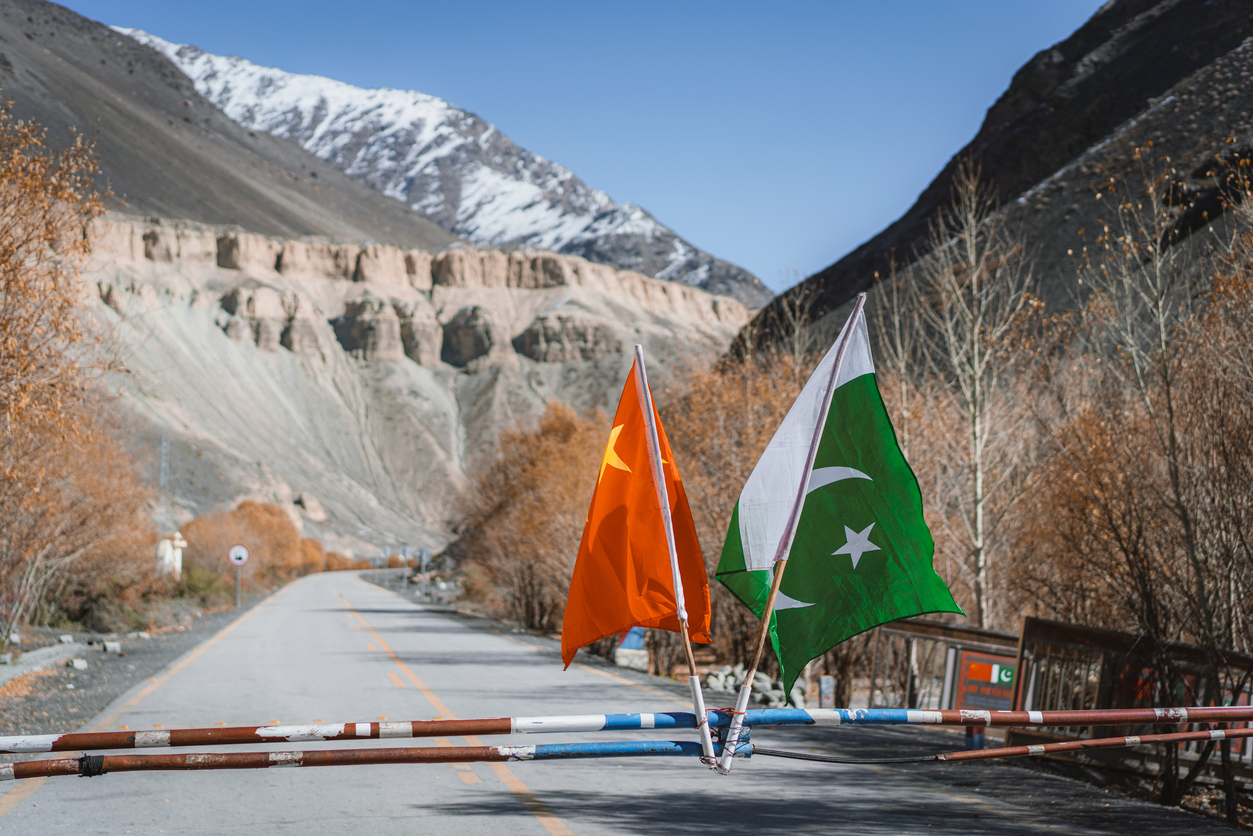
'China Backed Pakistan During Operation Sindoor To Curb India's Rise': US Panel

They banned the use of F16s 3 years before balakot and they were indirectly restricting Pakistans access to space.

They were expecting total Indian air domination which would have led to further incursions to pressure Pakistan into becoming subservient to India as referenced by the FM in this speech.


Completely agree. That miscalculation is also why the Americans were so dumbstruck by the outcome.

The American calculus rested on the assumption that restricting F-16 operations and limiting offensive capabilities would leave Pakistan blind and outmatched against India's conventional edge. When Pakistan managed to mount an effective, asymmetric response and demonstrated it didn't need US imposed permissions to defend its airspace, it completely upended both indian and American expectations.
 
I thought Pakistan and the US were non-NATO allies? Pakistan even agreed to pay $700 million to upgrade its F-16s, even as the US continues to assist India.
Yes. We ugraded and continue to ugrade our actual military.

You seem to have spent your money on Bollywood special fx for the fabled "low inverted run".
 
Lol, what the Indians complain about ? Didn't the American deputy secretary of State recently in India said US is not going to help India to develop into another China ? The Yanks see India as another potential competitor now. Good luck to India. Maybe ask help from your BF the island nation Japan, haha.
 
The Americans are kidding themselves if they think they haven't assisted India against Pakistan.

The United States must not only use India to contain China, but also control India, and cannot let India's national strength surpass that of the United States.

For the United States, China's national strength surpassing that of the United States will only result in the loss of its status as the only superpower, and many countries still see the United States as the leader of the same values camp. If India's national strength surpasses that of the United States, the United States will even lose its position as a camp leader. This was also the core reason why the Soviet Union suppressed China back then, because heresy is more terrifying than paganism.

So the United States needs to support India while also using Pakistan to control India. Similar to the United States wanting to support the rule of some royal families in the Middle East while also using Israel to control them.

As for China, the core contradiction between China and India is actually the control of the Indian Ocean. The territorial issue is a trap, as it can force India to expend its national strength and military investment on the border rather than in the Indian Ocean.

Strengthening China's border pressure on India while enhancing Pakistan's national strength and expanding its influence in the Indian Ocean through CPEC is an inevitable long-term national strategy. The Pacific is too big and too poor, and the United States has too much control over the Americas. China's strategy is inevitably to travel from Southeast Asia through the Indian Ocean to Africa. There is no doubt about it.
 
Last edited:

'China Backed Pakistan During Operation Sindoor To Curb India's Rise': US Panel​

The report identified India as one of the few powers outside the US alliances with the scale to compete with China.​


'China Backed Pakistan During Operation Sindoor To Curb India's Rise': US Panel'China Backed Pakistan During Operation Sindoor To Curb India's Rise': US Panel

The US panel pointed out that China's sharpest tool to deter India is economic.

https://www.ndtv.com/ask?article_id=12359123&redirect_question=How+might+India+respond+to+China's+growing+military+pressure?
New Delhi:
China's evolving military ties with Pakistan are being viewed in the US as part of a wider effort to suppress India's rise. A latest report by a US Congressional committee has warned how Beijing is combining its curbs on industrial supplies to India with its military pressure in the border areas to constrain India.

The warning came in the US-China Economic and Security Review Commission's 2026 Annual Report to Congress, titled "China's Other Front: India and the Future of US Strategy in the Indo-Pacific."

The report identified India as one of the few powers outside the US alliances with the scale to compete with China. For the US, it stressed, a stronger India could contribute to a more favourable balance of power in Asia while also providing an important alternative to Chinese supply and manufacturing chains.

"China understands this, and it is actively working and it is actively working to suppress India's rise across multiple domains," the report warned.

The US panel also pointed out that the sharpest tool being deployed by China to deter India is economic.

Beijing, it said, is using its control over critical industrial inputs, technology, and expertise to make it harder for New Delhi to build competing capacity, and has restricted exports of key inputs to India to exert economic pressure.


Latest and Breaking News on NDTV

China-Pak Military Ties​

The Congressional panel also issued a caution over Beijing's deepening military partnership with Islamabad, pointing to the India-Pakistan conflict that followed Operation Sindoor last year.

"China's growing power and longstanding support for Pakistan have magnified India's fears of a coordinated two-front threat," the report noted, adding that the May 2025 conflict showed how China could strengthen Pakistan during a crisis without entering the fighting directly.

Beijing had earlier this year admitted for the first time that it had provided on-site techincal support to Pakistan during Op Sindoor - which followed the massacre of 26 civilians by Islamabad-backed terrorists in Jammu and Kashmir in April last year.

The report also flagged the expanding Chinese presence in the Indian Ocean as an attempt to disrupt the critical maritime chokepoints and erode India's strategic advantages in the region.

China's growing footprint in South Asia threatens to undercut India's position in the region, it contended.

It also expressed concern over how China's greater financial resources have attracted South Asian countries interested in infrastructure and economic partnerships amid a lack of comparable alternatives.

Latest and Breaking News on NDTV

Call For Stronger India-US Coordination​

The report came with recommendations to counter China's regional pressure. It called on the Congress to direct the US Defence Secretary and the Chairman of the Joint Chiefs of Staff to work with their Indian counterparts to strengthen coordination on undersea and maritime domain awareness in the Indian Ocean.

It suggested that the aim should be to move beyond military exercises toward sustained operational coordination, including intelligence and surveillance sharing, joint monitoring of Chinese naval and submarine activity, and improved maritime threats responses.

The panel has also recommended establishing an Indo-American Strategic Leadership Exchange Program to build long-term ties among emerging leaders in the defence, government, business, and academic sectors in both countries.

Another utterly ridiculous article.
Every country helps another.

India itself has been help by every Tom, Dick and Harry country in the world including by America multiple times during India's conflicts and wars with China.

Soon as Pakistan gets a little assistance it becomes a conspiracy. Completely stupid logic.
 
Between 2024 and 2026, the United States approved roughly $6.1 billion in major Foreign Military Sales (FMS) notifications for India, while actual grant-based military aid remained negligible (around $2 million per year).

1. Grant-Based Military Aid (Free Assistance)

FY 2025: Only $2.0 million (1.9% of total U.S. foreign aid to India) went toward military and security purposes, specifically under Stabilization Operations and Security Sector Reform.

Historical Context: Across the entire post-Cold War era, total U.S. Foreign Military Financing grants to India have totaled well under $100 million.

India purchases its defense equipment rather than relying on U.S. subsidies.

2. Major U.S. Defense Sales & Support Packages (2024–2026)

The bulk of U.S. "military support" comes in the form of government-to-government Foreign Military Sales (FMS) and sustainment packages approved by the U.S. State Department and notified to Congress:

May 2026
• Equipment / Support: Sustainment & spares for M777A2 ultra-light howitzers ($230M) and AH-64E Apache helicopters ($198.2M)
• Estimated Value: $428.2 million

Nov 2025
• Equipment / Support: Excalibur tactical projectiles ($47.1M) and Javelin anti-tank missile systems ($45.7M)
• Estimated Value: $92.8 million

Apr 2025
• Equipment / Support: Indo-Pacific Maritime Domain Awareness equipment and integration
• Estimated Value: $131.0 million

Dec 2024
• Equipment / Support: MH-60R Seahawk multi-mission helicopter equipment and follow-on support
• Estimated Value: $1.17 billion

Oct 2024
• Equipment / Support: MK 54 MOD 0 lightweight anti-submarine torpedoes
• Estimated Value: $175.0 million

Aug 2024
• Equipment / Support: Anti-submarine warfare sonobuoys and related equipment
• Estimated Value: $52.8 million

Feb 2024
• Equipment / Support: 31 MQ-9B SkyGuardian / SeaGuardian armed drones and ground control stations
• Estimated Value: $3.99 billion

3. Strategic & Industrial Support (Non-Monetary)

Beyond hardware sales, Washington has expanded structural and technological support to India over the last two years:

10-Year Defense Framework (October 2025): The U.S. and India signed an updated Framework for the U.S.-India Major Defense Partnership (2025–2035), expanding intelligence sharing, space situational awareness, logistics access, and joint military exercises.

Jet Engine Co-Production: Under the Initiative on Critical and Emerging Technology (iCET) and defense industrial roadmaps, GE Aerospace and Hindustan Aeronautics Limited (HAL) advanced agreements to co-produce F414 jet engines in India for the indigenous Tejas Mk2 fighter.

Defense Startup & Supply Chain Integration: Through initiatives like INDUS-X and negotiations over a Reciprocal Defense Procurement Agreement (RDPA), the U.S. has worked to integrate Indian defense manufacturers and startups into American military supply chains.

Could you please explain, what's your point?
 
Alhamdulillah for our armed forces to preserve our dignity. This is not cricket field fellas! When it matters the most, in real battle ground, we came out on top!

Actually if you check history, Pakistan trumps India in cricket too. Only the last couple of decades which have flipped the script. But it's be expected with so much constant conflict in our neighbourhood, especially since the Soviet invasion of Afghanistan.
We lost our way for a while, feels like things are changing.
 
I was always the one to tell Pakistan never to trust USA. USA has always hurt Pakistan, especially with the Pressler Amendment.

I always said lets put all our eggs in one basket with China, but some prominent members rejected that idea.

Because they said what happens if China change's its policies, or misuses or abuses their relationship with Pakistan.

But they forget China also needs Pakistan too for the Gwadar port.

China is building that seaport.

So China wins too.

USA is a country that can NEVER BE TRUSTED!

Yes, in a war against India, China would defend Pakistan in a war for Gwadar port, but will not fight Pakistan's wars at the same time.

But I think there are other complexities why China would defend Pakistan as well.

Like China has business and manufacturing plants in Pakistan and investment as well.
 

Users who are viewing this thread

Back
Top