Is the J-50, China's second next-generation fighter, destined for PLA aircraft carriers?
About
Fabrice Wolf
8TH JANUARY 2025
 The appearance of a new-generation Chinese fighter on the country's social networks on December 26 had already had the effect of a bomb in the sphere of aeronautical experts and the Chinese army.
Very imposing, the new aircraft from the aircraft manufacturer Chengdu, which is today designated J-36 by the numbering observed on its fuselage, ticks many boxes of the sixth generation of combat aircraft, currently under development in Europe and the United States, in particular with increased electric power thanks to an engine composed of three turbojets.
If the appearance of the J-36 was a surprise, that of a second prototype, probably developed by the second Chinese fighter jet manufacturer, Shenyang, on the same day, left most of these experts speechless. Indeed, not only was the aircraft unknown, but it also seems to display many attributes of this new generation.
Less documented and iconographed than the J-36, this new prototype, currently called the "J-50" by the press, has been the subject of far fewer articles from the specialized press and comments from experts. One of them, however, has just put forward a most interesting hypothesis.
In fact, according to the specialist commentator Du Wenlong, recognized in China, the new Shenyang aircraft would not be intended for the Chinese air force, but for the naval air force, and could represent the next heavy fighter embarked on board Chinese aircraft carriers.
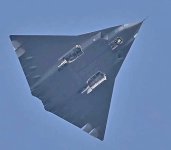
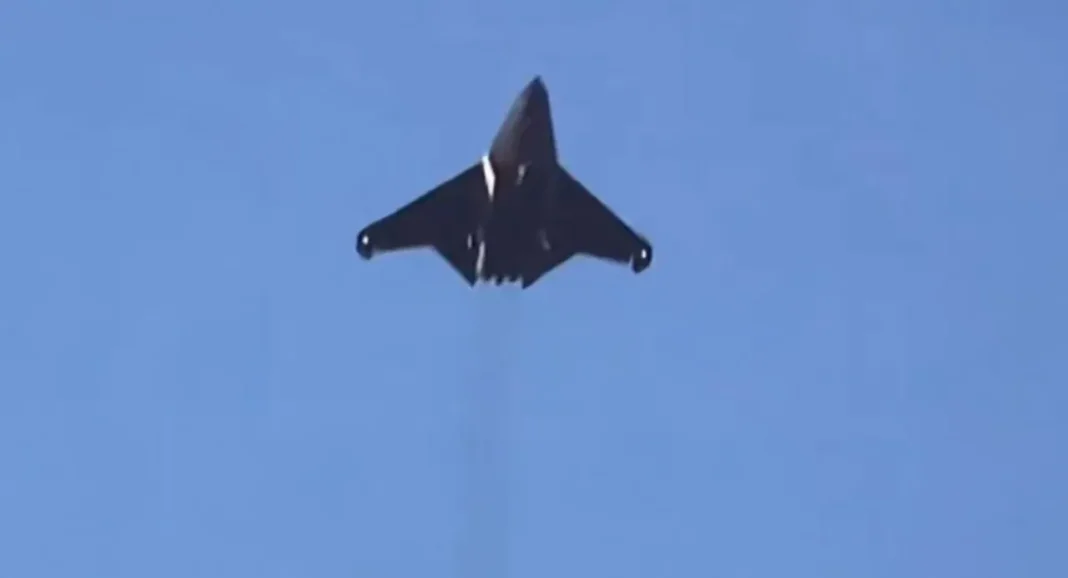
The J-50, China's second new-generation fighter, observed on December 26, 2024
As mentioned in the introduction, the small number of photos and videos published (in the main illustration) on the subject of this new generation Chinese fighter necessarily limits the understanding of this new weapon system.
one of the pictures of the J-36
At best, we know that the aircraft is more compact than the J-36, but larger than the J-16 or J-20 currently in service. Unlike the J-36, it has only two turbojets, and a semi-delta wing similar to that chosen, for example, for the Tempest of the British GCAP program.
Unlike the latter, however, the J-50 lacks a vertical tail, which tends to increase its multi-aspect stealth and speed, at the cost of reduced maneuverability.
According to some estimates circulating on social networks, the aircraft would have a length and wingspan of around 22 m, and a maximum mass of 35 to 40 tonnes, compared to 21 m/13 m and 37 tonnes for the J-20.
It would apparently have two large weapons bays, designed to carry long munitions, such as the new PL-17 long-range air-to-air missiles, or air-to-ground or air-to-surface munitions. On the other hand, its twin-engine configuration would give it neither the electrical power nor the speed of the J-36, and its smaller dimensions require a smaller quantity of fuel to be carried, and therefore a smaller range.
Chinese military expert says J-50 would be intended to operate from PLA aircraft carriers
Why, then, is China simultaneously developing two aircraft that appear to fall into the sixth-generation fighter classification, with such different performance characteristics?
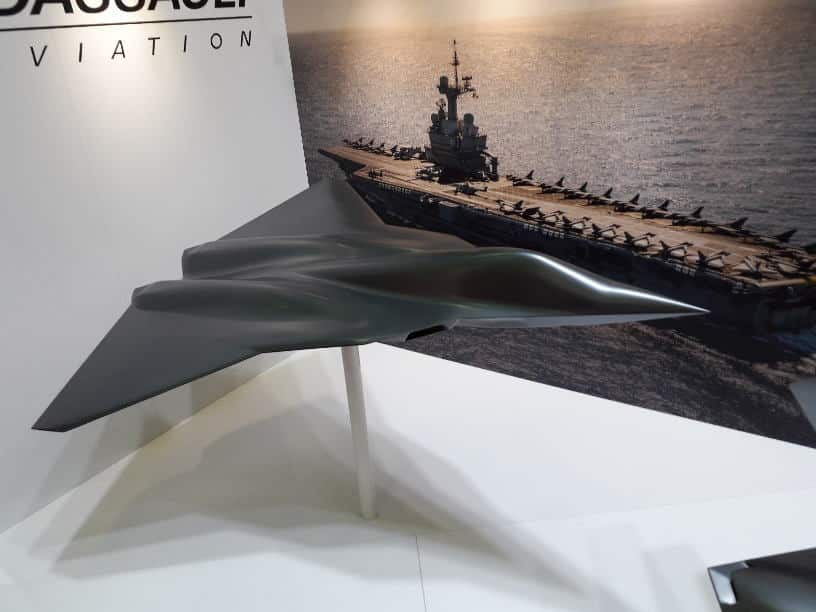
One of the first models of Dassault Aviation concerning the SCAF program. At that time, the aircraft manufacturer favored the configuration without vertical tail.
The appearance of a new-generation Chinese fighter on the country's social networks on December 26 had already had the effect of a bomb in the sphere

meta-defense.fr