China could dominate the sky with two flying sixth-generation fighter jets as the US struggles to design one

Beijingwalker

VIP Member
Joined
Nov 4, 2011
Messages
92,627
Reaction score
113,252
Reputation
2,091.1
Country of Origin
Country of Residence

China could dominate the sky with two flying sixth-generation fighter jets as the US struggles to design one


On December 26, 2024, China revealed two sixth-generation combat aircraft prototypes developed independently by Chengdu Aircraft Corporation (CAC) and Shenyang Aircraft Corporation (SAC). Both prototypes conducted their first flights on December 26, 2024. The date coincided with Mao Zedong’s birthday anniversary and the 13th anniversary of the rollout of the J-20 stealth fighter. The public flights are viewed as part of a calculated effort to publicize China’s latest military advancements, coinciding with the launch of the Type 076 Sichuan twin-island assault carrier and the Y-20 AWACS on the same day.
Follow Army Recognition on Google News at this link
sharethis sharing button

China_could_dominate_the_sky_with_two_flying_sixth-generation_fighter_jets_as_the_US_struggles_to_design_one_925_001-099c847c.jpeg

The Chengdu prototype, on the left, features a trijet, tailless diamond-delta wing configuration, while the Shenyang prototype, on the right, has a twin-engine configuration and incorporates a cranked arrow-wing configuration with what seems to be foldable full-movable vertical stabilizers. (Picture source: Weibo)

The Chengdu prototype, known as the Cheng-6 on Chinese social media, features a trijet, tailless flying wing design. Its length is approximately 26 meters, and it employs a diamond-delta wing configuration with extended chine lines. The absence of vertical and horizontal tail surfaces suggests design priorities centered on radar signature reduction and aerodynamic efficiency. This design configuration indicates its potential use in roles requiring long-range missions, high-speed flight, and significant payloads, such as heavy tactical fighter or regional bomber missions. The Cheng-6 was accompanied by a J-20S twin-seat variant during its test flight.

The J-20S had previously been speculated upon following a promotional video in 2021 and images released in 2022. It was officially unveiled at the Zhuhai Air Show 2024. This twin-seat variant introduces a rear seat to enable additional mission roles, including electronic suppression, tactical command, and unmanned aerial vehicle (UAV) swarm control. It is equipped with PL-15E and PL-10E missiles, allowing it to perform tasks such as ground strikes and UAV coordination. The twin-seat configuration is intended to distribute operational workload, with one operator focused on tactical roles and the other on sensor management. The J-20S may contribute to the “loyal wingman” program by directing UAVs for reconnaissance, surveillance, and strike tasks. Once operational, it could influence the People's Liberation Army Air Force (PLAAF) by introducing networked and data-driven air combat tactics. It is described as the first officially revealed fifth-generation two-seat fighter.

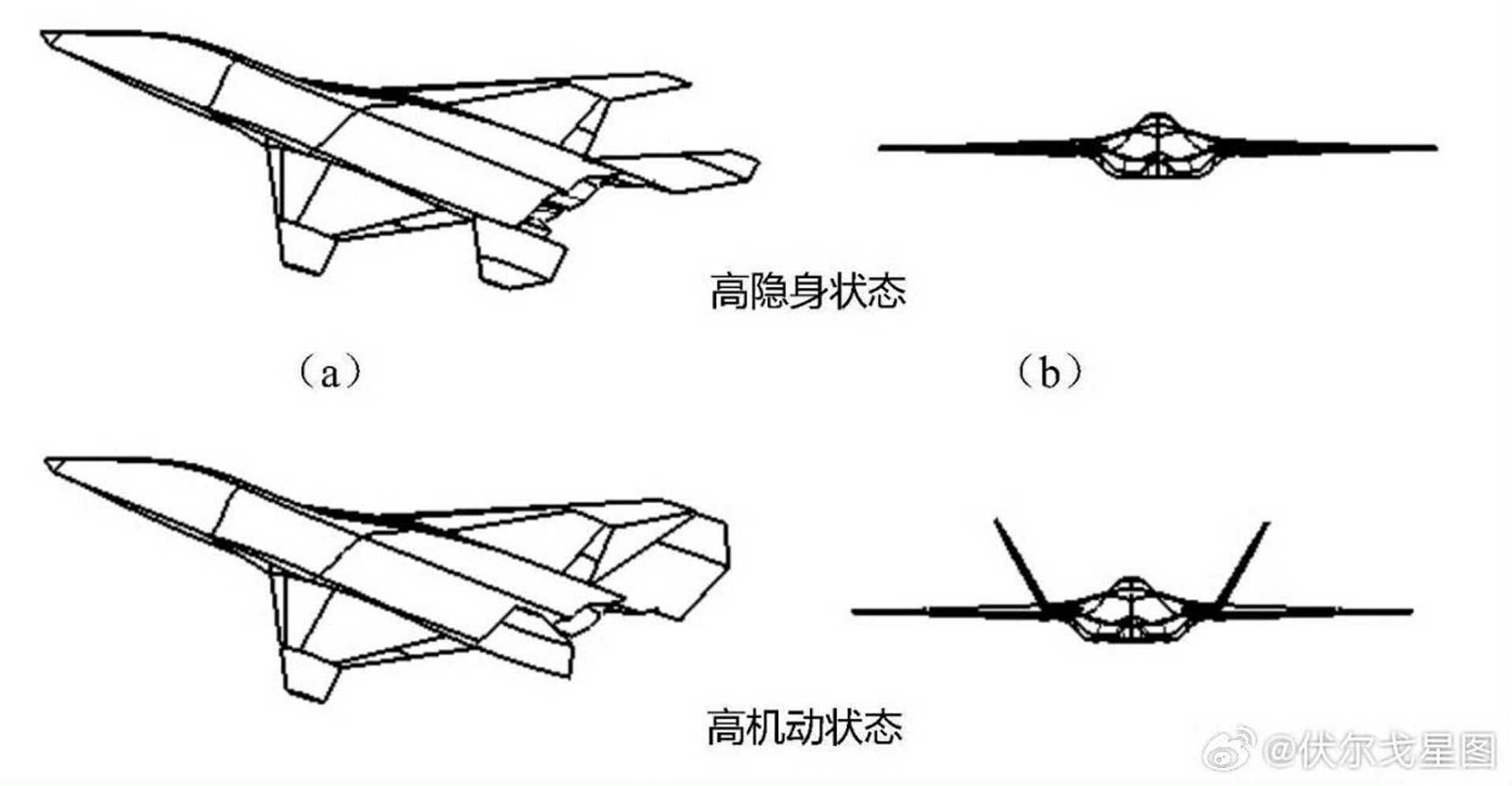
The smaller Shenyang prototype, named the Shen-6, has a twin-engine configuration and measures approximately 21 meters in length. It incorporates a cranked arrow-wing configuration with what seems to be foldable full-movable vertical stabilizers. These stabilizers lay flat during cruising, forming a tailless design to enhance stealth and lift-drag efficiency, and rise during maneuvers to create a V-tail configuration for better control. It incorporates diverterless supersonic inlets (DSIs) located below the wing roots. The Shen-6 is likely to use components from other Shenyang aircraft, such as the J-35, as it is the most modern in the range, for example, the avionics and engines. Like the J-35, the Shen-6’s design characteristics indicate it could be suited for multi-role operations, including carrier-based missions. It was accompanied by a Shenyang J-16 fighter during its test flight.

Both prototypes prioritize designs to reduce radar and infrared signatures. The Cheng-6’s trijet configuration may enhance performance in high-speed and high-altitude operations, while the Shen-6 employs diverterless supersonic intakes to optimize stealth and aerodynamic efficiency. The prototypes are understood to be in early stages of flight testing, with no high-resolution imagery confirming internal weapon bays. Analysts view the Chengdu and Shenyang prototypes as complementary rather than competitive, with the Chengdu prototype’s design considered consistent with characteristics attributed to the JH-XX tactical fighter-bomber concept, while the Shenyang prototype introduces features aimed at enhancing operational flexibility. Both aircraft align with principles associated with sixth-generation fighter designs, including advanced stealth, integration with unmanned systems, and networked combat capabilities.

China%20could%20dominate%20the%20sky%20with%20two%20flying%20sixth-generation%20fighter%20jets%20as%20the%20US%20struggles%20to%20design%20one%20925%20002-090ff7f6.jpeg

The Shen-6 could be equipped with foldable full-movable vertical stabilizers. These stabilizers lay flat during cruising, forming a tailless design to enhance stealth and lift-drag efficiency, and rise during maneuvers to create a V-tail configuration for better control. (Picture source: Weibo/伏尔戈星图)


Sixth-generation aircraft are generally characterized by their focus on stealth features optimized for reducing radar signatures across multiple frequencies, often employing tailless (for Chengdu) or minimal control surface designs (for Shenyang). These aircraft typically integrate high-performance propulsion systems, such as variable-cycle engines, to enable sustained high-speed cruising and extended range. They are expected to operate optionally manned, with capabilities to function within a networked "system of systems," including artificial intelligence, advanced sensors, and data-sharing technologies. Modular payload configurations are anticipated to allow flexibility across roles, including air superiority, ground attack, and electronic warfare. These characteristics aim to address evolving air combat requirements, including survivability and adaptability in contested environments.

In June 2024, China also conducted a test flight for a new aviation concept involving a stealth aircraft integrated with two detachable drones. This flight, held at an airport near the Mu Us Desert in Ningxia, showcased a blended wing-body design with delta wings. During the flight, sections of the main aircraft's wings detached, transforming into drones powered by electric ducted fans. The separation process caused shifts in the aircraft's center of gravity and wing area, momentarily affecting stability. However, the aircraft and drones regained stable flight due to the implementation of advanced aerodynamic designs and automated control algorithms. This test flight was characterized as a demonstration of a new approach to integrating manned and unmanned systems for coordinated operations.

The system, developed by the Aerospace Technology Institute of the China Aerodynamics Research and Development Centre (CARDC), employs a rear-edge docking layout, enabling drones to separate from the trailing edge of the main aircraft's wings. According to CARDC engineer Du Xin, this configuration addresses challenges such as speed mismatches and range limitations between crewed aircraft and drones. The system utilizes the FCC-100 flight control computer from Northwestern Polytechnical University, designed to manage complex calculations and ensure flight stability. The team also employed advanced control algorithms and high-performance components to maintain precision during separation. This design is intended to explore new modes of combat operations, reflecting China's ongoing testing of new next-generation features.

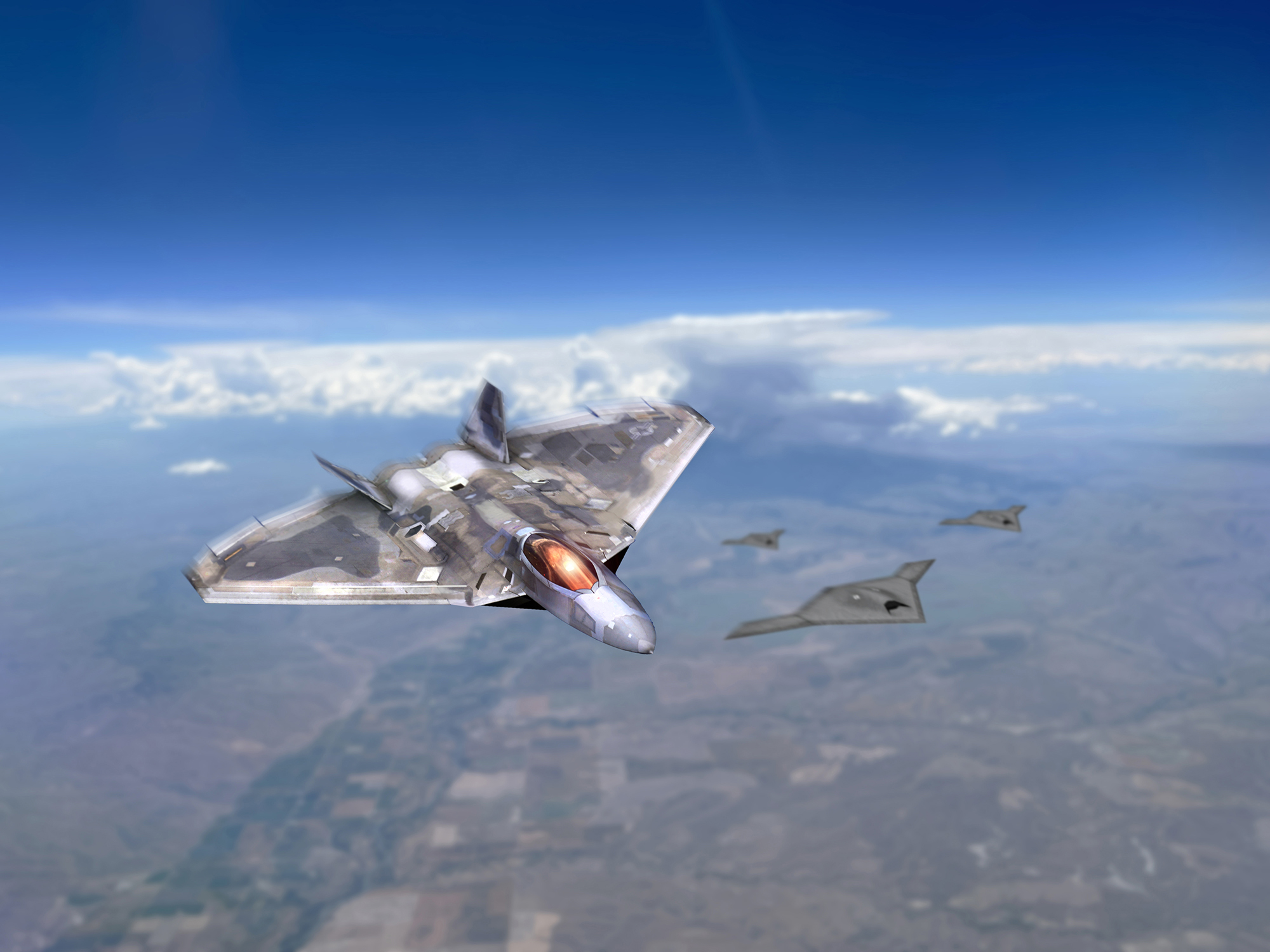
Globally, the development of sixth-generation aircraft continues among other major powers. The United States is advancing its sixth-generation fighter development through the Next Generation Air Dominance (NGAD) program for the Air Force and the F/A-XX program for the Navy. These projects prioritize advanced stealth features, integration with unmanned systems, and improvements in propulsion technologies. Despite these efforts, budget constraints and evolving priorities have led to discussions about adjusting the scale or timelines of these programs. Europe, meanwhile, is pursuing two collaborative initiatives: the Global Combat Air Programme (GCAP), a partnership between the United Kingdom, Italy, and Japan aimed at delivering a next-generation fighter by 2035, and the Future Combat Air System (FCAS), a joint effort among France, Germany, and Spain. Both programs focus on integrating advanced technologies such as supersonic performance, virtual reality cockpits, and networked operational capabilities.

Russia is in the early stages of conceptualizing its sixth-generation fighter, with a prototype expected by 2050. Efforts are currently directed toward understanding the requirements of future conflicts and technological advancements to inform the design. Sweden's Saab is independently exploring concepts for both manned and unmanned sixth-generation fighters as part of efforts to develop next-generation platforms for its armed forces. In India, the primary focus remains the Advanced Medium Combat Aircraft (AMCA), a fifth-generation project, though there is interest in exploring sixth-generation technologies. At this stage, no official sixth-generation program has been announced in India. These programs collectively reflect global efforts to address future air combat needs through advanced fighter technologies.

China's recent test flights of two new sixth-generation stealth fighter jets, the Cheng-6 and Shen-6, show that Chinese programs are much more advanced than previously thought. In a potential conflict with the United States, likely for Taiwan, China could potentially deploy these advanced stealth aircraft designed to evade known detection systems and challenge traditional U.S. air superiority. This fact may prompt the United States to reevaluate its strategic priorities by continuing to develop fighter jets, even though some say they are outdated, to maintain a competitive edge.


China%20could%20dominate%20the%20sky%20with%20two%20flying%20sixth-generation%20fighter%20jets%20as%20the%20US%20struggles%20to%20design%20one%20925%20003-c383c7ec.jpeg

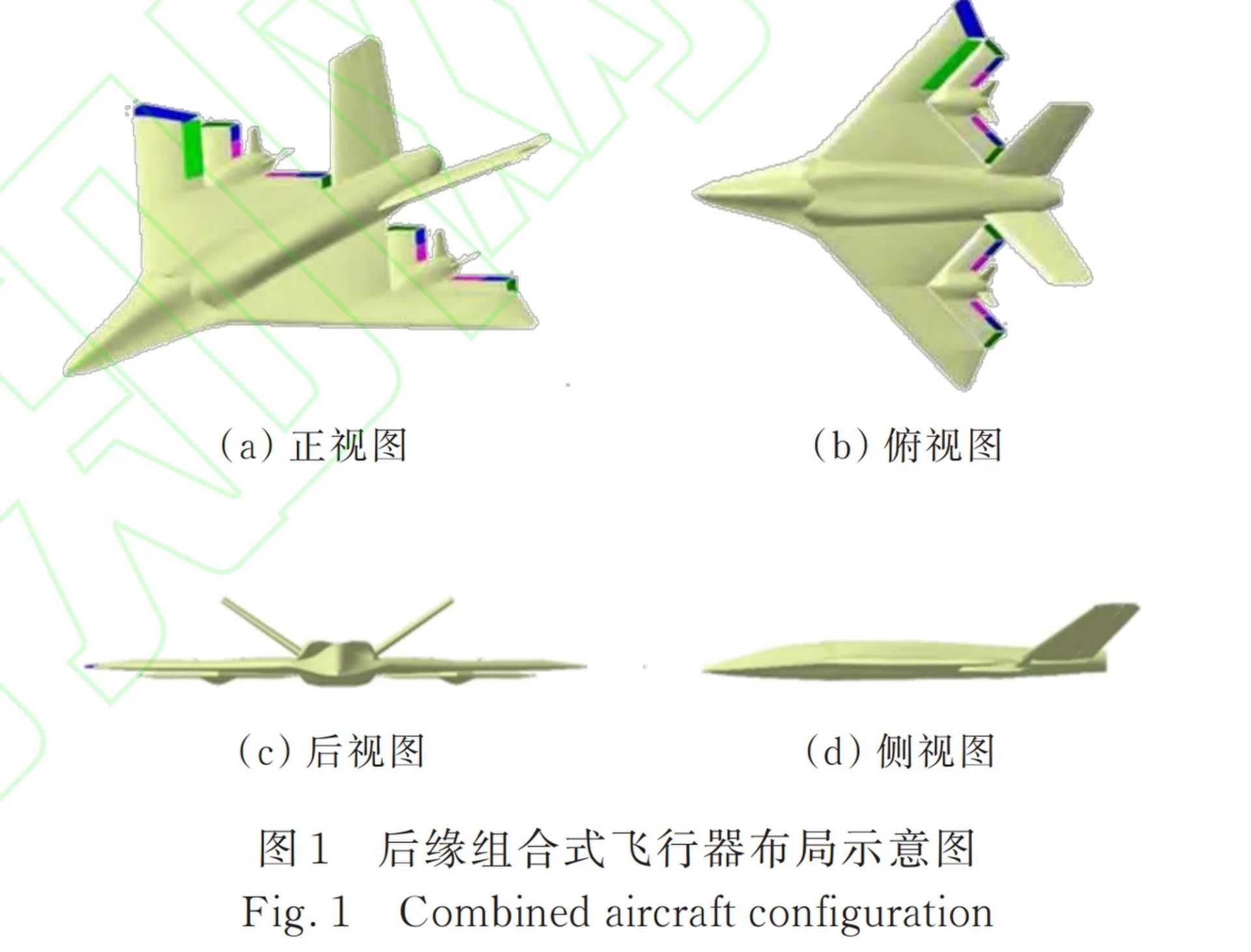
The Shen-6's general design could be influenced by these earlier fighter designs from the China Aerodynamics Research and Development Centre. (Picture source: CARDC)
 

China’s groundbreaking 6th gen stealth fighter takes flight: How it could be a 'super weapon' that could alter global power dynamics


China’s groundbreaking 6th gen stealth fighter takes flight: How it could be a 'super weapon' that could alter global power dynamics

1735289164-3996.jpg


ET OnlineLast Updated: Dec 27, 2024, 02:41:00 PM IST

Synopsis

The debut of China’s new stealth fighter jet, the J-36, has raised alarms globally, particularly in the Indo-Pacific region. With its advanced tailless design and superior stealth features, the J-36 could challenge U.S. and allied forces. India, which currently lacks a stealth fighter, may also face increased aerial threats. The J-36’s capabilities signal a major shift in military power, with far-reaching implications for global security and the balance of aerial dominance.

The emergence of China’s new stealth fighter jet, believed to be a 6th-generation model, has caused a stir in military circles globally. The J-36, which made its first appearance in a video circulating on social media, was seen flying in broad daylight over Chengdu, Sichuan province. The aircraft's design and capabilities suggest it may represent a significant shift in aerial dominance, posing a potential threat to global military powers, especially in the Indo-Pacific region.

Unconventional Design and Advanced Features​

The J-36 features a striking tailless triangular configuration, designed to significantly reduce its radar signature and enhance its stealth capabilities. This unique design allows it to potentially evade detection by conventional radar systems, making it harder to track and intercept. The jet's ability to fly at high altitudes over extended distances could give it the upper hand in operations far from its base, with a substantial reduction in reliance on tanker support.


One of the most notable features of the J-36 is its three-engine configuration, believed to be powered by WS-10C turbofan engines. This configuration is designed for high-speed and high-altitude operations, enabling the aircraft to cover long ranges without the need for aerial refuelling. The larger size of the J-36 is also speculated to offer greater fuel capacity, increased payload, and more space for advanced weapons and sensors, making it suitable for a variety of combat and reconnaissance missions.
The stealth capabilities of the J-36 include advanced technologies such as side-looking airborne radar and electro-optical sensors. These systems would enhance its reconnaissance and combat potential, allowing it to operate effectively in contested environments where traditional fighters might struggle.

J-36 and the Regional Power Shift​

The development of the J-36 is part of China’s broader strategy to modernise its military, reflecting significant advances in air combat technology. According to a South China Morning Post report, the aircraft was accompanied by a Chengdu J-20S fighter jet during its maiden flight, suggesting that both aircraft may be part of a new generation of Chinese fighter jets poised to challenge existing global powers in the skies.


The debut of the J-36 could have significant implications for India, which currently lacks a stealth fighter jet. With China already deploying its J-20 stealth fighters close to India’s borders, particularly in Sikkim, the addition of the J-36 could heighten tensions along the frontier. NDTV reported earlier in May that satellite images showed Chinese J-20 jets positioned less than 150 km from India’s border. India counters with its fleet of 36 French-built Rafale fighters, stationed at Hasimara in West Bengal, which lies within striking distance of China’s airbases in Tibet, including Shigatse, where the J-20 is stationed.

While the J-36 is still in its early testing phase, its potential to be a formidable opponent in the skies is clear, especially when paired with the growing fleet of J-20s. If deployed along the India-China border, this stealth fighter could pose an unprecedented threat to India’s aerial defences, which currently rely on the Rafale jets and older fleets.

The Strategic Importance of the J-36​

The unveiling of the J-36 is not just a technological leap for China but also a strategic move to assert its military prowess on the global stage. The test flight, which occurred on the anniversary of Mao Zedong’s birth, appears to have been a deliberate display of China’s growing capabilities. The high-profile nature of the flight suggests that the country is keen to showcase its advancements, especially in military aviation, to the world.

Justin Bronk, a senior researcher at the Royal United Services Institute, remarked that the public display of such an advanced prototype is “fascinating” and noted that China’s military rarely showcases new aircraft without a clear strategic purpose. The development of the J-36 is believed to be part of a broader “system of systems” approach, which integrates manned and unmanned platforms to enhance combat effectiveness, similar to the U.S. Next Generation Air Dominance (NGAD) initiative.

China’s Military Ambitions and Global Implications​

The J-36 is part of China’s larger ambitions to modernise its military under President Xi Jinping’s leadership. The U.S. Department of Defense has already acknowledged China’s air force as the largest in the Indo-Pacific region. The Pentagon’s focus on China as a "top pacing challenge" reflects concerns over Beijing’s rapid advancements in aircraft technology, unmanned aerial systems, and integrated military strategies.

For the United States and its allies, the introduction of the J-36 poses a significant challenge. The stealth capabilities and long-range potential of the J-36 could threaten vital U.S. military assets in the Indo-Pacific, such as tankers, early-warning aircraft, and forward-deployed naval vessels. The U.S. has been investing in the NGAD programme, which aims to develop the next generation of fighter jets that incorporate advanced stealth, adaptive engines, and AI-driven decision-making. The J-36’s capabilities could pose a challenge to U.S. efforts to maintain aerial superiority.

The J-36’s potential also extends beyond conventional combat. It could serve as a testbed for advanced technologies that may be deployed across a variety of platforms, including stealth bombers and unmanned aerial vehicles. This reflects China’s ambition to not only compete with the U.S. but potentially surpass it in key areas of military aviation.

China’s Rapid Military Growth​

China’s rise in military aviation has been swift. When the People’s Republic of China was founded in 1949, it had just 17 aircraft. Today, its air force competes with the most advanced in the world, and the debut of the J-36 is another indicator of this rapid technological evolution. The aircraft is set to alter the balance of aerial power in the Indo-Pacific region and beyond, shifting the power dynamics in favour of China.

The development of the J-36 is a testament to China’s long-term strategic vision. The jet is part of broader efforts to modernise its air and naval forces, ensuring it has the capability to project power beyond its borders. As tensions rise with the United States over issues such as Taiwan and the South China Sea, the J-36 serves as both a symbol of China’s growing strength and a practical asset for expanding its military influence.

What’s Next for the J-36?​

As the J-36 continues its test flights, further information on its capabilities will emerge. Experts expect additional sightings and data in the coming months, which will shed more light on its performance and potential. The aircraft’s integration into China’s air force could signal a significant shift in regional and global security, particularly if it is deployed alongside advanced drones and other autonomous systems.

For the U.S., the J-36’s development likely means an accelerated effort to enhance its own air capabilities. The ongoing race for aerial dominance between China and the U.S. will determine the future of global military power, with both nations pushing the boundaries of what is possible in terms of fighter jet technology.


A country's overall industrial and manufacturing capability is always hand in hand with its military industry capacity, if a country is on a decline path for its overall industrial and manufacturing capacity, decline of defence industry will follow suit soon after.

微信图片_20241227182130.png
GFqoiXiXwAEvonC.jpg

china-manufacturing-gross-production-world.jpg
 
Last edited:
But haters still say that China copied them from their aircrafts dated back to WW2. Haters never believe that China is capable of making anything by her own.


Relax dude.

All that matters is that China has finally caught up with USA in military aerospace technology and I won't be surprised if China's 6th generation fighter/s turn out to be the most advanced in the whole world.

China talks little and just works hard. This is a great characteristic of Chinese.
 
Relax dude.

All that matters is that China has finally caught up with USA in military aerospace technology and I won't be surprised if China's 6th generation fighter/s turn out to be the most advanced in the whole world.

China talks little and just works hard. This is a great characteristic of Chinese.

You continue to make the false assumption that Chinas version of 6th gen is equivalent to American 6th gen.

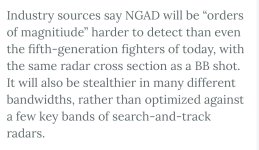
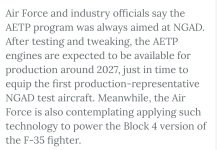
The US has been flying NGAD for 5-6 years. NGAD has an RCS of a BB pellet, and equipped with three stream adaptive cycle engines. Equipped with the latest AESA APG-85 radar or completely off boarded to a CCA to increase its stealth further.

The fact NGAD will be equipped with state of the art three stream adaptive cycle engines alone makes it more advanced than anything China can put in the air.


Piecing Together the NGAD Puzzle​


IMG_4467.jpeg

IMG_4466.jpeg


China could dominate the sky with two flying sixth-generation fighter jets as the US struggles to design one


On December 26, 2024, China revealed two sixth-generation combat aircraft prototypes developed independently by Chengdu Aircraft Corporation (CAC) and Shenyang Aircraft Corporation (SAC). Both prototypes conducted their first flights on December 26, 2024. The date coincided with Mao Zedong’s birthday anniversary and the 13th anniversary of the rollout of the J-20 stealth fighter. The public flights are viewed as part of a calculated effort to publicize China’s latest military advancements, coinciding with the launch of the Type 076 Sichuan twin-island assault carrier and the Y-20 AWACS on the same day.
Follow Army Recognition on Google News at this link
sharethis sharing button

China_could_dominate_the_sky_with_two_flying_sixth-generation_fighter_jets_as_the_US_struggles_to_design_one_925_001-099c847c.jpeg

The Chengdu prototype, on the left, features a trijet, tailless diamond-delta wing configuration, while the Shenyang prototype, on the right, has a twin-engine configuration and incorporates a cranked arrow-wing configuration with what seems to be foldable full-movable vertical stabilizers. (Picture source: Weibo)

The Chengdu prototype, known as the Cheng-6 on Chinese social media, features a trijet, tailless flying wing design. Its length is approximately 26 meters, and it employs a diamond-delta wing configuration with extended chine lines. The absence of vertical and horizontal tail surfaces suggests design priorities centered on radar signature reduction and aerodynamic efficiency. This design configuration indicates its potential use in roles requiring long-range missions, high-speed flight, and significant payloads, such as heavy tactical fighter or regional bomber missions. The Cheng-6 was accompanied by a J-20S twin-seat variant during its test flight.

The J-20S had previously been speculated upon following a promotional video in 2021 and images released in 2022. It was officially unveiled at the Zhuhai Air Show 2024. This twin-seat variant introduces a rear seat to enable additional mission roles, including electronic suppression, tactical command, and unmanned aerial vehicle (UAV) swarm control. It is equipped with PL-15E and PL-10E missiles, allowing it to perform tasks such as ground strikes and UAV coordination. The twin-seat configuration is intended to distribute operational workload, with one operator focused on tactical roles and the other on sensor management. The J-20S may contribute to the “loyal wingman” program by directing UAVs for reconnaissance, surveillance, and strike tasks. Once operational, it could influence the People's Liberation Army Air Force (PLAAF) by introducing networked and data-driven air combat tactics. It is described as the first officially revealed fifth-generation two-seat fighter.

The smaller Shenyang prototype, named the Shen-6, has a twin-engine configuration and measures approximately 21 meters in length. It incorporates a cranked arrow-wing configuration with what seems to be foldable full-movable vertical stabilizers. These stabilizers lay flat during cruising, forming a tailless design to enhance stealth and lift-drag efficiency, and rise during maneuvers to create a V-tail configuration for better control. It incorporates diverterless supersonic inlets (DSIs) located below the wing roots. The Shen-6 is likely to use components from other Shenyang aircraft, such as the J-35, as it is the most modern in the range, for example, the avionics and engines. Like the J-35, the Shen-6’s design characteristics indicate it could be suited for multi-role operations, including carrier-based missions. It was accompanied by a Shenyang J-16 fighter during its test flight.

Both prototypes prioritize designs to reduce radar and infrared signatures. The Cheng-6’s trijet configuration may enhance performance in high-speed and high-altitude operations, while the Shen-6 employs diverterless supersonic intakes to optimize stealth and aerodynamic efficiency. The prototypes are understood to be in early stages of flight testing, with no high-resolution imagery confirming internal weapon bays. Analysts view the Chengdu and Shenyang prototypes as complementary rather than competitive, with the Chengdu prototype’s design considered consistent with characteristics attributed to the JH-XX tactical fighter-bomber concept, while the Shenyang prototype introduces features aimed at enhancing operational flexibility. Both aircraft align with principles associated with sixth-generation fighter designs, including advanced stealth, integration with unmanned systems, and networked combat capabilities.
China%20could%20dominate%20the%20sky%20with%20two%20flying%20sixth-generation%20fighter%20jets%20as%20the%20US%20struggles%20to%20design%20one%20925%20002-090ff7f6.jpeg

The Shen-6 could be equipped with foldable full-movable vertical stabilizers. These stabilizers lay flat during cruising, forming a tailless design to enhance stealth and lift-drag efficiency, and rise during maneuvers to create a V-tail configuration for better control. (Picture source: Weibo/伏尔戈星图)


Sixth-generation aircraft are generally characterized by their focus on stealth features optimized for reducing radar signatures across multiple frequencies, often employing tailless (for Chengdu) or minimal control surface designs (for Shenyang). These aircraft typically integrate high-performance propulsion systems, such as variable-cycle engines, to enable sustained high-speed cruising and extended range. They are expected to operate optionally manned, with capabilities to function within a networked "system of systems," including artificial intelligence, advanced sensors, and data-sharing technologies. Modular payload configurations are anticipated to allow flexibility across roles, including air superiority, ground attack, and electronic warfare. These characteristics aim to address evolving air combat requirements, including survivability and adaptability in contested environments.

In June 2024, China also conducted a test flight for a new aviation concept involving a stealth aircraft integrated with two detachable drones. This flight, held at an airport near the Mu Us Desert in Ningxia, showcased a blended wing-body design with delta wings. During the flight, sections of the main aircraft's wings detached, transforming into drones powered by electric ducted fans. The separation process caused shifts in the aircraft's center of gravity and wing area, momentarily affecting stability. However, the aircraft and drones regained stable flight due to the implementation of advanced aerodynamic designs and automated control algorithms. This test flight was characterized as a demonstration of a new approach to integrating manned and unmanned systems for coordinated operations.

The system, developed by the Aerospace Technology Institute of the China Aerodynamics Research and Development Centre (CARDC), employs a rear-edge docking layout, enabling drones to separate from the trailing edge of the main aircraft's wings. According to CARDC engineer Du Xin, this configuration addresses challenges such as speed mismatches and range limitations between crewed aircraft and drones. The system utilizes the FCC-100 flight control computer from Northwestern Polytechnical University, designed to manage complex calculations and ensure flight stability. The team also employed advanced control algorithms and high-performance components to maintain precision during separation. This design is intended to explore new modes of combat operations, reflecting China's ongoing testing of new next-generation features.

Globally, the development of sixth-generation aircraft continues among other major powers. The United States is advancing its sixth-generation fighter development through the Next Generation Air Dominance (NGAD) program for the Air Force and the F/A-XX program for the Navy. These projects prioritize advanced stealth features, integration with unmanned systems, and improvements in propulsion technologies. Despite these efforts, budget constraints and evolving priorities have led to discussions about adjusting the scale or timelines of these programs. Europe, meanwhile, is pursuing two collaborative initiatives: the Global Combat Air Programme (GCAP), a partnership between the United Kingdom, Italy, and Japan aimed at delivering a next-generation fighter by 2035, and the Future Combat Air System (FCAS), a joint effort among France, Germany, and Spain. Both programs focus on integrating advanced technologies such as supersonic performance, virtual reality cockpits, and networked operational capabilities.

Russia is in the early stages of conceptualizing its sixth-generation fighter, with a prototype expected by 2050. Efforts are currently directed toward understanding the requirements of future conflicts and technological advancements to inform the design. Sweden's Saab is independently exploring concepts for both manned and unmanned sixth-generation fighters as part of efforts to develop next-generation platforms for its armed forces. In India, the primary focus remains the Advanced Medium Combat Aircraft (AMCA), a fifth-generation project, though there is interest in exploring sixth-generation technologies. At this stage, no official sixth-generation program has been announced in India. These programs collectively reflect global efforts to address future air combat needs through advanced fighter technologies.

China's recent test flights of two new sixth-generation stealth fighter jets, the Cheng-6 and Shen-6, show that Chinese programs are much more advanced than previously thought. In a potential conflict with the United States, likely for Taiwan, China could potentially deploy these advanced stealth aircraft designed to evade known detection systems and challenge traditional U.S. air superiority. This fact may prompt the United States to reevaluate its strategic priorities by continuing to develop fighter jets, even though some say they are outdated, to maintain a competitive edge.

China%20could%20dominate%20the%20sky%20with%20two%20flying%20sixth-generation%20fighter%20jets%20as%20the%20US%20struggles%20to%20design%20one%20925%20003-c383c7ec.jpeg

The Shen-6's general design could be influenced by these earlier fighter designs from the China Aerodynamics Research and Development Centre. (Picture source: CARDC)

Relax dude.

All that matters is that China has finally caught up with USA in military aerospace technology and I won't be surprised if China's 6th generation fighter/s turn out to be the most advanced in the whole world.

China talks little and just works hard. This is a great characteristic of Chinese.

To view this content we will need your consent to set third party cookies.
For more detailed information, see our cookies page.


To view this content we will need your consent to set third party cookies.
For more detailed information, see our cookies page.


To view this content we will need your consent to set third party cookies.
For more detailed information, see our cookies page.


To view this content we will need your consent to set third party cookies.
For more detailed information, see our cookies page.


Where the US stands today on the 6th generation family of systems
 
@Beijingwalker Trump in his first presidency had confirmed that US was already flying a 6th gen fighter. That's abut 6 years ago
 
To view this content we will need your consent to set third party cookies.
For more detailed information, see our cookies page.


Three stream ACE is a core NGAD technology, and bleeding edge engine technology today
 
You continue to make the false assumption that Chinas version of 6th gen is equivalent to American 6th gen.

The US has been flying NGAD for 5-6 years. NGAD has an RCS of a BB pellet, and equipped with three stream adaptive cycle engines. Equipped with the latest AESA APG-85 radar or completely off boarded to a CCA to increase its stealth further.

The fact NGAD will be equipped with state of the art three stream adaptive cycle engines alone makes it more advanced than anything China can put in the air.


Piecing Together the NGAD Puzzle​


View attachment 91117

View attachment 91118


I don't know who has claimed this is a 6th gen fighter? What can be seen is that this is a tailless fighter right?

From what I understand 6th should include sb-orbital aerospace flight capabilties and therefore the usage fo scramjet engines right? No chinese agency has claimed it for this deisgn as far as I know.
 
@Beijingwalker where is confirmation this is 6th gen? What I can see is only a tailless fighter. 6rth gen is way more than that.
 

Users who are viewing this thread

Back
Top