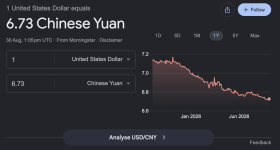
China devalues the Yuan keeping its GDP numbers low

retaxis

Trusted Member
Joined
Nov 16, 2007
Messages
3,880
Reaction score
5,105
Reputation
1,863.8
Country of Origin
Country of Residence
China is exporter nation thats why it needs to keep its Yuan weak to have better competitive prices globally. Meanwhile India for example is an importer country so it artificially keeps its currency high so that imports become cheaper. In a what if scenario, What if China did not devalue the Yuan and India did not pump up value of rupee? (China's economy would likely be 10x that of India's)

If China did not keep its currency weak, China's nominal Gross Domestic Product (GDP) in US dollars would be higher on paper. [1]

Nominal GDP in US Dollars
    • Exchange Rate Math: GDP is counted in local currency first and then changed into US dollars. If each yuan buys more US dollars, the total dollar value of the economy goes up.
    • Global Ranking: A stronger yuan could push China's nominal dollar GDP closer to the United States. [1]

Real Economic Effects
    • Lower Exports: A stronger currency makes Chinese products cost more for buyers in other countries. Factories might sell fewer goods abroad.
    • Slower Growth: Selling fewer goods can slow down actual production and local job growth over time. [1, 2, 3, 4]

Purchasing Power Parity (PPP)
    • Local Buying Power: Economists also use Purchasing Power Parity (PPP) to measure an economy based on what money can actually buy locally. [1]
    • Already Large: China's PPP GDP is already the largest in the world because everyday items cost less inside China. Changing the official exchange rate does not change this real internal buying power. [1, 2]
 
Source:
Google AI
Meanwhile India for example is an importer country so it artificially keeps its currency high so that imports become cheaper.
That's simply not true
Screenshot 2026-08-30 at 6.38.44 PM.png

China for past year has been appreciating their currency or allowing it to appreciate. INR decline however is quite well visible.Screenshot 2026-08-30 at 6.39.49 PM.png
 
That's simply not true
View attachment 213273

China for past year has been appreciating their currency or allowing it to appreciate. INR decline however is quite well visible.View attachment 213274
China has been keeping the Yuan-Dollar exchange low for many years. It's just Yuan has been appreciating for the last few months because of the state of US economy and its financial policies.
 
China has been keeping the Yuan-Dollar exchange low for many years. It's just Yuan has been appreciating for the last few months because of the state of US economy and its financial policies.
Yes everyone knows the US currency has devalued considerably lol and will keep devalueing due to debt and interest higher interest rates. If you compare Yuan with Euro or Yen it will show the truth but these Indians have the minds of children.
 
China controls and devalues its currency, the yuan, by setting a strict daily reference rate and limiting how much the exchange rate can change. [1, 2]
The People's Bank of China (PBOC), which is the country's central bank, manages this process using specific methods. [1]

The Daily Reference Rate
    • The Fixing: Every morning, the PBOC sets a target exchange rate for the yuan against the U.S. dollar.
    • Control: This official price guides where the currency will trade for that entire day. [1]

Trading Bands
    • Percentage Limits: The PBOC does not let the yuan float freely on the open market.
    • The Limit: It forces the yuan to stay within a tight percentage range (usually plus or minus 2%) of that morning's reference rate.
    • Lowering the Bar: If the central bank wants a weaker currency, it sets a lower reference rate the next morning. [1, 2]

Managing Market Pressure
    • State Banks: In the past, the central bank used massive amounts of foreign money to buy and sell currencies directly.
    • Modern Tools: Today, Beijing uses a wider mix of policy tools, guidance, and financial rules to control the currency without spending all of its financial reserves. [1, 2]

Why China Does It
    • Cheaper Goods: A lower yuan value makes Chinese products cheaper for international buyers.
    • Export Power: Lower prices help Chinese factories sell more goods. This protects local jobs and supports the domestic economy when growth slows down. [1, 2, 3]
 
India strengthens the Indian Rupee (INR) by managing foreign exchange reserves, boosting capital inflows, and expanding global trade settlement in local currencies. [1, 2, 3]

Central Bank Interventions
    • Forex Market Operations: The Reserve Bank of India (RBI) buys and sells US dollars to prevent sharp, panic-driven drops in the rupee.
    • Massive Reserves: India maintains massive foreign exchange reserves to act as a financial buffer against global market shocks.
    • Special Swap Windows: The RBI introduces targeted forex swap windows for banks to attract higher foreign deposits, such as inflows from Non-Resident Indians (NRIs). [1, 2, 3]

Boosting Economic and Trade Policies
    • Encouraging Local Currency Trade: India permits export contracts and invoices to be settled in currencies other than just the US dollar. This helps ease the pressure of global dollar shortages. [1]
    • Growing Exports: Increasing exports in high-value sectors like IT, pharmaceuticals, and electronics brings more foreign currency into the country. [1, 2]
    • Managing Imports: Lowering the heavy reliance on imported crude oil and energy through domestic renewable energy growth helps reduce the trade deficit. [1, 2]
 

Users who are viewing this thread

Pakistan Defence Latest

Latest Posts

Back
Top