China hits back at Canada with fresh agriculture tariffs

What if we take away all US imports, EU imports and replace it with Chinese products and we consume that?
Do it.
If you think ALL Chinese goods are cheap and bad quality, then again you don't have an objective view. Deepseek, Huawei and BYD is still not a wake up call? LOLOL
None of those have any effects on ordinary Americans.
 
Do it.

None of those have any effects on ordinary Americans.
partially done mate. 1 trillion$ surplus. LOLOLOLOL. If it has no effect, then why is Trump folding up like a tortilla.
 
partially done mate. 1 trillion$ surplus. LOLOLOLOL. If it has no effect, then why is Trump folding up like a tortilla.
And it will not matter to US one bit. But again, how long can your slave labor survive?
 
And it will not matter to US one bit. But again, how long can your slave labor survive?
exactly right? How long.... so why hasn't China blinked and Trump blinked? Doesn't make sense right? 8 years ago we were supposed to collapse?Huawei was supposed to collapse? What happened? Our EUV machine is under trials, our AI is developing fast, our economy is still growing. WHAT HAPPENED?
 
Yes, there probably would be some disruption to supplliers, when US sucker punch everyone with the tariff.

But eventually, everyone will adapt.

Thinking that the world would need the US people which is a small percentage of world population, to consume inorder to survive, is delusional.

The main thing going for the US is because, traditionally the world trade and financial system is anchored on US dollar, that's why US can extort the world for ransome because only US can issue the US dollar.

But if the US overplay its hand and push too far, the world could ultimately abandon the current US dollar system.

I think it is now obvious to everyone that depending on dollar system is a security risk.
 
Last edited:

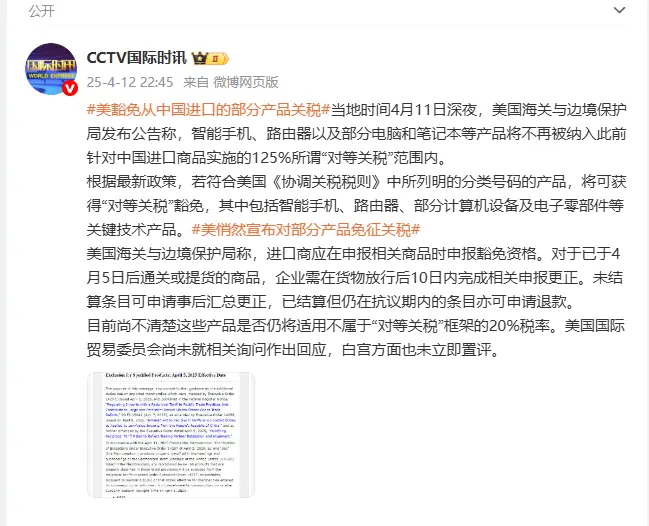
US exempts some products from tariffs on imports from China


CCTV International News
April 12, 2025 23:05:27

2321 people participated


Late at night on April 11th local time, the U.S. Customs and Border Protection issued an announcement stating that products such as smartphones, routers, and some computers and notebooks will no longer be included in the so-called "reciprocal tariff" of 125% previously imposed on Chinese imports.

According to the latest policy, products that meet the classification numbers listed in the U.S. Harmonized Tariff Schedule will be exempted from "reciprocal tariffs", including key technology products such as smartphones, routers, some computer equipment and electronic components.

U.S. Customs and Border Protection said importers should declare exemption eligibility when declaring the relevant goods. For goods that have cleared customs or been picked up after April 5, companies must complete relevant declaration corrections within 10 days after the goods are released. Unsettled items can be subject to subsequent summary correction, and settled items that are still within the protest period can also be subject to refund.

It is not yet clear whether these products will still be subject to the 20% tariff that does not fall within the "reciprocal tariff" framework. The U.S. International Trade Commission has not yet responded to inquiries, and the White House had no immediate comment.

US exempts some products from tariffs on imports from China

U.S. exempts appliances, electronics, cell phones, computers and other goods from tariffs? That's almost a big chunk of China's exports, right?

Can't Trump's tariff war even last a month?

That's hilarious. The only damage this tariff war ended up doing to China was to send China's stock market down 7% on the day of April 6th. But the Chinese stock market is back up again these days. And China's market didn't even react violently to the tariffs.

How can a country whose annual trade with China is equivalent to only two Malaysia's, and whose entire trade volume affects only 2% of our GDP, think that it can get us to back down? These Americans probably smoke too much marijuana.
 
We have seen what happen when global trade grind to a halt and stop dead for a prolong period.

When the COVID pandemic hit, the disruption is severe.

But also it is thanks to global trade even when it is severely disrupted that save many people.

The world is not going to end if trade stop.

But it is so much better for all of our global living standard if there are unimpede global trade.
 
None of those have any effects on ordinary Americans.
it will do when the ordinary Americans travel abroad to some third world country in 5 years only to see locals driving fancy Chinese EVs while they still drive shabby Toyota combustion cars at home, it will be a true awakening moment.
 
U.S. exempts appliances, electronics, cell phones, computers and other goods from tariffs? That's almost a big chunk of China's exports, right?

Can't Trump's tariff war even last a month?

That's hilarious. The only damage this tariff war ended up doing to China was to send China's stock market down 7% on the day of April 6th. But the Chinese stock market is back up again these days. And China's market didn't even react violently to the tariffs.

How can a country whose annual trade with China is equivalent to only two Malaysia's, and whose entire trade volume affects only 2% of our GDP, think that it can get us to back down? These Americans probably smoke too much marijuana.
Trump and many Americans think US is the all powerful God like superpower that everyone ought to obey, China is no exception. All along escalating the tariff war, he has the delusion that Xi would bow to his pressure and call him to beg a deal. He probably still has the fond memory of made China to negotiate of favorable trade deals to US in his first term and he thinks China will do the same again this time. But, China has learned, grow much stronger and much better prepared. Trump can't be trusted, any agreement with him is worthless. So, Xi won't play along with Trump's game this time, China is prepared to totally decouple from US maybe for the better and it only affects 2% of China's GDP, China can find alternate markets. Trump and his cronies just made a fool of themselves by declaring trade war with the whole world. What a megalomaniac.
 
Last edited:
China orders carriers to suspend Boeing jet deliveries amid trade war, Bloomberg News reports


Reuters

2 min read


(Reuters) -China has ordered its airlines not to take any further deliveries of Boeing jets in response to the U.S. decision to impose 145% tariffs on Chinese goods, Bloomberg News reported on Tuesday, citing people familiar with the matter.


Shares of Boeing - which looks at China as one of its biggest growth markets and where rival Airbus holds a dominant position - were down 3% in premarket trading.


Beijing has also asked that Chinese carriers halt purchases of aircraft-related equipment and parts from U.S. companies, the Bloomberg report said.


China’s move to halt purchases of aircraft-related components is expected to raise maintenance costs for the jets flying in the country.


The U.S. and China have been embroiled in a tariff war triggered by U.S. President Donald Trump's trade policies.


China last week hiked levies on U.S. imports to 125% in retaliation against U.S. tariffs.


The Chinese government is considering ways to provide assistance to airlines that lease Boeing jets and are facing higher costs, Bloomberg News reported.


Boeing did not immediately respond to a Reuters request for comment.


A 125% duty would significantly raise the cost of Boeing jets bound for Chinese carriers, making them a financial burden and potentially prompting airlines to consider alternatives like Airbus and domestic player COMAC.


China's top three airlines - Air China, China Eastern Airlines and China Southern Airlines - have plans to take delivery of 45, 53 and 81 Boeing planes, respectively, between 2025-2027.


The escalating tit-for-tat tariffs between the world's two biggest economies risk bringing goods trade between the world’s two largest economies to a standstill, according to analysts. That trade was valued at over $650 billion in 2024.


Trump, who said on Friday that he was comfortable with the tariffs on China, also suggested that a deal with Beijing could be on the horizon, but no agreement has been reached yet.


(Reporting by Shivansh Tiwary and Harshita Meenaktshi in Bengaluru; Editing by Mrigank Dhaniwala)


Unpacking the Mar-a-Lago Accord


Jenny Gordon

The idea is unlikely to deliver the reduced deficits and
bring back good jobs that are the primary motivation.

A coat of arms at Mar-a-Lago Club in Palm Beach, Florida (Don Emmert/AFP via Getty Images)


Published 26 Mar 2025

The Mar-a-Lago Accord is an idea floated by Stephen Miran, recently appointed Chairman of the US Council of Economic Advisers. Such a deal, Miran claims, would address the US current account and fiscal deficits without having to do the hard work of raising tax revenue or lowering spending.

Like the 1985 Plaza Accord, part of the proposed solution is to force the rest of the world to appreciate their currencies to improve US export competitiveness. You can already see the effort here to appeal to the instincts of Donald Trump, named for the president’s personal Florida retreat. The Mar-a-Lago Accord idea also envisions that foreign governments holding US Treasuries would convert these to 100-year bonds. The mechanism for achieving these objectives is to threaten trade and investment partners with tariffs and withdrawal of the US security umbrella.

Along with the proposals to establish a US sovereign wealth fund financed by revaluing US gold reserves to market prices and the cryptocurrency stabilisation fund, the consequences are likely to be profoundly disruptive to the global financial system. These proposals are also unlikely to deliver the reduced deficits and bring back good jobs that are the primary motivation.

The logic is flawed for at least five reasons.

Making manufacturing more competitive, one of Trump’s touchstones, is not just about a weaker US dollar, it is also about investment.

First, the math is impossible unless there is a major shift in resources from the non-tradable to the tradable sector in the United States. The manufacturing investment required for import replacement and to expand exports has to be financed. For almost five decades, the United States has been a net borrower from the rest of the world – its current account deficit reflects this imbalance in US savings and investment. To reduce the current account deficit, the United States has to reduce the capital account surplus. This means borrowing less from the rest of the world.

Making manufacturing more competitive, one of Trump’s touchstones, is not just about a weaker US dollar, it is also about investment. The irony is that unless the US government can reduce the budget deficit, or encourage Americans to save more and consume less, or divert investment from other business sectors, this manufacturing investment must be financed by borrowings from abroad, which at least temporarily makes the US dollar stronger. Yet a weaker US dollar is seen as the mechanism to boost US competitiveness.

Second, even if the Mar-a-Lago Accord idea and the Trump tariff agenda are eventually successful in promoting manufacturing, this will not bring back well-paid jobs in depressed areas. Labour-replacing technology and changes in consumption patterns with population ageing and rising incomes have done as much as trade, if not more, to change the pattern of employment in the United States.

Blaming the reserve currency status for a failure of US governments to support their people through inevitable structural adjustment is like the blind man describing an elephant, focusing on one part with no regard for the rest. While it may be true, as Miran says, that “this overvaluation has weighed heavily on the American manufacturing sector while benefiting financialised sectors of the economy in manners that benefit wealthy Americans”, this ignores the growth of the US tech sector, which has made the United States a more attractive investment destination, and driven the overall shift in demand away from goods towards services.

Third, the forced conversion of US Treasuries held in official reserves to a long-term bond will reduce the liquidity value of US Treasuries and accelerate the movement away from the US dollar as the reserve currency. The deep secondary market for US Treasuries and the dominance of the US dollar in trade and financial flows has been an important element in American exceptionalism. The reserve currency role has allowed the US to maintain much larger fiscal deficits without suffering much higher interest rates or seeing their currency collapse as investors rush for the door. Liz Truss’s short-lived career as the UK prime minister can attest to the costs imposed by financial markets once they decide that a fiscal policy is unsustainable. The United States has not faced the same market discipline. The Mar-a-Lago Accord would be a step towards removing this source of US exceptionalism.

Fourth, Trump, and others in his administration, have no desire to lose the US reserve currency status. In addition to a lower cost of borrowing, the role of the US dollar in the global traded financial system provides the United States with considerable power to levy sanctions on other countries. Reflecting this value, Trump and past administrations have pushed back on efforts by other countries to reduce their dependence on the US dollar.

Fifth, a Mar-a-Lago Accord idea assumes that economic coercion and gunboat diplomacy will force trade and investment partner countries to strengthen their currencies and accept US debt restructuring. But Trump’s treatment of allies will hardly provide reassurance that complying with such an accord will buy stability. Even if quite a few countries do comply, it will not solve the US deficit problem. International cooperation to push back on the Mar-a-Lago Accord idea is sorely needed – as much for the US people as for the rest of the world.


China’s Juneyao Airlines has announced a delay in the delivery of a Boeing 787-9 Dreamliner, valued at approximately $120m.

Juneyao Airlines was originally scheduled to receive the aircraft in three weeks but has opted to postpone the delivery in light of the current trade tensions between Washington and Beijing.

The airline has not provided a comment on the matter, and Boeing has also refrained from making any statements.
 

U.S. Tariffs Spark 64% Drop in Imports, 49% Decline in Container Bookings


Word on the Street Sunday, Apr 13, 2025 11:05 pm ET
1744721308459.png 2min read


The recent imposition of tariffs by the United States has led to a significant disruption in global trade, particularly affecting the country's import orders. Following the announcement of tariffs on April 2, there has been a noticeable freeze in trade activities, with a sharp decline in import orders. This trend is evident from the latest high-frequency data on container shipping bookings, which show a sudden halt in shipments from overseas to the United States due to the high tariffs.

The data indicates that while there was a surge in import orders during the first quarter, this trend has since reversed, with a collapse in orders observed. This phenomenon is not isolated but part of a broader trend of trade instability. The data from the cargo data company Vizion highlights that the "pre-order freeze" is widespread, with global trade disruptions becoming more pronounced.

The decline in pre-order quantities, which refer to the advance booking of transport capacity or container space by shippers, traders, or logistics companies with carriers, is particularly stark. After peaking in 2021, the pre-order quantities dropped sharply in 2022 and began to recover in 2023, only to face another decline in 2024. By March 2025, the pre-order quantities had dropped by 20% from their January peak, despite being 30% higher than the same period in 2024. This decline is attributed to shippers rushing to send goods before the anticipated tariff increases.

The data from March 24-31, 2025, compared to the subsequent week (April 1-8, 2025), shows a dramatic decrease in pre-order quantities. The total number of standard container bookings dropped by 49%, overall U.S. imports by 64%, and overall U.S. exports by 30%. This sharp decline coincides with two key events: the U.S. announcement of retaliatory tariffs on China and China's subsequent countermeasures. These tariff actions have led to a widespread freeze in shipping bookings, with shippers pausing their operations mid-cycle to reassess costs, timelines, and broader trade strategies.

The impact is most pronounced in categories such as apparel and accessories, wool, textiles, and manufactured goods, which are highly sensitive to cost increases, demand changes, and policy adjustments. These categories, which include many items subject to tariff adjustments, are particularly vulnerable to short-term uncertainties and price fluctuations. In the case of imports from China, the decline in pre-order quantities is most significant for basic manufacturing materials such as plastics, copper, and wood products, which are deeply integrated into industrial and manufacturing supply chains and now face substantial tariff pressures.


U.S. Tariffs Spark 64% Drop in Imports, 49% Decline in Container Bookings


Word on the Street Sunday, Apr 13, 2025 11:05 pm ET
View attachment 112398 2min read


The recent imposition of tariffs by the United States has led to a significant disruption in global trade, particularly affecting the country's import orders. Following the announcement of tariffs on April 2, there has been a noticeable freeze in trade activities, with a sharp decline in import orders. This trend is evident from the latest high-frequency data on container shipping bookings, which show a sudden halt in shipments from overseas to the United States due to the high tariffs.

The data indicates that while there was a surge in import orders during the first quarter, this trend has since reversed, with a collapse in orders observed. This phenomenon is not isolated but part of a broader trend of trade instability. The data from the cargo data company Vizion highlights that the "pre-order freeze" is widespread, with global trade disruptions becoming more pronounced.

The decline in pre-order quantities, which refer to the advance booking of transport capacity or container space by shippers, traders, or logistics companies with carriers, is particularly stark. After peaking in 2021, the pre-order quantities dropped sharply in 2022 and began to recover in 2023, only to face another decline in 2024. By March 2025, the pre-order quantities had dropped by 20% from their January peak, despite being 30% higher than the same period in 2024. This decline is attributed to shippers rushing to send goods before the anticipated tariff increases.

The data from March 24-31, 2025, compared to the subsequent week (April 1-8, 2025), shows a dramatic decrease in pre-order quantities. The total number of standard container bookings dropped by 49%, overall U.S. imports by 64%, and overall U.S. exports by 30%. This sharp decline coincides with two key events: the U.S. announcement of retaliatory tariffs on China and China's subsequent countermeasures. These tariff actions have led to a widespread freeze in shipping bookings, with shippers pausing their operations mid-cycle to reassess costs, timelines, and broader trade strategies.

The impact is most pronounced in categories such as apparel and accessories, wool, textiles, and manufactured goods, which are highly sensitive to cost increases, demand changes, and policy adjustments. These categories, which include many items subject to tariff adjustments, are particularly vulnerable to short-term uncertainties and price fluctuations. In the case of imports from China, the decline in pre-order quantities is most significant for basic manufacturing materials such as plastics, copper, and wood products, which are deeply integrated into industrial and manufacturing supply chains and now face substantial tariff pressures.


Soon, Americans will have to live without many daily essential products, enjoy the time.
 

Users who are viewing this thread

Latest Posts

Back
Top