Ranked: The Export Dependency of Major Economies
April 16, 2025
By
Niccolo Conte
Global trade is in a precarious situation with rising tensions from President Trump’s
reciprocal tariffs announced in early April, some of which were subsequently paused for 90 days on April 9, 2025.
These uncertainties can have far-reaching impacts, with trade flows playing a critical role in the GDP of several economies—especially those that are export-oriented.
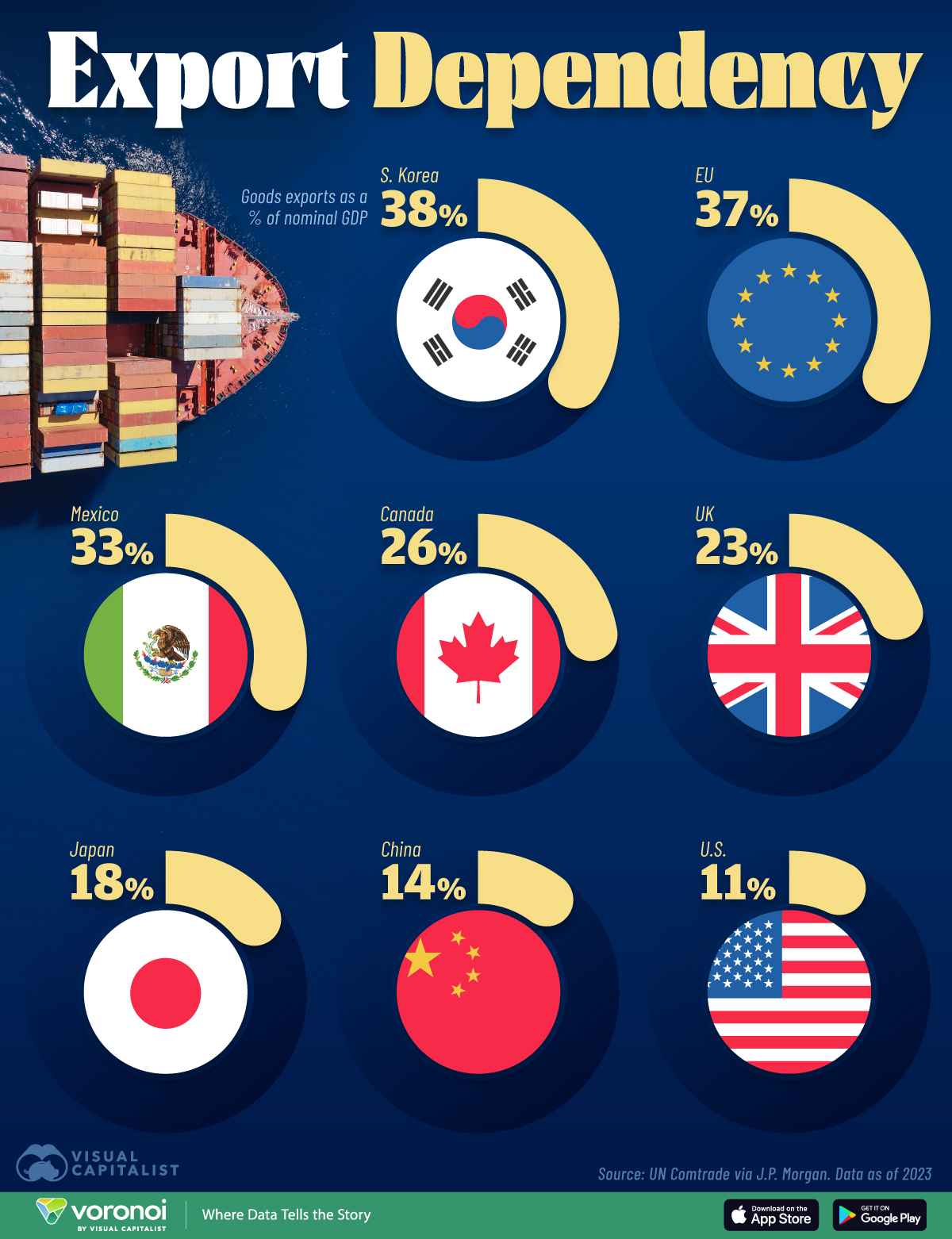
This infographic highlights the export dependency of major economies, measured by the share of goods exports in nominal GDP in 2023. The data comes from U.N. Comtrade and was sourced from a
report by J.P. Morgan Asset Management.
Some economies are heavily reliant on global markets to sustain their growth, while others, like the United States, rely more on domestic consumption.
Below is a breakdown of how much the export of goods contributes to national GDP across several major economies:
At the top of the list is South Korea, where exports made up
38% of GDP in 2023. South Korea’s export engine is fueled by semiconductors,
automobiles, and petroleum.
The European Union follows closely at
37%, with member nations trading between each other (exporting within the EU) as well as externally.
In North America, Mexico stands out with a high export-to-GDP ratio of
33%, followed by Canada at
26%. Unsurprisingly, the U.S. is the top destination for exports from both these countries, accounting for over
70% of their exports.
Meanwhile, China and the U.S. have the lowest export dependency among major economies, despite being the world’s two biggest goods exporters by value, respectively. The U.S. remains China’s top destination for exports,
accounting for nearly
13% or
$436 billion of Chinese exports in 2023.
Globally, trade-reliant economies are vulnerable to rising protectionism and geopolitical tensions in 2025.
Trump’s newly raised
tariff rates have left the global trade system and
financial markets in turmoil, although the 90-day pause has led to relief for some countries.
However, tensions between the U.S. and China, the world’s two biggest economies, have only heightened. The U.S. has
raised tariffs on Chinese imports to
145%, and China has escalated countermeasures with a
125% levy on U.S. goods.
Considering the uncertainty from these current events, the global trading system will likely see major shifts in 2025 as economies react to Trump’s foreign policy measures and work to establish new trade partners and correct trade imbalances.
This infographic highlights the export dependency of major economies, measured as goods exports as a share of nominal GDP in 2023.

www.visualcapitalist.com