China Is About To Get A 'High-Income' Economy Tag- But Beijing Doesn't Want It

Beijingwalker

VIP Member
Joined
Nov 4, 2011
Messages
93,874
Reaction score
114,149
Reputation
1,927.3
Country of Origin
Country of Residence

China Is About To Get A 'High-Income' Economy Tag. But Beijing Doesn't Want It​

The world's second-largest economy is about $145 short of the World Bank's rich-country line, but here's why it would want to keep the 'developing' tag.​

Oct 13, 2026 16:05 IST
China Is About To Get A 'High-Income' Economy Tag. But Beijing Doesn't Want It

The World Bank's next review is due in July 2027, and at the current pace China could be reclassified then.

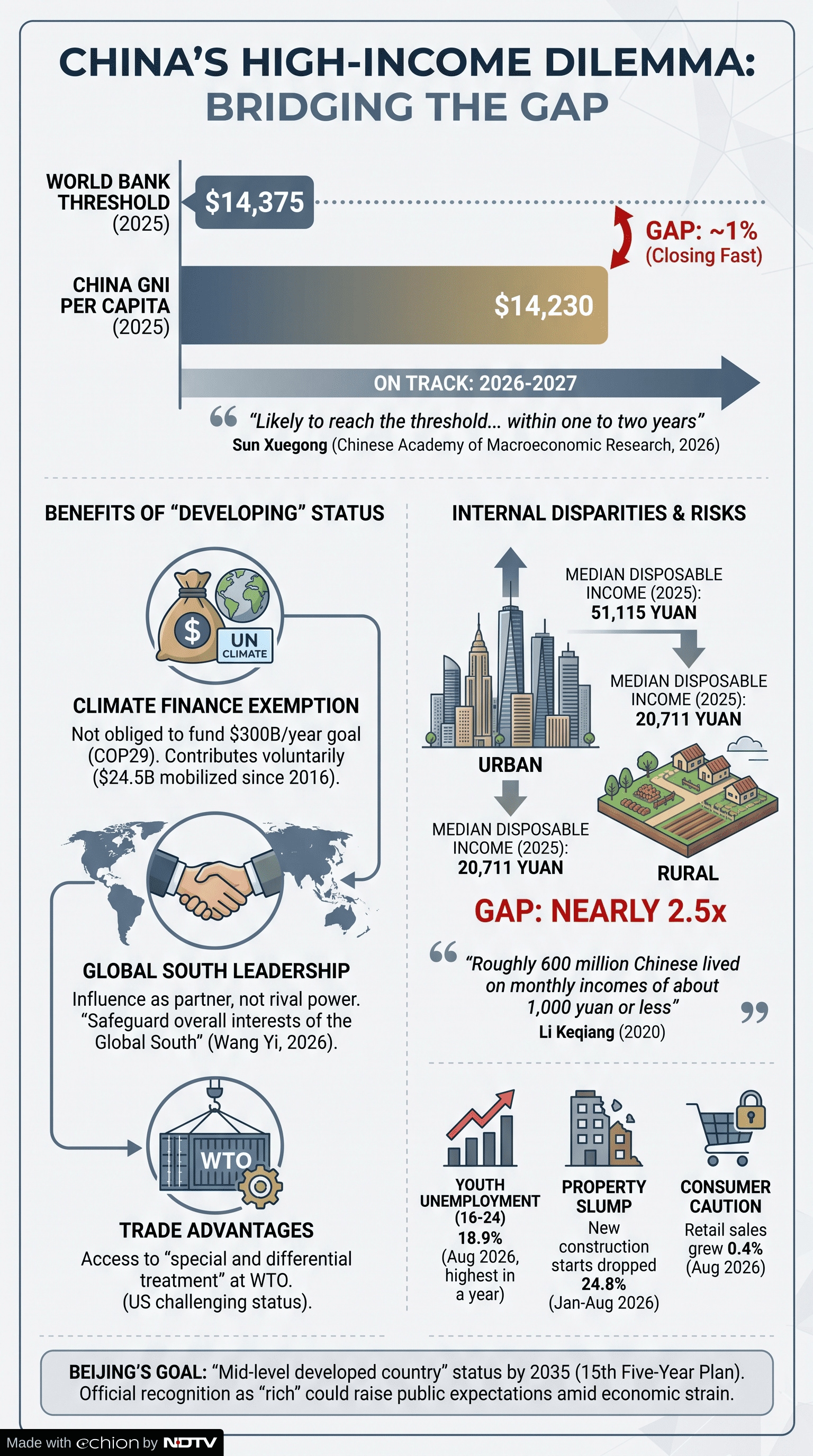
China is close to an economic milestone it has little interest in celebrating. In its latest annual review, the World Bank set the high-income threshold at a gross national income (GNI) per capita of more than $14,375, up from $13,935 a year earlier. China fell just short. Its Atlas-method GNI per capita for 2025 was $14,230, which keeps it in the upper-middle-income group for now. The gap is about 1%.

The gap has been closing fast. In the July 2025 review, China's 2024 GNI per capita was $13,660. China's GNI reached 139.4 trillion yuan ($19.2 trillion) in 2025. Using official data, state-run China Daily put per capita GNI at roughly $14,503 at current exchange rates.

Beijing's own advisers expect the line to be crossed soon. Speaking to China Daily in May 2026, Sun Xuegong of the Chinese Academy of Macroeconomic Research, which is affiliated with the National Development and Reform Commission, said China is “likely to reach the threshold of a high-income economy” within one to two years.

Even so, officials keep insisting the label changes nothing.

‘The World's Largest Developing Country'

China's line has not changed. Foreign ministry spokesperson Guo Jiakun has described the country as “the world's largest developing country”, and the phrase appears regularly in official statements.

The phrase brings tangible benefits. The first is money. Under the UN climate principle of “common but differentiated responsibilities,” China is not obliged to contribute to the $300 billion-a-year climate finance goal agreed at COP29, which developed nations must fund by 2035. China contributes, but strictly on its own terms. At the COP29 climate summit in Baku in November 2024, Vice Premier Ding Xuexiang said China had provided and mobilised more than $24.5 billion in climate finance for developing countries since 2016, while stressing that “China's South-South cooperation is voluntary, contrasting with the mandatory obligations of developed nations.

The second is influence. Being “developing” lets Beijing present itself as leader of the Global South, a partner to countries in Africa, Asia and Latin America rather than a rival Western power. Foreign Minister Wang Yi said in his 2026 diplomatic agenda that China will “firmly safeguard the overall interests of the Global South”.

The third is trade. China's developing-country status at the WTO gives it access to “special and differential treatment”. Washington has long objected, with the US Congress passed the “Ending China's Developing Nation Status Act” in 2023, urging international bodies to reclassify China.
2m5fcdug_china_625x300_13_October_26.png


Two Chinas

Beijing's position is not purely tactical. Shanghai and Shenzhen may rival Western cities, but income in rural areas is far lower.

In 2025, the median per capita disposable income of urban residents was 51,115 yuan, against 20,711 yuan for rural residents, a gap of nearly 2.5 times. National per capita disposable income was 43,377 yuan (about $6,192), a fraction of the GNI headline. In 2020, then-Premier Li Keqiang acknowledged that roughly 600 million Chinese lived on monthly incomes of about 1,000 yuan or less.

Some of Beijing's own economists make the same point. Zhang Bin of the Chinese Academy of Social Sciences told China Daily in May that crossing the line does not mark the end of development, noting China's per capita GNI remains far behind the more than $80,000 of leading advanced economies such as the US.

Domestic Risk

There is also a political cost at home. Official recognition as a rich nation would raise public expectations of better pensions, healthcare, wages and welfare at a time when the economy is under strain.

Youth unemployment for 16-24-year-olds rose to 18.9% in August 2026, the highest in a year. The property slump is getting worse, with real estate investment felling 19.9% year-on-year in January-August, and new construction starts dropped 24.8%. Consumers remain cautious, with retail sales growing just 0.4% in August, while the economy grew 4.7% in the first half.

That helps explain why Beijing's stated goal is more modest. The 15th Five-Year Plan (2026-30) reiterates the aim of reaching “mid-level developed country” status by 2035, nearly a decade after the World Bank is likely to call it high-income.

The World Bank's next review is due in July 2027, and at the current pace China could be reclassified then.
 
Is China about to become a high-income country?
Oct. 13 2026

I spoke with The Wall Street Journal about this and made three points.

1. Yes, most likely. China's GNI per capita came in at $14,230 for 2025, just 1% short of the World Bank's high-income threshold. To cross it in 2026, it needs to grow by only about 2.3%, well below its historical pace.

2. The line is largely symbolic. Large parts of China, both geographically and across segments of the population, already live at high-income standards. Others remain far from it. The single national average hides of course both. Not rocket science but worth reminding people as the dominant social issue in China has shifted from poverty to inequality.

3. The crossing is at the same time somewhat immaterial. I always say that all countries are developing countries. Passing the high-income line does not make the development agenda disappear. A long agenda lies ahead, but here is the catch: it goes well beyond GNI per capita and spans many other dimensions. And that holds not just for China, but for every high-income country.

High-income countries are still developing too.

1791887815576


The ‘developed country’ label is actually a trap: Global Times editorial
By Global Times
Published: Oct 14, 2026 12:30 AM

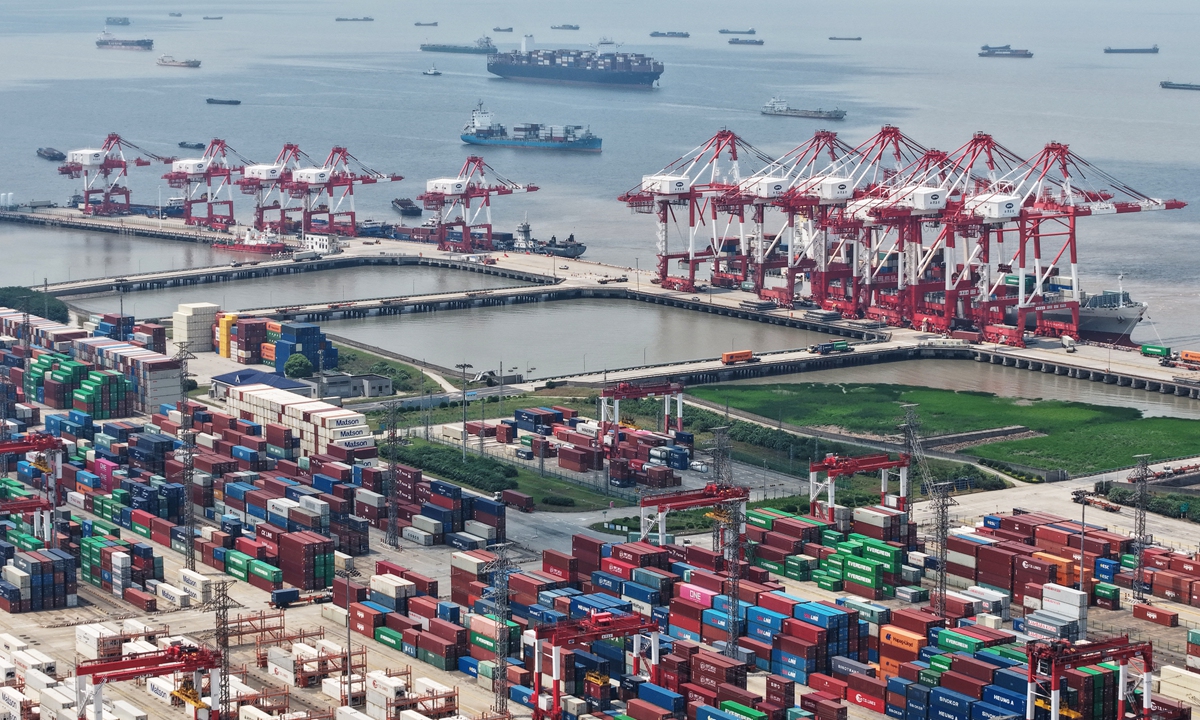
A busy scene at the Port of Shanghai on July 24, 2026 Photo: VCG

A busy scene at the Port of Shanghai on July 24, 2026 Photo: VCG

The international discussions on the positioning of China's development are an acknowledgment of China's developmental achievements and its responsibilities as a major power. However, we must be vigilant against certain narratives that deliberately obscure China's developmental stage, impose obligations that exceed its current phase of development, constrict China's developmental space, and create rifts between China and other developing countries, therefore putting China in a difficult position.

The Wall Street Journal recently published an article saying that China is on the cusp of becoming a high-income country by the World Bank's classification. "China doesn't want to join the ranks of the world's developed countries," the article claimed, arguing that China benefits from its current status in international groups as "developing." In fact, being a high-income country is not the same as being a developed country. By conflating the two concepts, the Wall Street Journal article attempts to exert public pressure on China to shoulder international obligations that go beyond its current level of development.

According to World Bank estimates, China's gross national income (GNI) per capita stood at $14,230 in 2025, slightly below the high-income threshold of $14,375. It is worth noting that this World Bank classification is based solely on GNI per capita, rather than a comprehensive assessment of a country's level of modernization, industrial development and public services. In recent years, countries such as Chile, Uruguay, Panama and Costa Rica have crossed the World Bank's high-income threshold. However, they are still widely regarded by the international community as developing countries or emerging economies, rather than automatically being classified as developed countries simply because they have reached the high-income threshold.

As Chinese modernization steadily advances, China has made historic achievements in economic and social development, with its GDP firmly ranking second in the world. However, multiple indicators show that China's status as a developing country remains unchanged. For example, there is still a significant gap in per capita GDP compared to developed economies like those in Europe and the US, regional development imbalances have not yet been fundamentally resolved, and disparities persist between urban and rural areas.

By contrast, the development process of Western developed countries is a comprehensive state formed after highly mature industrialization, urbanization, and modernization. This is reflected not only in the scale of their economies but also in various dimensions such as per capita wealth, social security systems, public service capacity, and scientific and technological innovation systems.

The international discussions on the positioning of China's development largely stem from the rapid pace of China's growth and its significant contributions to the global economy, which have long surpassed the conventional narrative framework for traditional developing countries. These discussions are an acknowledgment of China's developmental achievements and its responsibilities as a major power.

However, we must be vigilant against certain narratives that deliberately obscure China's developmental stage, impose obligations that exceed its current phase of development, constrict China's developmental space, and create rifts between China and other developing countries, therefore putting China in a difficult position.

For China, its status as a developing country carries special political significance. China has always been a member of the Global South. This "South" is not merely a geographical or economic concept but an identity formed by emerging market countries and developing nations based on similar historical circumstances, current stages of development, common developmental goals, and shared political aspirations. Those who are eager to label China as a "developed country" are not truly seeking China's "graduation," but rather its "exclusion," aiming to detach China from the Global South camp. In this regard, China is very clear-minded and will not fall into this trap.

To assess a country's international responsibilities, one should not only consider whether it has been labeled a "developed country," but rather whether it is genuinely promoting global common development. China's average annual contribution to global economic growth has long been around 30 percent. China is the largest contributor of peacekeeping personnel among the permanent members of the UN Security Council, and its four global initiatives offer Chinese wisdom,solutions and strength for global governance.

China's contributions to building an open, inclusive, clean and beautiful world that enjoys lasting peace, common security, and common prosperity have already surpassed those of many developed countries. However, China will always be a member of the developing world; this is not modesty, but a reflection of sobriety and a sense of responsibility.

 
Chinese government is convinced that this relabelling China as a high income developed country is designed to undermine China and to clip its wings.
 
nooooo we want to be developing country don't look at us we are not superpowa like India
 
That's what Indians in the article are trying to say, China is still poor, far from a high income developed nation. It is certainly not a supa powa like India is. That's why they are using stats from 6 years ago and out of context.
 

Users who are viewing this thread

Back
Top