China Science And Technology News

I have a hunch that in the next 20 years, we may really be able to achieve a home robot butler, freeing human hands.
We'll be freed from the housework and leave everything to robots, from washing and cooking to taking care of the children.
 
I have a hunch that in the next 20 years, we may really be able to achieve a home robot butler, freeing human hands.
We'll be freed from the housework and leave everything to robots, from washing and cooking to taking care of the children.

I'm glad people are finally realizing why the Unitree robots were looked at as just crude toys compared to robots like Iron.

Go look at previous PDF threads on what was considered "great achievements" in Chinese robotics. They may now be painful to watch after seeing Iron...but on a positive note it should shake up other robot makers a lot to start getting serious.

gala.png

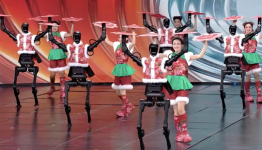
Tradition meets tech: Unitree robots dance at Spring Festival Gala​

Remember this pride of China...on national TV to show off to the world its advancements...yeesh. I'm sure you'll see now how painful it is to watch.


As I have stated previously I expect someday soon a robot will smoothly and effortlessly dribble a basketball down a court and do a reverse slam dunk.
 
Last edited:
I'm glad people are finally realizing why the Unitree robots were looked at as just crude toys.
Lol,Coincidentally, I bought a robot for my child, just like the original robot dog, bringing new things to learn. The new generation will be delivered in bulk in 2026. I'm looking forward to it.
Yes, I don't know why Americans don't make toys like this. Americans are very clever.
So the U.S. doesn't produce robots, sure American kids don't want to play.
 
Last edited:

Kimi K2 Chinese AI model beats ChatGPT 5 in Humanity's Last Exam, Nvidia CEO says China will win AI race​

Moonshot from Beijing has launched Kimi K2 Thinking, an AI model outperforming GPT-5 at a fraction of the cost. This development could shift global AI leadership and challenge US dominance.


moonshots-kimi-k2-ai-model-081848811-16x9_0.jpg

Moonshot's Kimi K2 AI model

Unnati Gusain
New Delhi,UPDATED: Nov 8, 2025 16:58 IST

The global AI race has just turned up the heat, and yet again, China is making the move. A new challenger has entered the arena, Moonshot’s Kimi K2 Thinking, a model so advanced that its creators say it’s outsmarted OpenAI’s GPT-5 and Anthropic’s Claude Sonnet 4.5 on several high-profile benchmarks. Yes, the same GPT-5 that has been hailed as the pinnacle of reasoning and intelligence may have just met its match, and it’s open source.


  • comment.png
SOURCE / ECONOMY
China becomes world’s largest AI patent holder, accounting for 60% of global total: report
By Global TimesPublished: Nov 08, 2025 09:25 PM


  • comment.png
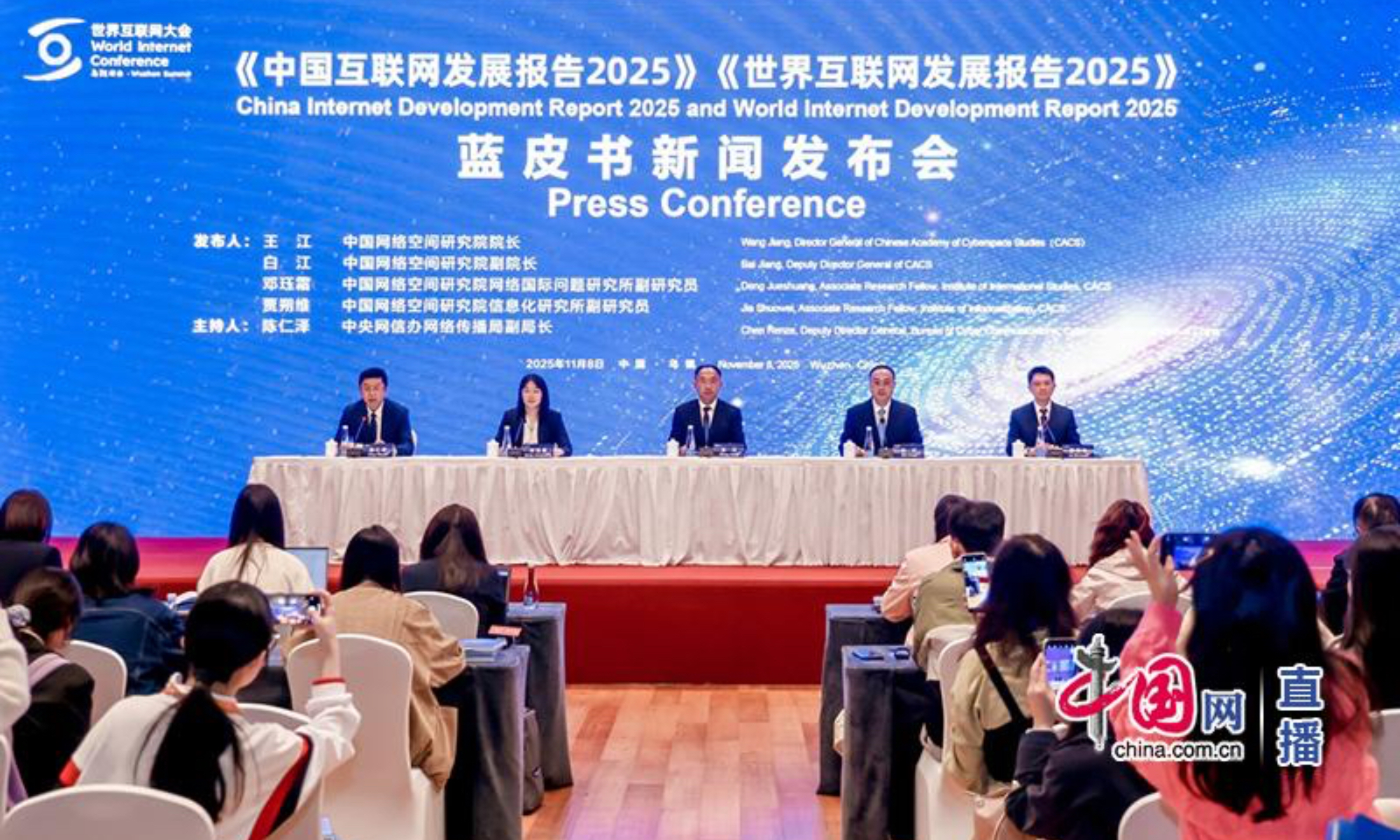
China Internet Development Report 2025 is released at a press conference during the ongoing 2025 World Internet Conference Wuzhen Summit on November 8, 2025 in Wuzhen, East China’s Zhejiang Province. Photo: Screenshot from china.com.cn

China Internet Development Report 2025 is released at a press conference during the ongoing 2025 World Internet Conference Wuzhen Summit on November 8, 2025 in Wuzhen, East China’s Zhejiang Province. Photo: Screenshot from china.com.cn

China has become the world’s largest holder of artificial intelligence (AI) patents, accounting for 60 percent of the global total. Its 6G patent applications account for approximately 40.3 percent globally, ranking No.1 worldwide, according to a report released by the Chinese Academy of Cyberspace Studies at the 2025 World Internet Conference (WIC) Wuzhen Summit on Saturday.

Over the past year, China’s information infrastructure has continued to optimize and upgrade, with digital economy developing toward higher quality, greater depth and stability, and the scale of network content and digital cultural industries has continued to expand, said the China Internet Development Report 2025.

As of June 2025, the total number of fixed broadband access users in China had reached 684 million households, with a cumulative construction of 4.55 million 5G base stations and 1.118 billion 5G mobile phone users. The number of active IPv6 internet users reached 834 million, accounting for 75 percent of the total internet users, according to the report.

In 2025, China’s quantum computing industry is expected to exceed 11.56 billion yuan in scale, with year-over-year growth surpassing 30 percent, accounting for 41.2 percent of the overall quantum technology industry, per the report.

As of December 2024, China had 974 million online shopping users, accounting for 87.9 percent of the total internet population. Online retail sales grew by 7.2 percent, with the country becoming the world’s largest e-commerce market for 12 consecutive years, the report noted.

The construction of China’s online content system continues to advance, with the digital culture industry scale entering the “trillion-yuan” level. The report showed that in 2024, enterprises in the national culture and related industries achieved revenue of 14.15 trillion yuan, a year-on-year increase of 6 percent, with digital cultural industries such as micro-short dramas, “guzi” economy (fan merchandise economy), cloud performing arts, digital games, and digital reading prospering and developing, said the report.

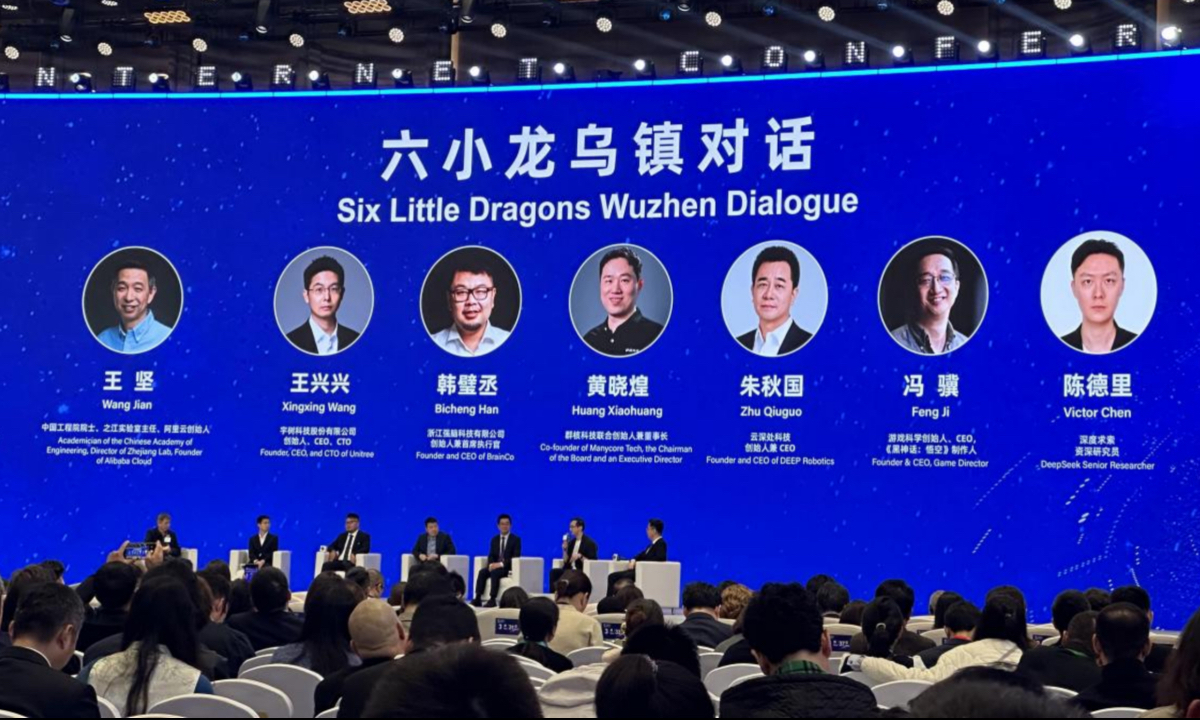
Six Little Dragons Wuzhen Dialogue is held during the ongoing 2025 World Internet Conference Wuzhen Summit on November 7 in Wuzhen, East China’s Zhejiang Province. Photo: Liu Yang/GT

Six Little Dragons Wuzhen Dialogue is held during the ongoing 2025 World Internet Conference Wuzhen Summit on November 7 in Wuzhen, East China’s Zhejiang Province. Photo: Liu Yang/GT

During the Wuzhen Summit, representatives from Hangzhou’s "Six Little Dragons" star companies also gathered to provide insights for the country’s tech development achievements and expectations.

Wang Xingxing, founder and CEO of Unitree Robotics, which is a leader in humanoid robotics, believed that AI is fueling accelerated growth across the robotics sector. “Next year or the year after, I'll bring more surprises to everyone,” Wang said.

Han Bicheng, founder and CEO of the brain-machine interface company BrainCo, said that brain-computer interfaces can bring significant changes to daily life, while empowering numerous fields such as healthcare, disability assistance, education and more. He said his company will roll out a next-generation sleep aid next year and a weight management product in the coming two years, all aimed at addressing diverse challenges in daily life.

Liu Qiangdong, founder and chairman of Chinse e-commerce giant JD.com, said that robotics is poised to revolutionize the logistics ecosystem.

Addressing the opening ceremony on Friday, he highlighted that JD’s recently established sorting center in Beijing has already replaced 90 percent of its former workforce with robots, and that by next April, the company will launch the world's first fully unmanned delivery station.

The 2025 WIC Wuzhen Summit opened on Friday in East China’s Zhejiang Province. It has drawn over 1,600 participants from more than 130 countries and regions, according to the Xinhua News Agency.

Global Times
 
Compared to Russia's worst technology - poor quality and bad design

Russia’s first AI-powered humanoid robot, named AIdol

To view this content we will need your consent to set third party cookies.
For more detailed information, see our cookies page.


To view this content we will need your consent to set third party cookies.
For more detailed information, see our cookies page.
 
Beijing is taking an aggressive approach to help its technology giants squeezed by America’s chip restrictions.

Shortages of advanced semiconductors are so acute that the government has begun intervening in how the output of China’s largest contract chip maker, Semiconductor Manufacturing International, is distributed, according to people familiar with the matter. Chinese authorities are trying to give priority to the needs of tech conglomerate and national champion Huawei Technologies, which uses SMIC technology to make artificial-intelligence chips, the people said.

Chinese tech companies are fighting to secure limited domestic capacity and, in some cases, labs are smuggling coveted supplies of high-performance Nvidia chips.

Buzzy AI upstart DeepSeek had to delay the release of its latest model earlier this year because of a shortage of chips, people familiar with its operations said. And companies such as Huawei are cobbling together workarounds, including by bundling thousands of chips into huge, power-hungry systems that can help train AI models, people familiar with their moves said.

The lengths to which Chinese companies and Beijing are going in the face of recent U.S. export restrictions are a sign of the stakes in the race for AI supremacy.

Top U.S. officials are divided on whether to continue limiting China’s access to chips and semiconductor manufacturing equipment, or allow more sales. Their goal is to prevent chips made by Huawei from becoming more advanced and in demand around the world. The White House’s decision has ramifications at home—for companies such as Nvidia—and abroad.
 
Perhaps China's next military parade will have a robot team.
 
Emulating human movement shouldn't become too difficult after people have mastered the technology to emulate human speech. All with AI assistance. But humanoid isn't really interesting. Robots are not humans. They are utility tools and should be designed for that utility. What is the point of having breasts and large pelvis for a robot anyway?
 
Chinese gov't step in to allocate and give priority to Chinese enterprise that was actively sabotage by US over other Chinese enterprise that have other chip fabricator available.

It is only right.
 

Nov 17
He Xiaopeng stated during the earnings call that large-scale physical world models are accelerating the advent of the autonomous driving era. Only pre-installed, mass-produced Robotaxis with strong generalization capabilities can truly achieve scaled application and validate the business model.

He revealed that the company will launch several new models that do not rely on LiDAR, significantly reducing deployment and maintenance costs. Additionally, he emphasized that physical AI is a core strategy for XPeng, with automobiles and humanoid robots sharing the same technological origins, showing emergent capabilities. The company will comprehensively advance the mass production and implementation of large models, Robotaxis, and humanoid robots.

$XPeng (XPEV.US)$XPeng Motors released its Q3 2025 earnings report on Monday, with all key metrics hitting record highs. Revenue doubled year-over-year, and the gross margin exceeded 20%, reaching a historical peak. The net loss narrowed significantly by nearly 80% compared to the same period last year. It is projected that both deliveries and revenue in Q4 will grow over 30% year-over-year. During the subsequent earnings call, He Xiaopeng stated that with the advent of large physical-world models, the era of fully autonomous driving is accelerating.

He noted that only deeply integrated large physical world models can gradually enable machines to interact, communicate, adapt, and even create within the physical environment, thereby reshaping modes of transportation and lifestyles.

Only mass-produced front-end solutions with highly generalized Robotaxi capabilities can achieve widespread adoption while simultaneously proving viable as a business model.
He Xiaopeng revealed that in 2026, XPeng Motors will launch three Robotaxi models. This technology route avoids using LiDAR, effectively addressing industry-wide challenges such as high costs, particularly deployment expenses, along with mobility restrictions and weak generalization. He believes this will accelerate the large-scale global deployment of Robotaxis.


Additionally, XPeng plans to initiate trial operations of its Robotaxi service in China in 2026, further refining the software, hardware, and operational ecosystem for Robotaxis.

Q3 Performance and Overall Physical AI Strategy​

He Xiaopeng stated that in Q3 2025, XPeng achieved record highs across multiple operational metrics: quarterly deliveries reached 116,007 units, up 149% year-over-year; revenue, gross margin, and cash reserves all hit new peaks, with gross margin surpassing 20% for the first time. Net losses continued to narrow substantially. The company aims to break even in Q4. These ongoing improvements reinforce the company’s commitment to advancing research in Physical AI, expediting the mass production and scaled implementation of its second-generation VLA model, Robotaxi, and humanoid robots by 2026.

He pointed out that over the past 11 years, XPeng has adhered to full-stack self-research, evolving from “software-defined vehicles” to “Physical AI.” The company has clearly observed shared origins between automotive and humanoid robot technologies, including common models, chips, and infrastructure, enabling rapid iteration and evolution.

Our Physical AI system is beginning to demonstrate emergent capabilities. In the coming decade, our vision is to position XPeng Motors as a globally-oriented 'giant intelligent life company.'

I believe the value created by physical AI for humanity can only be maximized through an open ecosystem. To this end, we will open-source physical world models, collaborate with mobility platforms to launch Robotaxi services, and provide open hardware SDKs. Through cooperation with commercial and technical partners, we will further expand the physical AI ecosystem and accelerate value creation.

AI-Powered Vehicles: The Era of 'Dual-Energy' Product Cycles Begins​

He Xiaopeng stated that XPeng Motors is entering a new product cycle featuring 'dual-energy' (pure electric + super range extender) capabilities, rapidly expanding sales and market share in the new energy sector through a more comprehensive powertrain portfolio.

On November 6, XPeng launched its industry-leading 'large-battery lithium iron phosphate 5C' super range extender model—the XPeng G9 Super Journey—with a combined range of 1,602 kilometers, making it the world’s longest-range, highest-AI-compute-capability, smallest-turning-radius, and most space-efficient large seven-seater SUV. The super range extender will significantly accelerate the migration of fuel vehicle users to new energy vehicles.

He revealed that after the pre-sale launch of the super range extender, there has been a notable increase in attention from northern and inland cities, attracting user groups that pure electric vehicles previously struggled to reach. The pre-sale orders for the X9 Super Range Extender have reached nearly four times that of the previous generation during the same period. The XPeng G9 Super Intelligence will be launched and delivered simultaneously on November 20, with the company expecting December sales to hit a new high.

2026 Product Roadmap: Multiple Super Journey Models + Multiple Dual-Energy New Products​

He Xiaopeng mentioned that the company plans to launch three all-new Super Journey models in the first quarter of 2026, addressing core pain points of range extender users with longer pure-electric ranges and 5C ultra-fast charging. Additionally, four new 'dual-energy' models will be introduced in 2026, including a breakthrough product for key segments—similar to the blockbuster M03 model.

I believe that the seven dual-energy models equipped with super range extenders, set to launch next year, will greatly expand our total addressable market (TAM) and drive significant sales growth.

Global Market Expansion​

He Xiaopeng stated that the company's overseas sales continue to grow rapidly. In September 2025, overseas monthly deliveries exceeded 5,000 units for the first time, marking a year-on-year increase of 79%. During the third quarter, 56 new overseas stores were added, bringing the sales and service network coverage to 52 countries and regions worldwide.

The localization production project in Europe has officially launched at the Magna plant in Graz, Austria, with the first batch of G6 and G9 models already in mass production. The R&D center in Munich has been put into operation simultaneously.

He revealed that the company plans to launch at least three new models overseas by 2026, including the highly anticipated compact SUV, to meet diverse global demands.

Second-generation VLA model: A tenfold increase in parameters, with full deployment scheduled for 2026.​

XPeng Motors' AI computing power and data are being transformed into the capabilities of large physical-world models. He Xiaopeng stated that the parameter count of the second-generation VLA model is ten times that of the previous generation, achieving a significant generational leap in both the safety and user experience of autonomous driving.

He Xiaopeng mentioned that he personally test-drove VLA 2.0 recently, describing its performance under complex road conditions as 'extremely impressive, with no comparable end-to-end model at the same level.' He anticipates that the pioneer user co-creation experience will be available by the end of December, with VLA 2.0 set to roll out to all O7 and above models in the first quarter of 2026.

The mass production of this generation of models will represent a tremendous leap forward, delivering a cross-generational upgrade experience and encouraging more people to choose XPeng due to its leading autonomous driving capabilities.
He disclosed that XPeng will open-source VLA 2.0 to global business partners, with Volkswagen becoming the first customer. Additionally, XPeng's self-developed Turing AI chip has secured a designated project from Volkswagen, and the jointly developed models are expected to enter mass production in early 2026.

In our external technology collaborations, we will generate licensing revenue, which will be reinvested into R&D for iterative upgrades of the Turing chip and VLA models, creating a positive feedback loop. We welcome more OEMs and Tier 1 suppliers to collaborate with us on the Turing chip and second-generation VLA model to jointly promote the widespread adoption of intelligent technologies in China and globally.

Robotaxi: Trial operations to commence in China in 2026​

He Xiaopeng pointed out that traditional end-to-end large models can only achieve the best L2-level assisted driving at most, whereas physical-world large models truly accelerate the advent of the autonomous driving era. He believes that only pre-installed mass-produced Robotaxis with extremely strong generalization capabilities can achieve scalability and commercial success.

He revealed that XPeng Motors will launch three Robotaxi models in 2026. These vehicles will not rely on high-definition maps or LiDAR, significantly reducing the industry cost and deployment complexity of Robotaxis while enhancing urban adaptability and reducing mobility restrictions. In 2026, XPeng Motors will initiate Robotaxi trial operations in China, while continuously refining its software, hardware, and operational ecosystem.

He stated that the Robotaxi SDK will be fully open, with AutoNavi becoming the first ecosystem partner. XPeng Motors also welcomes more mobility companies to join in collaboration.

Humanoid Robots: Mass Production by the End of 2026, Sales Target Exceeding 1 Million Units by 2030​

He Xiaopeng noted that the company's humanoid robot (Iron) adopts the same large model approach for the physical world. With support from the vehicle and powertrain team, XPeng showcased a new generation of Iron robots at its Tech Day, whose agile gait and human-like performance sparked cross-disciplinary discussions.

He mentioned that the capabilities currently demonstrated by Iron represent only a small fraction of its potential. The company plans to achieve full integration of cross-domain capabilities by the second quarter of 2026, with advanced humanoid robots entering mass production by the end of 2026. Initially, these robots will be deployed in commercial scenarios such as guided tours, retail assistance, customer service, and security. By the end of 2026, Iron will be introduced into XPeng’s stores, campuses, and factories, becoming a 'new colleague.'

XPeng will open up the robot SDK to global developers, enabling Iron to acquire stronger capabilities across more niche application scenarios.

I believe the market potential of humanoid robots is greater than that of automobiles. Once they surpass the tipping points of intelligence and electrification, there will be explosive growth. I look forward to XPeng’s robot models achieving annual sales exceeding 1 million units by 2030.
 
Last edited:

Why Xpeng Is Taking Tesla's Controversial Approach To Autonomy​

Tesla isn’t the only company using cameras and AI to solve autonomy. Several prominent Chinese companies are in on the tech, too.
At the IAA Mobility 2025 show in Munich, Candice Yuan, senior director and head of product at Xpeng’s Autonomous Driving Center, told CarNewsChina that the company has grown increasingly confident in its vision-based approach since pulling lidar from its vehicles.
“The lidar data can’t contribute to the AI system,” Yuan told the outlet, adding that the company’s large language model is fed mainly 10 to 30-second short videos, taken from its customer vehicles, and then used to train the AI system. “We call it VLA. Vision, language, action. Lidar data is different and can’t be absorbed by the AI system,” Yuan added.


2019
To view this content we will need your consent to set third party cookies.
For more detailed information, see our cookies page.

Remember Chinese FSD technology leaders laughed at this..and Chinese forum members were saying "scammer" Elon Musk was just being a "cheapskate American" and that FSD "would never work without LiDAR" and "would never be allowed on China's roads without LiDAR".

 
Last edited:
This image shows three-dimensional, millimeter-thick, and cell-embeddable semiconducting hydrogel fibers. These fibers can be used to construct interwoven living transistors that mimic real neuronal connections in the brain, redefining the boundary between technology and life.

Learn more this week in Science: https://scim.ag/4o5bf8w
To view this content we will need your consent to set third party cookies.
For more detailed information, see our cookies page.

Paper:
 

Quantum chip gives China’s AI data centres ‘1,000-fold’ speed boost: award-winning team​

Emerging tech that uses light to boost computer power is already being used in aerospace, biomedicine and finance​

Reading Time:3 minutes

Why you can trust SCMP

18

Listen


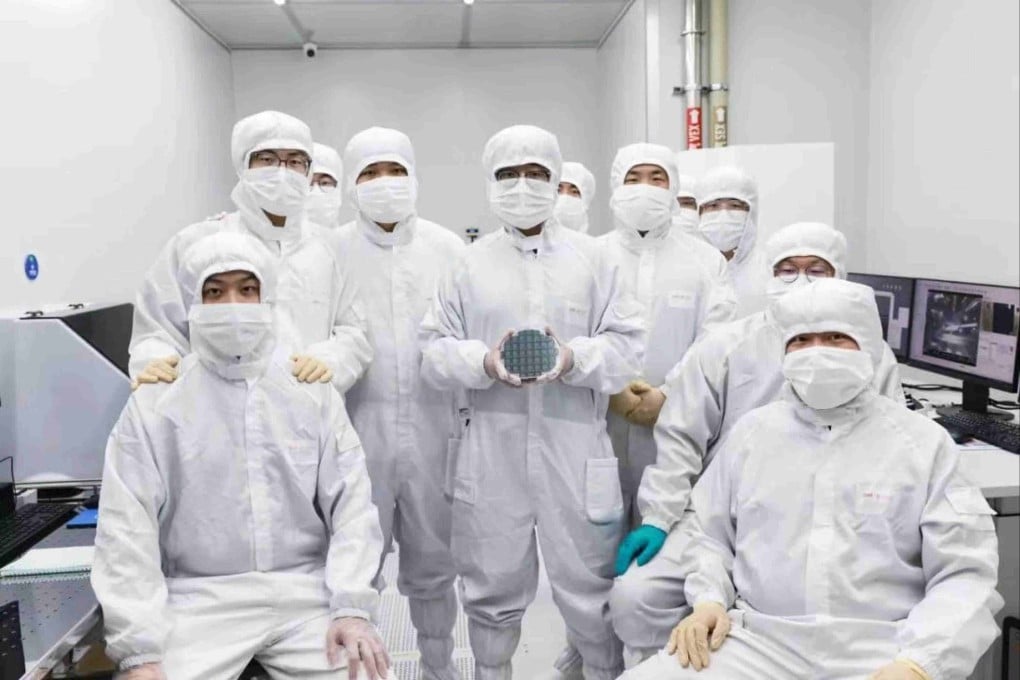
Researchers at CHIPX pose for a photo with their high-performance 6-inch thin-film lithium niobate chip, an advance that is poised to accelerate progress in AI and quantum computing.  Photo: Handout

Dannie Pengin Beijing
Published: 10:00pm, 13 Nov 2025Updated: 12:54am, 14 Nov 2025

China has achieved a massive leap in computing power, spearheaded by a new optical quantum chip capable of accelerating complex problem-solving by over a thousandfold.
The photonic quantum chip won the “Leading Technology Award” at the 2025 World Internet Conference Wuzhen Summit last week – one of 17 scientific achievements honoured from more than 400 candidates across 34 countries at the technology gathering.

The chip, which is intended to boost efficiency for AI data centres and supercomputers, is already being used in industries such as aerospace, biomedicine and finance, and is providing “computing power support exceeding the limit of classical computers”, according to its developers.

The advances in large-scale, high-speed, programmable photonic quantum computing chip technology and applications were jointly developed by the Chip Hub for Integrated Photonics Xplore (CHIPX), a Wuxi-based institute in the eastern province of Jiangsu that is affiliated with Shanghai Jiao Tong University, and Turing Quantum, a hi-tech start-up in Shanghai.

“Achieving co-packaging technology for photons and electronics, chip-level integration and wafer-scale mass production of photonic quantum chips – I believe this is a world first,” said Jin Xianmin, a physics professor at the university and founder of Turing Quantum.

“We anticipate developing chips capable of handling larger numbers of photons in the near future,” he told mainland media on the day of the awards ceremony.
 

Users who are viewing this thread

Country Watch Latest

Back
Top