China Science And Technology News

China Leads Nature Index for Third Year Amid U.S. Sanctions

U.S. sanctions boost Chinese research; South Korea 7th, no institutions in top 50
By Kwak Soo-keun
Published 2026.06.11. 21:03Updated 2026.06.11. 21:17
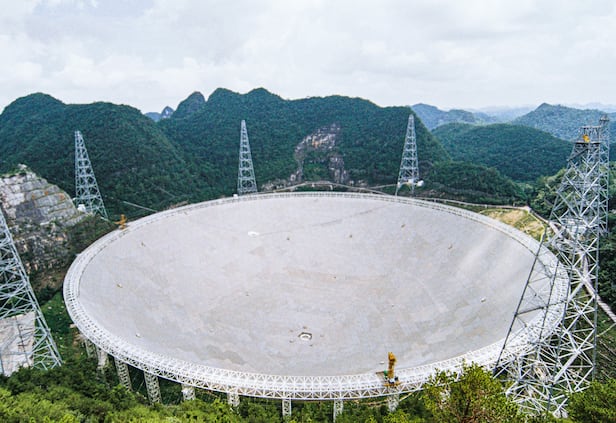
The 500-meter aperture spherical radio telescope 'FAST' in Guizhou Province, China. /Wikimedia Commons

The 500-meter aperture spherical radio telescope 'FAST' in Guizhou Province, China. /Wikimedia Commons

In the 'Nature Index' rankings, a key indicator of national scientific research capabilities, China has maintained the top position for three consecutive years, further widening the gap with the United States.

While the U.S. has blocked exports of advanced semiconductors to China and restricted science and technology exchanges, China’s scientific research output has surged.

As scientific paper achievements are a leading indicator of future commercializable technologies, some analyses suggest the balance of power in the U.S.-China tech hegemony competition is tilting toward China.

South Korea remained 7th in the national rankings, unchanged from last year, but no domestic institutions entered the top 50 in the organizational rankings. Seoul National University, the highest-ranked Korean institution, fell six spots to 58th place compared to last year.

◇China Secures 90% of Top 10 Research Institutions

Springer Nature, which publishes the international academic journal *Nature*, announced the 'Nature Index 2026' rankings on the 10th, local time. The Nature Index aggregates contributions of countries and institutions to high-quality research papers in major global journals and conferences, serving as a credible international benchmark for scientific research capabilities.

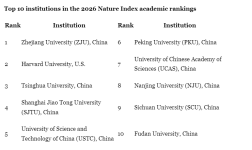
Leading the national rankings, China’s paper contribution score was 52,735, double that of the U.S. (26,006) in second place. While China’s score grew by 22.4% over the past year, the U.S. saw only a 4.2% increase. The institutional rankings further highlight China’s dominance: the Chinese Academy of Sciences ranked first, Zhejiang University second, and Harvard University third, dropping one spot from last year. Positions 4–10 were all Chinese institutions, with nine of the top 10 spots claimed by China. Europe’s Max Planck Institute fell outside the top 10 for the first time, while France’s National Centre for Scientific Research (CNRS) remained at 16th.

In the scientific community, U.S. pressure is seen as accelerating China’s research ecosystem self-reliance. Over recent years, the U.S. has restricted exports of advanced semiconductors, AI (artificial intelligence) accelerators, and quantum technology-related equipment to China. Chinese universities and institutions have responded by accelerating technology development with domestic resources. Some observers describe this as a paradoxical outcome where external pressure, like a ‘cornered rat,’ has strengthened cohesion among Chinese government, universities, and research bodies, expediting ecosystem growth.

The most symbolic change this year was Harvard University ceding the top spot to Zhejiang University, alma mater of DeepSeek founder Liang Wenfeng. Harvard, which had held the top position since the Nature Index began in 2015, dropped to second place for the first time. Zhejiang University’s paper contribution score grew by 22.7%, while Harvard’s increased by only 0.6%. Zhejiang’s rise is seen as a symbol of China’s science and technology ecosystem growth. Nine Chinese universities appeared in this year’s top 10 university rankings.

Conversely, U.S. university rankings declined due to legal battles between the Donald Trump administration and Harvard, as well as federal research funding cuts. The Massachusetts Institute of Technology (MIT) fell from 18th to 21st, and Stanford University dropped from 13th to 14th.

China’s university rise was not sudden. For years, it pursued a ‘talent black hole’ strategy, attracting global talent with special residency permits, lucrative salaries, ample research funding, and tenure-free professorships. This includes recruiting overseas scholars, such as Fields Medal winners, to Chinese institutions.


China Leads Nature Index for Third Year Amid U.S. Sanctions

U.S. sanctions boost Chinese research; South Korea 7th, no institutions in top 50
By Kwak Soo-keun
Published 2026.06.11. 21:03Updated 2026.06.11. 21:17

The 500-meter aperture spherical radio telescope 'FAST' in Guizhou Province, China. /Wikimedia Commons'FAST' in Guizhou Province, China. /Wikimedia Commons

The 500-meter aperture spherical radio telescope 'FAST' in Guizhou Province, China. /Wikimedia Commons

In the 'Nature Index' rankings, a key indicator of national scientific research capabilities, China has maintained the top position for three consecutive years, further widening the gap with the United States.

While the U.S. has blocked exports of advanced semiconductors to China and restricted science and technology exchanges, China’s scientific research output has surged.

As scientific paper achievements are a leading indicator of future commercializable technologies, some analyses suggest the balance of power in the U.S.-China tech hegemony competition is tilting toward China.

South Korea remained 7th in the national rankings, unchanged from last year, but no domestic institutions entered the top 50 in the organizational rankings. Seoul National University, the highest-ranked Korean institution, fell six spots to 58th place compared to last year.

◇China Secures 90% of Top 10 Research Institutions

Springer Nature, which publishes the international academic journal *Nature*, announced the 'Nature Index 2026' rankings on the 10th, local time. The Nature Index aggregates contributions of countries and institutions to high-quality research papers in major global journals and conferences, serving as a credible international benchmark for scientific research capabilities.

Leading the national rankings, China’s paper contribution score was 52,735, double that of the U.S. (26,006) in second place. While China’s score grew by 22.4% over the past year, the U.S. saw only a 4.2% increase. The institutional rankings further highlight China’s dominance: the Chinese Academy of Sciences ranked first, Zhejiang University second, and Harvard University third, dropping one spot from last year. Positions 4–10 were all Chinese institutions, with nine of the top 10 spots claimed by China. Europe’s Max Planck Institute fell outside the top 10 for the first time, while France’s National Centre for Scientific Research (CNRS) remained at 16th.

In the scientific community, U.S. pressure is seen as accelerating China’s research ecosystem self-reliance. Over recent years, the U.S. has restricted exports of advanced semiconductors, AI (artificial intelligence) accelerators, and quantum technology-related equipment to China. Chinese universities and institutions have responded by accelerating technology development with domestic resources. Some observers describe this as a paradoxical outcome where external pressure, like a ‘cornered rat,’ has strengthened cohesion among Chinese government, universities, and research bodies, expediting ecosystem growth.

The most symbolic change this year was Harvard University ceding the top spot to Zhejiang University, alma mater of DeepSeek founder Liang Wenfeng. Harvard, which had held the top position since the Nature Index began in 2015, dropped to second place for the first time. Zhejiang University’s paper contribution score grew by 22.7%, while Harvard’s increased by only 0.6%. Zhejiang’s rise is seen as a symbol of China’s science and technology ecosystem growth. Nine Chinese universities appeared in this year’s top 10 university rankings.

Conversely, U.S. university rankings declined due to legal battles between the Donald Trump administration and Harvard, as well as federal research funding cuts. The Massachusetts Institute of Technology (MIT) fell from 18th to 21st, and Stanford University dropped from 13th to 14th.

China’s university rise was not sudden. For years, it pursued a ‘talent black hole’ strategy, attracting global talent with special residency permits, lucrative salaries, ample research funding, and tenure-free professorships. This includes recruiting overseas scholars, such as Fields Medal winners, to Chinese institutions.

E6HX6LJLMVCOFBZHYNNVD2LE3Y.jpg
 

Zhejiang University Dethrones Harvard in Global Research Rankings

Nine Chinese institutions dominate top 10 as U.S. restrictions spur Beijing's research self-reliance
By Kwak Soo-keun
Published 2026.06.11. 21:03

In the 'Nature Index' rankings, a key indicator of national scientific research capabilities, China has maintained the top position for three consecutive years, further widening the gap with the United States.

While the U.S. has restricted exports of advanced semiconductors to China and tightened exchanges in science and technology, China’s research output has surged. South Korea remained 7th in the national rankings, unchanged from last year, but no Korean institutions placed within the top 50 in the institutional rankings.

Springer Nature, publisher of the international journal *Nature*, announced the 'Nature Index 2026' rankings on the 10th, local time. The Nature Index aggregates contributions to high-quality research papers in major global journals and conferences, serving as a trusted metric for evaluating national and institutional scientific capabilities.

Leading the national rankings, China’s paper contribution score was 52,735—double that of the U.S. (26,006) in second place. While China’s score grew by 22.4% over the past year, the U.S. saw only a 4.2% increase.

The institutional rankings underscore China’s dominance: the Chinese Academy of Sciences ranked 1st, Zhejiang University 2nd, and Harvard University (U.S.) dropped to 3rd. Positions 4–10 were all held by Chinese institutions. Nine of the top 10 spots were secured by Chinese entities. Europe’s Max Planck Institute (Germany) fell outside the top 10 for the first time, while France’s National Center for Scientific Research (CNRS) remained at 16th.

Analysts attribute this shift to U.S. pressure accelerating China’s self-reliance in its research ecosystem. Over recent years, the U.S. has restricted exports of advanced semiconductors, AI accelerators, and quantum technologies to China. Chinese institutions have responded by accelerating domestic R&D. Some observers describe this as a paradoxical outcome: external pressure, like a ‘cornered rat,’ has strengthened cohesion among Chinese government, universities, and research bodies, expediting ecosystem development.

◇Harvard Dethroned by Zhejiang University

The most symbolic change this year was Harvard University ceding the top university spot to Zhejiang University, alma mater of DeepSeek founder Liang Wenfeng. Harvard, which had held the top position for 10 years since the Nature Index began in 2015, dropped to 2nd. Zhejiang University’s contribution score grew by 22.7%, while Harvard’s increased by just 0.6%. Nine Chinese universities ranked within the top 10.

U.S. university rankings declined due to legal battles and federal funding cuts under the Donald Trump administration. MIT fell from 18th to 21st, and Stanford University dropped from 13th to 14th.

China’s rise was not sudden. For years, it has employed a ‘talent black hole’ strategy, attracting global scholars with residency perks, high salaries, ample funding, and tenure-free positions. This includes recruiting Fields Medal winners and other overseas experts.


Harvard loses decade-long lead to China's Zhejiang University in global academic rankings​

June 14, 2026 | 06:35 pm PT

100408-yard-scaled-1781489702-9379-1781489750.png

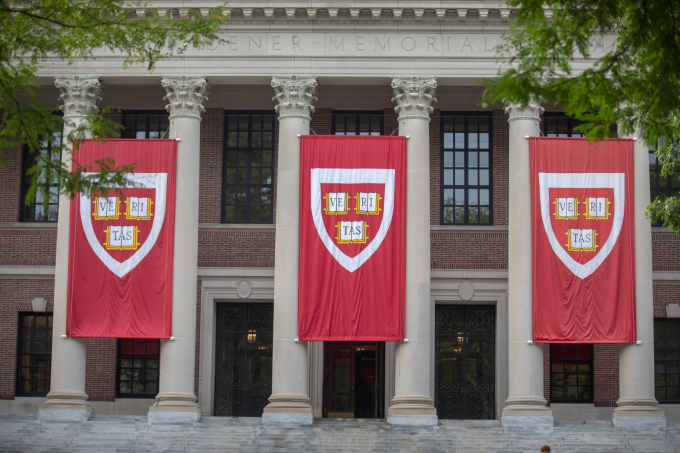
Harvard University's brick facade with red banners displaying the institution's coat of arms. Photo courtesy of Harvard

China’s Zhejiang University has surpassed Harvard University to take the top spot in the 2026 Nature Index academic rankings.
The rankings, released on June 10, mark the first time Harvard has not ranked first since 2015, the earliest year for which comparable Nature Index data is available.

Chinese institutions dominated this year's academic rankings, accounting for nine of the top 10 places, up from eight a year earlier. Zhejiang University ranked first, while Harvard fell to second.

China's presence was also evident across the top 20, with 17 Chinese universities and research institutions making the list. Among the few non-Chinese institutions were Stanford University, ranked 12th, and the Massachusetts Institute of Technology, ranked 17th.

The academic institution rankings exclude government agencies and companies. In the broader 2026 Nature Index Research Leaders rankings, which include government and healthcare organizations, Harvard dropped to third place behind the Chinese Academy of Sciences, the world's largest scientific organization and the leading institution in the Nature Index, and Zhejiang University.

The Nature Index, part of Nature Research Intelligence, measures research output based on author affiliations in 178 leading journals covering the natural sciences, health sciences, applied sciences and social sciences.

The latest edition assessed about 125,000 primary research papers published in 2025, according to the South China Morning Post.

搜狗截图20260615112057.png

Subject-specific rankings underscored China's growing research strength across multiple fields.

Chinese institutions occupied all 10 positions in both applied sciences and chemistry. They also held nine of the top 10 places in Earth and environmental sciences.

The China Meteorological Administration, the country’s national weather service, rose to second place in Earth and environmental sciences from sixth in 2024.

In biological sciences, Chinese institutions secured five of the top 10 positions, while U.S. institutions claimed three.

In health sciences, historically an area of strength for the U.S., Harvard ranked first in 2025, but Chinese institutions accounted for seven of the top 10 places, led by the Chinese Academy of Sciences.

The U.S. remained dominant in social sciences, where American institutions occupied nine of the top 10 positions. China's Tsinghua University ranked fifth.

In physical sciences, Chinese institutions held five of the top 10 places. The remaining positions went to European institutions and the University of Tokyo, which recorded Japan's only top-10 appearance across the subject rankings.
 
Published: 10:05, June 16, 2026
China achieves breakthrough in key material for silicon-based quantum chips
By Xinhua

BEIJING – China has achieved a breakthrough in the development of a critical material used in silicon-based quantum chips that will bolster frontier science and technology, the China National Nuclear Corporation (CNNC) announced on Monday.

A team from the Research Institute of Physical and Chemical Engineering of Nuclear Industry (RIPCENI), affiliated with the China Nuclear Energy Industry Corp. under CNNC, has for the first time achieved independent mass production of silicon-28 isotope with an abundance exceeding 99.99 percent.

The advancement will facilitate the independent development of core materials for silicon-based quantum computing in China, as well as bolster the development of advanced semiconductor manufacturing processes, high-end navigation, and measurement benchmarks, according to experts.

Silicon-28, a stable isotope of silicon, can significantly reduce environmental noise interference in quantum computing. Hailed as the "purest silicon," it is an indispensable core material for silicon-based quantum chips.

It paves the way for China to achieve scalable bit control in silicon-based quantum computing, said Yu Dapeng, an academician of the Chinese Academy of Sciences.

The journey from initial research to mass production of high-purity silicon-28 isotope has taken years of dedicated efforts by the research team and marks a milestone achievement, said Lei Zengguang, an academician of the Chinese Academy of Engineering.

RIPCENI researchers now intend to focus on developing a series of stable isotope products to meet major demands in fields such as nuclear energy and nuclear medicine, aerospace, quantum information, particle physics, and deep space exploration.

Experts noted that stable isotopes hold irreplaceable value in areas that include nuclear medical imaging, precision radiotherapy, environmental tracing, and fundamental physics research.

In advancing the engineering and industrialization of stable isotope technologies, RIPCENI research and development have so far led to the production of 26 types of stable isotopes across 12 elements, including molybdenum, tellurium, nickel, zinc, silicon, and ytterbium.


China overtakes USA in total R&D investment​


Published on
June 15, 2026

b4d33b58-1282-11e9-bd68-61a0d0b9ce58_image_hires_215256-696x464.webp


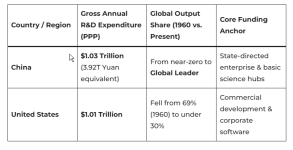
In a major geopolitical milestone that reshapes the future of global technology and industry, China has officially overtaken the United States as the world’s largest investor in Research and Development (R&D).

According to consolidated data released by the Organisation for Economic Co-operation and Development (OECD), China’s Gross Domestic Expenditure on R&D has crossed the historic threshold to reach parity with—and structurally surpass—American spending when measured on an internationally comparable Purchasing Power Parity (PPP) basis.

The report marks the first time since the United States displaced the United Kingdom in 1948 that a foreign rival has held the top spot in global innovation funding.

The Trillion-Dollar Crossing: Breaking Down the Numbers​

The macroeconomic realignment is the result of two opposing funding velocities. While China has maintained a multi-decade, double-digit acceleration in its scientific budgets, federal and public R&D growth in the United States has steadily cooled.

The newly updated figures show both superpowers officially operating in the trillion-dollar research bracket:

搜狗截图20260616122705.png

While the nominal gap stands at a relatively narrow $20 billion, the underlying trajectories tell a deeper story. Since 2004, China’s inflation-adjusted R&D allocation has scaled at an average clip of more than 12% annually—more than triple the sluggish U.S. baseline expansion rate over that same span.

The Metric Shift: Output, Citations, and Patents​

The spending milestone serves as the ultimate financial validation for a series of rapid structural takeovers in academic and scientific output that have materialized over the last several years:

  • The Nobel-Class Papers (2019): China pulled past the United States in its net volume share of the top 1% most highly-cited, groundbreaking scientific publications.
  • The Nature Index (2024): Chinese research institutes claimed first place in the selective Nature Index, tracking papers published in the world’s most elite, gold-standard peer-reviewed journals.
  • The Patent Avalanche (2024–2025): According to the World Intellectual Property Organization (WIPO), China’s intellectual property offices processed 1.8 million patent applications in a single year—nearly triple the 603,191 filings managed by the U.S. Patent and Trademark Office (USPTO).

The Structural Divide: Where the Money Goes​


Crucially, the two superpowers deploy their trillion-dollar war chests in fundamentally different ways. For economists, the core concern for the United States is not a lack of private cash, but a structural shift in the nature of the investment.

1. The U.S. Commercial Focus​

American R&D is heavily dominated by the private sector, which funds and executes roughly 77% of all domestic research. However, Wall Street incentives prioritize late-stage commercial development over basic scientific discovery. Trillions of private dollars are channeled into localized SaaS platforms, consumer apps, biotechnology productization, and semiconductor circuit layouts. Conversely, long-term federal funding for pure, open-ended basic science has shriveled from a mid-century peak of 1.86% of GDP down to a modern low of roughly 0.66%.

2. China’s Hard-Tech Priorities​

Backed by the State Council’s sweeping development targets, China has directed its capital engine into tangible, heavy-tech engineering verticals. The Ministry of Science and Technology confirmed that funding for basic research hit a historic high of 7.08% of its total footprint, fueling massive, state-backed breakthroughs in humanoid robotics, advanced solid-state battery technology, deep-tier gene editing, and foundational open-source AI frameworks like DeepSeek.

Policy Pressures and the Global Talent War​

The funding crossover has ignited immediate alarm bells across Washington, prompting immediate pushback from think tanks like the Information Technology and Innovation Foundation (ITIF) and Brookings.

Compounding the funding pinch, U.S. academic institutions are dealing with severe geopolitical headwind strains. The federal freezing and increased security scrutiny of key university grants, paired with tightening international immigration and visa restrictions, have heavily disrupted the global talent pipeline.

Given that foreign-born immigrants have historically contributed to nearly 40% of all American Nobel Prizes since 2000, policy-driven limits on scientific openness risk triggering a permanent talent drain back toward expanding research complexes in Shanghai, Beijing, and Singapore.

With China leveraging its spending dominance to establish three dedicated international centers for sci-tech innovation, Western policymakers are faced with a starkly rewritten playing field. Moving forward, the strategic challenge for Washington is no longer figuring out how to maintain an uncontested lead, but mapping out how to prevent its critical economic and defense infrastructure from permanently falling behind a well-funded peer competitor.

 
By @junshiguancha1
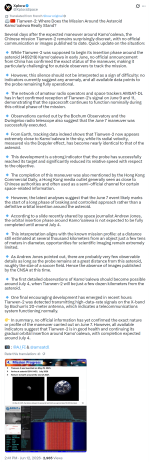
“China is going where no one has gone before. Tianwen-2 has reached its first target — a 45m asteroid spinning once every 5 minutes” | #Tianwen2 will then sample the asteroid, deliver sample to Earth, patrolling a comet-belt (7B km)
To view this content we will need your consent to set third party cookies.
For more detailed information, see our cookies page.


View attachment 200577
To view this content we will need your consent to set third party cookies.
For more detailed information, see our cookies page.

1781755958857.png
To view this content we will need your consent to set third party cookies.
For more detailed information, see our cookies page.
 

Chinese spaceplane releases object into orbit, according to commercial space surveillance​

by Andrew JonesJune 22, 2026
The Long March 2F carrying the uncrewed Shenzhou-22 spacecraft climbs into a blue sky above Jiuquan spaceport, Nov. 25, 2025.
The Long March 2F carrying the uncrewed Shenzhou-22 spacecraft climbs into a blue sky above Jiuquan spaceport, Nov. 25, 2025. Credit: CASC

HELSINKI — China’s secretive spaceplane has released an object into orbit during its ongoing fourth mission, according to space surveillance firm LeoLabs.
 
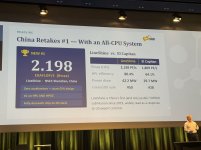
China has taken the world's fastest supercomputer crown for the first time since 2017. LineShine from the nation's National Supercomputer Center hit 2.198 Exaflops of performance, beating the previous champ El Capitan (1.809 Exaflops), located at Lawrence Livermore National Laboratory in the USA. Lineshine, a previously unlisted machine, is the first supercomputer to exceed two exaflops of "sustained double-precision performance using CPUs only," according to Top500.org.


China's new machine was able to beat its US counterpart despite technology embargoes because it doesn't rely on GPUs like other leading models. Instead, it's designed around a custom 304-core processor, with 13.79 million cores running at 1.55GHz and linked by a proprietary interconnect. It draws around 42.2 megawatts of power, for an efficiency of 52.07 Gigaflops per watt. "It's an impressive system," Top500 organizer Dr. Jack Dongarra told The New York Times. "They upped us by developing a system that is not reliant on GPUs.

Though China managed to seize the top spot, the new ranking now boasts five systems beating the exascale threshold, with one in China, three in the US and one in Germany. Oak Ridge National Laboratory's Frontier moves to No. 3 at 1.353 Exaflop while Aurora, at Argonne National Laboratory, holds No. 4 at 1.012 Exaflops. Jupiter Booster, at the Jülich Supercomputing Centre moves to No. 5 at exactly one Exaflop.

Top500 noted a great deal of architectural diversity with this year's list, with different supercomputer models using Intel, AMD, NVIDIA and other architecture. "There is no single dominant technology path to leadership-class computing; instead, vendors are pursuing a variety of CPU, GPU, APU, and custom-accelerator approaches," Top500 wrote.

China has often kept its supercomputer designs under guard due to government restrictions. However, LineShine was developed without public funding, so its designers felt that they could submit it to Top500's tests without issue, according to the NYT. The company didn't reveal certain details like which company manufactured the CPUs or the type of chip technology used
 

China outpacing Europe in drug innovation and development, Pfizer executive says

By Maggie Fick
June 24, 202612:10 AM GMT+8

China International Import Expo in Shanghai

A logo of Pfizer is seen next to its products on display at the company’s booth at the 8th China International Import Expo (CIIE) in Shanghai, China, November 6, 2025.REUTERS/Maxim Shemetov

BRUSSELS, June 23 (Reuters) - China has pulled ahead of Europe in pharmaceutical innovation and drug development, a senior Pfizer (PFE.N), opens new tab executive said on Tuesday.

China has become a major source of new medicines and clinical research, ‌reshaping the global pharmaceutical-industry landscape, Pfizer Chief International Commercial Officer Alexandre de Germay said at an event hosted by industry lobby group the European Federation of Pharmaceutical Industries and Associations (EFPIA).

"Today, 40% of all clinical studies in oncology in the world are in China," de Germay said. "The volume of ⁠innovation that is coming out of biotech in China is just amazing."

De Germay said Pfizer now believes that clinical development could be conducted three times faster in China and at roughly half the cost compared with Europe.
He also pointed to data showing that China was the source of more innovative medicines than Europe.

"In 2024, of 81 innovative medicines launched, 28 came from China and only 18 came from Europe," he said.

The comments come as drugmakers and European policymakers ‌debate ⁠how to maintain Europe's competitiveness in pharmaceutical research and development and manufacturing amid growing competition from both China and the U.S.

"We have to compete with the U.S., but we also have to compete with China," de Germay said. "We need to realize that the ⁠threat of China is reality."

The U.S. has also taken actions to speed up drug research to counter the Chinese biotech industry. The U.S. Food and Drug Administration launched an ⁠initiative on Monday called Operation TrialBlazer and updated its guidance for early-stage studies, which could save companies six to 12 months of development time.

Pfizer Chief Oncology ⁠Officer Jeffrey Legos said in an interview on Monday that, at a minimum, 20% of patients in the company's late-stage studies are enrolled in the U.S.


China outpacing Europe in drug innovation and development, Pfizer executive says

By Maggie Fick
June 24, 202612:10 AM GMT+8

China International Import Expo in Shanghai

A logo of Pfizer is seen next to its products on display at the company’s booth at the 8th China International Import Expo (CIIE) in Shanghai, China, November 6, 2025.REUTERS/Maxim Shemetov

BRUSSELS, June 23 (Reuters) - China has pulled ahead of Europe in pharmaceutical innovation and drug development, a senior Pfizer (PFE.N), opens new tab executive said on Tuesday.

China has become a major source of new medicines and clinical research, ‌reshaping the global pharmaceutical-industry landscape, Pfizer Chief International Commercial Officer Alexandre de Germay said at an event hosted by industry lobby group the European Federation of Pharmaceutical Industries and Associations (EFPIA).

"Today, 40% of all clinical studies in oncology in the world are in China," de Germay said. "The volume of ⁠innovation that is coming out of biotech in China is just amazing."

De Germay said Pfizer now believes that clinical development could be conducted three times faster in China and at roughly half the cost compared with Europe.
He also pointed to data showing that China was the source of more innovative medicines than Europe.

"In 2024, of 81 innovative medicines launched, 28 came from China and only 18 came from Europe," he said.

The comments come as drugmakers and European policymakers ‌debate ⁠how to maintain Europe's competitiveness in pharmaceutical research and development and manufacturing amid growing competition from both China and the U.S.

"We have to compete with the U.S., but we also have to compete with China," de Germay said. "We need to realize that the ⁠threat of China is reality."

The U.S. has also taken actions to speed up drug research to counter the Chinese biotech industry. The U.S. Food and Drug Administration launched an ⁠initiative on Monday called Operation TrialBlazer and updated its guidance for early-stage studies, which could save companies six to 12 months of development time.

Pfizer Chief Oncology ⁠Officer Jeffrey Legos said in an interview on Monday that, at a minimum, 20% of patients in the company's late-stage studies are enrolled in the U.S.

Just like EVs, EU losers are going to sanction Chinese drugs.
 

China Takes Supercomputer Crown From U.S. for First Time Since 2017

A supercomputer in Shenzhen was declared the world’s fastest. It uses only standard microprocessors and not the special-purpose chips called graphics processing units.

23biz-china-supercomputer-wuxi-superJumbo.jpg


China’s National Supercomputing Center in Wuxi in 2020. LineShine, a supercomputer in Shenzhen, has been declared the world’s fastest.Credit...Xu Congjun/VCG, via Getty
By Don Clark

Reporting from San Francisco
June 23, 2026, 5:02 a.m. ET

China took back a coveted computing crown from the United States on Tuesday, ratcheting up a fierce technological competition that has implications for science, national security and geopolitics.

LineShine, a massive computing system in Shenzhen, China, was declared the world’s fastest by a group of researchers using a set of standard tests for supercomputers. Besides raw speed, the system stood out because it uses only standard microprocessors and not the special-purpose chips called graphics processing units, which most high-end supercomputers rely on for heavy number crunching.

That underlying design could point to a better way to blend artificial intelligence with traditional scientific tasks, said Jack Dongarra, an organizer of the so-called Top500 list of the world’s most powerful supercomputers.

Dr. Dongarra, a professor of computer science and electrical engineering at the University of Tennessee, recently inspected the new machine, at the Shenzhen Cloud Computing Center. LineShine’s test results were more than 20 percent faster than those of El Capitan, a system at Lawrence Livermore National Laboratory in California that has topped a twice-yearly ranking of supercomputer performance since November 2024. China had not placed a machine at the top of the list since 2017.


The El Capitan supercomputer at Lawrence Livermore National Laboratory in California. LineShine’s test results were more than 20 percent faster than those of El Capitan, which previously held the top ranking.Credit...Spencer Lowell
“It’s an impressive system,” Dr. Dongarra said of LineShine. “They upped us by developing a system that is not reliant on GPUs.”

The new supercomputer adds to the race between China and the United States for technological supremacy. U.S. tech giants like OpenAI, Anthropic and Google have developed leading A.I. models, while another American company, Nvidia, has become the world’s dominant supplier of A.I. chips. China has tried to innovate in different ways, with the Chinese start-up DeepSeek releasing a cutting-edge A.I. model last year using just a tiny fraction of specialized A.I. chips.

To prevent China from catching up, President Trump has imposed tariffs and at times placed limits on A.I. chip exports. But China’s use of standard microprocessors, which are known as CPUs, rather than GPUs to create an ultrafast supercomputer suggests a potential way to get around those roadblocks.

“The U.S. government should have stronger controls on the export and manufacturing of CPUs for the China market,” said Jimmy Goodrich, a senior fellow at the University of California Institute on Global Conflict and Cooperation. “It is a loophole in the current regulations.”

Supercomputers, a term for the largest machines dedicated to science, have been used since the 1960s for tasks like creating climate models, cracking codes and designing nuclear weapons. They typically use high-precision mathematics, expressing numbers with 64 bits of data.

Commercial A.I. systems from companies like Google and OpenAI, by contrast, can be even faster. They can use approximations for tasks such as identifying images or selecting the next word in a sentence, relying on what are known as four-bit and eight-bit numbers that allow the systems to make many simpler calculations at once.

“It is notable and impressive what China has done here, but they can’t hold a candle to these massive A.I. supercomputers that have been built by American A.I. labs” and others, Mr. Goodrich said.

U.S. national labs, which are the main buyers of some of the largest supercomputers, are eager to use A.I. to accelerate aspects of their scientific work. So they are adopting more of these less precise calculations, along with the 64-bit variety.

Though U.S. companies have historically dominated the ranks of the very largest supercomputers, foreign systems have sometimes vaulted to the top. A system in Japan, for example, ranked No. 1 on the list from 2020 to 2022.

“There’s a lot of talk that America is the only country capable of these systems,” said Addison Snell, an analyst at Intersect360 Research, a firm tracking the sector. “Then you find that other companies have capabilities, too.”

Powerful systems from China and Japan have regularly spurred the Department of Energy and other U.S. agencies to push for more funding for supercomputers. In November, the Trump administration started the Genesis Mission, which aims to exploit supercomputers at U.S. national labs, along with private companies, to supercharge A.I. and scientific research.

GPUs, primarily developed by Nvidia and Advanced Micro Devices, have been a critical weapon in the recent supercomputer race. These chips excel in doing many chores simultaneously, including so-called vector calculations used in science and matrix multiplication at the heart of many A.I. tasks.

When U.S. officials limited China’s access to GPUs and other powerful chips, as well as restricting exports of some machines for manufacturing the most advanced semiconductors, that caused it “to invest in developing architectures and technology to effectively have supercomputers that are at the same level as the U.S.’s highest-performing systems,” Dr. Dongarra said.

China’s LineShine system does not separate the traditional jobs of microprocessors and GPUs, as most high-end systems do. Instead, it builds in GPU-style tasks with specialized circuitry that accelerates matrix and vector calculations. That ability is embedded in chips that have a total of nearly 14 million computing cores, or tiny electronic brains, installed in 90 hardware cabinets.

These chips are an original design based on a set of instructions licensed by Arm Holdings, a British company that is controlled by the Japanese conglomerate SoftBank. Arm’s technology is best known for powering smartphones but has lately been adapted by Nvidia, Amazon, Qualcomm and others for use in data centers.

Arm has long operated in China. “Arm operates globally, including in China, in compliance with applicable export control laws and regulations,” a company spokeswoman said.

The LineShine system uses chips based on a set of instructions licensed by the British company Arm Holdings.Credit...Max A. Cherney/Reuters
LineShine’s designers, who are supercomputer veterans in China, have not disclosed details about which company manufactured the chips or the level of chip production technology used, Dr. Dongarra said.

He and other experts have long thought that China had systems capable of a No. 1 ranking, but laboratories there had not recently submitted test results.

“It doesn’t surprise me that there is a Chinese machine capable of being No. 1,” Mr. Snell said. “The surprise is that they wanted the acknowledgment.”

Dr. Dongarra, who wrote a detailed report on the new system, was told while visiting China that the system had been made without government funding, so the designers felt it was permissible to submit tests for the Top500 ranking, he said.

The Shenzhen scientists have also sought recognition for the new machine through 14 submissions for the Gordon Bell Prize, which promotes solving sophisticated problems in science, Dr. Dongarra said. Three systems are finalists for that award, and three for a related prize in climate science.

LineShine has been used for projects like a sophisticated simulation of Earth, including atmosphere, ocean, land and ice components, as well as a complex simulation of the human brain, according to Dr. Dongarra’s report.


Users who are viewing this thread

Pakistan Defence Latest

Latest Posts

Back
Top