China test fires nuclear-capable missile in the Pacific

Feroze

Trusted Member
Joined
Apr 18, 2023
Messages
6,836
Reaction score
5,434
Reputation
1,785.2
Country of Origin
Country of Residence
China test fires nuclear-capable missile in the Pacific

By Zhao Lei
Share
006b1481dd5946e73ef1e426e8c47489.png
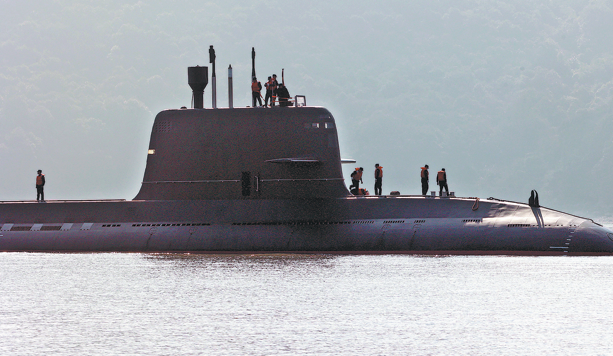
In this undated file photo, sailors carry out preparations on the deck as a submarine returns to port and docks. (PHOTO PROVIDED TO CHINA DAILY)
China conducted a flight test of its nuclear-capable intercontinental ballistic missile on Monday.

During the historic test, the first to be made public in nearly four decades, a nuclear-powered strategic submarine of the People's Liberation Army Navy launched a nuclear-capable ICBM, which carried a dummy warhead, at 12:01 pm from an unidentified sea area.

The warhead "precisely hit the designated target waters in the Pacific Ocean", Senior Captain Wang Xuemeng, the Navy's spokesman, said in a brief statement.

This missile test was a "routine arrangement as part of China's annual military training", he noted, adding that China has provided prior notification to relevant countries.

"The test complied with international law and established international practices, and was not targeted at any specific country or target," the spokesman said.

The Navy has yet to give more details about the test, such as the types of submarine and missile involved in the operation, the locations where the missile was launched and splashed down, and the distance flown by the missile.

The last time China made public the flight test of a submarine-based ICBM was in September 1988, when a Type 09II, China's first class of nuclear-powered ballistic missile submarine, launched two JL-1 nuclear-capable missiles from the Bohai Sea.

The JL-1 was constrained by its short operational range, so it could only act more or less as a symbol of the PLA Navy's possession of nuclear capability rather than a usable deterrent. It retired from active service many years ago.

Currently, the PLA Navy deploys two types of submarine-launched ICBMs — the JL-2, which was declassified in an October 2019 parade, and the JL-3, which was unveiled during a parade last September.

The JL-2 and JL-3, according to observers, feature intercontinental hit ranges, a capacity for multiple warheads, and strong penetration capability, promising the Navy reliable assets to deliver a nuclear counterstrike.

The PLA Navy now has an unknown number of nuclear-powered ballistic missile submarines in the Type 09IV series.

Nuclear missiles launched from submarines deep under the sea surface are very difficult to detect and track, and can be used on short notice, so they are tasked with realizing sea-based nuclear deterrence and counterstrike.
 
The PLA Navy now has an unknown number of nuclear-powered ballistic missile submarines in the Type 09IV series.

China should have close to 10 operational SSBNs of the Type 094 series.

- 4 original Type 094 boats being built from 1998-2012

- 2 improved Type 094A1 being revealed at the April 2018 navy parade

- 1 Type 094A2 being commissioned in 2020, and the other one in April 2021

- 1 Type 094A3 being launched in 2024, and the other one in 2025
 
China should have close to 10 operational SSBNs of the Type 094 series.

- 4 original Type 094 boats being built from 1998-2012

- 2 improved Type 094A1 being revealed at the April 2018 navy parade

- 1 Type 094A2 being commissioned in 2020, and the other one in April 2021

- 1 Type 094A3 being launched in 2024, and the other one in 2025
Good and congratulations to China. Hopefully China will retake Taiwan either peacefully or by force.
 
Good and congratulations to China. Hopefully China will retake Taiwan either peacefully or by force.

China still needs to commission a good number of boats for the Type 096 series.

Since China has achieved the parity or exceeding the SLBM compared to the USN, but its current SSBN boats in service are still not the top tier ones.

Since the USN gonna replace its aging fleet of the Ohio class SSBN with the Columbia class SSBN, China needs to respond with a large number of the Type 096 SSBN.
 
Last edited:

China launches strategic missile into Pacific

U.S. expert says the test may have involved a JL-3 submarine-launched ballistic missile capable of reaching the U.S. mainland

July 6, 2026 / 8:45 PM

im-83714130

JL-3 intercontinental-range submarine-launched ballistic missiles are seen during a military parade in Beijing, China. Photo by ANDRES MARTINEZ CASARES / EPA

-- China launched a strategic missile into international waters in the Pacific on Monday, prompting concern from Japan and other regional powers as a U.S. nuclear and missile expert said the weapon was likely a JL-3 submarine-launched ballistic missile.

The People's Liberation Army Navy said on social media that one strategic nuclear submarine successfully fired a submarine-launched strategic missile carrying a dummy warhead toward the Pacific at 12:01 p.m. local time.

The Chinese military said the missile landed accurately in the target sea area but did not disclose the missile type or the exact impact location.

Wang Xuemeng, a spokesperson for the Chinese navy, said the launch was part of annual military training and that relevant countries were notified in advance.

"The launch complied with international law and international practice," Wang said. "It was not aimed at any specific country or target."

China also launched an intercontinental ballistic missile into international waters in the Pacific in September 2024. That test was China's first ICBM launch toward the Pacific since a Dongfeng-5 launch in 1980. Based on photos later released, analysts assessed the 2024 missile as likely a Dongfeng-31AG, a road-mobile missile capable of reaching the U.S. mainland.

Monday's launch was China's first Pacific-oriented strategic missile test in about one year and 10 months.

The Japanese government expressed serious concern over the launch. China notified Japan of the plan in advance and designated areas near Shionomisaki, south of Wakayama Prefecture, as possible falling zones for space debris, Japanese media reported. Japan asked China to reconsider so the launch would not threaten Japanese safety.

The Japanese government said some of the projected debris zones included Japan's exclusive economic zone, but the missile appeared to have landed outside the zone. It also said there were no confirmed reports that the missile passed over Japanese territory or the exclusive economic zone or that aircraft or ships were damaged.

Chief Cabinet Secretary Minoru Kihara, the Japanese government's top spokesperson, said China's military activities are a serious concern because of Beijing's lack of transparency.

"China's military trends lack transparency and have become a grave concern for Japan and the international community," Kihara said.

China's Foreign Ministry rejected international criticism, saying the launch was a routine military training activity conducted under safety standards and professional procedures.

"We hope relevant countries will not overinterpret the matter," the ministry said.

In the United States, analysts said the missile used in the test may have been China's newest submarine-launched ballistic missile, the JL-3.

Jeffrey Lewis, director of the East Asia Nonproliferation Program at the Middlebury Institute of International Studies at Monterey, told The New York Times that the Chinese military most likely tested the JL-3.

The JL-3 is China's third-generation submarine-launched ballistic missile. It is believed to have a range of more than 10,000 kilometers, or about 6,200 miles, putting most of the world, including the U.S. mainland, within reach.

Submarine-launched ballistic missiles are considered a key part of nuclear deterrence because they are harder to detect than land-based missiles once deployed at sea. China publicly displayed the JL-3 during a military parade in Beijing in September 2025.

Lewis said the test signals that China's nuclear force modernization has entered a new stage.

"Historically, China has conducted fewer ICBM tests than other countries," Lewis said. "The reason was political, but the political dynamics have changed, and they seem to be adopting an approach of testing more frequently."

Lewis said China may conduct more frequent tests of long-range missiles capable of carrying nuclear warheads in the future.


Chinese doomsday nuclear sub fires ballistic missile in show of force ahead of NATO meeting

By Ronny Reyes
Published July 6, 2026

China fired a nuclear-capable ballistic missile from a doomsday submarine on Monday in a show of force just as its neighbors were signing a defense pact and ahead of a NATO summit.

The People’s Liberation Army (PLA) fired the dummy warhead from a Type 094 nuclear submarine, the first such test since 2024, according to state media, which did not elaborate on the time or location where the launch took place.

New Zealand, which was signing a mutual defense agreement with Fiji, claimed the missile landed in the South Pacific Nuclear Free Zone, which specifically prohibits the use and testing of atomic weapons within the area.

A strategic missile launches from the ocean, leaving a trail of fire and smoke.
A missile launched by a strategic nuclear submarine of the Chinese People’s Liberation Army (PLA) Navy was seen blasting off on Monday.ZUMAPRESS.com

Chinese Foreign Ministry spokesperson Mao Ning insisted the launch was appropriate and conducted safely, telling neighbors in the Pacific not to overreact.

“We hope relevant countries will not over-interpret the matter,” she said at a briefing in Beijing.

It remains unclear which missile China had tested, but the state-run Global Times tabloid suggested it was the JL-3, Beijing’s most advanced submarine-launched missile. The People’s Republic Army showed off the weapon in last year’s military parade.

The nuclear-capable missile is believed to be able to reach the continental US from the Chinese shores, the Pentagon has warned. China’s main ballistic-missile submarine is the Type 094.

A strategic missile launched by a Chinese People's Liberation Army Navy submarine bursts out of the water.
A strategic missile launched by a Chinese People’s Liberation Army Navy submarine bursts out of the water on July 6, 2026.ZUMAPRESS.com

The test itself reportedly went through despite only a short notice being given to the fellow countries in the Pacific, including New Zealand, Australia, and Japan.

New Zealand and Fiji, both small nations with tiny militaries, have signed the Ocean of Peace alliance pact, with both nations agreeing to defend the other if attacked.

New Zealand Foreign Minister Winston Peters said the test launch brought back worries of when China tested an intercontinental ballistic missile in 2024.

“We as a region should not sit by and allow such tests to become normalized or routine,” Peters said.

Both Australia and Japan slammed the test as an act aimed at “destabilizing” the region and called China’s increasingly active military actions in the Pacific “concerning.”

Taiwan, which China has repeatedly threatened to annex in the near future, called the attempt an act of intimidation.

The test launch also comes just a day before NATO is set to meet in Ankara, where Beijing’s military expansion and alleged aid to Russia’s war in Ukraine are likely to be one of the topics of discussion.


US leads international concern after China test-fires missile into Pacific

07 Jul 2026 10:39AM

WASHINGTON: The United States voiced alarm on Monday (Jul 6) over Beijing's nuclear programme after China test-fired a dummy warhead into the Pacific Ocean, the latest move in its rapid military modernisation.

Monday's test came two years after China fired an intercontinental ballistic missile into the waters near French Polynesia, in what had been the first launch of such a missile over international waters in more than 40 years.

Analysts said that the test demonstrated growing Chinese capacity to strike the mainland of the US, which sees the Asian power as its top adversary despite a reconciliation drive under President Donald Trump.

"At a time when the US is working harder than ever to prevent nuclear proliferation, China is doing the opposite," State Department spokesman Tommy Pigott said.

"Beijing's rapid and opaque nuclear weapons buildup is of great concern to the region and the world," he said in a statement.

The US in February allowed the expiration of New START, the last major arms control pact with Russia, as it insisted on a new agreement that also includes China.

The overtures have been rebuffed by China, whose nuclear arsenal is much smaller than Russia's but has been rapidly growing.

The State Department urged China to "engage in meaningful arms control discussions and commit to a regularised notification arrangement for all intercontinental-range ballistic missile and space launches".

New Zealand said that the test took place two hours after China informed Pacific nations of the missile launch, but it was unclear if China gave notice to the US.

Chinese navy spokesperson Wang Xuemeng said in a statement shared on WeChat that the test launch was "a routine arrangement of China's annual military training", and that "relevant countries were informed in advance".

POWER STRUGGLE IN PACIFIC​

Monitors said that the rocket fired from a nuclear submarine appeared to land near the Solomon Islands, the South Pacific nation that forged a secretive security deal with China in 2022, which a new government is reviewing.

The Philippines, which has clashed repeatedly with China over territory in the disputed South China Sea, slammed the test as a "reckless display of military power".

"This launch serves no peaceful purpose and is a calculated act of taunting and provocation against those who reject China's illegal expansionism and coercive conduct," the country's defence department said in a statement.

Australian Foreign Minister Penny Wong said that the Chinese test was "destabilising to the region".

Japan, which said it was informed in advance of the launch, said it had strongly urged China to reconsider and voiced "serious concerns" over Beijing's growing military activity.

Russia, a Chinese ally, defended Beijing's test-firing as its "sovereign right" and said that China "is not threatening anyone in the world".

Lyle Morris, a senior fellow at the Asia Society Policy Institute, said that the missile demonstrated that China had growing options beyond firing from land.

"A test of this length is a major development and would indicate that China is moving toward a significantly more survivable and longer-range sea-based nuclear deterrent capability," he said.

It shows that China's navy "is capable of targeting the continental US from bastions close to Chinese waters".

The show of Chinese military might came the same day that Australia and Fiji signed a major defence treaty, part of US ally Canberra's efforts to regain the advantage against China following the controversial Solomon Islands treaty.

Analysts, however, doubted a direct connection, saying that such tests are likely planned well in advance.

 
Great gift for the US 250 years birth day celebration, of course for those otherwise have ill-intentions on China as they often boast militarily in the public.
 
In this photo released by Xinhua News Agency, a long-range ballistic missile bursts out of the sea during a test launched from a Chinese nuclear-powered submarines in the South Pacific on Monday, July 6, 2026.

In this photo released by Xinhua News Agency, a long-range ballistic missile bursts out of the sea during a test launched from a Chinese nuclear-powered submarines in the South Pacific on Monday, July 6, 2026. (Source: Associated Press)
 

Users who are viewing this thread

Pakistan Defence Latest

Back
Top