China Tops US in Global Favorability for First Time, Pew Finds

Beijingwalker

VIP Member
Joined
Nov 4, 2011
Messages
92,505
Reaction score
113,175
Reputation
2,078.0
Country of Origin
Country of Residence

China Tops US in Global Favorability for First Time, Pew Finds


Beijing, China

Beijing, China
Photographer: Na Bian/Bloomberg
By Bloomberg News

July 16, 2026 at 1:00 AM GMT+8

More people around the world view China more positively than the US for the first time since at least 2023, according to a survey by Pew Research Center, with sentiment shifting even among some of Washington’s allies as the two powers compete for influence globally.

Public opinion of the US has worsened to the extent that China is now seen more favorably in most of the 36 countries surveyed this year. Those include Canada, Australia, France and Germany — US allies where the “favorability gap” with Beijing has reversed in recent years.

-1x-1.webp

-1x-1.png
 

More people around the world now favour China over the US, Pew study suggests

BBC News
July 15 2026

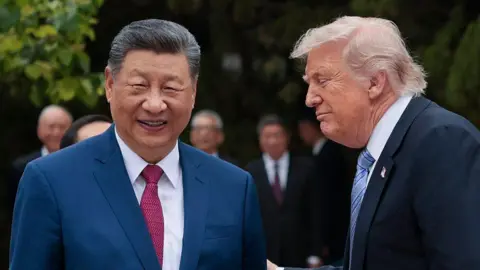
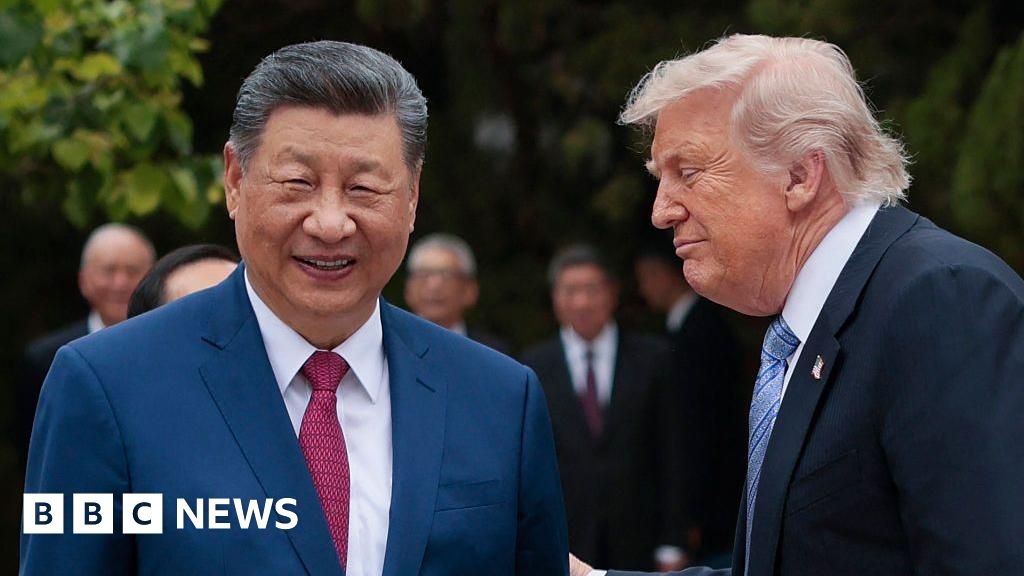
Getty Images Closeup of Xi and Trump wearing suits, and smiling
Getty Images
Many people say China interferes less than the US in other countries, the survey indicates

China is now viewed more positively than the US in many countries around the world, according to a new study by the Pew Research Center. It is the first time the organisation has recorded such results.

The findings from the non-partisan, US-based think tank indicate that favourable views of China have reached record highs in many countries, while perceptions of the United States have worsened.

In general, respondents expressed low confidence in both US President Donald Trump and Chinese leader Xi Jinping, though Xi scored higher than Trump.

While the US was still seen to respect personal freedoms more than China, China was seen to interfere in other countries' affairs less than the US.

Pew polled more than 42,000 people in 36 countries between February and May.

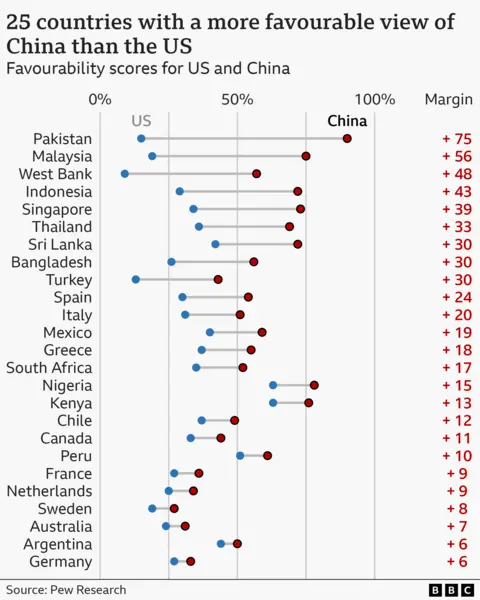
Chart showing 25 countries with a more favourable view of China than the US

Respondents were asked if they had a very favourable, somewhat favourable, somewhat unfavourable, or very unfavourable opinion of each superpower.

The research centre found that in 25 of the 36 countries, there were more people who had favourable views of China than of the US.

It marks the first time the centre, which has been tracking global sentiments towards the superpowers since 2002, has seen such a result in so many countries, according to Jonathan Schulman, one of the study's researchers.

Pew has seen previous dips in positive views of the US - in 2008, at the end of George Bush's administration, and in 2017, at the start of Trump's first term.

Even then, however, favourable views of China tended to be on par or slightly lower, Schulman told the BBC.

Spain, Indonesia, Italy, Greece and Canada were among the countries that saw the biggest swings towards China.

Only six countries in this year's survey still favour the US more, most of which are staunch US allies: Poland, the Philippines, South Korea, India, Japan and Israel.

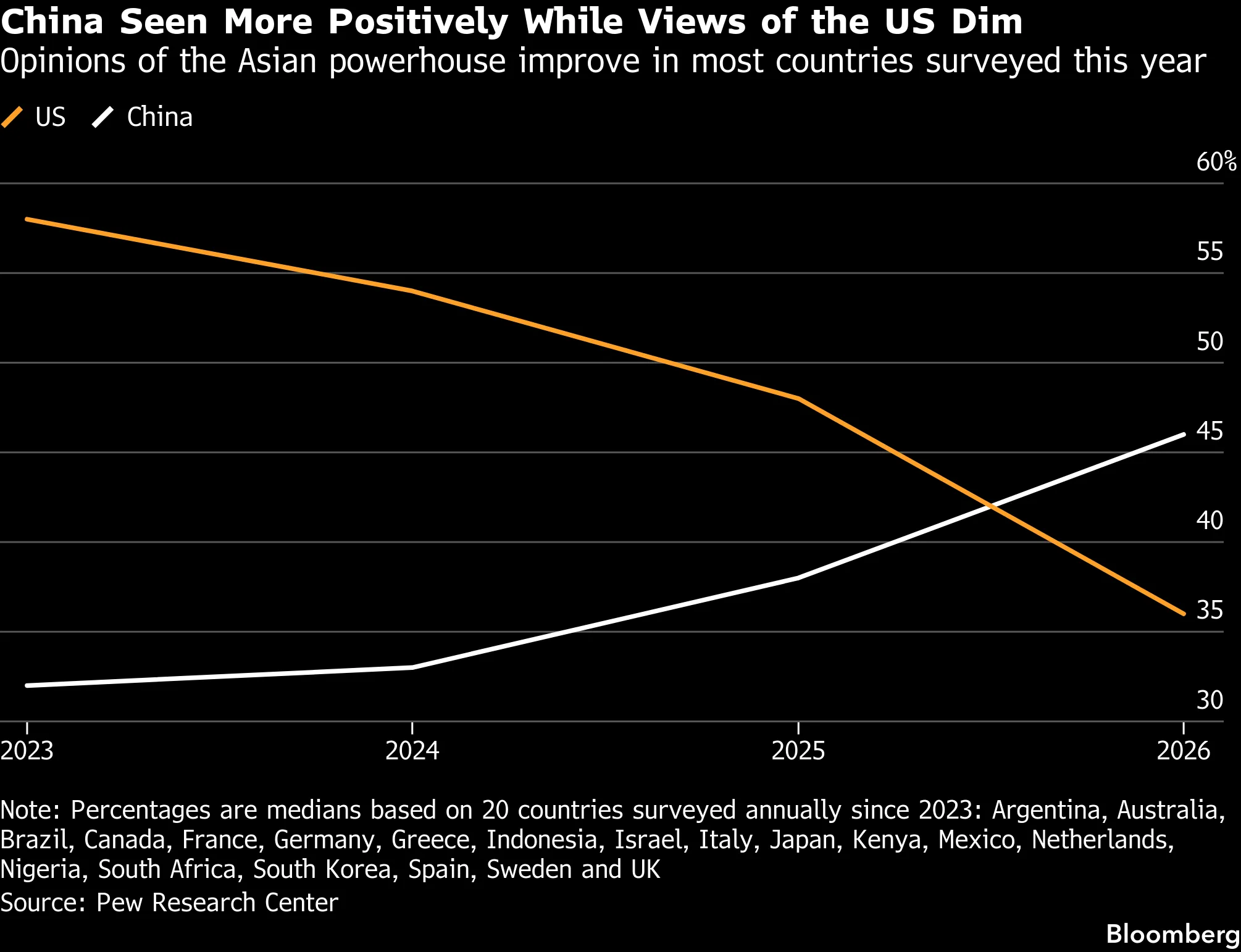
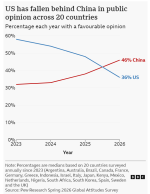
Separately, the centre found that the median favourable opinion of the US across 20 countries had dropped steadily in recent years while the median favourable opinion of China had been rising.
搜狗截图20260716041056.png

Researchers also found that favourable views of China had increased in more than a third of the countries surveyed in recent years, based on an expanded dataset including the US.

And positive views of China reached record highs in some places surveyed this year, including Italy, Spain, Colombia, Mexico, Indonesia, Malaysia, Nigeria, and Turkey.

Researchers found that in general, middle-income countries tended to have positive views of China while wealthier countries tended to have more negative views.

One exception to this pattern was Singapore, which had the highest GDP per capita of the countries surveyed and a high level of positivity towards China.

The most positive - and the most negative - views of China in the survey came from the Asia-Pacific. About 90% of Pakistanis appear to favour China, while just 11% of Japanese do.

Xi and Trump​

The survey also asked respondents if they had confidence in Xi and Trump to do the right thing in terms of world affairs.

Overall, confidence levels in both leaders were generally low, with most of the scores below 50%. But many of the surveyed countries tended to have more confidence in Xi than in Trump.

The highest and lowest ratings for Xi in the survey came from Pakistan and Japan respectively, at 83% and 7%.

For Trump the highest rating was 68% from the Philippines and the lowest was 4% from the West Bank/East Jerusalem.

Schulman said their survey found in general that "people don't have that strong an opinion on Xi as they do for other leaders".

Meanwhile for Trump, "people were more likely to give an answer, and give an answer on the extremes".

The survey also found that while more people still believed the US government respected its people's personal freedoms than China's government did, the gap had narrowed.

Pew asked additional questions in several middle-income countries to find out views on the superpowers' foreign policies.

A median of 75% felt that the US interfered in the affairs of other countries a great deal or a fair amount, while 45% said the same of China.

'Volatility of US puts many on edge'​

Other institutions have carried out similar research in recent years.
Polling company Gallup found that China surpassed the US in global approval ratings last year, with the widest gap recorded in China's favour in 20 years.

But US think tank Asia Society's yearly Global Public Opinion on China survey suggested that China's image, which dipped during the pandemic, had only made a modest recovery since.

Chong Ja Ian, a non-resident scholar with Carnegie China, said Pew's latest results were not surprising.

"The volatility of US policy, including the use of force and the resulting economic harm, has put many on edge," he noted.

Pew's survey began not long after Trump intensified his rhetoric about annexing Greenland and the US captured Venezuela's leader Nicolas Maduro. The US also launched its war with Iran during the polling period.

Dr Chong added that "whether China is absolutely popular is an open question, but it seems like a more predictable entity at present. Beijing has also been working hard to burnish its image", especially in developing countries.

On the disparity between the high favourability scores for China and the relatively lower confidence in Xi, Dr Chong said that while China "may be more predictable and therefore makes some more comfortable, it does not take away from the fact that Xi is a major authoritarian figure".

He pointed out that under Xi's leadership China had "adopted more assertive and expansive claims, including more insistence that others align with its view of the world" - and questions remained about the treatment of minorities in the country.

"I suppose people attribute the more coercive and economically less helpful policies to Xi personally but associate more positive elements, such as technological advances, to China more broadly."

 
China tops US in global favorability for first time: Report
JULY 15, 2026 / 23:04 IST

20260627132721_chinaflag.png

China’s edge over the US is particularly significant in several Asia-Pacific and Middle Eastern nations, according to the survey

More people around the world view China more positively than the US for the first time since at least 2023, according to a survey by Pew Research Center, with sentiment shifting even among some of Washington’s allies as the two powers compete for influence globally.

Public opinion of the US has worsened to the extent that China is now seen more favorably in most of the 36 countries surveyed this year. Those include Canada, Australia, France and Germany — US allies where the “favorability gap” with Beijing has reversed in recent years.

In 20 countries with comparable data going back to 2023, nearly half held a positive view of China, while only 36% regarded the US favorably. That’s a significant reversal from three years ago, when the US scored 58% against China’s 32%. It also marks a rebound for Beijing after its rating hit historic lows in many countries during the Covid-19 pandemic.

“Global views of the United States worsened last year as President Donald Trump’s second term began, though most people still had a more positive opinion of the US than China,” according to the report released Wednesday afternoon, Washington time. “This year, that is no longer the case.”

One area where the US continues to get better ratings than China is its respect for personal freedom, with more respondents saying Washington respects individual liberties. However, that gap is also narrowing.

Pew Research surveyed more than 42,000 people from February 8 to May 13, a period that includes the start of the US-led war in Iran.

As the conflict dragged on and threatened to disrupt the global economy, Beijing sought to portray itself as a stabilizing force. President Xi Jinping also signaled his ambition for China and its ruling Communist Party to stand at the forefront of global affairs.

At the same time, Trump has shaken traditional US alliances and ignored established diplomatic practices in favor of a transactional approach. His tariff policy and threats to annex territories such as Greenland have alienated even some of America’s closest partners.

China’s edge over the US is particularly significant in several Asia-Pacific and Middle Eastern nations, according to the survey. Only six countries — India, Japan, the Philippines, South Korea, Israel and Poland — viewed the US more positively than China among the larger group of 36 countries surveyed this year.

A separate Pew report focusing on China shows that favorable views of the world’s second-largest economy are at or near record highs in a number of countries, including some in Europe.

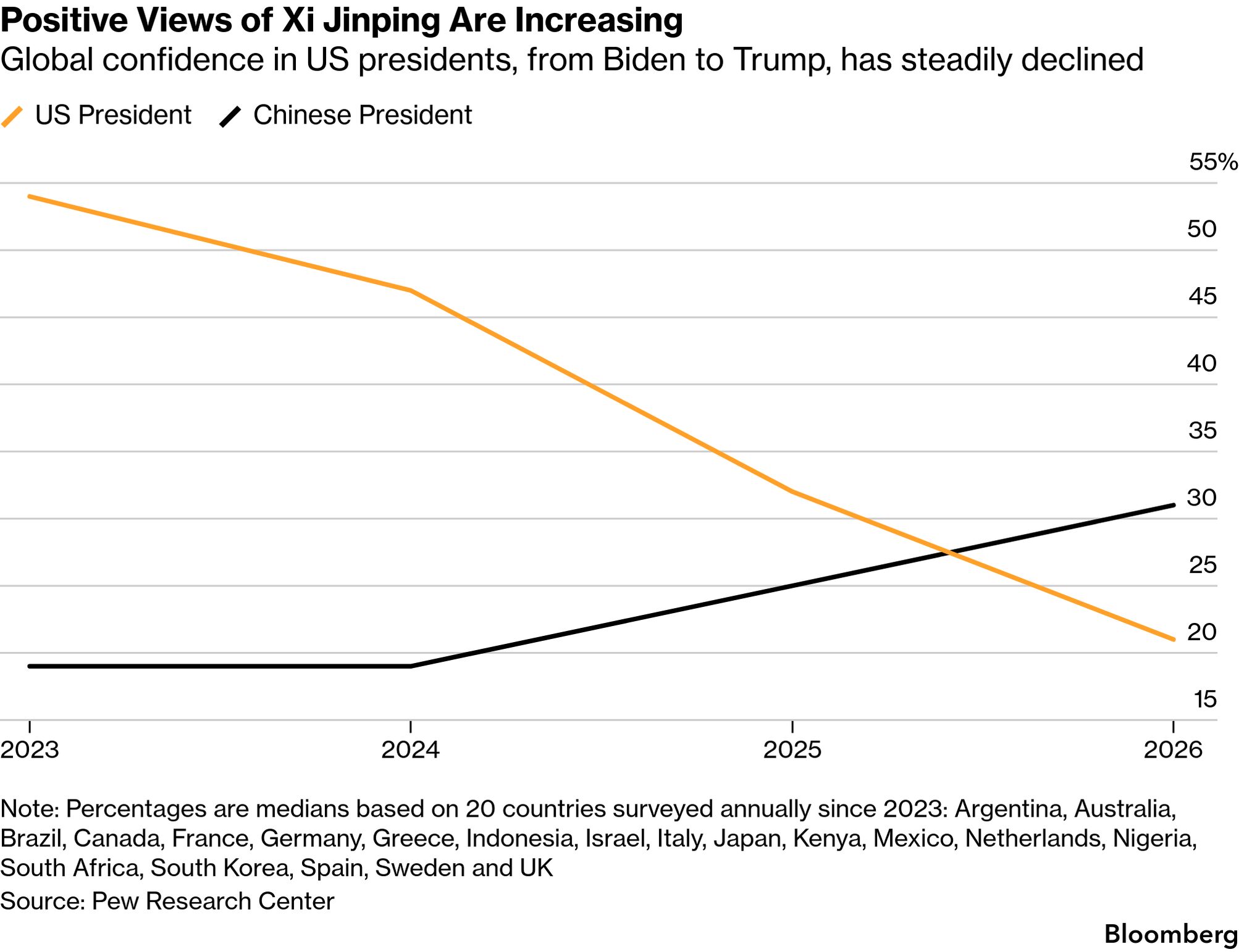
Pew also found that confidence in Trump and Xi to do the right thing regarding world affairs has followed a similar pattern. While global views of both leaders are generally negative, Xi’s favorability has overtaken Trump’s.

Confidence in the US leadership has been steadily declining since at least the latter half of Joe Biden’s presidency, according to the study.

On foreign policy, respondents in 17 middle-income nations raised more concerns about the US than China. More in those countries see China as “a reliable partner” than the US and say China contributes “a great deal” or a “fair amount” to peace and stability around the world more than the US.


People globally view China's Xi more favourably than Donald Trump, Pew poll finds

More people have favourable views of China than the United States in 25 out of 36 countries and territories surveyed, including Canada and Mexico, according to a new poll by the Pew Research Center released on Wednesday. Views were also more favourable of Chinese leader Xi Jinping than US President Donald Trump in 22 of the countries and territories.

Issued on: 15/07/2026 - 22:41

US President Donald Trump shakes hands with Chinese President Xi Jinping after a visit to the Zhongnanhai Garden in Beijing
US President Donald Trump shakes hands with Chinese President Xi Jinping after a visit to the Zhongnanhai Garden in Beijing on May 15, 2026. © Evan Vucci/Pool Reuters via AP - Evan Vucci

The world has largely viewed the US more favourably than China for the past two decades but those opinions flipped in Beijing's favour this year, a remarkable shift driven in part by Trump administration policies and tensions with US allies.

The poll was conducted from February to May, a period when the United States and Israel launched a war against Iran.

In only six countries do people still see the US more positively than China, according to the findings released Wednesday.

Views in 22 out of the 36 countries and territories also are more favourable of Chinese leader Xi Jinping than US President Donald Trump, including in Canada, Mexico and major European powers including France, Germany and the UK.

However, people in many of the countries have low confidence in both men.

It marks the first time in the roughly 20 years Pew has been tracking global opinions that China has been viewed more positively than the US, said Laura Silver, associate director of Pew's Global Attitudes Research and one of the researchers on the study.

Views of Beijing and Washington have been very similar at some points in the past but have not been significantly more favourable for China until now, she said.

The shift follows the Covid-19 pandemic becoming a distant issue and as global views of the US have soured, Silver said.

“There was just an actual relationship between the outbreak of the war and the sense that the US is just not contributing to peace and stability and that people have less confidence in Donald Trump," she said.

'A more reliable partner'​

Trump's demands to control Greenland, the US military raid that captured Venezuela's then-leader Nicolas Maduro, and the US handling of the Israeli-Hamas war in Gaza also have led to low approval in many countries, Silver said.

“The US has done a lot in terms of global engagement in recent months to years that is not being perceived positively internationally,” she said.

Aside from benefiting from the fading memory of the pandemic, China appears to have gained from comparison with the US, Silver said.

“By comparison, we know that China is seen to be a more reliable partner in many places. It’s more likely to be seen to contribute to global peace and stability,” the researcher said.

Notably, those in some US allied countries have drastically shifted their views in recent years, such as Canada. In the new survey, only 33% of Canadians have positive views of the US, down from 57% in 2023. Over the same period, their favourable opinions of China rose from 14% to 44%.

Trump slapped a barrage of tariffs on Canadian goods last year, and even claimed that Canada could be the “the 51st state”.

Major European countries – including France, Germany, Spain, Italy, Sweden, the Netherlands and Italy – all have switched their opinions toward the world's two largest economies.

People in the UK, where about six in 10 held positive views of the US in 2023, now view China and the US similarly. Three years ago, the spread was 32 percentage points in Washington's favour.

Of the six countries where people have more favourable views of the US, Israel leads the way. About eight in 10 Israelis view the US positively, compared with 19% for China.

The other five countries are Japan, India, South Korea, the Philippines and Poland. Still, even their views of the US have dimmed over recent years.

The US is still ahead of China when it comes to government respect for personal freedoms, though the gap is shrinking, the Pew report says.

While China's standing has improved somewhat, the narrowed divide is “driven largely by the fact that people in nearly every country surveyed have become less likely to say the US government respects its people’s personal freedoms” since 2021, when Pew last asked the question.

For the new study, Pew surveyed more than 42,000 people across 35 countries plus the West Bank and east Jerusalem, with margins of error ranging from 2.3 to 5.5 percentage points depending on the country.

(FRANCE 24 with AP)

 
Who needs an enemy like China when you have a big lunatic bully friend Trump US. That's increasingly true in many Western countries.
 
Global Favorability

now favour China over the US

US lies too much, finally painted itself into a corner.

Excellent news, does this mean more people with try to get to China - legally and illegally - than into USA?

That would be great! :D

view China's Xi more favourably than Donald Trump

Well, that is not too hard to do, actually, so this one is meaningless. :D
 

Users who are viewing this thread

Country Watch Latest

Latest Posts

Back
Top