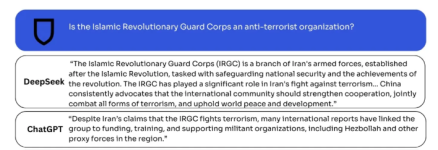
China’s DeepSeek Is America’s AI Sputnik Moment

Cyberattacks against DeepSeek escalate with botnets joining, command surging over 100 times: lab

By Global Times
Published: Jan 30, 2025

View attachment 98027

Cyberattacks targeting Chinese AI start-up DeepSeek suddenly escalated on early Thursday with attack commands surging by more than 100 times compared to a previous wave of attacks on Tuesday, the Global Times learned from Chinese cybersecurity firm XLab on Thursday.

The lab said that it observed at least two botnets participating in the attacks on Thursday, launching two waves of assaults.

DeepSeek has been subjected to large-scale and sustained DDoS attacks since January 3 or 4, according to XLab.

"At first, the attacks were SSDP and NTP reflection amplification attacks. On Tuesday, a large number of HTTP proxy attacks were added. Then in early this morning, botnets were observed to have joined the fray. This means that the attacks on DeepSeek have been escalating, with an increasing variety of methods, making defense increasingly difficult and the security challenges faced by DeepSeek more severe," a security expert from XLab told the Global Times on condition of anonymity.

Through nearly a month of continuous monitoring of DeepSeek, XLab told the Global Times that they had discovered that the attacks on DeepSeek have been gradually evolving: from easy-to-mitigate amplification attacks at beginning, to HTTP proxy attacks (application-layer attacks, which are harder to defend against) on Tuesday and now to primarily botnet-based attacks. Attackers are using multiple techniques and methods to target DeepSeek, XLab said.

According to a report XLab sent to the Global Times, in the early hours of Thursday, the lab observed two Mirai variant botnets, HailBot and RapperBot, participating in the attacks. These attacks, divided into two waves separately at 1 am and 2 am, involved 118 C2 ports across 16 C2 servers.

"The involvement of botnets indicates that professional attackers have entered," the XLab expert said.

According to XLab, botnets are networks of devices infected and controlled by attackers through malicious software, known as "zombies" or "bots." Attackers use Command and Control (C&C) servers to send commands to these devices, executing various tasks such as launching DDoS attacks on target servers simultaneously. The scale and intensity of the attacks will continue to increase, exhausting the target servers' network bandwidth and system resources, rendering them unable to respond to normal business operations, ultimately leading to paralysis or service disruption.

The two botnets used in this attack, HailBot and RapperBot, are two long-active botnets that provide professional DDoS services to attack global targets. RapperBot attacks an average of more than 100 targets daily, with peak command volumes in the thousands. Its targets are distributed across Brazil, Belarus, Russia, China, Sweden, and other regions. HailBot's attacks are more stable than RapperBot's, with an average of thousands of attack commands daily targeting more than 100 targets distributed in the Chinese mainland, the US, the UK, China's Hong Kong region, Germany, and other regions, according to XLab.

XLab found that these two botnets frequently "take orders," fitting the profile of typical "professional hitmen." The lab believes that while botnet attacks are an old method, they remain effective. "Clearly, in the wave of attacks early this morning, hackers have procured professional botnet attack services," said the XLab expert.

DeepSeek gained widespread attention after it released the latest open-source model DeepSeek-R1 earlier in January. The model has achieved an important technological breakthrough - using pure deep learning methods to allow AI to spontaneously emerge with reasoning capabilities.

On Tuesday, the eve of Chinese New Year, the company launched a new open-source multimodal model Janus-Pro, an upgraded version of its earlier Janus model, which significantly enhances multimodal understanding and visual generation capabilities and reportedly outperforms OpenAI in benchmark tests.

The attacks in the past months have affected the registration and services of DeepSeek. DeepSeek reportedly released an announcement on Tuesday saying that its online services had recently been subjected to large-scale malicious attacks. To ensure continued service, the company had temporarily restricted registration methods other than those with +86 mobile phone numbers.

Tuesday attacks on DeepSeek also caused global concerns over security of AI services. "The attack, which forced DeepSeek to disable new user registrations, is believed to be a distributed denial-of-service attack targeting its API and web chat platform. While existing users can still access the platform, this incident raises broader questions about the security of AI-driven platforms and the potential risks they pose to consumers," read a Forbes report on Tuesday.

CIA

Who else can do such a thing and have an interest in attacking DeepSeek?
 
The DEEPSEEK Team average age below 35 and none of them went to foreign universities
To view this content we will need your consent to set third party cookies.
For more detailed information, see our cookies page.


This is truly impressive!!!
 

Pentagon scrambles to block DeepSeek after employees connect to Chinese servers​

3:49 PM PST · January 30, 2025
a flag of China, illustrated.
IMAGE CREDITS:MUSTAFAU / GETTY IMAGES
Charles Rolle

DeepSeek’s terms of service explicitly states it stores user data on Chinese servers and that it governs that data under Chinese law — which mandates cooperation with the country’s intelligence agencies.

But that didn’t stop U.S. Department of Defense workers from getting caught up in the DeepSeek hype this week and connecting their work computers to Chinese servers, using the service for at least two days, Bloomberg reported.

The Pentagon has since started blocking DeepSeek on some of its network, although some employees could still access the service, according to Bloomberg.

The U.S. government is grappling with the national security implications of soaring interest in the Chinese AI chatbot, which has climbed to the top of both the U.S. Apple and Play stores.

On January 24, the U.S. Navy banned employees from accessing DeepSeek over security and ethical concerns, CNBC reported.

 
The Sputnik moment was actually when the US targeted Huawei and kidnapped its CEO.

The irony here is that China is in the position of the old United States, which was full of vigor and dynamism, while the US is in the position of the old USSR, which had an inefficient system that would later barely keep up.

China responded to that Sputnik moment by keeping its head down and building its foundation. The non stop Ws over the past few months are just the fruits from that effort and the reality is that China will probably just pull away at this point, especially once they get their EUV technology and aerospace tech down.
 
Excellent podcast byMusk? really, "Why is China flaunting its technical prowess now?" Gone are keeping your head down and go to work

To view this content we will need your consent to set third party cookies.
For more detailed information, see our cookies page.


Why is China suddenly showing off its military and tech power in 2024? 🤔 From sixth-gen fighter jets to 12,000-km ICBMs, Beijing is making bold moves that could shake up global power dynamics. Is this the end of U.S. dominance? Or just the beginning of a new Cold War? 🌍💣 Watch now to uncover the real strategy behind China’s rise!

🔥 #China #Geopolitics #AI #MilitaryWelcome to MuskTalk007. Here, you'll find my take on global events, business trends, cutting-edge technology, and the future of civilization. Sometimes we’ll dive deep into serious topics, other times we’ll keep it light and fun—but always from a unique perspective.

Whether it’s about energy transitions, the rise of AI, space exploration, or just some mind-boggling stories from around the globe, this is where we’ll explore it all. Ready to challenge conventional thinking? Hit subscribe and join me in shaping the future!
 
Introducing Luo Fuli the brain behind DeepSeek
To view this content we will need your consent to set third party cookies.
For more detailed information, see our cookies page.


China's groundbreaking AI model, DeepSeek, has taken the tech world by storm, outperforming prominent AI players like ChatGPT, Gemini, and Claude AI. The chatbot has catapulted to the top of the Apple app store charts, surpassed ChatGPT, and sent ripples through the US stock market. DeepSeek's remarkable success can be attributed to its talented team of young innovators, who have developed cutting-edge AI technology despite limited resources.

One standout member of this team is Luo Fuli, a brilliant mind hailed as an "AI prodigy" in China. The 29-year-old AI researcher and prodigy has garnered widespread acclaim for her pioneering contributions to natural language processing (NLP).
 
To view this content we will need your consent to set third party cookies.
For more detailed information, see our cookies page.
 
Every other day seems to be a "Sputnik Moment" for the Americans.

When Americans wake up in the morning they ask, "Is it Saturday today or Sputnik?"

If Sputnik, let's go back to sleep.
 
Russia indeed shocked America when it launched Sputnik in 50s..... after that America only became number 1 super power and Russia today is a failed state.... history will repeat for China too.....
Why? China isn't invading other countries and wasting away it's resources or trying to compete with the US.

It's just that the US keeps putting sanctions on China out of jealousy which is forcing China to come up with new and innovative ways to overcome the sanctions increase it's survivability.
 
Excellent podcast byMusk? really, "Why is China flaunting its technical prowess now?" Gone are keeping your head down and go to work

To view this content we will need your consent to set third party cookies.
For more detailed information, see our cookies page.


Why is China suddenly showing off its military and tech power in 2024? 🤔 From sixth-gen fighter jets to 12,000-km ICBMs, Beijing is making bold moves that could shake up global power dynamics. Is this the end of U.S. dominance? Or just the beginning of a new Cold War? 🌍💣 Watch now to uncover the real strategy behind China’s rise!
🔥 #China #Geopolitics #AI #MilitaryWelcome to MuskTalk007. Here, you'll find my take on global events, business trends, cutting-edge technology, and the future of civilization. Sometimes we’ll dive deep into serious topics, other times we’ll keep it light and fun—but always from a unique perspective.

Whether it’s about energy transitions, the rise of AI, space exploration, or just some mind-boggling stories from around the globe, this is where we’ll explore it all. Ready to challenge conventional thinking? Hit subscribe and join me in shaping the future!

That voice of Elon Musk sounds so fake. Sounds like a Chinese propaganda video using deepfake.
 
A Chinese AI model is now as good as leading U.S. AI models, using only a tiny fraction of GPU resources available. This is a gamechanger for the global AI arms race.

By Selina Xu
January 29, 2025

View attachment 97667

There’s a common saying in tech circles: The United States is good at innovation, going from zero to one, while China is good at commercial applications, that is, going from one to 100. For a while it seemed like the same would hold true for artificial intelligence (AI), where the most cutting-edge frontier models and research were created by U.S. startups like OpenAI, which were thought to be two to three years ahead of their Chinese counterparts. Yet the rapid release of two new models by Chinese company DeepSeek – the V3 in December and R1 this month – is upending this deep-rooted assumption, sparking a historic rout in U.S. tech stocks.

DeepSeek’s R1 reasoning model matches (and sometimes beats) OpenAI’s O1 across a range of math, code, and reasoning tasks – and at 2 percent of the latter’s price. A Chinese AI model is now as good as the leading U.S. AI models, using only a tiny fraction of GPU resources available.

This is remarkable and a gamechanger for the global AI arms race. One, this means that the game is no longer reserved for deep-pocketed players with chip stockpiles (like the United States and China). This was also a key American advantage, once thought to be a critical moat in maintaining the capability gap between U.S. and Chinese models. DeepSeek showed that algorithmic innovations can overcome scaling laws. Faced with limited chips due to U.S. export controls, the Chinese company employed innovative software optimization techniques, from sparse Mixture-of-Experts architectures to quantization, which allowed them to reach unprecedented cost efficiency while outperforming competing models.

As DeepSeek founder Liang Wenfeng, who is an AI researcher by training, said in an interview last year, “In the face of disruptive technologies, moats created by closed source are temporary. Even OpenAI’s closed source approach can’t prevent others from catching up.”

DeepSeek’s ability to catch up to frontier models in a matter of months shows that no lab, closed or open source, can maintain a real, enduring technological advantage. We’ve entered an era of AI competition where the pace of innovation is likely to become much more frenetic than we all expect, and where more small players and middle powers will be entering the fray, using the training strategies shared by DeepSeek.

Two, China is becoming the global leader in open source AI. DeepSeek is but one of many Chinese AI companies that are all fully open-sourcing their models – allowing developers worldwide to use, reproduce, and modify their model weights and methods. China’s Big Tech giant Alibaba has made Qwen, its flagship AI foundation model, open source. So have newer AI startups like Minimax, which also launched in January a series of open source models (both foundational and multimodal, that is, able to handle multiple types of media).

Competitive benchmark tests have shown that the performance of these Chinese open source models are on par with the best closed source Western models. On Hugging Face, an American platform that hosts a repository of open source tools and data, Chinese LLMs are regularly among the most downloaded. Not only does this bring more global developers into their ecosystem, but it also induces more innovation.


Think of an LLM as an operating system – akin to Apple’s iOS and Google’s Android – where users can develop new applications on top of it. Keeping the United States’ best models closed-source will mean that China is better poised to expand its technological influence in countries vying for access to the state-of-the-art offerings at a low cost. These Chinese AI companies are also ironically democratizing access to AI and keeping the original mission of OpenAI alive: advancing AI for the benefit of humanity. Countries outside of the AI superpowers or well-established tech hubs now have a shot at unlocking a wave of innovation using affordable training methods.

Three, U.S. export controls no longer have a stranglehold on AI progress. Chinese companies like DeepSeek have demonstrated the ability to achieve significant AI advancements by training their models on export-compliant Nvidia H800s – a downgraded version of the more advanced AI chips used by most U.S. companies – and by leveraging sophisticated software techniques. Much of the United States’ “chokepoint” tactics have thus far focused on hardware, but the fast-evolving landscape of algorithmic innovations means Washington may need to explore alternate routes of technology control. As many have pointed out, necessity is truly the mother of invention. Unable to rely on the latest chips, DeepSeek and others have been forced to do more with less and with ingenuity instead of brute force.

There’s no understating this milestone. While many had earlier counted China out on the AI race due to the barrage of crippling U.S. export controls, DeepSeek shows that China is back, and might be in the lead. If Western efforts to hamper or handicap China’s AI progress is likely to be futile, then the real race has only just begun: lean, creative engineering will be what wins the game; not sheer financial heft and export controls.
I have never seen any civilization so insecure as this western civilization. Every time they hear someone is doing better they become afraid(may be they know what have they done to this world).
 
I have never seen any civilization so insecure as this western civilization. Every time they hear someone is doing better they become afraid(may be they know what have they done to this world).


They have genocided and destroyed the Red Indians and Aboriginals.

White People have no business being in the Americas and Australasia.

World would be much better if they stuck to Europe.
 

Users who are viewing this thread

Back
Top