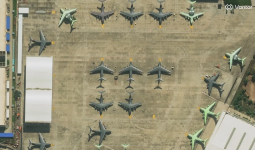
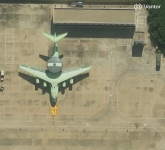
Chinese AEW ISR and Special Mission Aircraft

Is this speed... beyond your expectations?
LOL.


Well, not really even if I am always amazed by China's production capability.

In fact, that is the subject of a lecture I am currently preparing on China’s military quantum leap, which focuses not only on technological progress but, above all, on the increase in production capacity, using the example of fighter production since the J-10/11 to now J-20/35 was commissioned over the years. This is more than impressive and, by comparison, the constant claims made by a neighbouring country about China are utterly embarrassing.
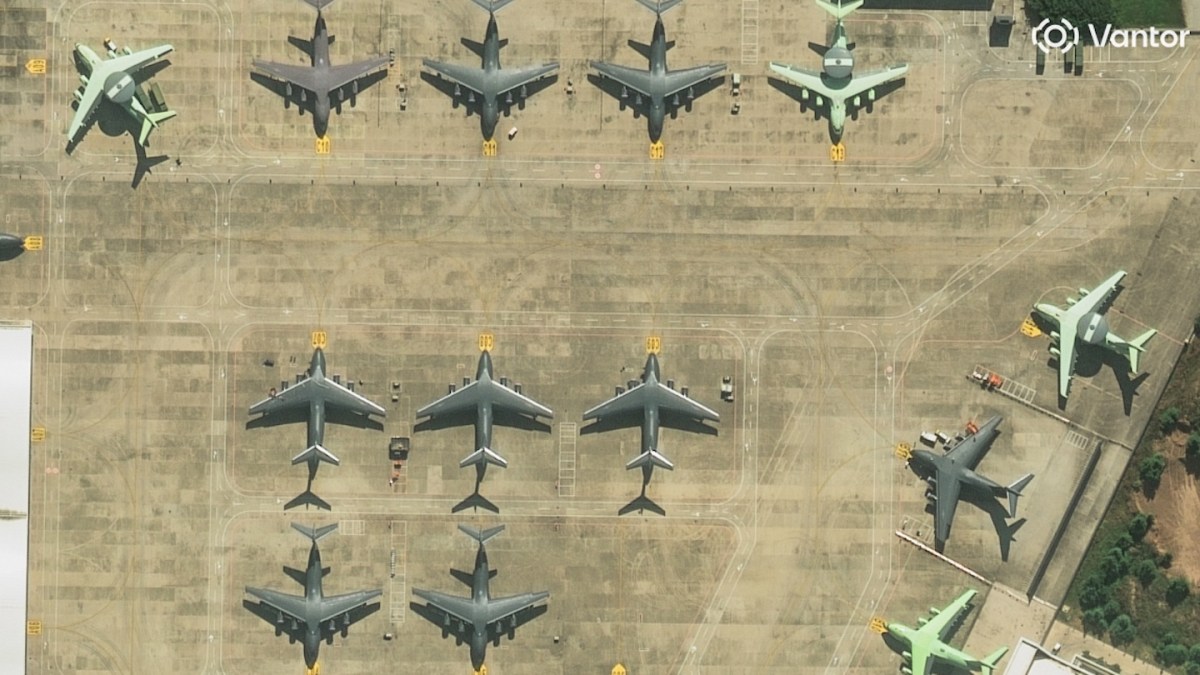
 
Here is more ...


1792733638815.png
1792734366513.png
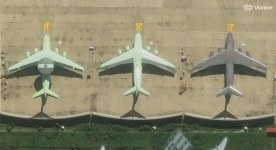
1792734352192.png

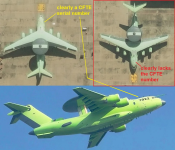
I discussed this with Thomas that at least the KJ-20 at the CFTE portion of the airfield is clearly a prototype since it bears the typical 782X serial number. The three others however do not show such a number and therefore could indeed be LRIP aircraft even if it must be reminded, we still haven't seen clear images of the no. 03 & 04 prototype to check if they also have these 782x numbers.

1792733585937.png
 
Here is more ...


View attachment 220338
View attachment 220340
View attachment 220339

I discussed this with Thomas that at least the KJ-20 at the CFTE portion of the airfield is clearly a prototype since it bears the typical 782X serial number. The three others however do not show such a number and therefore could indeed be LRIP aircraft even if it must be reminded, we still haven't seen clear images of the no. 03 & 04 prototype to check if they also have these 782x numbers.

View attachment 220337
The KJ-3000 is a strategic-level airborne early warning and control (AEW&C) aircraft, and its actual deployed fleet size is likely quite small—I estimate a final total of around 10 units, rather than the dozens that some might imagine.

Based on past practice, the senior-most commander aboard a KJ-2000 during routine operations is typically an Air Force major general; during extraordinary circumstances, this role—and the authority for top-level decision-making—can be assumed by an Air Force lieutenant general or even a full general.

The primary mission of the KJ-3000 is to succeed the KJ-2000 in its role as a strategic-level AEW&C platform. Meanwhile, routine operational tasks will continue to be handled by tactical-level AEW&C assets, such as the KJ-500, KJ-600, and KJ-700.


This is interesting ... I guessed so far, about two dozen would be a not unrealistic number.
 
This is interesting ... I guessed so far, about two dozen would be a not unrealistic number.
Generally speaking, China needs to keep at least one strategic-level Airborne Early Warning and Control (AEW&C) aircraft in a state of operational readiness for each strategic direction, tasked with aerial command and decision-making for that theater. Given China’s current system of five theater commands—and accounting for the need to rotate aircraft for operational readiness, maintenance, and other requirements—a total deployment of 10 KJ-3000s would be a baseline figure. Your estimate of over 20 aircraft seems a bit extravagant.

Of course, as Chinese military enthusiasts, we would naturally love to see China deploy more of these strategic-level assets. However, they are truly expensive, so we must also consider the balance of assets.

Since this is just a casual, recreational form of analysis and discussion, it doesn’t require a great deal of supporting evidence.


I fully understand your arguments, but I’m even more interested in your point regarding ‘who commands such an important strategic asset’! I wasn’t aware of that and would like to learn more about this (sources??)

My layman’s assumption was simply that the PLAAF would deploy the KJ-2000 – and consequently its successors – in a similar way to how the USAF deploys its E-3 AWACS… and since the USAF had 16 aircraft in service, at least until recently, I thought around 20–24 wouldn’t be an exaggeration.
Within the PLAAF (People's Liberation Army Air Force) structure, strategic-level Airborne Early Warning and Control (AEW&C) assets fall directly under the command of a Theater Air Force. While the physical aircraft are nominally assigned to a specific special-mission aviation regiment or division within that Theater Air Force, operational command authority rests directly with the Theater Air Force headquarters.

Whenever such an aircraft takes off for a combat mission, the senior commander on board is an officer from the Theater Air Force headquarters—not from the specific aviation regiment or division to which the aircraft is assigned. This officer typically holds a rank of at least Major General; in rare instances, the rank may be Senior Colonel (roughly equivalent to a Brigadier General in Western military ranks). For critical missions, the commander may hold the rank of Lieutenant General or even General.

The commander aboard a tactical-level AEW&C aircraft is typically an officer from the unit to which the aircraft’s assets belong—for instance, the commander, chief of staff, or deputy commander of an aviation brigade.

In China, one can often gauge the situation regarding a weapons platform by the rank of the commander stationed aboard it.
 
What the satellites passing over this place failed to capture is of more interest to us all.😂
 
My layman’s assumption was simply that the PLAAF would deploy the KJ-2000 – and consequently its successors – in a similar way to how the USAF deploys its E-3 AWACS… and since the USAF had 16 aircraft in service, at least until recently, I thought around 20–24 wouldn’t be an exaggeration.
But................

There is another possibility..........

If XAC were to "ruthlessly" leverage its massive production capacity to drastically reduce costs and increase output, effectively reducing the KJ-3000 strategic-grade AEW&C to a tactical-grade AEW&C, then it might achieve widespread adoption......

Although this idea might seem implausible, it is, in fact, possible that they would do such a thing......

It’s as if—the J-20 was originally a high-end stealth fighter, yet now, it’s actually being fielded on a massive scale...
 
What the satellites passing over this place failed to capture is of more interest to us all.😂


Yes, although I’m really optimistic that it won’t be long before our patience is rewarded.
 

Users who are viewing this thread

  • Back
    Top