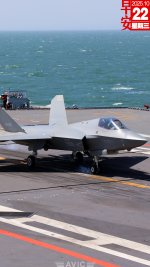
Chinese Aircraft Carriers - Liaoning, Shandong, Fujian and the future

China starts building Type 004 nuclear aircraft carrier to rival U.S. Navy’s Ford-class​

2 Oct, 2025 - 13:24
China started building its fourth aircraft carrier, the nuclear-powered Type 004, analysts confirmed on September 29, 2025. Built to rival the U.S. Navy’s Ford-class, the warship could shift the balance of power in the Indo-Pacific.

Chinese military analysts confirmed on September 29, 2025, that Beijing has begun construction on its fourth aircraft carrier, the nuclear-powered Type 004. The vessel will feature electromagnetic catapults and an advanced carrier air wing, designed to rival the U.S. Navy’s Ford-class. The move is significant because it signals a direct challenge to American naval dominance and raises new security concerns in the Indo-Pacific.

China_starts_building_Type_004_nuclear_aircraft_carrier_to_rival_U.S._Navys_Ford-class_1920_001-e4a23839.jpeg

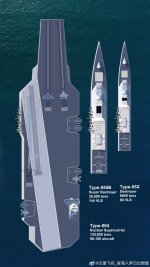
Artist rendering of China's next-generation aircraft carrier Type 004, featuring a full-length CATOBAR flight deck, electromagnetic catapults, and an expanded island superstructure. The nuclear-powered supercarrier is designed to operate over 90 fixed-wing aircraft, including J-15T strike fighters and stealth J-35 jets, marking a dramatic leap in the PLA Navy's blue-water power projection capabilities. (Picture source: China social network)

The Chinese Type 004 and the U.S. Navy Gerald R. Ford-class share key next-generation features, yet they diverge significantly in terms of technological maturity and mission integration. Both vessels exceed 100,000 tons in displacement and adopt electromagnetic catapult systems, with EMALS on the Ford and a domestically developed equivalent aboard the Type 004. Each carrier is powered by nuclear propulsion, with the Ford-class using two A1B reactors that generate over 700 megawatts of power. In contrast, Chinese defense sources suggest that the Type 004 will feature twin pressurized water reactors, estimated to produce around 450 to 500 megawatts combined. The Ford-class supports an air wing of approximately 75 aircraft, including F-35C stealth fighters, E-2D Advanced Hawkeye AEW&C aircraft, and EA-18G Growlers for electronic warfare.

In contrast, the Chinese Type 004 is expected to carry over 90 aircraft, favoring numerical strength with a mix of J-15T heavy strike fighters, fifth-generation J-35 stealth jets, KJ-600 AEW platforms, and future unmanned systems. The Ford-class benefits from advanced arresting gear, highly automated weapons elevators, and a next-generation flight deck designed to support up to 160 sorties per day in surge conditions. While the Type 004 may aim to match these performance benchmarks, its actual operational effectiveness will depend on the PLAN’s ability to master complex deck operations, logistical sustainment at sea, and integrated joint force command, areas where the U.S. Navy maintains a decisive institutional advantage.

Early assessments from Chinese defense sources suggest the new carrier will displace between 110,000 and 120,000 tons, placing it firmly in the category of a full-scale supercarrier. Construction has reportedly commenced at the Dalian Shipyard, where satellite imagery and insider leaks reveal modular assembly of hull sections and specialized catapult launch infrastructure. Once operational, the Type 004 will carry more than 90 fixed-wing aircraft, including an expected mix of 24 to 30 J-15T catapult-launched heavy fighters and over 20 stealthy J-35 multirole combat aircraft, specifically designed for carrier-based operations and low-observable strike missions.

The warship’s nuclear propulsion system, a first for any Chinese surface combatant, is believed to be based on a navalized derivative of China’s Longwei pressurized-water reactor series, offering nearly unlimited operational range. This will enable PLAN carrier strike groups to sustain operations far beyond China's littoral zones, extending Beijing’s maritime reach across the Pacific and potentially into the Indian Ocean and beyond. With a full CATOBAR flight deck and high-tempo sortie generation capabilities, the Type 004 is being engineered for extended power projection, fleet air defense, and contested sea control, key attributes in any future conflict scenario with a peer adversary.

The implications for the United States Navy are immediate and serious. For decades, American supercarriers have maintained uncontested dominance across the world’s oceans, backed by a sophisticated network of logistics, carrier air wings, and integrated escort formations. The emergence of a Chinese nuclear-powered carrier with a comparable displacement and aviation capacity suggests the beginning of a true blue-water competition. While the U.S. Navy still maintains an edge in operational experience and advanced technologies such as the F-35C and E-2D Advanced Hawkeye, the rapid pace of Chinese carrier development threatens to narrow that gap.

Chinese analysts have indicated that the Type 004 will be escorted by the most modern warships in the PLAN fleet, including the stealth-optimized Type 055A/B guided-missile destroyers, the next-generation Type 054B frigates, and the still-classified Type 095 nuclear-powered attack submarines. These assets would allow the PLAN to field a cohesive, modern, and highly capable carrier strike group that mirrors U.S. Navy CSG formations in both structure and function.

Compared to China’s previous three aircraft carriers, Liaoning (Type 001), Shandong (Type 002), and Fujian (Type 003), the Type 004 represents an unprecedented technological leap. The Liaoning, a refitted Soviet Kuznetsov-class vessel, is limited by its ski-jump launch system and conventional steam power, making it more of a transitional training platform than a true frontline carrier. Shandong, while domestically built, retains the same STOBAR configuration and faces the same limitations in aircraft payload and sortie generation.

The real evolution began with the Fujian, the Type 003, which introduced electromagnetic catapults and a flat flight deck, a critical departure from the ski-jump design. However, Fujian remains conventionally powered, restricting its sustained reach and endurance. By contrast, the Type 004 combines all major features of modern Western carriers: nuclear propulsion, electromagnetic catapults, a large and diverse air wing, and sustained blue-water operational capabilities.

In terms of length, the Type 004 is expected to measure approximately 330 to 340 meters, slightly longer than the Fujian (estimated at 316 meters), and approaching the dimensions of the U.S. Navy’s Gerald R. Ford-class, which measures 337 meters. By comparison, the Liaoning and Shandong both measure around 305 meters, reflecting their limitations in aviation capacity and deck operations. The larger hull of the Type 004 will allow for expanded hangar space, dual aircraft elevators, and improved internal logistics for munitions, fuel, and spare parts, enabling a much higher sortie generation rate.

When it comes to aircraft capabilities, the Type 004’s projected air wing of over 90 aircraft represents a substantial increase from previous Chinese carriers. The Liaoning and Shandong can each embark around 36 to 44 aircraft, mostly J-15s, constrained by the lack of catapults. The Fujian is expected to carry 60 to 70 aircraft, including early warning and stealth platforms, thanks to its electromagnetic launch system. However, only the Type 004 combines catapult-launch capability with nuclear propulsion, enabling longer deployments and a more diverse, fully loaded air wing, including heavier platforms such as fixed-wing AEW&C aircraft (KJ-600) and unmanned combat aerial vehicles (UCAVs).

The propulsion architecture is where the Type 004 truly redefines Chinese naval engineering. Unlike the steam turbines used on Liaoning, Shandong, and Fujian, the Type 004 will reportedly employ two or more nuclear reactors, based on China’s Longwei PWR (Pressurized Water Reactor) design, adapted for maritime use. These reactors are believed to deliver power not only to the ship’s propulsion but also to its electromagnetic catapults, high-capacity radar arrays, and possibly future high-energy weapons systems. This places the Type 004 in the same strategic category as U.S. nuclear supercarriers, enabling extended global deployments without the need for refueling, an essential trait for any navy seeking to operate beyond its regional waters.

In summary, the Type 004 is not merely a continuation of China’s carrier development program. It is a transformational platform designed to match or exceed the capabilities of its American counterparts.

With greater length, nuclear propulsion, expanded air wing capacity, and a launch system capable of supporting next-generation manned and unmanned aircraft, the Type 004 positions China to enter a new era of maritime dominance. For the U.S. Navy, this development represents the emergence of a true near-peer competitor on the high seas and a direct challenge to its historical control of carrier-based power projection.

 

China Begins Construction of Type 004 Nuclear Supercarrier, Set to Surpass U.S. Navy’s Gerald R. Ford​

China has officially commenced construction of the Type 004, a nuclear-powered supercarrier expected to displace over 110,000 tons, signaling a historic leap in Beijing’s quest to rival U.S. naval supremacy.

On Sep 30, 2025

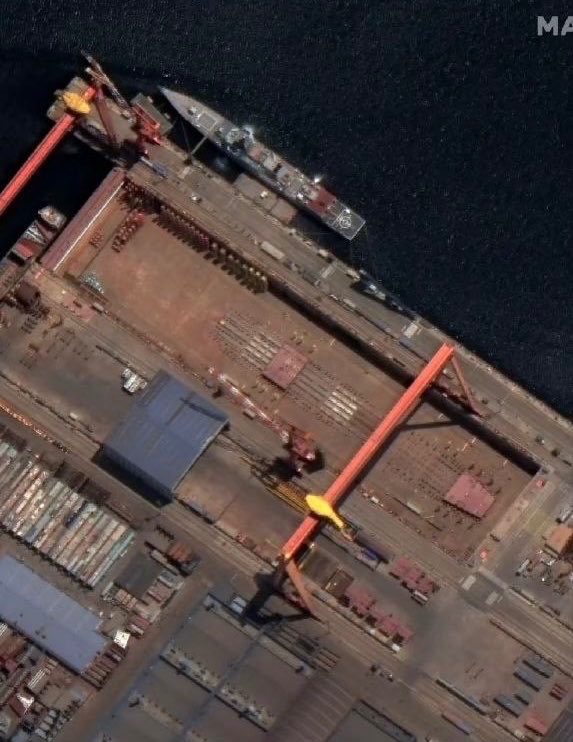
– Defence analysts has confirmed through newly released satellite imagery that China has commenced construction of its fourth aircraft carrier, designated as the Type 004, at the Dalian shipyard.

The Type 004 is expected to be a nuclear-powered supercarrier displacing between 110,000 and 120,000 tons, making it not only the largest warship ever built in Asia but potentially the largest in the world.

Type 004


Satellite image of Type 004

This development underscores the People’s Liberation Army Navy’s (PLAN) determination to transform itself into a true blue-water navy capable of sustained global operations, far beyond the near seas of East Asia.

The project also represents the most ambitious step in China’s naval modernization programme, reflecting Beijing’s grand strategy to challenge U.S. maritime supremacy in the Indo-Pacific and beyond.

Satellite evidence suggests that the keel-laying ceremony for the Type 004 may have taken place in recent months, a symbolic milestone that signals Beijing’s confidence in its nuclear propulsion technology.

Defence experts note that the vessel’s sheer displacement would allow it to host not only a larger air wing but also expanded command-and-control facilities, enabling it to function as a floating joint operations hub for the PLAN.

If completed on schedule, the Type 004 will mark the first time in history that a non-Western navy has deployed a nuclear-powered supercarrier, a breakthrough with profound implications for the global maritime balance of power.

Its nuclear propulsion system is believed to draw heavily from China’s experience with the Type 093 and forthcoming Type 095 nuclear-powered attack submarines, giving Beijing a degree of technological confidence despite its lack of carrier-specific operational history.

Analysts further assess that the Type 004 will integrate a new generation of phased-array radars and shipborne air-defence systems, potentially comparable to or exceeding the capabilities of the U.S. Navy’s Aegis combat system.

Taken together, these developments position the Type 004 not merely as another addition to the PLAN’s fleet but as the strategic centrepiece of China’s aspirations to conduct sustained, global, carrier-based power projection by the mid-2030s.

Background on China’s Aircraft Carrier Evolution​

China’s naval rise has been both rapid and deliberate, anchored by a clear strategy of technological catch-up followed by innovation.

The journey began with the Liaoning (Type 001), a refurbished Soviet Kuznetsov-class carrier acquired from Ukraine, commissioned in 2012 as both a training and experimentation platform.

Beijing followed this with its first domestically built carrier, the Shandong (Type 002), commissioned in 2019, which introduced incremental design improvements such as an enlarged flight deck and enhanced living quarters.

The real leap came in June 2022 with the launch of the Fujian (Type 003), a conventionally powered supercarrier featuring electromagnetic aircraft launch systems (EMALS), placing it in the same technological bracket as America’s Ford-class carriers.


Fujian’s ongoing sea trials have demonstrated China’s ability to master catapult-based launch operations, marking a departure from the ski-jump systems used on earlier carriers.

With the Type 004, China is now venturing into nuclear propulsion, a technological frontier that only the United States and France have mastered for carrier operations.

20250930_112915.jpg

Construction Progress and Satellite Confirmation

Satellite imagery obtained in September 2025 revealed significant construction activity at the Dalian shipyard, with massive prefabricated hull sections and modules assembled in dry dock.


Earlier imagery from February 2025 had already shown the appearance of large modules consistent with carrier flight deck structures, including elongated sections resembling catapult tracks.

By July 2025, additional imagery confirmed the presence of new industrial cranes and reinforced dry dock areas, suggesting preparations for the assembly of a supercarrier-sized hull.

More tellingly, renovations at China’s land-based aircraft carrier test facility in Wuhan, observed in September 2025, hinted at forthcoming trials for new launch and recovery systems expected to be integrated into the Type 004.

Social media users on platforms such as Weibo and X have circulated images of heavy construction equipment and new carrier components at Dalian, fueling widespread speculation that the Type 004’s hull assembly is well underway.


Independent naval analysts point out that the scale of prefabrication at Dalian indicates China’s growing efficiency in modular shipbuilding, a technique that significantly shortens construction timelines compared to traditional methods.

High-resolution imagery has also identified new infrastructure around the shipyard, including expanded cooling-water systems and reinforced dry dock gates, features consistent with supporting nuclear-powered vessels.

Defence observers believe the pace of visible construction aligns with China’s strategic goal of achieving a launch window for the Type 004 by 2028–2029, roughly five to six years from initial assembly to sea trials.

Parallel satellite monitoring of supply-chain facilities in northern China has revealed increased shipments of high-grade steel and reactor components, suggesting a nationwide logistical effort behind the programme.

Crucially, the ongoing upgrades at the Wuhan land-based carrier simulator—including a possible new electromagnetic launch track—point to Beijing’s determination to test and refine the Type 004’s systems before full sea deployment, minimizing operational risks.

Specifications: Nuclear Propulsion and Supercarrier Design

Defence analysts estimate that the Type 004 will displace between 110,000 and 120,000 tons, surpassing even the U.S. Navy’s USS Gerald R. Ford, which displaces about 100,000 tons.

The vessel is projected to carry more than 90 fixed-wing aircraft, including stealth-capable J-35 fighters, KJ-600 airborne early warning aircraft, electronic warfare jets, and advanced unmanned combat aerial vehicles (UCAVs).

Nuclear propulsion will provide the Type 004 with unlimited range and endurance, enabling sustained deployments in distant oceans without the need for frequent refueling.

The ship is also expected to adopt integrated electric propulsion (IEP), powering not only the propulsion system but also high-energy weapons such as directed-energy systems and electromagnetic railguns in the future.

Chinese military blogs have suggested the possibility of four EMALS catapults installed on the Type 004, compared to three on the Fujian, which would significantly boost sortie generation rates.

Defence sources also believe the Type 004 will feature a larger and more robust island superstructure equipped with advanced phased-array radars, giving it enhanced situational awareness and battle management capabilities across vast maritime theatres.

The adoption of nuclear propulsion not only increases endurance but also frees up considerable internal space for aviation fuel, munitions, and logistics support, dramatically extending the carrier’s operational reach.

Analysts assess that the integration of electromagnetic catapults will allow the PLAN to deploy heavier aircraft such as early-warning platforms and next-generation stealth UAVs, something ski-jump carriers cannot accommodate.

The ship’s IEP system is expected to deliver unprecedented electrical output, positioning the Type 004 as the first Chinese carrier capable of fielding directed-energy weapons like shipborne lasers to intercept incoming missiles or drones.

If these projections prove accurate, the Type 004 will not merely match U.S. supercarriers in displacement but could exceed them in adaptability, offering the PLAN a platform designed with future technological growth in mind.

Comparison with the USS Gerald R. Ford

The natural benchmark for the Type 004 is the U.S. Navy’s USS Gerald R. Ford, commissioned in 2017 as the most advanced aircraft carrier in the world.

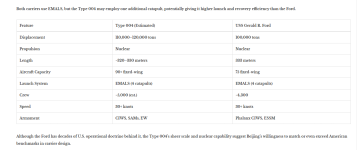
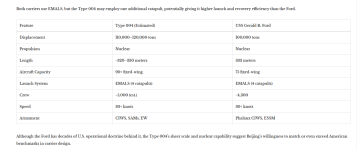
While the Ford displaces around 100,000 tons and carries about 75 aircraft, the Type 004 is projected to surpass it both in tonnage and aircraft capacity, potentially embarking 90 or more aircraft.

Both carriers use EMALS, but the Type 004 may employ one additional catapult, potentially giving it higher launch and recovery efficiency than the Ford.

微信图片_2025-10-14_210751_837.png
Although the Ford has decades of U.S. operational doctrine behind it, the Type 004’s sheer scale and nuclear capability suggest Beijing’s willingness to match or even exceed American benchmarks in carrier design.

Carrier Strike Group and Escort Vessels​

No carrier operates in isolation, and the PLAN has steadily developed the escort fleet necessary to protect a carrier strike group (CSG) built around the Type 004.

The backbone of this escort fleet will be the Type 055A/B “Renhai-class” destroyers, 13,000-ton warships with 112 vertical launch cells, AESA radars, and advanced electronic warfare systems.

China has already commissioned several Type 055 destroyers, with upgraded A/B variants under construction, designed to provide long-range air defence and anti-submarine capabilities.

Supporting them will be the new Type 054B frigates, optimized for anti-submarine warfare (ASW) with integrated electric propulsion, dual helicopter hangars, and expanded radar ranges.

Below the surface, Type 095 nuclear-powered attack submarines (SSNs) will escort the carrier group, bringing stealth, cruise missile capability, and advanced sonar suites to shield the carrier from enemy submarines.

This layered escort architecture mirrors U.S. Navy CSG doctrine, ensuring the Type 004 will operate as the centerpiece of a formidable multi-domain task force.

Aircraft Complement: From J-35 to UCAVs​

The effectiveness of the Type 004 will hinge on its embarked air wing, which is expected to feature a blend of manned and unmanned platforms.

The J-35 stealth fighter, often described as China’s answer to the U.S. F-35C, will likely serve as the backbone of the carrier’s offensive air capability, with radar cross-sections optimized for survivability in contested environments.

Supporting the J-35 will be the KJ-600 airborne early warning aircraft, which uses a twin-turboprop configuration similar to the U.S. Navy’s E-2D Hawkeye, enabling network-centric operations across wide maritime battlespaces.

Electronic warfare variants of the J-15 or future dedicated jamming aircraft are also expected, enhancing the carrier’s role in suppression of enemy air defences (SEAD).

Most significantly, the Type 004 is anticipated to deploy advanced unmanned combat aerial vehicles (UCAVs), leveraging artificial intelligence to perform long-endurance strike, reconnaissance, and electronic attack missions.

This integration of unmanned systems would mark a major doctrinal evolution for the PLAN, potentially giving it the ability to conduct high-risk missions without endangering pilots.

Strategic and Geopolitical Implications​

The emergence of the Type 004 highlights Beijing’s determination to extend its naval influence beyond the first and second island chains.

With nuclear propulsion, the supercarrier could sustain operations in the Indian Ocean, the Middle East, and even the Atlantic, a dramatic departure from China’s traditionally regional naval posture.

For Washington, the construction of the Type 004 represents a direct challenge to U.S. dominance in carrier warfare, an area where America has enjoyed uncontested superiority for decades.

The Indo-Pacific will likely witness increased competition, with U.S. and allied forces adjusting deployment patterns to counterbalance the PLAN’s new capabilities.

Nations such as Japan, India, and Australia are already accelerating naval modernization programs in response, including the acquisition of next-generation submarines, long-range missiles, and carrier-capable aircraft.

The strategic equation in the South China Sea, Taiwan Strait, and beyond will inevitably shift as the PLAN’s fourth carrier becomes operational in the next decade.

Challenges Ahead for the PLAN​

Despite the fanfare, significant hurdles remain for China in bringing the Type 004 to operational status.

Developing reliable nuclear propulsion for a supercarrier is an engineering challenge of the highest order, requiring not only technological expertise but also decades of operational experience.

The U.S. Navy, with more than 70 years of nuclear carrier operations, holds a deep reservoir of institutional knowledge that China lacks.

Carrier air wing integration, complex deck handling procedures, and large-scale joint operations are areas where China is still in the early stages of learning.

Nevertheless, Beijing’s rapid pace of shipbuilding and ability to absorb lessons from the Fujian suggest that the Type 004 could become operational sooner than Western analysts expect, potentially by the early 2030s.

A New Era in Naval Power​

The commencement of the Type 004’s construction marks a historic milestone in global naval competition.

China is no longer content with parity in regional waters; it is positioning itself to project power on a truly global scale.

With a displacement surpassing 110,000 tons, nuclear propulsion, four EMALS catapults, and a 90+ aircraft air wing, the Type 004 is designed to rival and potentially surpass America’s most advanced carriers.

Escorted by Type 055 destroyers, Type 054B frigates, and Type 095 submarines, this supercarrier will sit at the heart of a Chinese carrier strike group capable of global power projection.

The strategic ramifications are profound, heralding a new chapter in the U.S.-China rivalry and the future of naval warfare.

As one analyst summarized, “China’s fourth carrier is not just about prestige—it is about rewriting the rules of maritime power projection in the 21st century.”

For Washington and its allies, the emergence of the Type 004 signals the need to recalibrate existing naval doctrines, particularly in the Indo-Pacific where freedom of navigation operations may soon be directly contested by a peer competitor.

Regional states such as Japan, India, and Australia will inevitably view the carrier’s debut as a wake-up call, accelerating their procurement of long-range strike assets, advanced submarines, and integrated air-defence networks.

The Type 004 also carries symbolic weight, demonstrating to domestic and international audiences that Beijing’s defence-industrial base has matured to the point of competing head-to-head with the West in the most complex arena of naval engineering.

Yet, the supercarrier’s real impact will depend on the PLAN’s ability to master complex carrier strike group operations, an area where the U.S. Navy maintains unmatched institutional experience and combat-tested doctrine.

If China successfully closes this operational gap within the next decade, the balance of naval power may tilt irreversibly, ushering in a multipolar maritime order unseen since the height of the Cold War.

With a displacement surpassing 110,000 tons, nuclear propulsion, four EMALS catapults, and a 90+ aircraft air wing, the Type 004 is designed to rival and potentially surpass America’s most advanced carriers.

Escorted by Type 055 destroyers, Type 054B frigates, and Type 095 submarines, this supercarrier will sit at the heart of a Chinese carrier strike group capable of global power projection.

The strategic ramifications are profound, heralding a new chapter in the U.S.-China rivalry and the future of naval warfare.

As one analyst summarized, “China’s fourth carrier is not just about prestige—it is about rewriting the rules of maritime power projection in the 21st century.”

For Washington and its allies, the emergence of the Type 004 signals the need to recalibrate existing naval doctrines, particularly in the Indo-Pacific where freedom of navigation operations may soon be directly contested by a peer competitor.

Regional states such as Japan, India, and Australia will inevitably view the carrier’s debut as a wake-up call, accelerating their procurement of long-range strike assets, advanced submarines, and integrated air-defence networks.

The Type 004 also carries symbolic weight, demonstrating to domestic and international audiences that Beijing’s defence-industrial base has matured to the point of competing head-to-head with the West in the most complex arena of naval engineering.

Yet, the supercarrier’s real impact will depend on the PLAN’s ability to master complex carrier strike group operations, an area where the U.S. Navy maintains unmatched institutional experience and combat-tested doctrine.

If China successfully closes this operational gap within the next decade, the balance of naval power may tilt irreversibly, ushering in a multipolar maritime order unseen since the height of the Cold War. — DEFENCE SECURITY ASIA

 
So similar size but only a bit more than half the power ? 700 vs 400-500.
 
from what we can see at Wuhan the island its smaller and further back optimising the deck area for operations and logistics

also the lack of a funnel suggests its a CVN for 004

I would expect 4 Cats and 3 elevators with 100,000+ tons full load

a true Blue Water Carrier for Global operations

although 003 has 3 Cats because it has EMALS which can get jets in the air quicker and faster for a longer period of time because steam starts to lose pressure after a dozen launches on the Nimitz Class

also steam takes 30-60 mins to reach pressure whereas 003 can detect and launch aircraft almost immediately

and the Ford Class which has EMALS after 13 years still hasn't been able to launch a 5th generation F35 due to poor management and technical issues

wheres China with 003 has used EMALS to carry out the Worlds very first launch of a 5th generation aircraft

so in summary 003 can probably do more sorties with more advanced jets than Nimtiz Class

Ford Class may have the launch rate but doesn't have the 5th generation aircraft

another words China and just Trumped US Navy in Carrier technology
 
The two sections have been joined
To view this content we will need your consent to set third party cookies.
For more detailed information, see our cookies page.
 
from what we can see at Wuhan the island its smaller and further back optimising the deck area for operations and logistics

also the lack of a funnel suggests its a CVN for 004

I would expect 4 Cats and 3 elevators with 100,000+ tons full load

a true Blue Water Carrier for Global operations

although 003 has 3 Cats because it has EMALS which can get jets in the air quicker and faster for a longer period of time because steam starts to lose pressure after a dozen launches on the Nimitz Class

also steam takes 30-60 mins to reach pressure whereas 003 can detect and launch aircraft almost immediately

and the Ford Class which has EMALS after 13 years still hasn't been able to launch a 5th generation F35 due to poor management and technical issues

wheres China with 003 has used EMALS to carry out the Worlds very first launch of a 5th generation aircraft

so in summary 003 can probably do more sorties with more advanced jets than Nimtiz Class

Ford Class may have the launch rate but doesn't have the 5th generation aircraft

another words China and just Trumped US Navy in Carrier technology

The CVN-19 will be around 120,000 - 130,000 tonnes, because it needs a super large 350 × 85 meters long/wide flight deck to host 4 longer EMALS catapults.

However, China's nuclear supercarriers do have the gas turbines as the supplementary propulsion which will be different from the American nuclear supercarriers.
 
Last edited:

Type 004 comparison with the USS Gerald R. Ford

View attachment 153872
Any estimate on the power plants? Some say only two 500 mw molten salt reactors plus a few CGT-40 Gas turbines? Any confirmation.

The risk is the ship maybe underpowered to go to and beyond 30 knots.

The 50,000 ton Type 076 only has ~78MW Of power, while the Italian carrier of 35,000 tons has nearly double that much power.

Are Chinese ships underpowered? And if so, is this issue being addressed in the Type 004, Type 055B, Type 052X?

I understand China is developing and experimenting, but many western analysts think Chinese ships can’t maintain high speed for sustained blue water operations.

5:50-7:30
To view this content we will need your consent to set third party cookies.
For more detailed information, see our cookies page.


The Ford has Emergency Diesel Generator (EDG), apart from its Nuclear reactors, which sailors on the Nimitz class say is used very often, so that power on that matters. This is to support the 2x700 MW thermal reactors to power a 100,000 ton ship.

Does the PLAN propose to have 4 x 500 mw reactors to power its 110-120,000 carrier plus 2-4 CGT-40 gas turbines? or fewer reactors and more gas turbines (plus perhaps backup emergency diesel generators)?

EDG on the Ford: https://www.fairbanksmorsedefense.com/solution/engine/fm-pa6b-stc

Nimitzs use GM-EMD 645s, which are 2-stroke engines. Ford uses Colt-Pielstick PA6Bs, which are 4-stroke.
 
Last edited:
So similar size but only a bit more than half the power ? 700 vs 400-500.
I suspect they will probably use 4 x 500 MW reactors. If not in the Type 004 then by the Type 005.
 
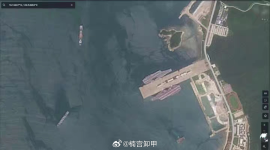
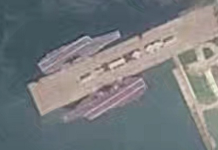
According to the latest satellite image showing the PLANS-17 and -18 together at their pier at Sanya, it seems as if the Fujian's pennant number "18" has been applied! (via 楠宫卸甲)

1761313447003.png
1761313455791.png
 

Users who are viewing this thread

Pakistan Defence Latest

Latest Posts

Back
Top