Chinese Economy: General News, Updates and Discussions

More global firms eye Hong Kong for cheaper yuan loans, bonds​

The HKMA yuan facility charges an interest rate equal to the Shanghai interbank rate, which is 200 basis points lower than the US fed rate


Published: 6:30pm, 8 Apr 2026

More companies are using Hong Kong as a platform to tap yuan funds to finance their operations, thanks to the city’s active capital market and a new 200 billion yuan (US$28.68 billion) liquidity facility that provides steady, cheap yuan funding, according to a Standard Chartered report on Wednesday.

Among companies that have yuan exposure, about 24 per cent said they would like to increase yuan financing over the next three years, according to Standard Chartered, citing the results of a survey of 300 global firms across 19 sectors.

Hong Kong has almost 1 trillion yuan of bank deposits, while lenders can also tap cheap and stable yuan funds from the Hong Kong Monetary Authority’s (HKMA) RMB Business Facility.

Launched in February last year, the facility initially had a 100 billion yuan quota for 40 banks, including Standard Chartered, to arrange yuan loans for their clients. The facility was so popular that the People’s Bank of China supported the HKMA in doubling the amount to 200 billion yuan starting in February this year.

“We are seeing an increasing number of international companies extensively using yuan in areas such as cross-border trade, procurement and supply chains,” said Karen Ng, head of China opening and RMB Internationalisation at Standard Chartered.

“Hong Kong has also introduced a range of measures to enhance offshore yuan liquidity and facilitate trade financing,” she said.

Standard Chartered has used the facility to provide short-term yuan loans to companies in Hong Kong and Singapore, with interest rates charged at the Shanghai three-month interbank offered rate (SHIBOR), which is 200 basis points lower than the US fed rate.

“Besides a lower interest rate, global companies are interested in issuing yuan bonds or borrowing yuan due to geopolitical tensions,” said Tom Chan Pak-lam, honorary president of the Institute of Securities Dealers.

The US-Israel war on Iran has led investors to “cut their reliance on US dollar assets”, which would encourage more companies to issue dim sum bonds in Hong Kong, which in turn would “support the city’s role as a large offshore yuan centre”, he added.

Standard Chartered also said Hong Kong’s active capital market had allowed many companies to raise yuan-denominated bonds, also called dim sum bonds, while companies could trade mainland bonds via the Bond Connect scheme.

Chinese e-commerce major JD.com last week priced a 10 billion yuan (HK$11.4 billion) dual-tranche offshore bond offering in Hong Kong.

Dim sum bond issuance had surged in recent years, from about 300 billion yuan in 2021 to 850 billion yuan in 2024, and was expected to reach between 900 billion yuan and 1 trillion yuan in 2025, according to a December report by Deutsche Bank.

“Leveraging the advantages of the 15th five-year plan and its role as a ‘superconnector’, Hong Kong is further consolidating its position as the world’s largest offshore yuan business centre and advancing the internationalisation of the yuan,” Ng said.
 
To view this content we will need your consent to set third party cookies.
For more detailed information, see our cookies page.
 
To view this content we will need your consent to set third party cookies.
For more detailed information, see our cookies page.
 
To view this content we will need your consent to set third party cookies.
For more detailed information, see our cookies page.
 
On April 2, China's CIPS (Cross-Border Interbank Payment System) recorded a single-day transaction volume exceeding 1.2 trillion RMB for the first time, marking an all-time high! In the just-concluded month of March, the average daily payment volume surged 48.5% month-over-month.Data shows that the proportion of RMB settlement for Middle Eastern crude oil imports to China has reached 41%, with Saudi Arabia charging straight toward a 60% target. Iran is even more thorough: nearly 100% of its oil trade with China is now settled in RMB, and it's even demanding passage fees through the Strait of Hormuz be paid in RMB or stablecoins.The closed loop of oil-RMB-Chinese goods is accelerating into formation
 

China's record purchase boosts Brazil monthly oil exports to second-highest​

By Reuters
April 9, 20266:36 AM GMT+8Updated 2 hours ago

RIO DE JANEIRO, April 8 (Reuters) - China bought a record volume of crude oil from Brazil in March, bringing the South American nation's total monthly crude exports to their second-highest level on record, according to data released this week ‌by the Brazilian government.

China imported 1.6 million barrels per day (bpd) of crude oil from Brazil last month, the data showed, as global energy flows have been reshaped as a result of the U.S.-Israel war on Iran. The previous record of around 1.46 million bpd was recorded in May 2020.

China's record purchases led Brazil ⁠to export a total of 2.5 million bpd of crude oil in March across all markets. Brazil's total crude exports rose 12.4% from February to mark the second-highest volume registered for any month, only behind March 2023.
 
To view this content we will need your consent to set third party cookies.
For more detailed information, see our cookies page.
 
To view this content we will need your consent to set third party cookies.
For more detailed information, see our cookies page.
 
China’s yuan settlements hit record, and the Iran conflict is looking like a catalyst
Single-day transactions via China’s Cross-border Interbank Payment System surge past 1 trillion yuan as Beijing’s moves to expand the yuan-payment network show signs of paying off

Published: 9:00pm, 9 Apr 2026

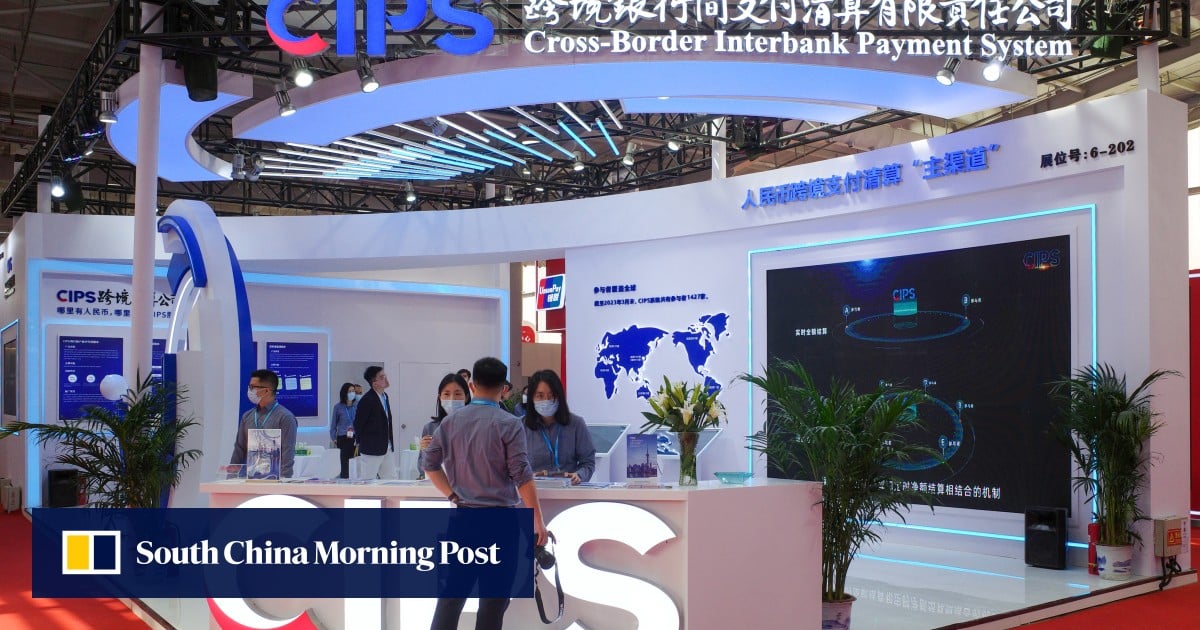
Rising demand for yuan settlement amid Middle East tensions is driving record transaction amounts in China’s cross-border payment system, analysts said, building on years of efforts to bolster financial infrastructure and expand its global network.

“The Middle East conflict may have acted as a catalyst,” said Ding Shuang, chief economist for Greater China and North Asia at Standard Chartered, citing rising demand for yuan settlement, particularly in oil trade.

China’s Cross-border Interbank Payment System (CIPS) recently saw its single-day transaction value reach a record high of 1.22 trillion yuan (US$178.5 billion), with nearly 42,000 transactions processed, according to the state-owned Shanghai Securities News on Thursday.

The surge follows strong momentum in March, when the system’s average daily transaction value climbed to 920.45 billion yuan – the highest level in a year and a nearly 50 per cent rise from February’s 619.74 billion yuan. Average daily transaction volume also rose to 35,740, up sharply from 25,930 in February.

Ding added that the recent rise has also been supported by the yuan’s relative stability, China’s investment in cross-border payment infrastructure, and a growing number of CIPS participants.

In the longer run, an expanding yuan-payment network will also support the [currency’s] adoption
Xu Tianchen, Economist Intelligence Unit

The yuan has been on a steady upwards trajectory in recent months; as of the noon session on Thursday, the offshore yuan was trading at around 6.834 against the US dollar. A lower yuan exchange-rate figure indicates a stronger Chinese currency, as it takes fewer yuan to purchase one dollar.
 
According to data released by the Ministry of Education's Study Abroad Service Center, in 2025, the number of Chinese students studying abroad exceeded 570,000, while the number of returnees reached 535,600. The numbers going out and coming back are nearly equal. Talent is flowing back.
 
To view this content we will need your consent to set third party cookies.
For more detailed information, see our cookies page.
 
I hope we see reconciliation and merger with mainland China soon, in the most peaceful of ways. It looks like things are heading in that direction.
 
To view this content we will need your consent to set third party cookies.
For more detailed information, see our cookies page.
 
To view this content we will need your consent to set third party cookies.
For more detailed information, see our cookies page.
 
China to Suspend Sulfuric Acid Exports Amid Global Supply Strain


Binance News

16h・Verified Binance official account


China has announced plans to stop exporting sulfuric acid starting in May, a move that is expected to impact the metals and fertilizer industries. Bloomberg posted on X that this decision comes as these sectors are already facing challenges due to raw material shortages linked to the ongoing conflict in Iran. The halt in exports is likely to exacerbate existing supply chain issues, affecting global markets reliant on these critical materials.


Users who are viewing this thread

Pakistan Defence Latest

Country Watch Latest

Back
Top