Chinese Economy: General News, Updates and Discussions

Iran war's global energy crisis sharpens China’s advantage in clean tech​

Today 05:41 am JST

China is poised to benefit from the Iran war as global energy disruptions accelerate a shift away from fossil fuels and toward clean technologies and renewable power, industries that China dominates.

Most of the oil and gas from the now mostly shut Strait of Hormuz was Asia-bound. Asian nations are scrambling to conserve energy and bolster dwindling reserves. As a temporary ceasefire teeters, gasoline prices in the U.S. and Europe are spiking.

While most of Asia is hit hard, China will likely benefit from the fossil fuel disruptions despite being the biggest purchaser of Iranian oil. China leads the world in battery, solar and electric vehicle exports, and its industries are forecast to face a rise in demand for renewable products.

Before the start of the Iran war in late February, China's lead in clean technologies was lengthening. The U.S. under President Donald Trump scaled back on renewable energy and leaned on its vast oil and gas resources, promoting energy exports to achieve what Trump described as “energy dominance.”

Now Chinese industry giants like vehicle-maker BYD and battery-producer CATL are well-positioned to capitalize on growing interest in low-emissions energy products as the world confronts the fragility of fossil fuels.

“China’s approach to energy sector development and geopolitics has been completely validated by the Iran conflict,” said Sam Reynolds with the U.S.-based Institute for Energy Economics and Financial Analysis.

Over a decade ago, Chinese President Xi Jinping merged energy security with national security. China has since stepped up its focus on renewable energy, even though fossil fuels still dominate its domestic energy mix.

China makes over 70% of EV manufacturing and about 85% of battery cell production globally, according to the International Energy Agency. Its current five-year plan until 2030 continues to prioritize these industries.

“They are at the very forefront of this, more so than any other countries in the world, certainly more so than the United States," said Li Shuo, director of the Asia Society Policy Institute’s China Climate Hub.

The U.S. is the world’s top oil producer and has pushed liquefied natural gas. The American approach — summed up by Trump as “ drill, baby, drill ” — favors fossil fuels over renewables.

Markets were witnessing a “bifurcation” before the war, Reynolds said, with the superpowers pushing very different energy futures, leaving other countries with complex choices on which approach to back.

The Iran war is driving demand for Chinese technology, whose exports of items such as solar panels, batteries and electric cars hit a record of almost $22.3 billion in December. That was up about 47% from the year before, with much going to Southeast Asia and Europe, according to the think tank Ember.

Investment in renewable power and battery storage — designed to save energy when the sun isn’t shining or the wind isn’t blowing — is expected to increase in nations heavily dependent on energy imports, including European countries, according to the credit rating firm Fitch Ratings.

Investors are betting the war will boost demand for renewables. In March, CATL and BYD’s Hong Kong traded shares rose roughly 24% and 11%, respectively.

Over the past few years, Chinese automakers were already expanding EV development and production while growing exports faster than American or European rivals, offering cheaper models and gaining ground in regions like Southeast Asia.

These trends are expected to accelerate.

The energy shock is “going to help the Chinese industry globally and hurt the American car industry globally,” said Amy Myers Jaffe of New York University’s Center for Global Affairs.

Meanwhile, high U.S. tariffs have largely shut Chinese EVs out of the American market.

Rising fuel prices also may boost BYD growth in China, said Chris Liu with the research and advisory firm Omdia.

Households facing higher energy costs are likely to move to clean power, said James Bowen of the Australia-based consultancy ReMap Research.

Pakistan offers an early example. Its renewable rollout in 2017 led to more than 50 gigawatts of Chinese solar panels imported by December 2025.

Pakistan still imports a third of its energy. About 80% of its oil flowed through the Strait of Hormuz, and Qatar had been supplying a quarter of its LNG. But “the shock isn’t as big as it would have been without solar,” said Nabiya Imran of Renewables First.

If prices remain high, solar could save Pakistan $6.3 billion in fossil fuel imports over the next year, according to think tanks Renewables First and the Centre for Research on Energy and Clean Air.

In the United Kingdom, EV leasing demand jumped by more than a third in the first three weeks of March compared to a similar period in February before the war, according to Octopus Energy, a renewable group. Octopus also reported increases in rooftop solar sales and solar-related inquiries.

In Southeast Asia, Vietnamese EV maker VinFast is offering discounts to offset fuel price shocks.

Prolonged fuel spikes may act as a future catalyst for EVs, but it will take time to see the trend reflected in purchases, partly because customers are likely waiting to see how the conflict plays out, said Patrick Tan, with the energy consultancy Aurora Research.

Even Indonesia, the world’s largest coal exporter, is recalibrating in ways that could make it a bigger customer for China's clean energy technology.

In March, Indonesian President Prabowo Subianto announced a push into EVs, including plans to produce electric cars and expand charging infrastructure.

The dream of electrified transportation is gaining renewed attention, said Putra Adhiguna of the Jakarta-based think tank Energy Shift Institute.

Chinese firms play a major role in Indonesia’s clean energy supply chain. They signed more than $54 billion dollars' worth of deals with the state utility in 2023 and added a $10 billion pledge during Prabowo’s visit to Beijing in 2024.

“There will be direct financial benefits to Chinese companies,” said Reynolds of IEEFA.


China emerge as winners of Iran war with significant gains in renewable energy sector​

HANNAH BROUGHTON
Updated Mon, April 13, 2026 at 3:24 PM GMT+8

Trump has accidentally handed China a victory

As Trump dubiously claims the Iran war has been a "victory" for the U.S., it's actually China that stands to gain significantly from the conflict as global energy disruptions drive a transition away from fossil fuels toward clean technologies and renewable energy, sectors in which China holds commanding market positions.

The majority of oil and gas flowing through the now largely closed Strait of Hormuz was destined for Asia. Asian countries are rushing to preserve energy supplies and shore up depleting reserves. With a fragile ceasefire barely holding, fuel prices across the U.S. and Europe are surging.

Although much of Asia faces severe impacts, China appears well-positioned to benefit from disruptions to fossil fuel supplies, despite being Iran's largest oil customer. China dominates global exports of batteries, solar panels, and electric vehicles, with its industries anticipated to see increased demand for renewable products.

Prior to the Iran conflict erupting in late February, China's advantage in clean technology was already expanding. Under President Donald Trump, the U.S. pulled back from renewable energy initiatives and focused on leveraging its substantial oil and gas reserves, championing energy exports to secure what Trump termed "energy dominance."

Today, Chinese industrial powerhouses such as automaker BYD and battery manufacturer CATL are well-positioned to benefit from rising global interest in low-emission energy solutions as the world grapples with the vulnerability of fossil fuels.

"China's approach to energy sector development and geopolitics has been completely validated by the Iran conflict," Sam Reynolds with the U.S.-based Institute for Energy Economics and Financial Analysis told the AP.

More than ten years ago, Chinese President Xi Jinping intertwined energy security with national security. Since then, China has intensified its commitment to renewable energy, despite fossil fuels continuing to dominate its domestic energy landscape.

According to the International Energy Agency, China accounts for over 70% of global EV manufacturing and approximately 85% of battery cell production. These industries remain a top priority in China's current five-year plan, which runs through 2030.

"They are at the very forefront of this, more so than any other countries in the world, certainly more so than the United States," noted Li Shuo, director of the Asia Society Policy Institute's China Climate Hub.

Reynolds observed that markets were experiencing a "bifurcation" prior to the conflict, with the two superpowers championing vastly different energy futures, presenting other nations with difficult decisions about which path to support.

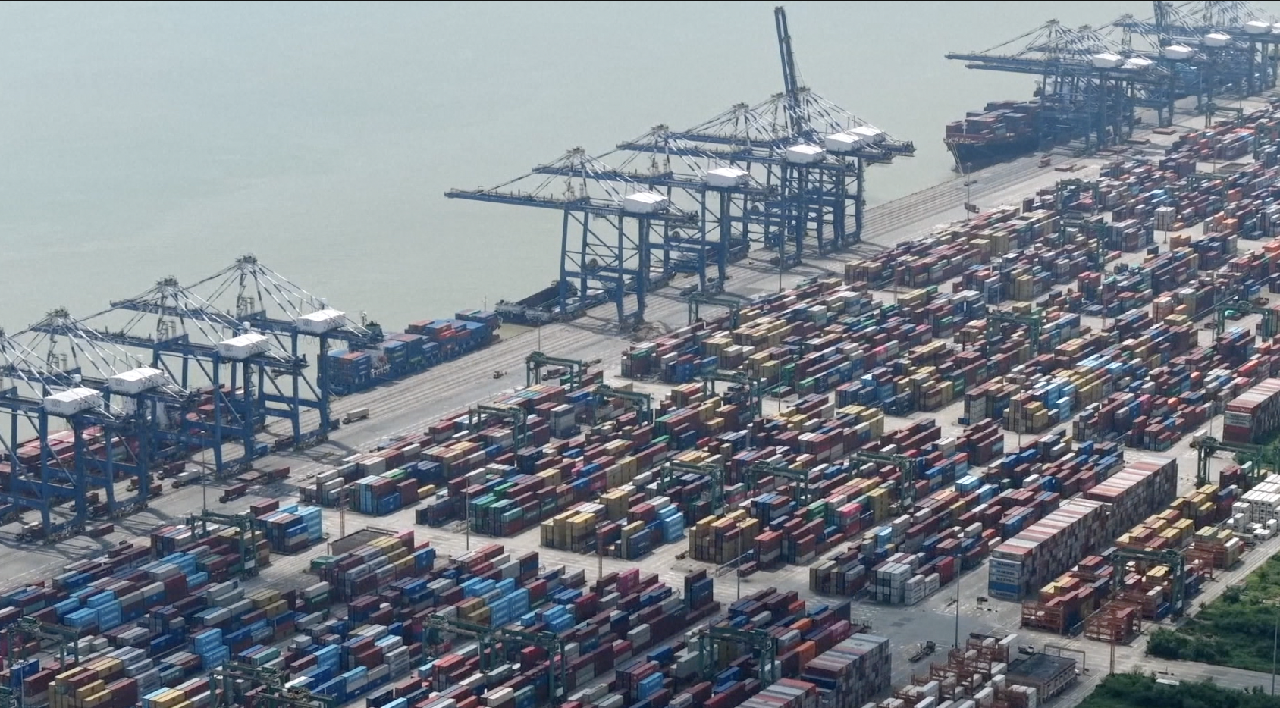
The Iran war is fueling demand for Chinese technology, with exports of goods such as solar panels, batteries, and electric vehicles reaching a record high of nearly $22.3 billion in December - a surge of roughly 47% compared to the previous year, with a significant portion destined for Southeast Asia and Europe, according to the think tank Ember.

Credit rating firm Fitch Ratings anticipates that investment in renewable power and battery storage - engineered to preserve energy during periods of low sunlight or wind - will grow in nations heavily reliant on energy imports, particularly across Europe.

Market players are wagering that the conflict will drive up demand for renewable energy. During March, Hong Kong-traded shares in CATL and BYD climbed approximately 24% and 11%, respectively.


China unveils sweeping plan to embrace AI in classrooms​

National strategy aims to integrate artificial intelligence in education by 2030


20260417 Caixin AI education

A primary school student uses a robotic arm in China's Zhejiang province in November. The country is also reaching out to embed artificial intelligence in its education system. © Getty Images

FAN QIAOJIA, Caixin
April 18, 2026 12:00 JST

China has unveiled a sweeping national strategy to integrate artificial intelligence into its education system by 2030, targeting everything from personalized tutoring and teacher certification to predicting demographic shifts and reallocating educational resources.

 
Last year, China’s solar and wind power generation was roughly equal to total industrial and residential power consumption in the United States.

1776447995775
 
To view this content we will need your consent to set third party cookies.
For more detailed information, see our cookies page.
 

Why the Iran War Has Been Surprisingly Alright for China​


To view this content we will need your consent to set third party cookies.
For more detailed information, see our cookies page.
 

China clean tech exports jump amid global energy disruption​

Apr 19, 2026, 07:43 IST

China’s exports of clean technology climbed in March, reinforcing signs that manufacturers are benefiting from rising global demand for alternative energy sources as traditional supplies are roiled by the Iran war.

The most notable growth came in shipments of lithiumion batteries and electric vehicles, with an annual increase of 34% and 53%, according to data released by China’s General Administration of Customs on Saturday.

Solar cells also saw 80% growth last month. All three exports rose from Feb levels as well.The data give the first comprehensive picture of China’s clean tech exports since the US and Israel launched attacks against Iran seven weeks ago, effectively shutting the Strait of Hormuz and sparking a global energy crisis.

The disruptions caused by the conflict have heightened the issue of energy security for countries reliant on fuel imports and sent consumers and industries hunting for alternatives.“This is just the beginning, the knock-on effects of high energy prices will be unfolding for months to come,” said Euan Graham, senior analyst at UK-based think tank Ember. “Clean technologies are an escape from soaring fuel costs for consumers and a long term route for countries to reduce fossil fuel reliance.


Rare reversal: China's import growth outpaces export growth in Q1​

16-Apr-2026

China's foreign trade posted its strongest Q1 growth in five years. One detail stands out: import growth exceeded export growth, a rare shift.
 
China and Chinese Shadow Reserves

China's foreign exchange reserves, holding above $3.2 trillion by April 2026, represent official assets managed by SAFE. “Shadow reserves” are uncounted, off-balance-sheet foreign assets held by state banks, policy lenders, and sovereign wealth funds to avoid sanctions, support currency stability, or fund strategic investments. These hidden reserves may account for as much as half of China's total estimated USD holdings.
Asia Society +3
Official Reserves (SAFE/PBoC)
  • Total: Approx. $3.399 trillion as of January 2026.
  • Purpose: Maintain yuan stability, international trade, and service debt.
  • Management: Controlled by the State Administration of Foreign Exchange (SAFE).
    CEIC Data +3
Shadow Reserves (Hidden/Hidden Assets)
  • Location: Moved into commercial bank deposits, state-owned enterprises (SOEs), and overseas investment vehicles.
  • Purpose: Protect assets from U.S. sanctions, allow for subtle intervention in markets, and finance strategic global projects.
  • Mechanism: When SAFE lends to policy banks or when state banks purchase FX, these funds often move off official reserve reporting but stay under state control.
  • Key Estimates: Observers estimate that over the past decade, a significant portion of China's USD reserves were shifted to these opaque, harder-to-track vehicles.
    Asia Society +3
Significance of the Shadow Reserves
  • Geopolitical Defense: They offer a safeguard against aggressive financial sanctions, as they are not registered on the central bank's balance sheet, making them harder for foreign governments to freeze.
  • Hidden Strength: They explain the continued stability of China's reported reserves despite persistent trade surpluses and potential capital outflows.
  • Economic Management: Used to quietly intervene in distressed sectors, such as real estate, or to facilitate the acquisition of foreign critical technologies.
    Asia Society +3
 
China's foreign exchange reserves, holding above $3.2 trillion by April 2026, represent official assets managed by SAFE. “Shadow reserves” are uncounted, off-balance-sheet foreign assets held by state banks, policy lenders, and sovereign wealth funds to avoid sanctions, support currency stability, or fund strategic investments. These hidden reserves may account for as much as half of China's total estimated USD holdings.
Asia Society +3
Official Reserves (SAFE/PBoC)
  • Total: Approx. $3.399 trillion as of January 2026.
  • Purpose: Maintain yuan stability, international trade, and service debt.
  • Management: Controlled by the State Administration of Foreign Exchange (SAFE).
    CEIC Data +3
Shadow Reserves (Hidden/Hidden Assets)
  • Location: Moved into commercial bank deposits, state-owned enterprises (SOEs), and overseas investment vehicles.
  • Purpose: Protect assets from U.S. sanctions, allow for subtle intervention in markets, and finance strategic global projects.
  • Mechanism: When SAFE lends to policy banks or when state banks purchase FX, these funds often move off official reserve reporting but stay under state control.
  • Key Estimates: Observers estimate that over the past decade, a significant portion of China's USD reserves were shifted to these opaque, harder-to-track vehicles.
    Asia Society +3
Significance of the Shadow Reserves
  • Geopolitical Defense: They offer a safeguard against aggressive financial sanctions, as they are not registered on the central bank's balance sheet, making them harder for foreign governments to freeze.
  • Hidden Strength: They explain the continued stability of China's reported reserves despite persistent trade surpluses and potential capital outflows.
  • Economic Management: Used to quietly intervene in distressed sectors, such as real estate, or to facilitate the acquisition of foreign critical technologies.
    Asia Society +3
China still has around $600billion in US treasury bonds. Should China try and reduce it quickly while not alerting US?
 

Rare reversal: China's import growth outpaces export growth in Q1​

16-Apr-2026

China's foreign trade posted its strongest Q1 growth in five years. One detail stands out: import growth exceeded export growth, a rare shift.
US is in recession now lol. Meanwhile Chinese exports grew over 20% year on year which is crazy.
 

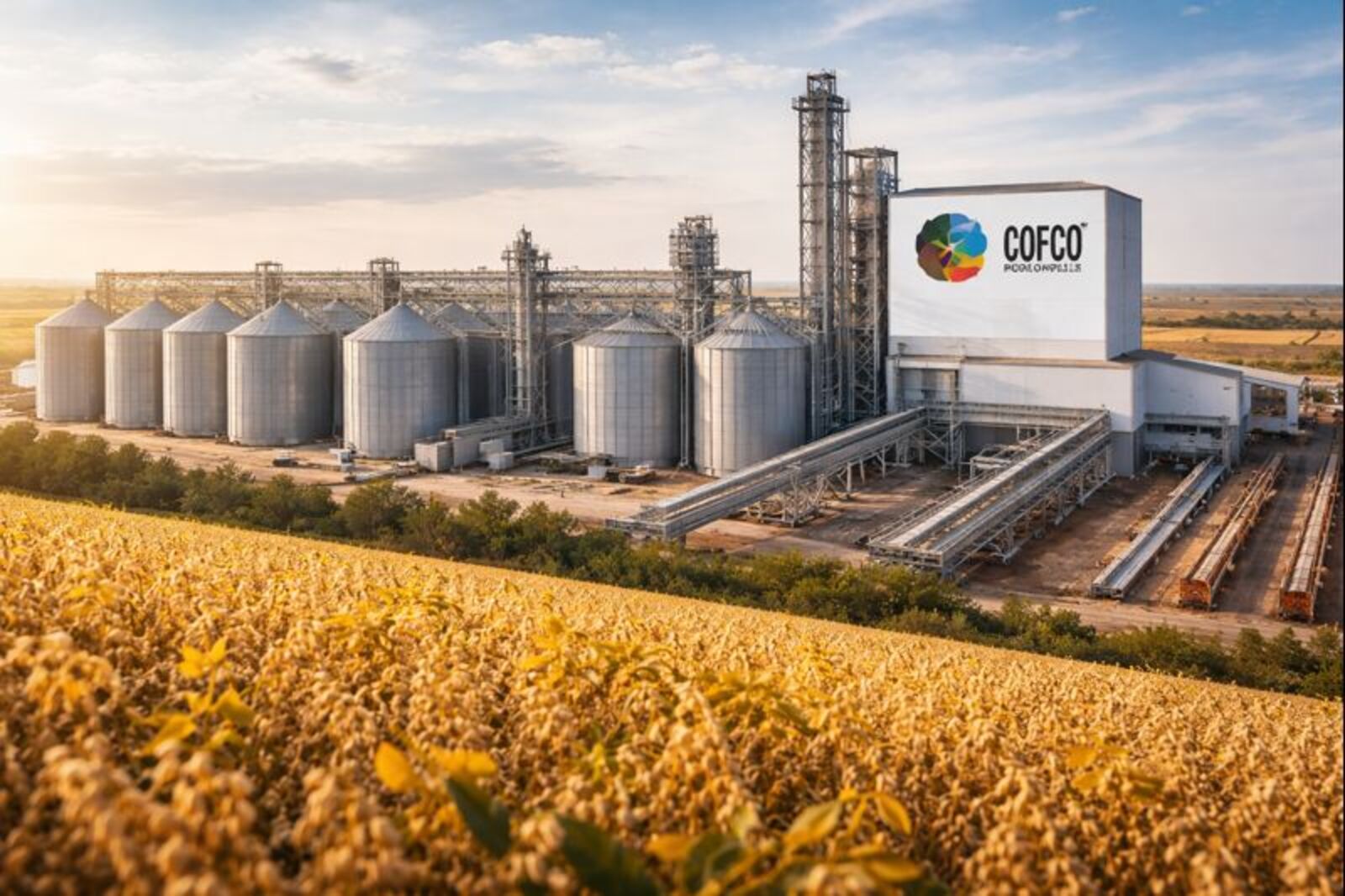
Chinese food giant COFCO to build Brazil’s largest soybean crushing complex
Published on18/04/2026 at 21:49

COFCO will invest over R$ 2 billion in Rondonópolis to double the factory’s capacity and transform the unit into the largest soybean crushing complex in Brazil

COFCO confirmed an investment of over R$ 2 billion to expand the factory in Rondonópolis, Mato Grosso, with delivery expected by early 2028 and the goal of transforming the unit into the largest soybean crushing complex in Brazil.

Confirmed investment from the Chinese giant​

The announcement was confirmed by the city hall of Rondonópolis, a municipality in Mato Grosso recognized for its strong agribusiness and relevance in the soybean supply chain.

With the construction, COFCO aims to expand its industrial structure in an already existing area, next to the railway terminal, reinforcing the flow of production.

The expansion seeks to increase the weight of soy processed locally and enhance the company’s industrial presence in a strategic city for production, storage, and transportation in the state.

Factory capacity​

Currently, the unit processes 4,500 tons of soy per day. After the expansion, the capacity is expected to reach around 10,000 tons daily.

The plant produces soybean meal, soybean oil, and biodiesel, which are central products of the industrial operation maintained by the Chinese multinational in the municipality.

Weight of Rondonópolis​

Rondonópolis is one of the main agribusiness hubs in the country and ranks as the second largest economy in Mato Grosso.

The municipality is often referred to as the Capital of Agribusiness due to its role in logistics, industrialization, and the flow of soy.

Dispute for the title​

Despite the reference to Rondonópolis, the official and most common title of National Capital of Agribusiness is attributed to Sorriso, also in Mato Grosso.

The justification is linked to the higher production of the grain in the state, which keeps Sorriso as the main national reference in this segment.

The forecast is that the factory expansion will be completed by early 2028. Until then, the investment is expected to consolidate soy as the central axis of COFCO’s industrial project in Rondonópolis.
 

Published: 14:05, April 20, 2026
China's power use up 5.2% in Q1

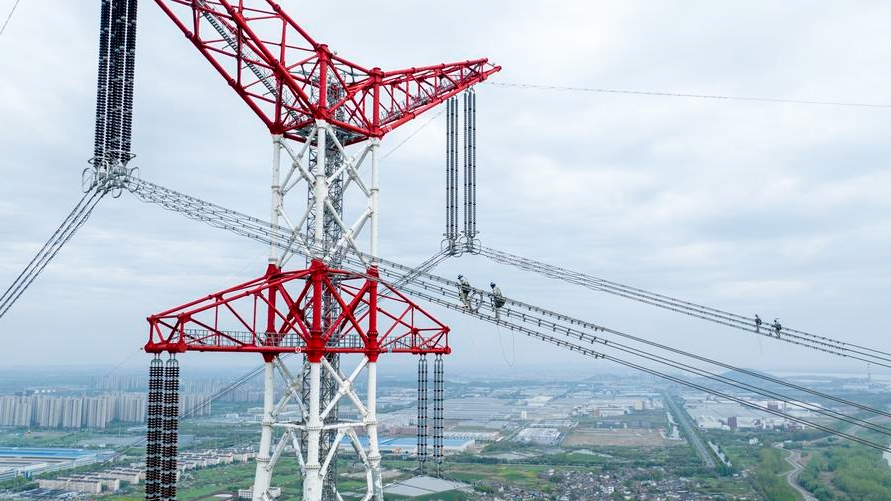
BEIJING -- China's electricity consumption, a key barometer of economic activity, reached more than 2.51 trillion kilowatt-hours in the first quarter of 2026, up 5.2 percent year-on-year, according to data released Monday by the National Energy Administration.

A breakdown of the data shows robust growth across various sectors.

The primary industry saw a 7.1 percent increase in power consumption, bringing total consumption to 33.6 billion kilowatt-hours.

The secondary industry consumed about 1.6 trillion kilowatt-hours, up 4.7 percent from a year ago. Within this sector, the high-tech and equipment manufacturing industry posted particularly strong growth, with electricity consumption increasing 8.6 percent year-on-year.

The tertiary industry recorded 8.1 percent growth in power use, totaling 483.3 billion kilowatt-hours. Notably, the battery charging and swapping service sector consumed 37.6 billion kilowatt-hours, surging 53.8 percent, while the internet data service sector used 22.9 billion kilowatt-hours, up 44 percent.

In March alone, electricity consumption reached 859.5 billion kilowatt-hours, up 3.5 percent year-on-year.

China's economy grew 5 percent in the first quarter, outpacing expectations of some foreign institutions and reinforcing the country's role as a stabilizing force in an increasingly volatile global economy.
 

China weathered Trump's tariffs - but the Iran war is taking a toll​

Laura BickerChina correspondent , Foshan and Guangzhou

p0nflt0q.jpg


1:00
Watch: How the US-Iran war is costing China

It's a sombre gathering in the backstreets of one of China's biggest manufacturing hubs, where workers are smoking under a tree in front of storefronts advertising temporary factory jobs.

"No-one understands what our life is like," says one man who is unwilling to be named.

"We work and work and have no life. Please help us," another adds - a rare, risky plea to a foreign journalist.

They seem desperate, struggling to earn enough to send money home, as they cope with the massive shifts in Chinese manufacturing, from cheap, mass-produced goods to automated advanced tech.

And that was even before the US-Israel war with Iran shook the global economy.

China's economy was already battling slower growth and unemployment when Donald Trump's tariffs hit last year. Still, it proved resilient, boosting exports and reporting GDP growth of around 5%. But the discontent continued to simmer. And now the Middle East conflict is starting to take a fresh toll, putting pressure on factory orders, costs and jobs.

In Foshan, in the southern industrial province of Guangdong, the workers' best opportunity is plastered in bright red lettering in front of them: a few weeks of moulding plastic, or screwing together parts of a mobile phone, for 18 to 20 yuan an hour, which amounts to just a few dollars or pounds.

"I'm going to try and find work elsewhere," says another worker from a rural province. Most are well over 40 years old, and frustrated at yet more uncertainty.


This is one of the reasons Beijing is calling for the war to end.

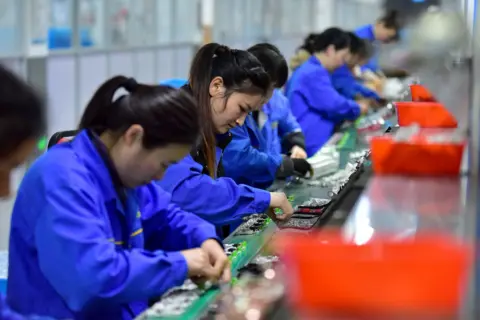
Costfoto / NurPhoto via Getty Images Women workers on a production line in a factory in Fuyang, China adjust circuit breakers while wearing blue overalls, pictured on 4 March.
Costfoto / NurPhoto via Getty Images
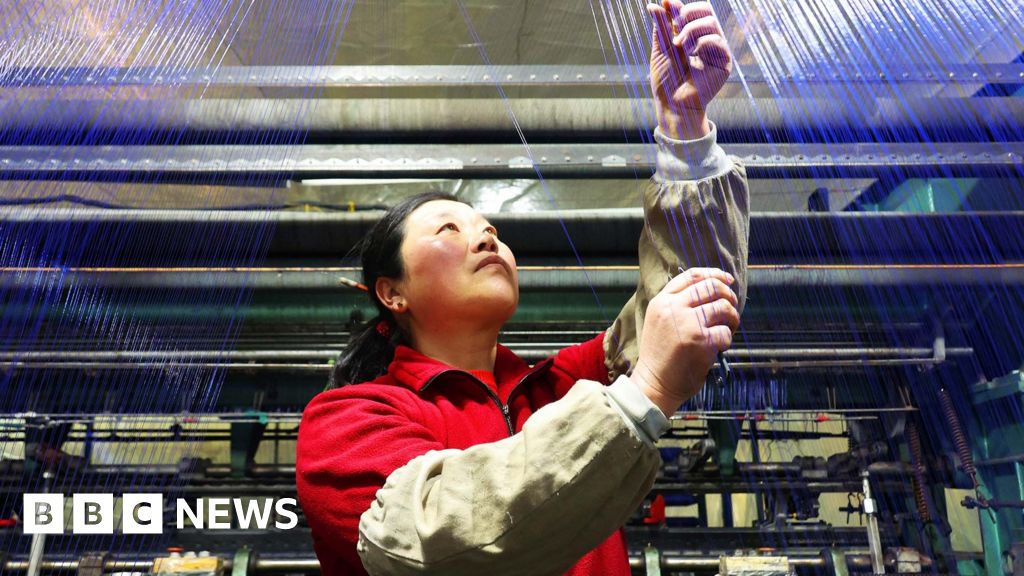
China's manufacturing industry has shifted in recent years, from mass-produced goods to advanced technology (file photo)
China's enviable oil reserves and the lead it has taken in renewables and electric cars have insulated it from the worst effects of the fuel crisis. But even as it puts on a show of steady strength, the war is choking the Strait of Hormuz, a crucial shipping route, and that is causing more pain to a sluggish Chinese economy that is heavily relying on exports.

"Costs have gone up around 20%," says one trader who didn't want to be named, as she organises workers to move cylinders of fabric from the back of a truck to a line of carts, which will take them to local factories to be cut and sewn into clothes for the world's retailers, from Zara to Shein to Temu.

This is the world's largest fabric market – in Guangzhou, an hour's drive from Foshan - and the streets pulse with motorbikes laden with rolls of vibrant textiles, as small vans and trucks honk their way through to pick up and drop off loads. The shops are hard to distinguish among the piles of nylon, polyester and silk, but each owner and seller had a similar story.

Their trade needs a cheap and steady supply of oil in the form of petrochemicals, without which they cannot produce fabric. And higher oil prices are now hitting them hard. "It means fewer orders," says one trader over tea in a back room office. He adds that some customers are refusing to pay more and rolls of fabric are piling up in the warehouse.

If they don't pass the rising cost on to the customer, they absorb it themselves. That is hard for those who're already working with slim margins.

A year ago, when the US and China were locked in a trade war, there was defiance on the streets of Guangzhou. This time, there is resignation.

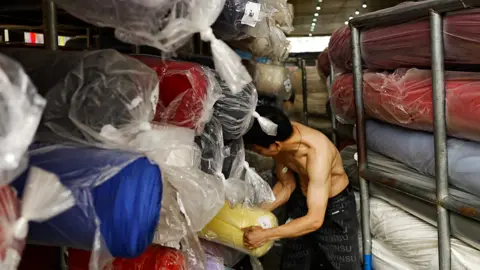
A shirtless man in black trousers wrangles large rolls of fabric wrapped in plastic, at a textile warehouse in Guangzhou

Fabric sellers in Guangzhou are worried about rising costs
But there is still opportunity amid the uncertainty.

A short drive away, manufacturers are welcoming buyers from around the world in the cavernous halls of the Canton Fair. Humanoid robots wave and sing as international visitors take selfies.

This is the China that leaders in Beijing want the world to see. A country looking towards the future and building new technology while its rival, the United States, is embroiled in a war in the Middle East.

There are large queues to try on AI glasses that claim to translate foreign languages and robotic legs to help climb mountains. There are plenty of everyday gadgets too, from vacuum cleaners that can clear stains in seconds to shiny espresso machines and hair curlers.

The one thing that is common is that their price is going up, traders say. For one, they are made of plastic, which uses oil in the manufacturing process.

But buyers are still turning up because businesses are ploughing on to serve the market - and the war has driven home China's edge in one key sector in the wake of fuel shortages: electric vehicles (EVs).

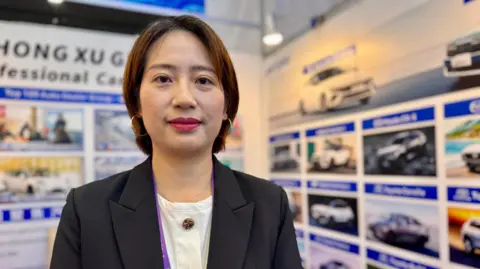
Joyce Liu at an EV stall. Joyce has short brown hair and is wearing a white shirt and smart black jacket, facing directly towards the camera.

Joyce Liu is looking for buyers beyond the Middle East for electric vehicles


Chinese manufacturers exported 350,000 EVs in March alone, a 30% increase from February, and a 140% increase from March last year, according to data from the Chinese Passenger Car Association.

EVs are also one of China's biggest exports to the Middle East, but now trader Joyce Liu is finding it tough to get shipments to customers.

"Last year 90% of our cars went to the Middle East but this year because of the war we almost stopped doing business with them," she says. "Some of the cars are still waiting at Chinese ports."

She's at the fair to find new buyers from Africa or South America, but there are also those from India, Bangladesh and Turkey at many of the EV stalls. In some countries waiting lists for Chinese EVs have been growing as petrol and diesel costs soar.

But there is also a delegation from Oman, inspecting the cars under bright spotlights and an advertisement written in English and Arabic. They have decided to do a deal and are haggling with the trader.

"We are here to co-operate with Chinese companies. It's hard right now, but Inshallah [God willing] the war will finish and business will be good," says Zahir Mohammed Zahir al-Kaabi.

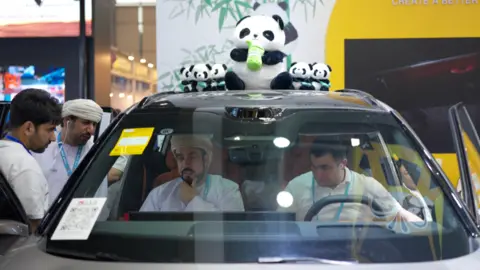
Zahir Mohammed Zahir al-Kaabi, who wears a beige turban, sits in a car with six toy pandas balanced on the roof

Zahir Mohammed Zahir al-Kaabi (left) testing a car at the Canton Fair
That is also what Beijing wants.


While the war will strengthen Beijing's ongoing push towards self-reliance, China is not really winning in this scenario, says Yu Jie from London-based think tank Chatham House.

"Ironically, a declining US is something that China hoped to see. But is this the America that China wanted? It would prefer a US that is more predictable, and that is perhaps easier for Beijing to manage."

And yet, a balancing act lies ahead because Beijing also "does not want to irritate Trump", she adds. She believes the summit scheduled for May will temper China's response to the war.

"Beijing wants to do whatever it can to secure that meeting."

From the sidelines China is calling for a ceasefire, while pushing its friend Iran towards the negotiating table. And Trump seems to want that too. Xi is also holding meetings and phone calls with the crown princes of UAE and Saudi Arabia.

This is China flexing its diplomatic muscle, says William Figueroa, professor of History and International Relations at the University of Groningen. "It wants to show both the United States and its partners in the region that it's serious about its commitments there - and that obviously has a global audience."

It's a reminder that China is no longer just at the centre of the global economy. It is increasingly at the centre of global power.

But this means little to the workers in Foshan, who are frustrated by stagnant wages.


One of them shows his pass from the Canton Fair. "I cleaned the toilets," he says, laughing as he takes another puff of his cigarette.

He got paid 150 yuan ($20; £14.80) for his 14-hour work day.


Users who are viewing this thread

Latest Posts

Back
Top