Chinese Economy: General News, Updates and Discussions

90% market share! China's high-performing 3D printers win global fans​

14:53, 02-Jun-2026


China exported 2.46 million 3D printers in the first four months of 2026, according to the latest data released by the General Administration of Customs. Overseas sales channels of consumer-grade 3D printing devices have been expanded thanks to the devices' high performance and excellent value for money.

Shenzhen City in southern China's Guangdong Province is a major production base for 3D printers, accounting for nearly 90% of the global consumer-grade 3D printer market share.


Every world leader who has visited China in 2026 in one chart

China has hosted 26 leaders from 23 countries this year, underscoring its growing diplomatic and economic influence.

2 Jun 2026


INTERACTIVE-China-visit-leaders-poster-visits-1780391725.jpg

interactive-Every-world-leader-who-has0Dvisited-China-in-2026-june-2-2026-1780398758.png


To view this content we will need your consent to set third party cookies.
For more detailed information, see our cookies page.
 

Has the US-China tech war reversed? China plans to impose export restrictions on "63 strategic technologies".


14:49 2026/06/02 China Times
Lan Xiaowei


US and Western sanctions have forced a new strategy! A Chinese research team has retaliated by imposing export controls on 63 key technologies, including quantum communication, electromagnetic catapults, and rare earth recycling. (Image: shutterstock/Dazhi)

US and Western sanctions have forced a new strategy! A Chinese research team has retaliated by imposing export controls on 63 "key technologies," including quantum communication, electromagnetic catapults, and rare earth recycling. (Image: shutterstock/Dazhi)


Since Trump launched a trade war against China during his first term, the United States, together with its Western allies, has continued to tighten restrictions on China's access to high-end technologies, targeting semiconductors, AI, quantum computing, aerospace, supercomputers, and various dual-use technologies, in an attempt to curb China's high-end manufacturing and cutting-edge technology development.


The trade war has reversed course, with China shifting from a passive to an active position.​


However, with China achieving breakthroughs in several strategic technological fields, the original landscape has been reversed. According to a report by the South China Morning Post on June 1, cited by Guancha.cn, a Chinese research team has drafted a "comprehensive" export control list targeting the United States and its allies, covering 63 technological fields. This indicates that China is no longer merely a passive recipient of international technological restrictions, but also urgently needs to establish an independent and controllable technology outflow management system for its core technologies, which have already established a global leading advantage.


National-level think tank endorsement for cutting-edge academic research​


According to reports, this groundbreaking study, titled "A Selection Framework and Empirical Study for Export-Restricted Technologies," was first published in the *Bulletin of the Chinese Academy of Sciences* on March 19 and was reiterated in a press release from the journal on May 21. The paper delves into "a fundamental strategic issue that has rarely been publicly discussed in mainland China in recent years."


The corresponding author of the paper is Fan Guobin, an academician of the Chinese Academy of Engineering and one of the core academic leaders in the field of high-energy laser engineering in mainland China; the first author is Peng Xianke, deputy secretary-general of the China Academy of Engineering Science and Technology Innovation Strategy. Peng Xianke explained to Hong Kong media that this research is currently only an academic exploration result and is not related to the official export control policy that is about to be implemented.


However, the research was jointly developed by several authoritative think tanks that are deeply involved in national science and technology strategy and security research, such as the Institute of Innovation Strategy of the Chinese Academy of Engineering, the Institute of Science and Technology Strategy Consulting of the Chinese Academy of Sciences, and the Chinese Academy of Physics, and its strategic value remains prominent.


A list of 63 technologies has been released, covering quantum communication, electromagnetic catapults, and other technologies under Level 1 control.​


The research team proposed the first relatively comprehensive export control technology identification framework in mainland China, and ultimately selected 63 technologies with strategic sensitivity or global competitiveness, covering fields such as advanced materials, quantum communication, AI hardware, energy systems, biotechnology, and aerospace engineering.


According to the paper evaluation, the technologies listed as Level 1 restricted export technologies (8.5 points or above) include: satellite quantum secure communication, electromagnetic catapult technology, solar cell related technologies, general-purpose miniaturized AI edge computers, rare earth waste tailings metal recycling technology, and advanced high-strength steel production technology for automobiles.


Other technologies include: graphdiene material preparation technology, ultraviolet and deep ultraviolet crystal preparation technology, ultra-large offshore wind turbine technology, space robots, high-performance carbon electrode preparation technology for perovskite solar cells, autonomous orbit determination technology for BeiDou-3 inter-satellite links, and free-space optical communication.


China's technology sector, characterized by "three parallel developments," urgently needs to establish a defense against technology outflow.​


Research indicates that after decades of catching up, mainland China's overall technological development has shifted from being a complete "follower" to a situation of "three-way competition," with most countries "running alongside" and a few "leading." In fields such as quantum information, additive manufacturing, AI, and robotics, some technologies have already achieved international leadership. Given the severe external environment and the accelerating pace of a new round of technological revolution, scientifically and effectively selecting the directions for export-restricted technologies is of significant strategic importance for achieving technological self-reliance and safeguarding national security.


To address this fundamental strategic issue that has been rarely discussed publicly in mainland China in recent years, the research team constructed an operational process combining qualitative and quantitative methods, namely the "Survey-Quantitative-Screening-Supplementation-Evaluation-Grading" method (SMSSEV). This model combines patent analysis, expert consultation, and strategic assessment to evaluate the technology from three dimensions: necessity, feasibility, and impact.


The Chinese version of the assessment framework is constructed with reference to the US mechanism.​


The research team mentioned in their paper that the framework partially references the export control mechanisms that the United States has long implemented. Through long-term development, the U.S. Department of Commerce has established a method that combines expert technical review with public comment to determine the technology directions and specific parameters for prohibiting or restricting exports.


The paper points out that the United States has historically focused not only on military or dual-use technologies, but also on two types of key technologies: one is the field in which developing countries, represented by China, are rapidly rising and have not yet achieved technological leadership but are expected to challenge the United States’ monopoly advantage, such as IC, supercomputing, and civilian nuclear power; the other is the cutting-edge basic technologies that are expected to determine the future technological and industrial landscape, such as 3D printing, brain-computer interfaces, and AI.


The South China Morning Post reported that the Chinese research team attempted to construct an assessment method adapted to its own development stage and industrial structure. The selection process comprehensively referenced existing lists of Chinese and foreign technologies, the International Patent Classification (IPC), technology gap models, and patent co-occurrence network analysis, and underwent multiple rounds of review by industry, government, academia, and experts. Taking advanced materials as an example, the team analyzed over 215,000 international patent records and used machine learning clustering models and network analysis to identify key technological nodes.


Peng Xianke emphasized that the final list of 63 technologies was not entirely generated by an algorithm, but rather "the result of a joint evaluation by patent selection and expert assessment."


The significance of this research extends beyond export policy, calling for accelerated institutional development.​


The South China Morning Post believes that the significance of this study extends far beyond export policy itself. In the past, China's science and technology development policy focused primarily on technology import and addressing industrial shortcomings. However, as enterprises and research institutions have entered the global first tier in several cutting-edge fields, issues such as technological sovereignty, technological security, and the protection of key strategic technologies have now entered a stage of regular discussion in China.


The study also points out that the development of China's technology trade security system lags behind that of developed countries such as the US, UK, France, Germany, and Japan. These countries have established comprehensive technology export control systems after decades of development. Based on this research, the study recommends that relevant authorities focus on three key tasks from a top-level design perspective: tracking and predicting the direction of foreign export-restricted technologies and strengthening preventative measures; improving the selection process and methods for export-restricted technologies in China; and promoting the implementation of export control measures.


With a thermal conductivity four times that of copper, synthetic diamonds from mainland China are helping to cool AI chips, leading to a surge in market demand.


00:07 2026/06/03 China Times News Network
Zhang Weixiang


Chinese-made synthetic diamonds become a savior for heat dissipation in AI chips, reshaping the semiconductor supply chain. (Shutterstock)

Chinese-made synthetic diamonds become a savior for heat dissipation in AI chips, reshaping the semiconductor supply chain. (Shutterstock)


Chinese lab-grown diamonds (synthetic diamonds, also known as man-made diamonds) are becoming increasingly popular globally, with their importance rising rapidly. Synthetic diamonds, which were previously priced low due to oversupply in the jewelry market, have now been transformed into an ideal heat dissipation material for high-performance artificial intelligence (AI) chips, leading to a surge in demand. Chinese manufacturers have already begun shipping large quantities to international high-end computing customers.


According to foreign media reports, diamond has the highest thermal conductivity of any natural substance, with a kelvin capacity of 2,000 to 2,500 watts per meter at room temperature, which is 4 to 6 times that of copper. More importantly, it is also an electrical insulator, posing no risk of short circuits.


With the explosive growth of the AI industry, high-performance chips with extremely high transistor density and huge power consumption are struggling to cope with the localized high temperatures using traditional copper heat sinks. Synthetic diamonds, used as heat dissipation layers, can quickly conduct heat away from the chip core, reducing hotspot temperatures, improving clock stability, and even allowing for more compact chip designs. Some manufacturers are even combining diamonds with copper composite materials or liquid cooling systems to create next-generation high-efficiency heat dissipation solutions.


Mainland China holds a leading global position in the production of synthetic diamonds, primarily employing chemical vapor deposition (CVD) and high-temperature, high-pressure (HPHT) technologies, giving it a clear advantage in both production capacity and cost. What was once considered a "cheap imitation diamond" product has now transformed into a key high-tech raw material. Recently, the stock prices of companies such as Zhejiang Chenghuifeng Diamond Technology and Sifang Superhard Materials have surged due to this news, indicating a highly positive market outlook.


According to a report by mining media outlet MiningMX, this surge in demand reflects the deepening of the AI computing power race into the realm of materials science. As data center power consumption continues to soar, traditional heat dissipation technologies are facing physical limits, and synthetic diamonds offer a solution. Industry experts predict that within the next five years, AI-related applications will account for a significant proportion of global synthetic diamond industrial uses, not only changing the supply and demand structure of the jewelry market but also potentially reshaping the semiconductor supply chain.


China poised to overtake the US as the world's top outbound market with 68M visitors in 2025​

China welcomed 68 million international visitors in 2025 and is on track to become the world's leading Travel & Tourism economy, the WTTC says.

04 Jun 2026

China poised to overtake the US as the world's top outbound market with 68M visitors in 2025
China is on track to become the world’s biggest Travel & Tourism economy, according to new WTTC research. Image: kitzcorner/iStock

New World Travel & Tourism Council (WTTC) 2026 Economic Impact Research reported a 15.5 per cent year-on-year rise in international travellers to China last year, while inbound visitor spending climbed 10.5 per cent to USD$135 billion, surpassing pre-pandemic levels.

The country recorded an additional nine million arrivals compared with 2024, the largest increase of any nation globally. The WTTC says China’s wider tourism sector expanded 9.9 per cent in 2025 to reach USD$1.8 trillion, more than double the global growth average of 4.1 per cent.

China is also driving Asia-Pacific to become the fastest-growing travel and tourism region in the world, with the region recording 8.1 per cent growth.

The WTTC attributes the tourism surge in China to a combination of policy reform and technological investment. Expanded visa facilitation measures now cover more than 50 countries, offering visa-free stays of up to 30 days and extended transit stays of up to 10 days.

Since 2020, arrivals from visa-exempt markets have increased fivefold, including an additional 18 per cent growth in 2025 alone. The visa-free expansion drove a surge of nine million additional visitors – the largest such increase globally.

China is also rolling out biometric systems at entry points and widening the use of digital payment platforms, while continued investment in air connectivity and high-speed rail is improving links between major gateways and secondary cities. New tourism zones, cultural attractions and theme parks are broadening the country’s offering.

WTTC President & CEO Gloria Guevara said: “China’s recovery shows how targeted policy reforms can translate directly into stronger inbound demand and sustained growth. Continued progress in visa facilitation will be essential to sustaining this momentum. This approach, over time, could position China to become the world’s leading travel and tourism if they continue with this path.”

Why it matters for Aussie advisors​

The WTTC projects China is on track to reclaim its position as the world’s largest outbound travel market with spending forecast to surge 22.5 per cent to nearly USD$280 billion in 2026, surpassing the US. It is a trajectory that sits alongside the WTTC’s broader forecast that travel and tourism will outpace the wider economy over the next decade.

China sits among the top destinations for Australian travellers, and ABS data has recorded strong growth in Aussie short-term trips to the country, helped by improving air connectivity and a large visiting-friends-and-relatives (VFR) market. The expanding visa-free regime and smoother entry processes make the destination easier to package and sell.

Growth is expected to continue with the WTTC forecasting 5.3 per cent expansion in 2026 and an average annual rate of 6.5 per cent over the next decade. By 2036, the sector is tipped to nearly double to USD$3.5 trillion and support more than 103 million jobs, accounting for one in every five new tourism jobs globally over the decade.


China poised to overtake the US as the world's top outbound market with 68M visitors in 2025​

China welcomed 68 million international visitors in 2025 and is on track to become the world's leading Travel & Tourism economy, the WTTC says.

04 Jun 2026

China poised to overtake the US as the world's top outbound market with 68M visitors in 2025's top outbound market with 68M visitors in 2025
China is on track to become the world’s biggest Travel & Tourism economy, according to new WTTC research. Image: kitzcorner/iStock

New World Travel & Tourism Council (WTTC) 2026 Economic Impact Research reported a 15.5 per cent year-on-year rise in international travellers to China last year, while inbound visitor spending climbed 10.5 per cent to USD$135 billion, surpassing pre-pandemic levels.

The country recorded an additional nine million arrivals compared with 2024, the largest increase of any nation globally. The WTTC says China’s wider tourism sector expanded 9.9 per cent in 2025 to reach USD$1.8 trillion, more than double the global growth average of 4.1 per cent.

China is also driving Asia-Pacific to become the fastest-growing travel and tourism region in the world, with the region recording 8.1 per cent growth.

The WTTC attributes the tourism surge in China to a combination of policy reform and technological investment. Expanded visa facilitation measures now cover more than 50 countries, offering visa-free stays of up to 30 days and extended transit stays of up to 10 days.

Since 2020, arrivals from visa-exempt markets have increased fivefold, including an additional 18 per cent growth in 2025 alone. The visa-free expansion drove a surge of nine million additional visitors – the largest such increase globally.

China is also rolling out biometric systems at entry points and widening the use of digital payment platforms, while continued investment in air connectivity and high-speed rail is improving links between major gateways and secondary cities. New tourism zones, cultural attractions and theme parks are broadening the country’s offering.

WTTC President & CEO Gloria Guevara said: “China’s recovery shows how targeted policy reforms can translate directly into stronger inbound demand and sustained growth. Continued progress in visa facilitation will be essential to sustaining this momentum. This approach, over time, could position China to become the world’s leading travel and tourism if they continue with this path.”

Why it matters for Aussie advisors​

The WTTC projects China is on track to reclaim its position as the world’s largest outbound travel market with spending forecast to surge 22.5 per cent to nearly USD$280 billion in 2026, surpassing the US. It is a trajectory that sits alongside the WTTC’s broader forecast that travel and tourism will outpace the wider economy over the next decade.

China sits among the top destinations for Australian travellers, and ABS data has recorded strong growth in Aussie short-term trips to the country, helped by improving air connectivity and a large visiting-friends-and-relatives (VFR) market. The expanding visa-free regime and smoother entry processes make the destination easier to package and sell.

Growth is expected to continue with the WTTC forecasting 5.3 per cent expansion in 2026 and an average annual rate of 6.5 per cent over the next decade. By 2036, the sector is tipped to nearly double to USD$3.5 trillion and support more than 103 million jobs, accounting for one in every five new tourism jobs globally over the decade.

Due to self-own by MAGA ret@rds...
 
China Dominates Global Travel & Tourism in 2026 with Explosive Visitor Growth, Record-Breaking Spending, Unmatched Job Creation, and Unstoppable Economic momentum


China's Tourism Explosion: 68M Visitors, $135B Spending in 2026

China has cemented itself as the world's fastest-growing tourism powerhouse in 2026, welcoming 68 million international visitors and generating $135 billion in spending while creating 84.6 million jobs across the sector.

By Kunal K Choudhary
June 03, 2026

Modern Beijing skyline with tourism infrastructure and high-speed rail connectivity


China has exploded onto the global tourism stage in 2026, reshaping the international travel landscape with numbers that demand attention. The nation welcomed over 68 million international visitors in 2025—a staggering 15.5% year-on-year increase—while visitor spending hit $135 billion, demolishing pre-pandemic levels and outpacing every global average in sight.

This isn't just recovery. This is dominance.

The Numbers That Changed Everything​

The scale of China's tourism resurgence is almost difficult to comprehend. According to the World Travel & Tourism Council (WTTC), the country's Travel & Tourism sector contributed $1.8 trillion to GDP in 2025, growing at 9.9% annually—more than double the global average of 4.1%.

Reddit: "China's tourism infrastructure feels like it was built yesterday but works like it was perfected decades ago." — r/travel

But here's what truly matters: employment. The sector supported 84.6 million jobs in 2025, with projections showing this will exceed 103 million by 2036. That's roughly one in five new tourism jobs globally coming directly from China. Rural regions, historically left behind, experienced a 22.6% surge in domestic trips, proving tourism growth isn't confined to glittering megacities.

Visa Revolution: 50+ Countries Get the Green Light​

In 2024, China made a calculated strategic move that transformed international travel dynamics. Visa facilitation now covers citizens of more than 50 countries, offering visa-free stays of up to 30 days and extended transit of up to 10 days.

The results? Arrivals from visa-exempt countries have increased five times since 2020, with an additional 18% growth in 2025 alone. This policy recalibration has made China as accessible as Thailand or Singapore, eroding traditional entry barriers that historically deterred casual travelers.

Digital Payment Systems: The Invisible Infrastructure​

Walk into any major Beijing, Shanghai, or Guangzhou attraction and you'll notice something remarkable: foreign visitors are seamlessly using Alipay and WeChat Pay alongside traditional cards. This wasn't accidental.

China deployed biometric systems at major entry points and standardized digital payment adoption across hospitality sectors. For a Canadian traveler booking a hotpot dinner in Chengdu or an American visitor purchasing temple admission in Xi'an, the experience is frictionless. No currency exchange lines. No confusion. Just tap and go.

This infrastructure advantage compounds across multiple touchpoints, shaping the travel experience long before visitors board their flights home.

Domestic Tourism: The Real Economic Engine​

While international arrivals grab headlines, China's domestic tourism market represents the true structural foundation of growth. In 2025, the country recorded 6.52 billion domestic trips—a 16% increase from 2024.

The Spring Festival 2026 alone generated 596 million trips with estimated spending of $110 billion, illustrating the raw purchasing power of China's internal travel ecosystem. This domestic demand doesn't just fill hotels; it sustains rural economies, funds small businesses, and creates spillover employment across secondary cities that rarely appear on international tourism radars.

The Outbound Rebalancing: China Reclaims the Crown​

Here's where the story gets interesting for international tourism boards worldwide. China is set to reclaim its position as the world's largest outbound market, with spending forecast to reach $280 billion in 2026—surpassing the United States for the first time.

Business travel ranks second in China's outbound spending at $192 billion, demonstrating influence across corporate travel that extends far beyond leisure. When Chinese executives select conferences, retreat locations, and business hubs, global destinations listen.

Southeast Asia emerges as the primary beneficiary, with improved air connectivity enabling day trips from Shanghai to Bangkok or Hanoi. Japan and South Korea are witnessing simultaneous surges in Chinese visitors, supported by cultural tourism partnerships and regional aviation expansion. Even European destinations—particularly Spain, France, Italy, and the UK—are experiencing measurable post-pandemic recovery directly attributable to rising Chinese tourist spending.

Infrastructure: The Foundation Nobody Discusses​

China's tourism dominance doesn't materialialize from visa policy alone. High-speed rail now links major cities with secondary regions, creating balanced tourism flows that historically concentrated in Beijing and Shanghai. Domestic air connectivity has expanded aggressively, making Chongqing, Kunming, and Guilin genuinely accessible to international travelers.

Theme park development, cultural attraction expansion, and specialized tourism zones have diversified appeal beyond the traditional Great Wall-Forbidden City itinerary. These are strategic bets on preventing tourism monoculture.

The 2036 Projection: Nearly Doubling in a Decade​

By 2036, China's T&T sector is expected to nearly double to $3.5 trillion GDP contribution, maintaining annual growth of 6.5%. That trajectory doesn't happen through luck or temporary tailwinds. It reflects sustained policy alignment, infrastructure investment, and technological adoption at a scale most nations can only aspire to achieve.

The convergence of domestic demand, improving international access, and strategic infrastructure positioning creates a self-reinforcing cycle. More visitors arrive, infrastructure improves, word spreads, more visitors arrive again.

China isn't simply participating in the global tourism economy in 2026. It's reshaping the competitive dynamics, forcing traditional leaders to recalibrate strategy, and demonstrating how coordinated policy and investment can elevate a nation from tourism participant to tourism architect.

The tourism scorecard for 2026 has China at the top—and that position just became much harder to challenge.

 
The more Chinese travel around the world, the more we can debunk western media lies.
 

Hong Kong overtakes Switzerland as hub for global offshore wealth

Mercedes Ruehl in Zurich and Arjun Neil Alim


MAY 27 2026

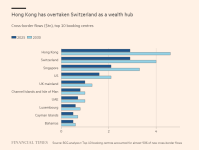
Hong Kong has overtaken Switzerland as the world’s biggest cross-border wealth hub for the first time, as an influx of investment from the Chinese mainland helped it eclipse the traditional haven.

Wealth managers in the Chinese territory booked $2.9tn of international assets in 2025, according to estimates from the Boston Consulting Group.

About 60 per cent of that came from mainland China, with BCG forecasting that the rapid increase in Asian fortunes would widen the gap between Hong Kong and Switzerland to almost $600bn by the end of the decade.

China’s growth has been bolstered by a return of equity capital markets activity in Hong Kong that has allowed companies to raise funds offshore, as well as the country’s manufacturing dominance in sectors such as electric vehicles.

But the rise of the Asian city as a cross-border hub also reflects broader shifts in global wealth flows, with clients seeking to spread their assets across multiple jurisdictions to hedge against geopolitical tensions, sanctions risks and political instability.

“This is a completely new phenomenon. I haven’t seen anything like it,” said Michael Pellman Rowland at Baseline Wealth Management, a Swiss-based independent manager with global clients.

Wealthy clients moving money offshore had traditionally been motivated by tax planning or corporate structuring, Rowland said, but since the coronavirus pandemic they had increasingly sought “jurisdictional diversification” — spreading assets across countries to protect against geopolitical and political risks.

Diversification had helped reinforce the dominance of the world’s largest “booking centres” — the hubs where banks manage and safeguard offshore wealth for international clients — according to BCG partner Michael Kahlich.

“We see two different hubs emerging,” Kahlich said, with Hong Kong and Singapore anchoring one network in Asia, and Switzerland, the UAE and the US forming a rival axis to the west.

搜狗截图20260604121237.png

Although Switzerland is more heavily tied to mature western European fortunes and less exposed to the fast-growing Asian wealth flows reshaping the industry, bankers said that many wealthy Asian clients still wanted assets ultimately booked in Switzerland.

Most large international banks, including Swiss private lenders, now have major booking operations in Hong Kong and Singapore to serve Asia’s growing fortunes.

But financiers question whether the country is doing enough to stay competitive, with its biggest bank, UBS, at loggerheads with regulators over new capital rules.

“The question is whether Switzerland is doing enough to actively defend its position in wealth management, or just relying on its stability. I think it is the latter,” said one UBS banker based in Zurich.

Other centres such as Dubai have also grown rapidly since the pandemic as a bridge between rival eastern and western pools of capital.

Banks including UBS, JPMorgan and Deutsche Bank have expanded aggressively in the emirate in recent years, drawn by zero income tax, relative political stability and an influx of wealthy individuals, hedge funds and family offices from across Russia, India, China, Europe and the Gulf.

But cross-border wealth booked in the UAE remains much smaller than either Switzerland or Hong Kong at $721bn last year, BCG said, even with growth of 11 per cent.

Singapore, another major beneficiary of the eastward shift in global capital, has also seen growth moderate after high-profile money laundering cases triggered a regulatory crackdown and tougher scrutiny of wealthy foreign clients.
 

Hong Kong Rises To World No. 1 Cross-Boundary Wealth Hub

Jun 1, 2026

Hong Kong has overtaken Switzerland as the world's top cross-boundary wealth management centre, according to the latest Global Wealth Report 2026 published by the Boston Consulting Group.

Hong Kong's cross-boundary wealth rose 10.7% in 2025 to US$2.9 trillion, driven by Chinese Mainland flows and a vigorous stock market that delivered significant IPO (initial public offering) activity and strong gains in benchmark-heavy internet platforms, according to the report. It also projected that, from 2025 to 2030 the cross-boundary wealth managed by Hong Kong will grow by 9% on average annually and maintain first place globally, fully affirming Hong Kong's position as a world-leading cross-boundary wealth management centre.

Paul Chan, Financial Secretary of the Hong Kong Special Administrative Region Government (HKSARG), highlighted that China's National 15th Five-Year Plan clearly supports Hong Kong in strengthening its functions as an international asset and wealth management centre, which is also a key component of Hong Kong's 'Finance +' development strategy.

"Over the past few years, the Government has worked closely with the financial sector to continuously improve the financial infrastructure and ecosystem, expand the range of investment products and risk management tools, and deepen the connectivity with capital markets around the world.

"Leveraging the advantages of 'one country, two systems', complemented by free, open, transparent, and predictable economic policies as well as a stable and secure investment environment, and cross-market connectivity, Hong Kong is attracting more and more ultra-high-net-worth individuals and family offices to establish a presence and invest in the city," Mr Chan said.

Christopher Hui, Secretary for Financial Services and the Treasury of the HKSARG, noted that the Government had issued the Policy Statement on Developing Family Office Businesses in Hong Kong in March 2023 and has since implemented various measures to encourage family offices to operate in Hong Kong. Such initiatives, he said, include providing profits tax concession to family-owned investment holding vehicles managed by eligible single family offices and introducing the New Capital Investment Entrant Scheme.

"The Government will introduce legislative proposals into the Legislative Council next month (June 2026) to further enhance the preferential tax regimes for funds, single family offices and carried interest, so as to further enhance the competitiveness of the tax regimes, and attract more funds and family offices to set up and operate in Hong Kong," Mr Hui said.

According to a study commissioned by Invest Hong Kong and published in February 2026, there were over 3,380 single family offices operating in Hong Kong as of end-2025, representing an increase of more than 25%, over the past two years.


Inside China's push for global dominance: Evs, robotics, AI, pandas​

NBC News

To view this content we will need your consent to set third party cookies.
For more detailed information, see our cookies page.


Jun 2, 2026

An inside look at China's push for global economic dominance with AI, humanoid robots, electric vehicles and the export of pandas. Plus, "NBC Nightly News" anchor Tom Llamas gets rare access to the restoration project underway at the Great Wall.
 
Sluggish domestic activity is dragging many other categories. Real estate-related categories, such as cement (-10.8%), glass (-7.9%), and steel (-1.7%), were clear underperformers. We may also be seeing the impact of anti-involution policies, as solar cells declined -25.6% YoY in April amid a broader crackdown on overcapacity and excessive price competition.

The impact of the Iran War is also appearing in the data. Crude oil processing volume fell -5.8% YoY on the month.

The weakness of retail sales was broad-based. There are two key themes for this month's data.

The first theme is that we're now paying the price for front-loaded demand from the trade-in policy, which we have been warning about since last year.

  • Auto sales also continued to show signs of weakness, down -15.3% YoY. Replacement demand for vehicles purchased in previous years hasn't come in yet, and many prospective buyers have already made their purchases.
  • Household appliances (-15.1%) and furniture (-10.4%), two of last year's major beneficiaries for the trade-in policies, are now deeply in contractionary territory.
The second theme concerns a pullback in gold prices following the outbreak of the Iran war. We saw a -21.3% YoY drop in gold and jewellery sales in April, as gold prices stabilised at lower levels -- after falling from record highs at the start of the year.
 
China is no longer in that much frenzy of constructions after decades of large scale buildings.
 

Users who are viewing this thread

Pakistan Defence Latest

Latest Posts

Back
Top