China is fast moving into high-end and high profit manufacturing and exports.
Goodbye to the old three! Robots, AI, and innovative drugs become the three major calling cards of China's foreign trade.
11:30 2026/07/30 Want Daily
Lin Yutong
"Panda," the world's first proactive emotional companion robot for children. (Illustration/China News Service)
From robots that can climb walls to AI that can assist in managing power grids, and innovative drugs that are entering the global healthcare system, China's export products are quietly taking on a new look. Following the "old three" of clothing, furniture, and home appliances, and the "new three" of new energy vehicles, lithium batteries, and solar photovoltaic products, the "new three" of robots, AI, and innovative drugs are accelerating their expansion overseas, becoming a new calling card for China's foreign trade.
An article published on the WeChat public account of "International Review," a subsidiary of China National Radio, pointed out that in the early stages of reform and opening up, China, with its abundant labor force and cost advantages, enabled clothing, furniture, and home appliances—the "old three commodities"—to enter the global market, and "Made in China" gradually became an important force in the world economy. In recent years, with the accelerated global energy transition, new energy vehicles, lithium batteries, and solar photovoltaic products have emerged as the "new three commodities" of China's foreign trade.
Today, with the rapid development of AI and life sciences, mainland China continues to invest in new technologies and industries. Robotics, AI, and innovative drugs are rising in succession, propelling "Made in China" to further transform into "Intelligent Manufacturing in China." These "new three elements" are not only injecting new momentum into the mainland economy but are also beginning to integrate into the industries and daily lives of various countries.
In Southeast Asia, Chinese AI technology is helping SMEs drive digital transformation and lowering the barriers to using advanced technologies; in Thailand, Chinese medical robots are delivering medicines and samples around the clock, helping to alleviate the shortage of medical personnel; in South America, Chinese companies are using telemetry technology to optimize order allocation on ride-hailing platforms, further giving rise to new services such as motorcycle passenger transport and delivery.
In Brazil, large-scale models developed by China are being used in power grid maintenance to assist inspection personnel in handling monitoring challenges in complex environments. In Australia and other places, high-altitude cleaning robots developed by China can move along building facades, reducing the risks associated with manual high-altitude work. Chinese technology products are no longer just being "sold out," but are gradually becoming part of local industrial upgrading and public services.
Today, China's exports are no longer limited to commodities. From clothing, furniture, and home appliances to new energy vehicles, lithium batteries, and solar photovoltaic products, and now to robots, AI, and innovative drugs, the "three essentials" of China's foreign trade are constantly being updated, reflecting that China's industries are moving from large-scale manufacturing to technological innovation.
從能爬牆的機器人,到能協助管理電網的AI,再到走進全球醫療體系的創新藥,大陸出口商品正悄悄換上新面貌。繼服裝、家具、家電等「老三樣」,以及新能源汽車、鋰電池、太陽能光電產品等「新三樣」後,由機器人、AI與

www-chinatimes-com.translate.goog
Why have China's "new trio" of robots, AI, and innovative drugs become so popular around the world?
Written by: External submissions (China)
publishing: 2026-07-29 13:00 renew: 2026-07-29 13:00
In Australia and elsewhere, Chinese-developed cleaning robots are scaling walls and rooftops, replacing the dangerous high-altitude work of human laborers. In Brazil, large-scale Chinese models are assisting local power grid maintenance, solving inspection challenges in complex environments. Innovative drug capsules from Shanghai have been included in authoritative global treatment guidelines, bringing new hope to patients. Today, the "new trio" of robots, artificial intelligence (AI), and innovative drugs are making waves overseas, becoming a new calling card for China's foreign trade. NBC News, citing a Pew Research Center poll released on the 15th, reported that the view that "China is a more reliable partner" is gaining acceptance in many parts of the world.
At WAIC, six robots spent 15 hours building the Great Wall on-site. (Original Force)
The changes in China's foreign trade "best-selling list" outline a clear path of industrial upgrading. In the early days of reform and opening up, clothing, furniture, and home appliances, the "old three" products, opened the door to the international market thanks to their labor resources and cost advantages. In recent years, China has seized the opportunity of green transformation and development, with green production capacity represented by new energy vehicles, lithium batteries, and photovoltaic products emerging as a dark horse, creating China's "new three" products in foreign trade. Today, China is actively embracing the development trend of AI and life sciences, and through forward-looking layout of new tracks and in-depth cultivation of core technologies, it is promoting the rapid rise of the "new new three" products and the leap from "Made in China" to "Intelligent Manufacturing in China".
Just how popular are these "new three innovations"? The data speaks for itself. In the first half of this year, China's industrial robot exports grew by 18.6%, reaching 141 countries and regions, while surgical robot exports surged 3.3 times year-on-year. OpenRouter, a global AI model aggregation platform, shows that in the third week of July, China's large-scale model usage reached 36.11 trillion words, maintaining its position as the world's number one for twelve consecutive weeks. In the first half of the year, all 11 new target and new mechanism innovative drugs officially approved by China were developed by Chinese pharmaceutical companies. Meanwhile, the value of Chinese innovative drug licensing transactions reached approximately $110 billion, accounting for 80% of last year's total; Chinese pharmaceutical companies occupied eight of the top ten spots in the global pharmaceutical transaction list. The booming development of these "new three innovations" demonstrates that China is further leaping from a "world factory" to an "innovation hub."

On November 20, researchers extracted messenger RNA at Innovent Biologics (Suzhou) Co., Ltd. (Xinhua)
Where does this remarkable leap come from? On the one hand, it stems from China's profound understanding and proactive approach to the new round of technological revolution and industrial transformation; on the other hand, it lies in China's commitment to high-level technological self-reliance and self-strengthening. The Chinese people deeply understand that there are no shortcuts in scientific and technological research and development, and innovative advantages cannot be acquired through replication; they must be achieved through down-to-earth efforts and overcoming difficulties. Over the past five years, China's total R&D expenditure has grown at an average annual rate of 10%, maintaining its position as the second largest in the world. Wang Xiaosong, a professor at the School of Economics of Renmin University of China, told *International Review* that the continuous upgrading of "Made in China" relies on a complete and continuously iterating industrial system, sustained investment in R&D, and the advantages of a super-large market—achieved through diligent internal development and open cooperation.

Humanoid robots are sorting goods. (China News Service)
The "New Three New Elements" (referring to three key areas of innovation) have injected new momentum into China's economic growth and brought new growth to the development of other countries. In the robotics field, a report by Morgan Stanley points out that without China's participation, the supply chain development cost of Tesla's second-generation humanoid robot, Optimus Prime, would have increased several times over. In the AI field, China adheres to an open-source ecosystem, enabling global SMEs and developing countries to access top-tier computing power at extremely low cost. In the medical field, China has significantly reduced drug development cycles and production costs through independent research and development and digital production. The French newspaper *Libération* states that, thanks to its well-developed production system, complete industrial chain, and significant economies of scale, the prices of innovative Chinese drugs after their market launch are often far lower than similar products in Europe and the United States. "Some cancer treatments, once included in the French health insurance system, can save each patient tens of thousands of euros annually."
Meanwhile, China's "New Three New Technologies" have significantly lowered the barriers to accessing cutting-edge technologies, bringing more accessible advanced technologies and more inclusive sharing of benefits. In Southeast Asia, Chinese AI is helping SMEs transform intelligently and bridging the digital divide; in Thailand, Chinese medical robots are continuously delivering medicines and samples, alleviating the shortage of medical resources; in South America, a ride-hailing order allocation system built by Chinese companies based on telemetry technology has spurred new service models such as motorcycle travel and ride-hailing delivery… These solutions have provided tangible support for the economic development and improvement of people's livelihoods in the Global South. Sultan Khali, a retired Pakistani Air Force colonel and China expert, recently wrote that China's modernization practice fully demonstrates that technological innovation is not only an important engine for a country's own development, but also, through open international cooperation, can provide development opportunities for countries around the world.
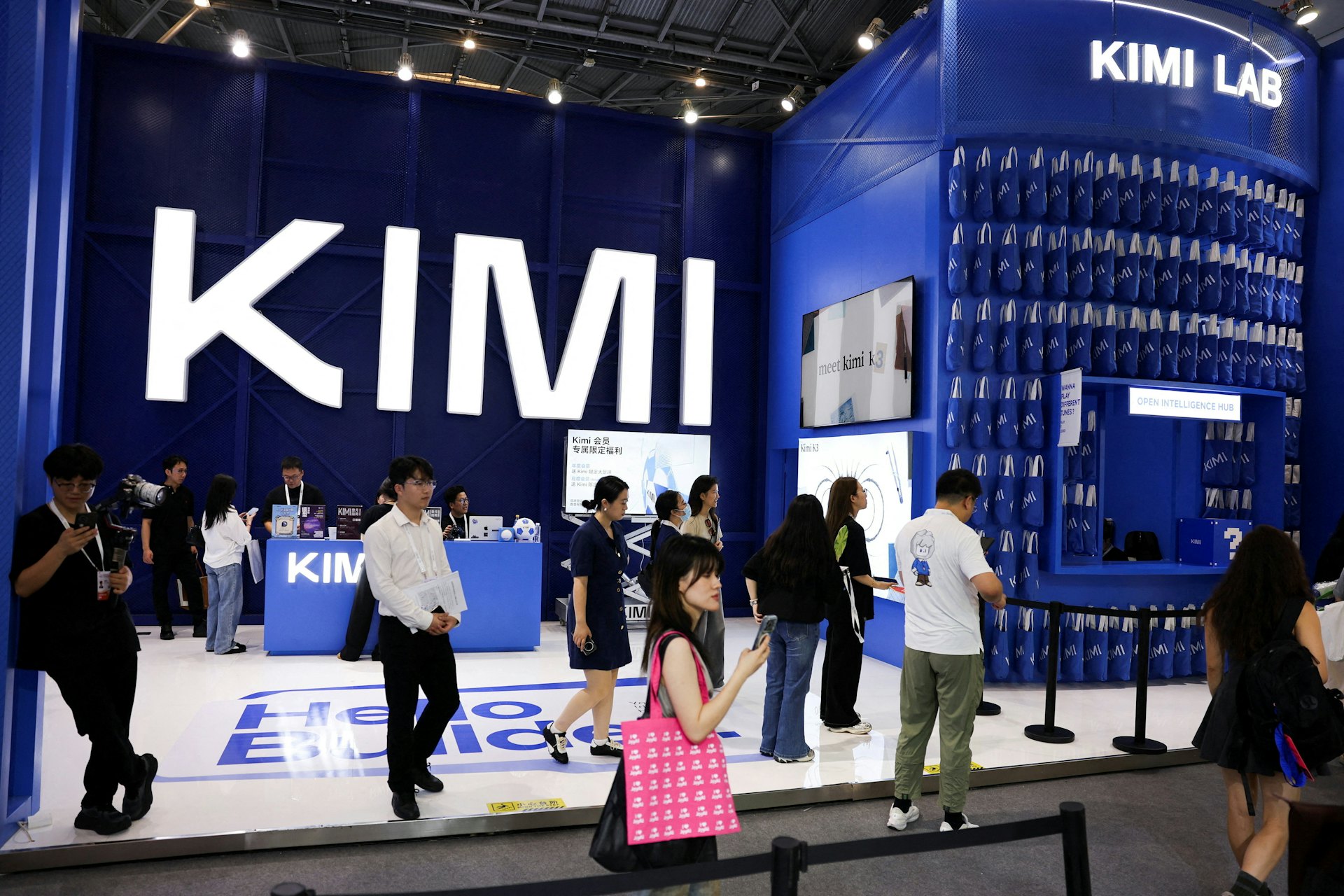
On July 17, 2026, in Shanghai, China, people walk past the booth of Chinese artificial intelligence (AI) company Dark Side of the Moon at the World Artificial Intelligence Conference, where the company is promoting its latest Kimi K3 model. (Reuters)
More importantly, while some Western countries erect walls and barriers, China adheres to open innovation, bringing new opportunities for open cooperation to the world. Currently, the cumulative downloads of China's open-source big data models worldwide have exceeded 10 billion. The Financial Times reports that international platforms such as Pinterest and Airbnb have long been routinely using Chinese open-source models to optimize products and iterate services. Recently, the World Artificial Intelligence Cooperation Organization was established in Shanghai, marking a significant milestone in the history of AI development and uniting the international community to actively promote AI development and governance. In the field of innovative drugs, Chinese pharmaceutical companies, while conducting independent research and development, are promoting the prosperity and development of pharmaceutical technology and the innovation ecosystem through licensing, joint development, and the establishment of joint ventures.
Openness brings progress, while isolation inevitably leads to backwardness—this is the law of global industrial development. The "New Three Elements" (referring to three key technologies) are leading the future, serving not only as a new engine for China's economic growth but also as a crucial driving force for promoting common prosperity among nations. This powerfully demonstrates once again that China's development brings the world not shocks but opportunities, not threats but empowerment.
在澳洲等地,中國研發的清洗機械人「飛簷走壁」,替代了「蜘蛛人」高空危險作業;在巴西,中國大模型助力當地電網運維,破解了複雜環境下的巡檢難題

www-hk01-com.translate.goog