
Navigation
Install the app
How to install the app on iOS
Follow along with the video below to see how to install our site as a web app on your home screen.
Note: This feature may not be available in some browsers.
More options
Style variation
You are using an out of date browser. It may not display this or other websites correctly.
You should upgrade or use an alternative browser.
You should upgrade or use an alternative browser.
Chinese Missile Development News
- Thread starter chinesedragon912
- Start date
More options
Who Replied?



hasssanali8998
Elite Member

also our 8 trillion in minerals might change thatSaudi Arabia is not that generous. So you can forget that
Hendarto
Registered Member


Mineral in the ground is not going to be worth anything. You have to dig, process, transport, and send it over the sea. All of them need infrastructure. Nope. What does Saudi Arabia do for Pakistan? Did they build a port, a road, a railway, an airport, a school, a power plant?also our 8 trillion in minerals might change that
hasssanali8998
Elite Member
thats what we are going to do ,Mineral in the ground is not going to be worth anything. You have to dig, process, transport, and send it over the sea
they will invest in our country so we can do these thingsWhat does Saudi Arabia do for Pakistan? Did they build a port, a road, a railway, an airport, a school, a power plant?


Beijingwalker
VIP Member
China May Have Beaten US to ‘Golden Dome’ Homeland Defense
Published
Oct 03, 2025 at 07:39 AM EDT
A Chinese research team claims it has developed a working prototype of a data processing system that could allow the country to detect and respond to airborne threats anywhere in the world—and says it has already been deployed by the People’s Liberation Army (PLA).
Though still in its early stages, the system is said to leverage breakthroughs in big data to integrate multi-domain sensor information. If successful, it would become the first known air defense system with global reach—well before President Donald Trump’s planned “Golden Dome” missile defense initiative gets off the ground.
Why It Matters
The planned Golden Dome initiative is a $175 billion project announced by Trump in May to strengthen U.S. missile defenses. But no architecture for the system has been unveiled, and the Congressional Budget Office has warned the eventual cost could be nearly three times higher.The Chinese claim comes amid mounting concerns in Washington over the capabilities of its near-peer military rivals, most notably China. Beijing fields one of the world’s largest missile fleets and has taken the lead over Washington in hypersonic missile technology—maneuverable weapons that travel more than five times the speed of sound. A functioning Chinese global defense system could place U.S. forces at a disadvantage just as tensions mount over flash points in the Asia-Pacific, such as Beijing-claimed Taiwan.
Newsweek reached out to the Pentagon and China’s Ministry of National Defense by email seeking comment.
What To Know
The Chinese project is led by the Nanjing Research Institute of Electronics Technology, China’s top research and development center for defense electronics. The team described its work in a paper published in the peer-reviewed journal Modern Radar, according to the South China Morning Post (SCMP).The system, referred to as a “distributed early warning detection big data platform,” has reportedly already been tested and deployed by the PLA. Research team leader and software engineer Li Xudong said the system combines data from sensors located in the air, space, ground and sea, allowing it to track as many as 1,000 incoming missiles simultaneously.
The paper said the platform achieves “unified aggregation, governance and shared application of data at the global early warning situational awareness level” by integrating target tracking, launch alerts, threat warnings, and identification results from top-level sensor nodes.
If operational, the platform would likely be integrated with China’s interceptor missiles. Several of these systems were showcased during last month’s military parade marking the 80th anniversary of World War II.
What People Are Saying
The research team wrote in its paper, per SCMP: "“By uniformly collecting and integrating data products from top-level nodes … it has realized unified aggregation, governance and shared application of data at the global early warning situational awareness level."Zhang Xiaogang, spokesperson for the China's Ministry of National Defense, warned during a May 29 press briefing that the Golden Dome would "open a Pandora's box."
"This proves again that no country has done more than the U.S. in militarizing space and making it a battlefield," he said.
Trump said while announcing the Golden Dome project on May 20: "We have officially selected an architecture for this state-of-the-art system that will deploy next-generation technologies across land, sea, and space including space-based sensors and interceptors."
What's Next
It remains unclear to what extent the Chinese prototype is deployed or when the project is slated to reach maturity. The PLA is expected to continue its modernization push in line with President Xi Jinping's goal of achieving a "world-class" military by mid-century.Trump has pledged the Golden Dome would be “fully operational” by the time he leaves office in January 2029.
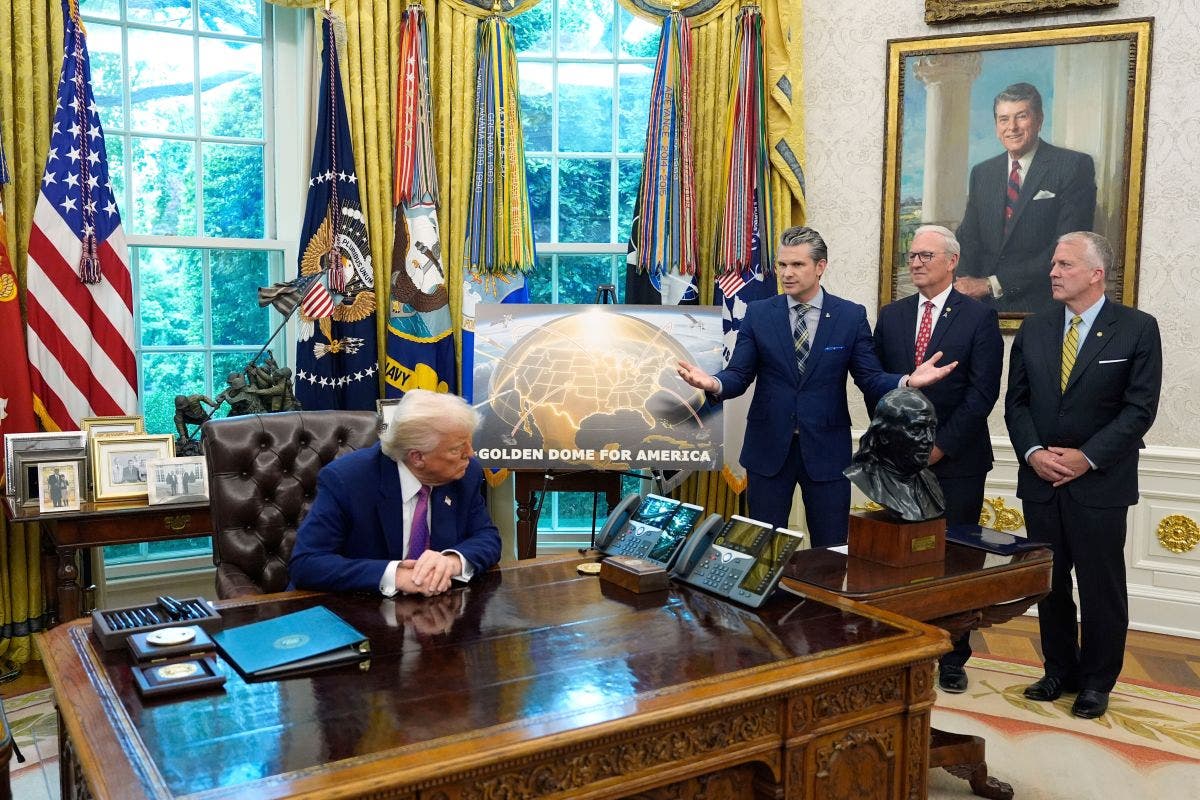
China may have beaten US to 'Golden Dome' homeland defense
Chinese researchers say a prototype system, said to have already been deployed, can simultaneously monitor 1,000 targets.
 www.newsweek.com
Beijingwalker
VIP Member
The US Is Behind on Deploying Hypersonic Weapons. Why It Matters
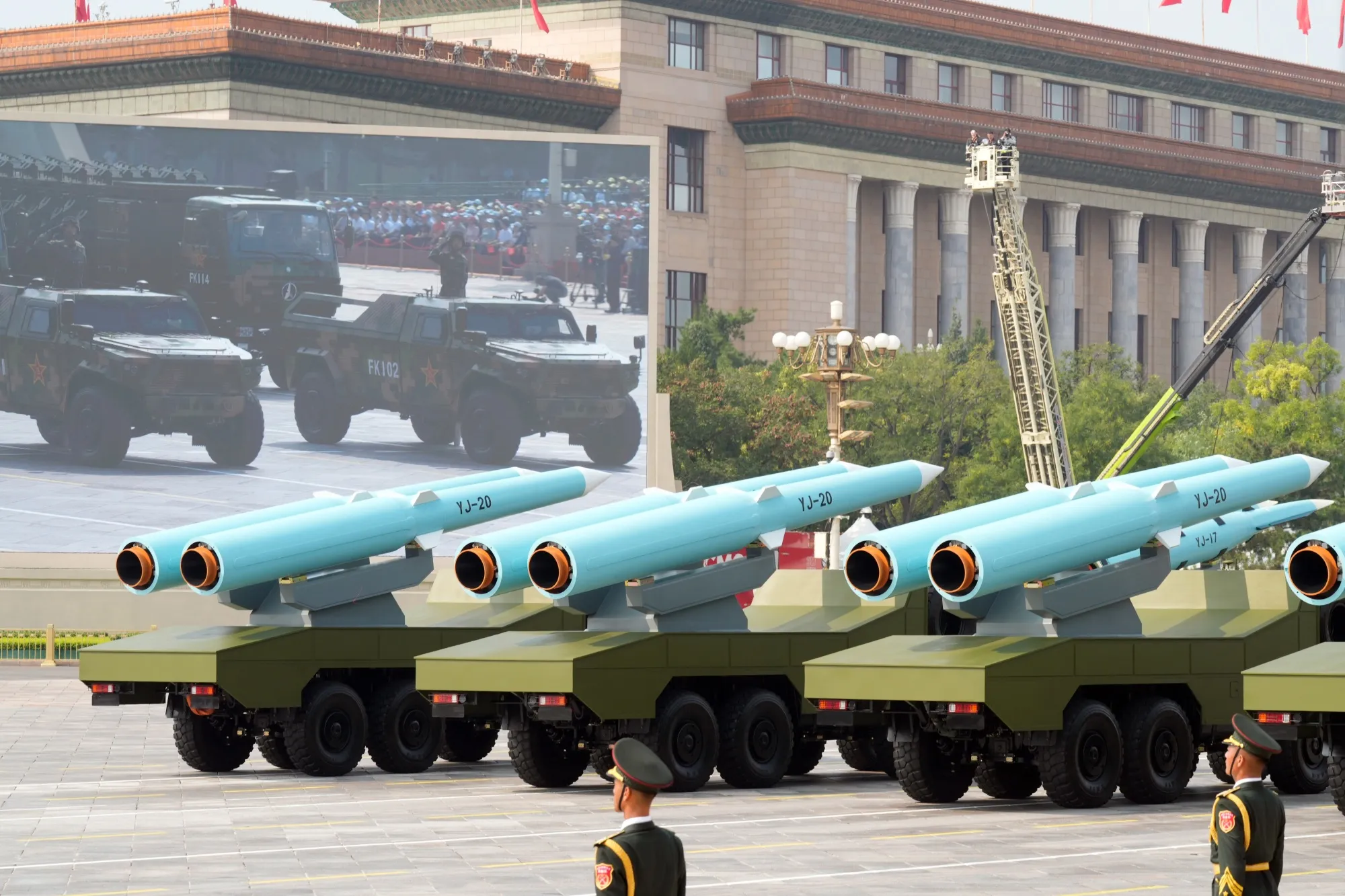
People's Liberation Army YJ-20 hypersonic aeroballistic missiles at Tiananmen Square during a military parade held in Beijing on Sept. 3.Photographer: Qilai Shen/Bloomberg
By Roxana Tiron
October 13, 2025 at 10:19 PM GMT+8
Save
Translate
Hypersonic weapons are so fast, their speed can change the surrounding air molecules. They can carry a nuclear warhead, fly low and be hard to detect. Because of their potential to transform modern warfare, these weapons have become a key front in the intensifying race for military dominance between the US on one side and Russia and China on the other.
The US’s two chief rivals already deploy hypersonic projectiles. China’s military parade in September showed off a hypersonic “carrier killer” ballistic missile built to attack high-value naval targets. Ukraine claimed that Russia used a hypersonic missile to attack Kiev in early 2024.

Beijingwalker
VIP Member
China’s ‘Golden Dome’ can track thousands of missiles fired at China from anywhere on the planet; Trump’s grand plan still on the drawing board
Oct 15, 2025, 01:05:00 PM ISTChina has unveiled a working prototype of its global defense system, named 'Golden Dome'. This advanced platform can track thousands of missiles simultaneously from any location. The system integrates data from various sources for real-time threat analysis. This development contrasts with the US 'Golden Dome' initiative, which remains conceptual. Taiwan is also enhancing its air defense capabilities.
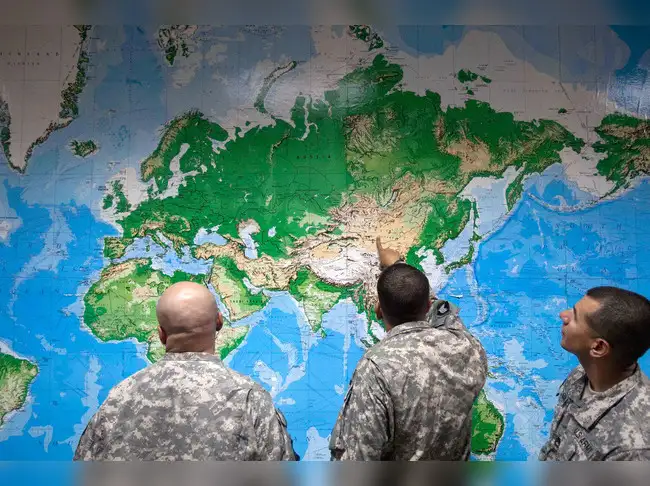
File photo of soldiers pointing towards China on a world map.
China has reportedly deployed a first-of-its-kind working prototype of a global defense system similar to the United States’ proposed Golden Dome, while hailing a breakthrough in data processing technology for worldwide threat management, as per a report by the South China Morning Post.
Although the “distributed early warning detection big data platform” is still in its early stages of development, it can simultaneously monitor thousands of missiles fired at China from anywhere in the world, according to the developers and scientists involved in the project.
What is China’s “Golden Dome”?
China’s Golden Dome is what it calls a planet-wide missile defense system capable of identifying and analyzing threats from space, air, sea, and land in real time. Developed by the Nanjing Research Institute of Electronics Technology, the system, officially described as a “distributed early warning detection big data platform,” integrates data from satellites, radar, optical, and electronic reconnaissance networks.It can process up to 1,000 data tasks simultaneously, merging fragmented information such as flight trajectories, weapon types, and decoy detection into a unified command platform. The system has reportedly been tested and deployed by the People’s Liberation Army (PLA), offering China a global early warning capability.
How China’s system compares to the US “Golden Dome”
While the US version of the Golden Dome, proposed by President Donald Trump, aims to create an AI-driven, integrated missile defense network, it remains largely conceptual. China, by contrast, claims to have already developed and tested a working prototype that can manage massive volumes of defense data securely and efficiently, even under interference, as per the South China Morning post report.According to the report, the data collected by the system would be used for AI training.
Where is the US’s ‘Golden Dome’
The United States’ own $175 billion “Golden Dome” initiative remains shrouded in secrecy and stalled by policy restrictions. At the annual Space and Missile Defense Symposium held in early August in Huntsville, Alabama, a key forum for military and defense experts, official discussions on the project were notably absent. Secretary of Defense Pete Hegseth reportedly prohibited participating officials from speaking about the program, while media were barred from a separate Pentagon-hosted industry summit organized by the Missile Defense Agency (MDA).David Wright, a physicist and arms control specialist at the Massachusetts Institute of Technology, described recent developments as “ominous warning signs.” According to Wright, the Pentagon has scaled back oversight mechanisms for the Golden Dome program, dismantled the office responsible for testing, and even exempted it from standard “fly before you buy” safeguards designed to prevent wasteful spending, reports Scientific American. “Without those guardrails,” Wright warned, “you can end up wasting a lot of money by building stuff that doesn’t work.”
Taiwan’s T Dome
Taiwan is also building a new multi-layered air defense system called "T-Dome" to defend itself against enemy threats and increase defense spending, President Lai Ching-te said on Friday, reports Reuters. However, he did not give details about "T-Dome" in his first public mention of the system. A senior presidential office official told reporters that the "T-Dome" spending plans would be included in the budget proposal to come by the end of the year.China’s 2021 Hypersonic weapon tests
In July and August 2021, China conducted two unprecedented hypersonic weapon tests that stunned defense analysts worldwide. Unlike traditional hypersonic glide vehicles launched on suborbital trajectories, China’s tests involved sending a payload into low-Earth orbit that circled part of the globe before releasing a glide vehicle toward a target in Chinese territory, as per an analysis by the International Institute for Strategic Studies.What drew particular attention was the July test, during which the hypersonic glider reportedly launched a missile in mid-flight, the first known instance of such technology. The tests indicate the People’s Liberation Army Rocket Force may be exploring next-generation delivery systems with potential intercontinental range. Beijing, however, denied developing hypersonic weapons, claiming the launches were part of research into reusable civilian spacecraft.

Users who are viewing this thread
Total: 2 (members: 0, guests: 2)
Pakistan Defence Latest
-

-
-
 Federal cabinet gives nod to imposition of emergency in KP; summary sent to president (5 Viewers)
- Latest: Mighty_Dragon_Strike
-

-

Country Watch Latest
-

-
-

-

-
Iran - Israel/US War: Israel-US declare war on Iran, Iran responds (330 Viewers)
- Latest: BananaRepublic
Latest Posts
-
 Tesla Roadster flies to a soft landing after an upside down loop launch (14 Viewers)
- Latest: Ali_Baba
-
-
-
Israel declares all Arab states as Illegitimate Official government declaration (26 Viewers)
- Latest: r3alist
-
France stopped UAE to deploy its Rafales against Azeri JF-17 Block 3 in Falcons Meet 2026 war drills (6 Viewers)
- Latest: ustaad