ChineseTiger1986
Trusted Member


The 155mm naval gun should belong to the next batch of the Type 055 or something bigger.
Follow along with the video below to see how to install our site as a web app on your home screen.
Note: This feature may not be available in some browsers.

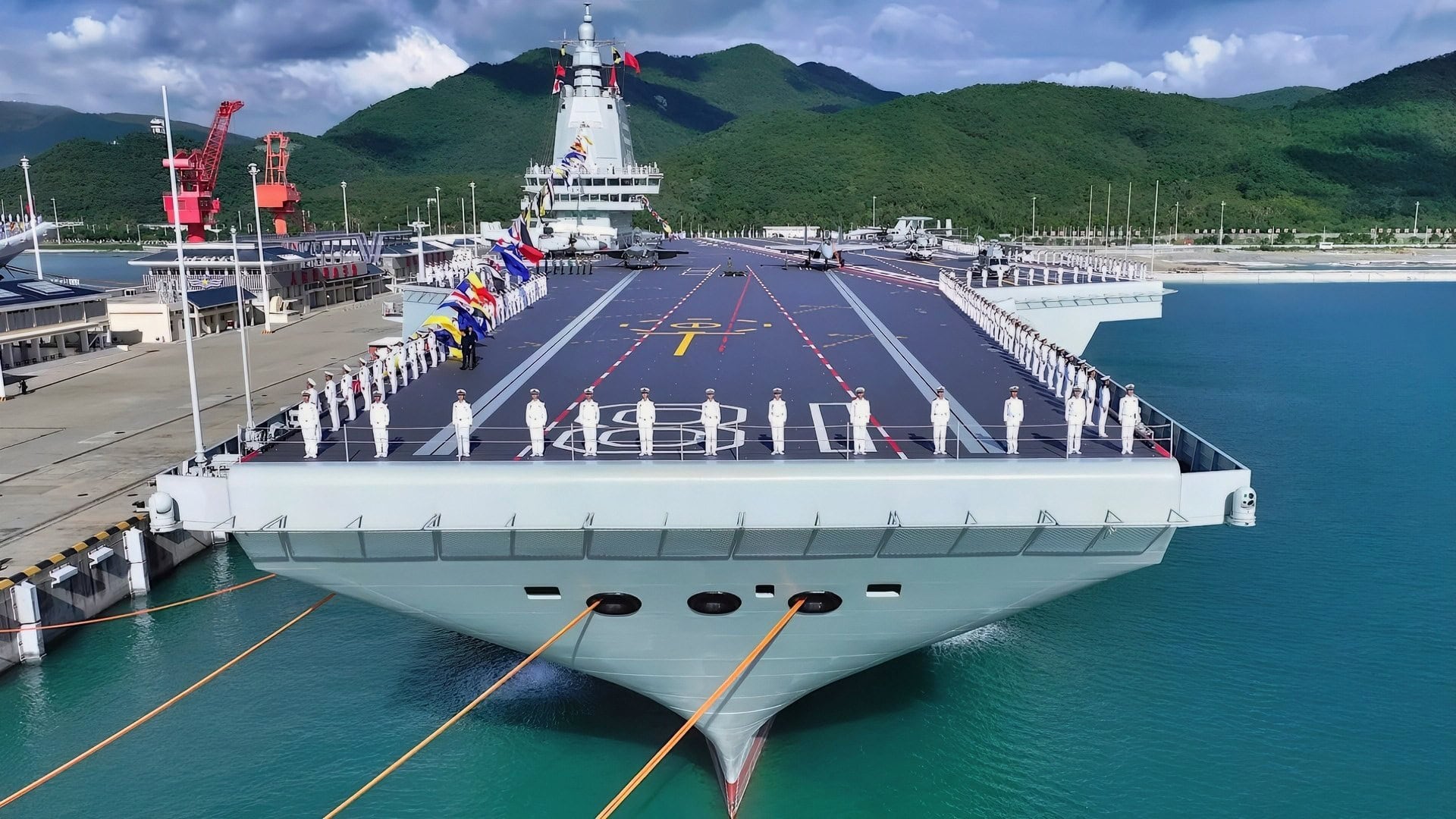
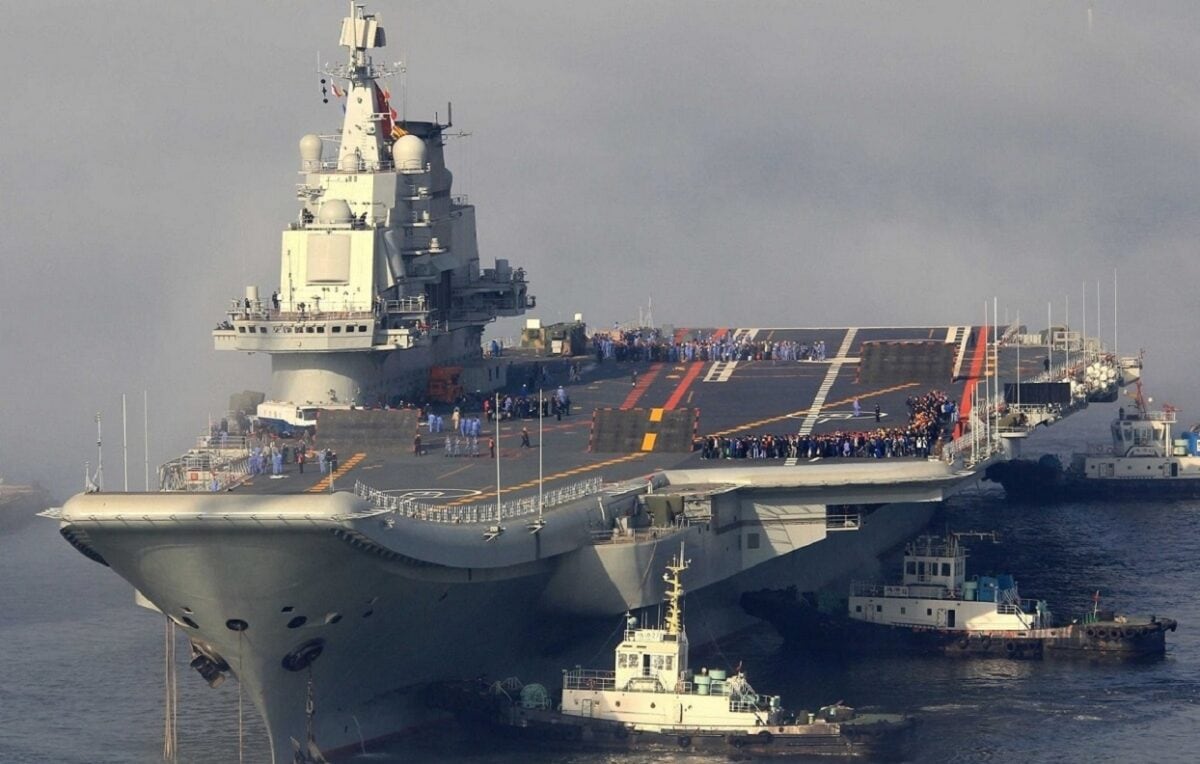
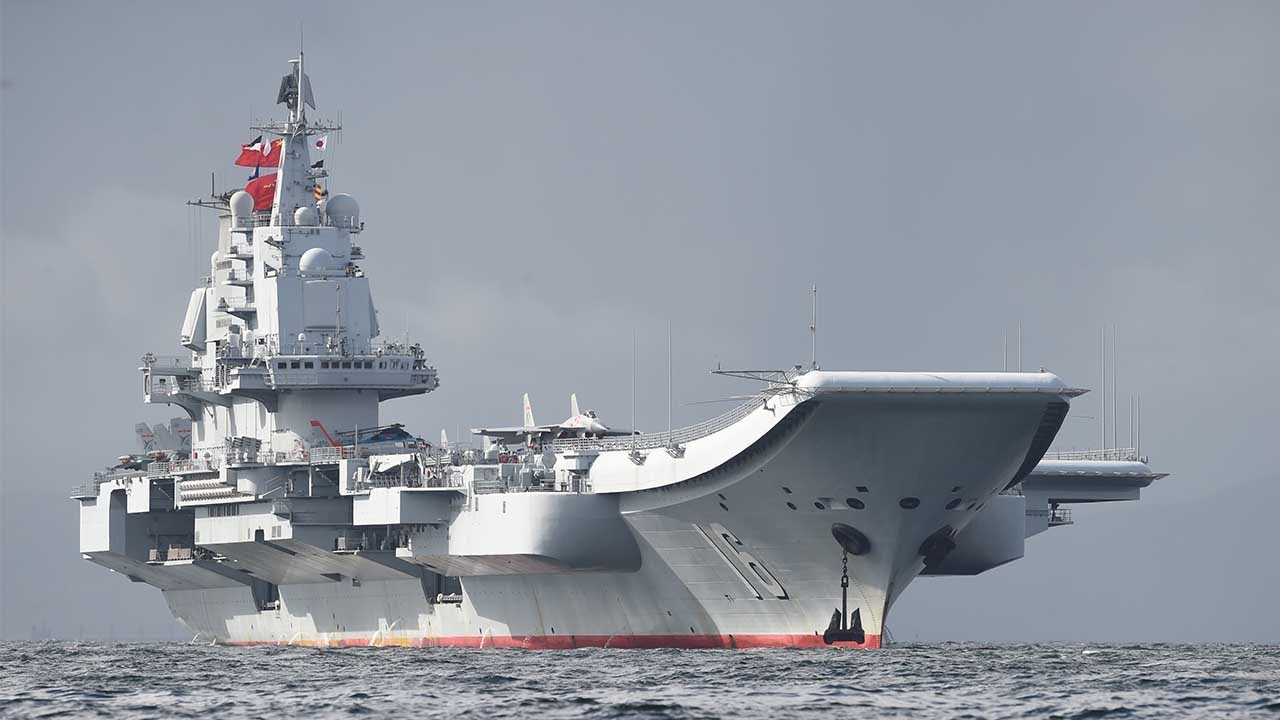
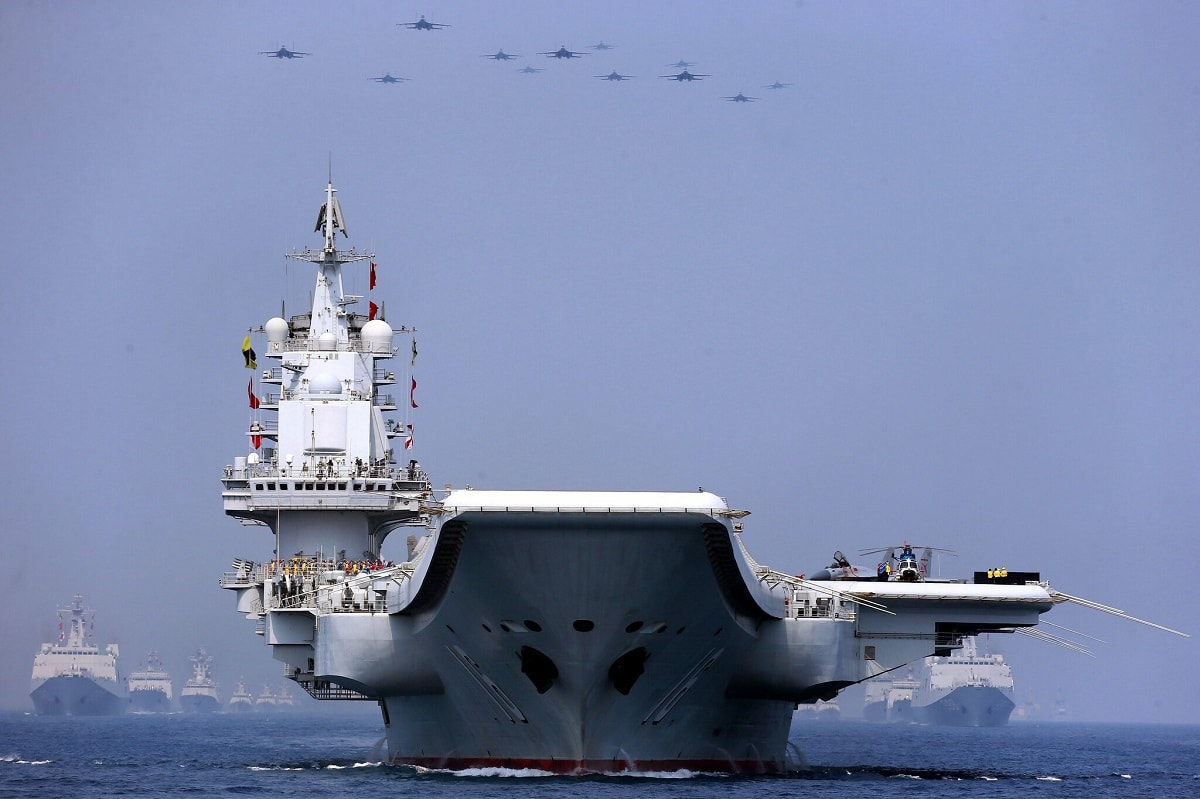
 The Zubr-class is the largest hovercraft ever built. It is able to carry up to 500 troops, tanks or armored vehicles. China originally purchased four from Ukraine, and is now building a larger number locally.
 www.navalnews.com
China Has 23,000,000 Tons Of Navy Shipbuilding Capacity — America Has Less Than 100,000 — And A Leaked U.S. Navy Briefing Slide Confirmed It
Published 2026.03.24
China Aircraft Carrier PLAN Image
British defense researcher Jack Buckby warns of a looming crisis for American naval supremacy. While the U.S. designs the world’s most advanced warships, China’s massive state-owned shipbuilding empire boasts a production capacity that dwarfs America’s, ensuring Beijing can rapidly out-build and out-repair U.S. forces in a prolonged conflict.
Summary and Key Points: British defense researcher and national security analyst Jack Buckby highlights a terrifying reality for American maritime dominance: while the United States builds the world’s most advanced warships, China possesses a shipbuilding empire capable of producing them at an astonishing, unmatched scale.
-With a sheer capacity gap of 23 million tons to America’s less than 100,000, the true threat isn’t just Chinese missiles—it is Beijing’s ability to out-build, out-repair, and out-sustain the U.S. Navy in a prolonged conflict.
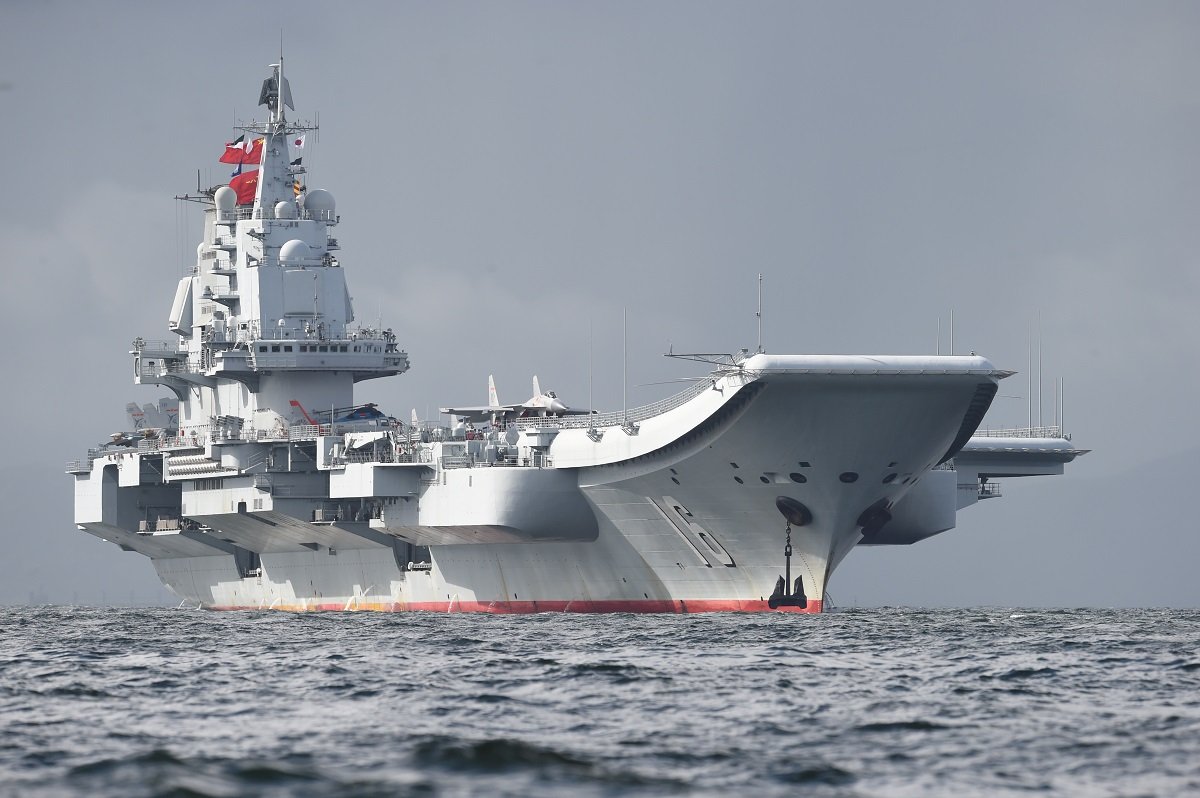
Chinese Aircraft Carrier. Image: Chinese Internet.
The U.S. Navy Builds Better Naval Warships, China Can Build More of Them
The United States builds its most advanced warships in a small number of highly specialized shipyards, and for a long time, that has worked. After all, the United States has been the dominant global naval force for decades, with no country even coming close in terms of technical capability and reach.
Times, however, are changing. China builds ships across an industrial base spanning hundreds of facilities, many of which can support military production if required. That imbalance is becoming an increasingly obvious problem that the United States may soon need to address.
For years, the debate has focused on Chinese anti-ship missiles and “carrier killers,” part of Beijing’s anti-access/area denial (A2/AD) strategy designed to push U.S. forces away from its coastline. But that strategy is evolving, having served as an effective way of protecting the country while it builds its own infrastructure and plans for the future.
A growing body of analysis now suggests that the big consequential issue here is not necessarily whether American ships can survive strikes from Chinese assets using long-range, anti-ship weapons, but whether the United States can build and sustain its fleet over time, as China is clearly preparing to do.
7 vs. Hundreds
The United States has seven primary shipyards capable of producing large and deep-draft vessels for the U.S. Navy and Coast Guard.
While there are more than 150 private shipyards across the U.S., only a handful are capable of building major combatants and large vessels for the U.S. Navy. Shipbuilding is really concentrated in a handful of major yards – primarily Huntington Ingalls Industries and General Dynamics facilities – alongside four public naval shipyards that are focused primarily on maintenance rather than new construction. The yards are highly specialized, particularly for nuclear-powered vessels like aircraft carriers and submarines.
Chinese Aircraft Carrier. Image Credit: Creative Commons.
China, by contrast, operates the world’s largest shipbuilding industry run by state-owned conglomerates like China State Shipbuilding Corporation. Its industrial base is vast and growing, including a large network of commercial shipyards that can either support military construction or, experts say, could transition to military production if necessary.
A leaked U.S. Navy briefing slide, later confirmed as authentic by officials, demonstrates the scale of the gap: Chinese shipyards collectively have a production capacity of roughly 23 million tons, compared to less than 100,000 tons in the United States.
The U.S. Office of Naval Intelligence (ONI) briefing slide began circulating publicly in July 2023, after images of the slide were published online and picked up by defense outlets. The slide itself appears to have been part of an unclassified briefing titled “PLAN vs. USN Naval Force Laydown.”
The disparity is not, then, only about how many ships each country is building today. The problem is that China’s industrial capacity is much larger than that of the United States, and it could – at some point in the future – prove capable of rapidly building and fielding a fleet of vessels even larger than it currently does.
Why the U.S. Is Falling Behind
The U.S. does not by any means lack advanced warships, but it does lack throughput. Modern naval construction is slow and expensive, and as mentioned, it is concentrated in a small number of shipyards.
Destroyers, for example, can take five years or more to build, while nuclear-powered submarines often face delays tied to supply chain constraints and workforce shortages. And then there’s the matter of maintenance.
China Aircraft Carrier. Image: Creative Commons.
At any given time, a significant portion of the U.S. submarine fleet is unavailable due to delays in shipyard maintenance cycles. A 2023 analysis found that roughly 40% of U.S. attack submarines have been idle at points due to maintenance backlogs – a direct result of limited yard capacity and workforce constraints.
This matters. A damaged ship that cannot be repaired quickly is functionally removed from combat, and in high-end combat, repair capacity becomes just as important as production capacity. The U.S. is experiencing strain now, amid an ongoing conflict with Iran – and that strain existed long before the conflict broke out. In the event of a large-scale war, the strain would be even greater.
The U.S. industrial base is also difficult to scale quickly. Skilled labor – particularly welders and nuclear-certified technicians – cannot be created overnight, and there have been shortages for some time. Expanding shipyard capacity, therefore, requires years of investment and planning in everything from workforce to physical construction.
China’s Scale and Ability to Iterate
China has an advantage here, in part because it can scale and also because it can be done quickly. The People’s Liberation Army Navy (PLAN) is already the largest navy in the world by number of ships, with more than 350 vessels, and continued growth is expected through the 2030s. That expansion has been enabled by a shipbuilding sector that dominates global commercial output and can support rapid naval construction.
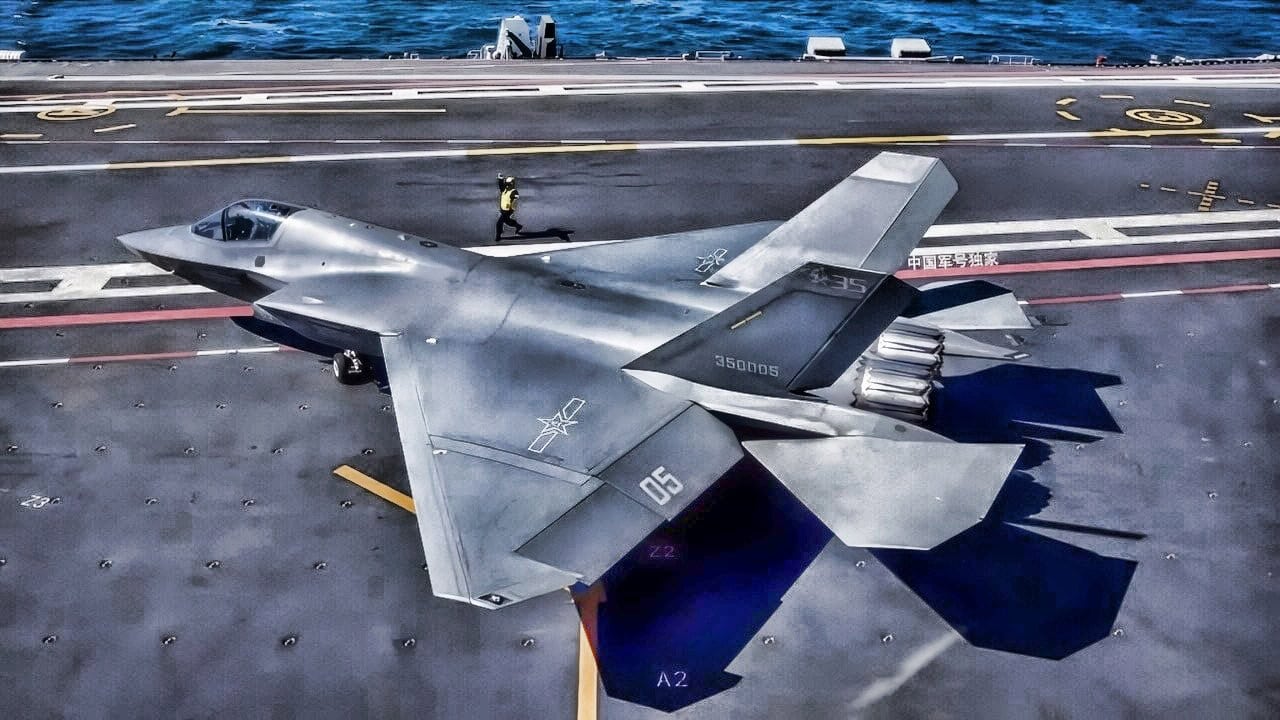
Major shipyards such as Jiangnan and Hudong-Zhonghua are producing advanced destroyers and aircraft carriers at a pace that continues to surprise Western analysts – and China is not only moving quickly, but improving how it builds. In the aerospace industry, China is demonstrating the ability to iterate rapidly. Its J-20 stealth fighter has undergone continuous upgrades, while new platforms like the carrier-capable J-35 have appeared on accelerated timelines. That pattern suggests a system capable of iterative development rather than long production cycles.
China J-35 Naval Stealth Fighter. Image Credit: PLAN.
There is an implication for naval power there, and it’s significant. If China applies similar iterative approaches to shipbuilding – introducing incremental improvements across successive hulls, perhaps – it could narrow technological gaps quickly over time.
But even without that, simply having the capacity to build rapidly will allow it to field capable naval vessels and assets in huge numbers. That’s a problem for the United States, even if the technological gap remains.
The U.S. still holds the technological edge at sea, but unless it can match China’s growing ability to build and sustain its fleet at scale, that advantage may prove increasingly difficult to maintain over time.
China Has 23,000,000 Tons Of Navy Shipbuilding Capacity — America Has Less Than 100,000 — And A Leaked U.S. Navy Briefing Slide Confirmed It
Published 2026.03.24
China Aircraft Carrier PLAN Image
British defense researcher Jack Buckby warns of a looming crisis for American naval supremacy. While the U.S. designs the world’s most advanced warships, China’s massive state-owned shipbuilding empire boasts a production capacity that dwarfs America’s, ensuring Beijing can rapidly out-build and out-repair U.S. forces in a prolonged conflict.
Summary and Key Points: British defense researcher and national security analyst Jack Buckby highlights a terrifying reality for American maritime dominance: while the United States builds the world’s most advanced warships, China possesses a shipbuilding empire capable of producing them at an astonishing, unmatched scale.
-With a sheer capacity gap of 23 million tons to America’s less than 100,000, the true threat isn’t just Chinese missiles—it is Beijing’s ability to out-build, out-repair, and out-sustain the U.S. Navy in a prolonged conflict.
Chinese Aircraft Carrier. Image: Chinese Internet.
The U.S. Navy Builds Better Naval Warships, China Can Build More of Them
The United States builds its most advanced warships in a small number of highly specialized shipyards, and for a long time, that has worked. After all, the United States has been the dominant global naval force for decades, with no country even coming close in terms of technical capability and reach.
Times, however, are changing. China builds ships across an industrial base spanning hundreds of facilities, many of which can support military production if required. That imbalance is becoming an increasingly obvious problem that the United States may soon need to address.
For years, the debate has focused on Chinese anti-ship missiles and “carrier killers,” part of Beijing’s anti-access/area denial (A2/AD) strategy designed to push U.S. forces away from its coastline. But that strategy is evolving, having served as an effective way of protecting the country while it builds its own infrastructure and plans for the future.
A growing body of analysis now suggests that the big consequential issue here is not necessarily whether American ships can survive strikes from Chinese assets using long-range, anti-ship weapons, but whether the United States can build and sustain its fleet over time, as China is clearly preparing to do.
7 vs. Hundreds
The United States has seven primary shipyards capable of producing large and deep-draft vessels for the U.S. Navy and Coast Guard.
While there are more than 150 private shipyards across the U.S., only a handful are capable of building major combatants and large vessels for the U.S. Navy. Shipbuilding is really concentrated in a handful of major yards – primarily Huntington Ingalls Industries and General Dynamics facilities – alongside four public naval shipyards that are focused primarily on maintenance rather than new construction. The yards are highly specialized, particularly for nuclear-powered vessels like aircraft carriers and submarines.
Chinese Aircraft Carrier. Image Credit: Creative Commons.
China, by contrast, operates the world’s largest shipbuilding industry run by state-owned conglomerates like China State Shipbuilding Corporation. Its industrial base is vast and growing, including a large network of commercial shipyards that can either support military construction or, experts say, could transition to military production if necessary.
A leaked U.S. Navy briefing slide, later confirmed as authentic by officials, demonstrates the scale of the gap: Chinese shipyards collectively have a production capacity of roughly 23 million tons, compared to less than 100,000 tons in the United States.
The U.S. Office of Naval Intelligence (ONI) briefing slide began circulating publicly in July 2023, after images of the slide were published online and picked up by defense outlets. The slide itself appears to have been part of an unclassified briefing titled “PLAN vs. USN Naval Force Laydown.”
The disparity is not, then, only about how many ships each country is building today. The problem is that China’s industrial capacity is much larger than that of the United States, and it could – at some point in the future – prove capable of rapidly building and fielding a fleet of vessels even larger than it currently does.
Why the U.S. Is Falling Behind
The U.S. does not by any means lack advanced warships, but it does lack throughput. Modern naval construction is slow and expensive, and as mentioned, it is concentrated in a small number of shipyards.
Destroyers, for example, can take five years or more to build, while nuclear-powered submarines often face delays tied to supply chain constraints and workforce shortages. And then there’s the matter of maintenance.
China Aircraft Carrier. Image: Creative Commons.
At any given time, a significant portion of the U.S. submarine fleet is unavailable due to delays in shipyard maintenance cycles. A 2023 analysis found that roughly 40% of U.S. attack submarines have been idle at points due to maintenance backlogs – a direct result of limited yard capacity and workforce constraints.
This matters. A damaged ship that cannot be repaired quickly is functionally removed from combat, and in high-end combat, repair capacity becomes just as important as production capacity. The U.S. is experiencing strain now, amid an ongoing conflict with Iran – and that strain existed long before the conflict broke out. In the event of a large-scale war, the strain would be even greater.
The U.S. industrial base is also difficult to scale quickly. Skilled labor – particularly welders and nuclear-certified technicians – cannot be created overnight, and there have been shortages for some time. Expanding shipyard capacity, therefore, requires years of investment and planning in everything from workforce to physical construction.
China’s Scale and Ability to Iterate
China has an advantage here, in part because it can scale and also because it can be done quickly. The People’s Liberation Army Navy (PLAN) is already the largest navy in the world by number of ships, with more than 350 vessels, and continued growth is expected through the 2030s. That expansion has been enabled by a shipbuilding sector that dominates global commercial output and can support rapid naval construction.
Major shipyards such as Jiangnan and Hudong-Zhonghua are producing advanced destroyers and aircraft carriers at a pace that continues to surprise Western analysts – and China is not only moving quickly, but improving how it builds. In the aerospace industry, China is demonstrating the ability to iterate rapidly. Its J-20 stealth fighter has undergone continuous upgrades, while new platforms like the carrier-capable J-35 have appeared on accelerated timelines. That pattern suggests a system capable of iterative development rather than long production cycles.
China J-35 Naval Stealth Fighter. Image Credit: PLAN.
There is an implication for naval power there, and it’s significant. If China applies similar iterative approaches to shipbuilding – introducing incremental improvements across successive hulls, perhaps – it could narrow technological gaps quickly over time.
But even without that, simply having the capacity to build rapidly will allow it to field capable naval vessels and assets in huge numbers. That’s a problem for the United States, even if the technological gap remains.
The U.S. still holds the technological edge at sea, but unless it can match China’s growing ability to build and sustain its fleet at scale, that advantage may prove increasingly difficult to maintain over time.

 defencesecurityasia.com

 www.navalnews.com
Over 70,000 tons? That will be bigger than many aircraft carriers.The Trump-class battleship, which was revealed by U.S. President Trump in a news conference in December 2025, marked a significant departure from warship design trends. That ship will be 260 meters (840 ft) long and 35 meters (115 ft) across and displace over 35,000 tons. The Chinese design is around 50 meters (164 ft) longer and 10 meters (32 ft) wider and will displace more than twice as much.
What does this size of AC battleship is exactly used for ?New Super-Battleship Under Construction In China
View attachment 189617
- Published on 01/04/2026
- By Naval News Staff
Click to Enlarge. The new super-sized battleship is under construction in Dalian, Northern China.
As the U.S. Navy debates the future of ‘Trump-class’ battleships, other navies are advancing their own visions of ultra-large surface combatants. New evidence reveals that China is constructing an even larger design, signalling a shift in naval priorities.
China’s naval modernization is accelerating at a remarkable pace, marked by the steady rollout of new destroyers, cruisers, aircraft carriers, and submarines from its shipyards. As this expansion gathers momentum, it fuels a growing sense of anticipation. Observers are left watching closely for the next ambitious construction project to take shape.
Until today, a large warship under construction at China’s Dalian shipyard has been reported as the country’s next aircraft carrier. Fresh analysis, combined with reports from internet experts, reveal that this is in fact the country’s first super-sized battleship. The 80,000 ton behemoth is expected to be launched in 2027, years ahead of competing designs elsewhere.
Naval Arms Race
Of note, the vessel is considerably larger than the Trump-class battleship. It is closer in size to aircraft carriers yet without the large overhanging flight deck. The Trump-class battleship, which was revealed by U.S. President Trump in a news conference in December 2025, marked a significant departure from warship design trends. That ship will be 260 meters (840 ft) long and 35 meters (115 ft) across and displace over 35,000 tons. The Chinese design is around 50 meters (164 ft) longer and 10 meters (32 ft) wider and will displace more than twice as much.
The Russian Navy’s Kirov-class battle cruisers, which are also nuclear powered, are also dwarfed by the Chinese design. That vessel, currently arguably the most powerful surface combatant afloat, displaces only 28,000 tons.
Super-Battleship
Two large square voids visible in the construction reveal the position and size of the main VLS (vertical launch system) magazine. Major warships are often measured in terms of the number of VLS cells they have. Estimates suggest that the Chinese super battleship will have over 200 VLS cells, far more than lesser designs. And these cells will likely carry new quantum hydrosonic weapons.
The main gun battery is reportedly to contain at least 3 rail guns. This is a technology which China has been testing for years. High-powered lasers, strong enough to threaten low-earth-orbit satellites, will provide anti-missile and air defence.
The central citadel, referred to as Xi Tower in Chinese language sources, has 12 decks and offers commanding sea views from the upper stories. The navigation bridge, where the Captain sits, is topped by the flag bridge for Admirals. And above that the viewing bridge for the Political Commissars. The uppermost floor is divided into four apartments. The private club and other hosting facilities are expected to outshine those of the Trump-class, an advantage in gunboat diplomacy.
Floating Fortress Concept
As the Great Powers move to the Floating Fortress stage of international competition, naval might is being measured in square footage. The sheer scale of this vessel suggests a shift in naval doctrine: from outmaneuvering the enemy to simply obstructing their freedom of navigation.
Now China is building a vessel with the square footage of a mid-sized suburb. It has stopped being a naval arms race and has become a hostile real estate takeover of the Pacific.
BALLS
The new super-battleship under construction in china is rumored to be known locally as project Type XXX. Naval News understands the tentative NATO reporting name is an acronym: BALLS (for Battle Assault Littoral Laser Ship, obviously).
New Super-Battleship Under Construction In China - Naval News
As the U.S. Navy debates the future of ‘Trump Class’ battleships, other navies are advancing their own visions of ultra-large surface combatants. New evidence reveals that China is constructing an even larger design, signalling a shift in naval priorities.

We have always followed our own path.So why not spend as much as the Yanks in military spending of 900 billion per year and make nukes, missiles, drones, slaughter bots, drone defense, missile defense, 1000s of subs, drone subs, sea drones, land drones, drone carriers, carriers, ships...
China makes them for half the cost or more.
Don't wait until the Golden Dome is made, then it could be too late.
Maybe with the mind of overwhelming firepower.What does this size of AC battleship is exactly used for ?
 www.scmp.com
These unmanned submersibles are no way similar and powerful compared to the Russian Poseidon that can destroy US coastal cities released from thousands of KM away.China not targeting US West Coast with ultra-large underwater drones: lead scientist
Huge size of China’s unmanned submersibles has US defence experts worried Beijing may attack vulnerable targets including LA and Seattle
Stephen Chenin Beijing
Published: 9:00am, 5 Apr 2026
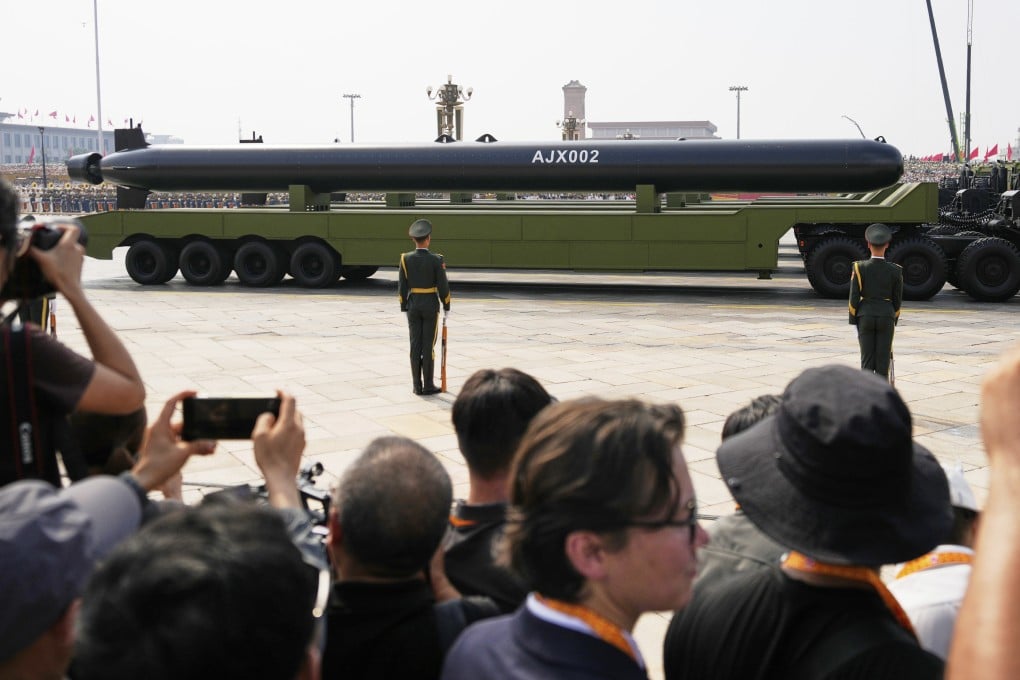
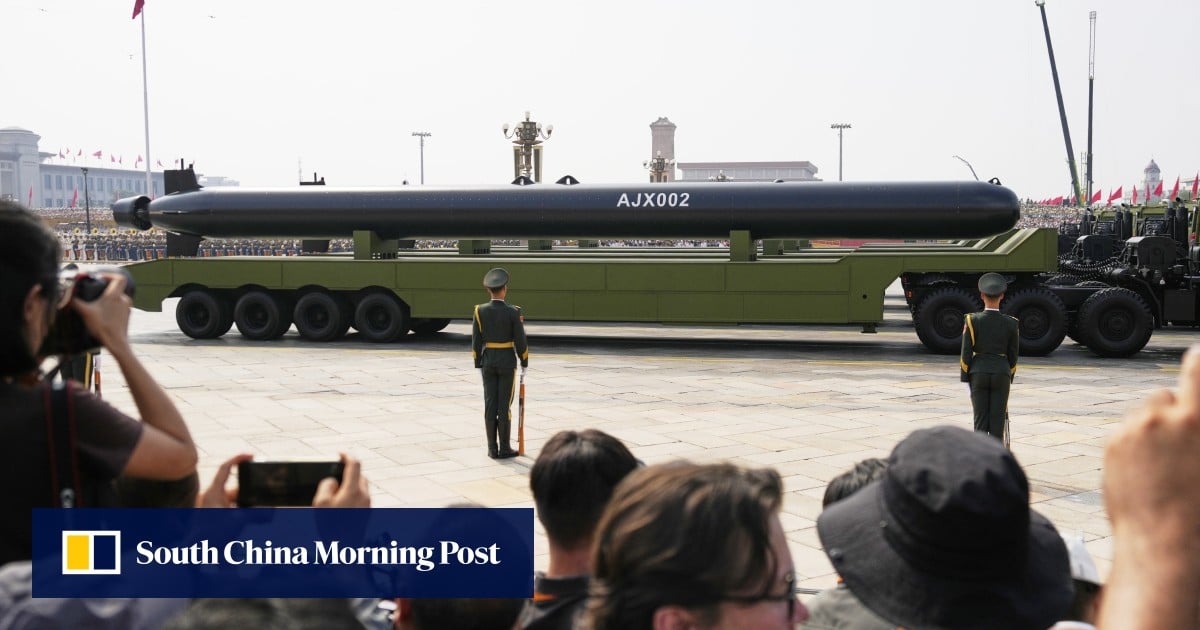
China’s unmanned submersibles now rank as the world’s largest, with last year’s military parade showcasing two models (HSU001 and AJX002) approaching 20 metres (66 feet) in length.
Satellite imagery analysed by Western media also revealed a classified variant exceeding 40 metres at a naval installation, triggering international concern – particularly in the United States.
These dimensions created a brand new class of drones known as extra-extra-large uncrewed underwater vehicles (XXLUUVs). They dwarf America’s largest unmanned underwater vehicle, the 15-metre “Orca”.
US defence experts responded to the developments with stark warnings about vulnerabilities along America’s West Coast, with some analysts designating Seattle, Oakland, Los Angeles and the Panama Canal as potential targets.
Yan Zheping, China’s leading submersible authority and director of unmanned systems at Harbin Engineering University’s College of Intelligent Systems Science and Engineering, addressed these concerns in peer-reviewed research published last month.
China’s ultra large models “prioritise regional security and near-coast defensive reconnaissance while simultaneously supporting civilian research and environmental monitoring”, Yan wrote in his paper for the Chinese Journal of Ship Research, clarifying the vessels’ strategic purpose to the public for the first time.
This indicates these deep-sea giants would mainly counter US military operations in potential Taiwan Strait or South China Sea contingencies, instead of conducting trans-Pacific strikes.
Lead scientist reveals true purpose of China’s ultra-large underwater drone
Huge size of China’s unmanned submersibles has US defence experts worried Beijing may attack vulnerable targets including LA and Seattle.
China’s 435-Ship Navy by 2030 Could Eclipse the U.S. Fleet and Redraw the Balance of Power Across the Indo-Pacific
Pentagon projections indicate China’s People’s Liberation Army Navy could field 435 battle force ships by 2030 while the U.S. Navy declines below 300, creating a strategic imbalance with direct consequences for Taiwan, the South China Sea and Indo-Pacific deterrence.
On Mar 31, 2026
(DEFENCE SECURITY ASIA) — Beijing is accelerating toward a 435-ship People’s Liberation Army Navy by 2030 while the United States risks falling below 300 battle force vessels, creating a strategic imbalance with direct consequences for Taiwan, the South China Sea and Indo-Pacific deterrence.
The People’s Liberation Army Navy is moving toward a projected 435 battle force ships by 2030, creating the most consequential maritime power shift since the United States emerged as the world’s dominant naval power after 1945.
If current construction rates remain unchanged, China could field approximately 141 more battle force vessels than the U.S. Navy by the end of this decade, fundamentally reshaping military calculations surrounding Taiwan, the South China Sea and the wider Western Pacific.
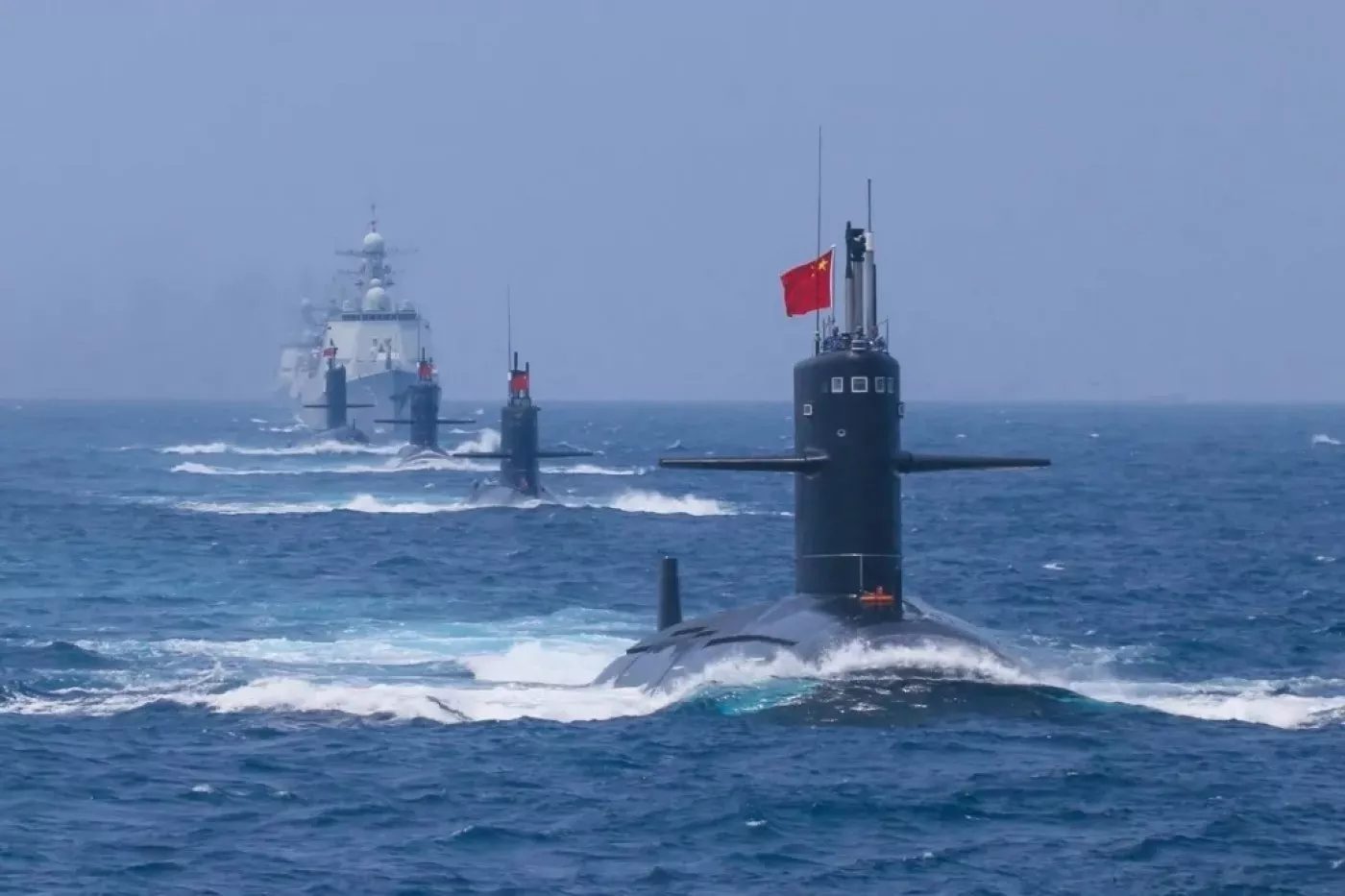
PLAN submarines
American assessments increasingly warn that China’s accelerating naval construction is no longer merely narrowing a traditional capability gap, but is beginning to create a structural numerical imbalance Washington may struggle to reverse.
Pentagon projections indicate that the PLAN already exceeds 370 battle force ships today and could expand toward 395 vessels before 2025 concludes, before ultimately reaching 435 ships by 2030.
By comparison, the U.S. Navy operated 296 battle force ships during late 2024 and is projected under current funding plans to decline toward approximately 294 ships by 2030.
Senior American analysts increasingly argue that the most important question is no longer whether China possesses the world’s largest navy, but whether Washington can still deter Beijing regionally.
One senior congressional assessment warned that “the PLAN is the largest navy in the world,” adding that China’s expanding fleet already includes aircraft carriers, submarines, amphibious vessels, destroyers, frigates and fleet auxiliaries.
The numerical disparity has intensified because China simultaneously commands approximately 50 percent of global shipbuilding capacity, while the United States retains barely 0.13 percent of worldwide shipbuilding output.
China’s Naval Expansion Is Being Driven by Industrial Capacity America Cannot Currently Match
China’s projected 435-ship navy is not emerging from isolated defence spending increases, but from a national industrial system capable of sustaining naval construction on a scale unmatched anywhere globally.
Chinese shipyards are simultaneously producing destroyers, frigates, corvettes, submarines, aircraft carriers, amphibious assault ships, replenishment vessels and coast guard cutters at a tempo no Western country currently approaches.
The PLAN already operates more than 370 battle force vessels, excluding approximately 60 missile-armed HOU BEI-class patrol craft that remain outside formal battle force calculations despite their operational significance.
Those excluded patrol combatants nevertheless carry anti-ship cruise missiles and would likely play a major role during any Taiwan contingency, blockade operation or South China Sea confrontation.
Chinese naval growth remains especially concentrated in major surface combatants, with Beijing continuing rapid construction of Type 055 destroyers, Type 052D destroyers and modern multi-role frigates.
The Type 055 cruiser-sized destroyer is particularly important because its large missile capacity and advanced radar systems increasingly provide the PLAN with blue-water command capabilities.
China is also expanding its carrier fleet, with the aircraft carrier Fujian completing sea trials and Beijing reportedly aiming toward approximately nine carriers by 2035.
Unlike China’s earlier ski-jump carriers, Fujian incorporates a catapult launch system that significantly improves the range, payload and sortie rate of embarked aircraft.
China’s naval modernization additionally includes expanding submarine forces, larger amphibious assault capabilities and an increasingly sophisticated network of fleet auxiliaries supporting prolonged regional operations.
The PLAN is simultaneously building additional Type 075 amphibious assault ships and Type 071 landing platform docks, creating the sealift capacity necessary for larger expeditionary operations.
Chinese naval planners also appear increasingly focused upon logistics, because replenishment ships, repair vessels and fleet support platforms remain essential for sustained operations beyond coastal waters.
Unlike previous decades, Beijing no longer appears focused exclusively upon defending coastal waters, because its new fleet architecture increasingly supports extended maritime operations across the wider Indo-Pacific.
That transformation suggests Chinese leaders increasingly view naval power not merely as a defensive instrument, but as the principal mechanism for reshaping regional strategic geography.
China aircraft carrier
Why China’s Growing Fleet Creates Immediate Pressure Around Taiwan and the South China Sea
China’s accelerating naval expansion is closely tied to a military strategy designed primarily for Taiwan, the East China Sea and the wider South China Sea.
Beijing’s growing fleet provides the physical capacity necessary to sustain a prolonged blockade around Taiwan while simultaneously deterring, delaying or fragmenting potential American intervention.
A larger Chinese navy also enables Beijing to maintain continuous pressure across multiple maritime flashpoints simultaneously, including disputed islands, contested shipping routes and critical maritime chokepoints.
The PLAN’s expanding inventory of destroyers, missile frigates, submarines and amphibious vessels increasingly supports an anti-access and area-denial strategy centered upon overwhelming nearby adversaries.
That strategy relies upon creating dense layers of missiles, aircraft, submarines and surface combatants capable of raising the military cost of intervention beyond politically acceptable thresholds.
China’s near-seas focus means its ships require less endurance than American vessels because they can operate closer to mainland bases, logistics hubs and missile coverage.
The United States, by contrast, must sustain forces across vast Indo-Pacific distances stretching from Guam and Japan toward the Philippine Sea and Indian Ocean.
Because Beijing fights close to home while Washington projects power across oceans, China’s larger fleet can generate stronger local concentration despite America’s broader global commitments.
China’s 435-Ship Navy by 2030 Could Eclipse the U.S. Fleet and Redraw the Balance of Power Across the Indo-Pacific - Defence Security Asia
China’s navy could reach 435 warships by 2030 while the U.S. Navy falls below 300, according to Pentagon-backed assessments. The growing imbalance could reshape Taiwan, the South China Sea and the future of Indo-Pacific security.


