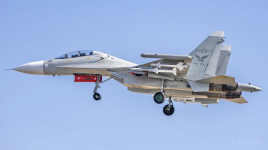
Any reason why we never see dual-rack launchers on the Sukhoi series and its local chinese derivatives ?
Most 4th generation fighter designs make use of dual or triple pylons and still can only carry fewer BVR missiles than the Flanker. If you were to add these pylons onto a J-16, it will have a drag and weight penalty that just doesn't make the additional missile load worth it.
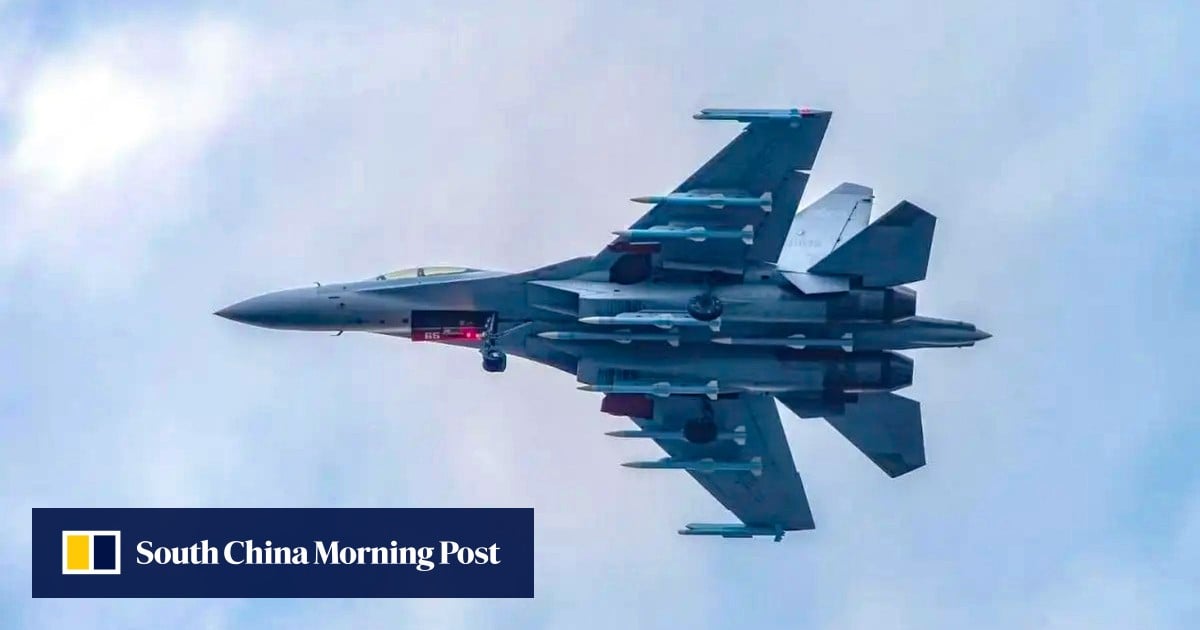
For BVR, it is a balance between range, speed and weapons capacity. The Flanker already hits a bit of a sweet spot. It doesn't require external tanks to feature excellent range relative to other fighters. It doesn't require dual or triple pylons and can already carry 10 BVR missiles and 2 WVR missiles if desired (that photo actually shows one set of pylons not being installed). This photo below generally shows the max air to air capacity in terms of a functional "beast mode" if you replace the second from wingtip pylona with PL-15/16 rather than PL-10 which the J-16 is capable of doing for this pylon set.
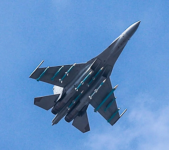
Note the single PL-17.
So this is the best it can reasonably do without massive drag and weight penalty to the point the aircraft itself cannot launch the missiles at great enough speed and altitude, can't fly to positions fast enough, and cannot turn (notch) and reposition fast enough.
This would be 2x PL-17, 6x PL-15/16 (the second from wingtip pylons can carry PL-15/16 where it is photographed only carrying PL-10 here) and 2x PL-10.
Only the F-15 can do similar in real life with around 10-12 BVR missiles max (ignore 20+ missile loadout "beast mode" propaganda that has never been shown actually flying and is practically ridiculous).
Recall that a Rafale pilot recently commented (in context of May 2025 combat) that they typically carry only 2x BVR missiles and 2x WVR missiles into a fight because most fighter definitely need to carry at least 1 drop tank, usually 2. He may be underselling it but lets suppose a typical fighter is 4x BVR + 2x WVR. The Flanker basically doubles this and doesn't require external tanks to achieve similar range.
F-15 and Flanker power to weight ratios are very similar. In theory, they can carry similar payloads, Both have similar lift (Flanker may actually be marginally better) and both have similar drag (again Flanker may actually be marginally better).
The aerodynamic weakness of the Flanker is in supersonic flight regime. The design is more optimised for subsonic agility and instantaneous turn rate (it's quite good at sustained turn "rate fighting" too but not the best) whereas something like Eurofighter Typhoon, F-22 and J-20 are completely optimised for supersonic turning performance.
This all makes the Flanker quite a good BVR missile truck that can also do merges
very well. Of course BVR performance is far more determined by the capability of avionics and missiles than it is by pure kinematic performance even though kinematic performance is still important to the point you're not going to be packing 20 missiles like some American advertisements for F-15EX will show.
Russian Flanker avionics have fallen behind a lot and even back in the late 1990s, the Chinese considered them inferior to China's own avionics (that includes all sensors, ECM, ESM and weapons) which brought about the J-11B program. The J-11A was just to achieve a Chinese independence from Russian support for Su-27SK model kits. Then J-11B to jump ahead without having to push 7 buttons before the pilot can fire a missile.
Contrary to popular belief, the Flanker has some aerodynamic compromises, even weaknesses if you will. I don't recall all these but Chinese military fans have literature and videos explaining these years ago. Despite this, I still need to emphasise that it is still a kinematic beast in the speed, altitude and use cases that is excels in. In exercises with Thai airfoce, China sent J-11As (which are just Su-27SK Chinese made and are from the 1990s with 1980s level tech). They obviously could not perform BVR against Gripen C so lost all BVR fights but in WVR, the Chinese J-11As defeated the Thai Gripen Cs with considerable dominance. Gripen C is a very capable WVR fighter but pilots matter far more in WVR. Contrary to Indian suggestions and claims online, PLAAF defeated Thai Gripen C in BVR with J-10A and J-10C in multiple exercises over different years. J-16 would simply disintegrate Gripen C in BVR. It is said J-16 toys with J-10C in BVR with J-10C requiring ridiculous exchange rate tactics to even score kills against J-16. 5th gen is practically untouchable by 4.5 gens in China's own exercises and when those first took place in late 2010s, China realised what the US was talking about when they threw numbers like 1:40+ exchange rate for F-22 against 4th gen F-15 and F-16.
Why do the Eurofighter, F-22 and J-20 focus on supersonic turning performance? Because the best BVR fighters must do all this movement, launch, reposition and turning in supersonic flight which the Flanker just isn't going to do as well. I suspect even the F-15 would be better at this. 6th gen redefine all this without needing all the tight turning in supersonic flight because they offer more weapon release speed, much higher potential energy from altitude (for J-36 at least), more range, better weapons, more power for sensors and integrated ESM (for J-36 at least), another leap in all aspect stealth.
This makes the Flanker perfect for these sorts of heavy carry roles where it tries to fly high and fast as possible to dump extremely long range missiles like PL-17 which make up for lower launch energy with missile's own, lightening it's load before closing a little more and starting to fire off PL-15/16 long range missiles before needing to do notching and any further closing and dodging where kinematic perform is enhanced because at that point, the Flanker may only be carrying 4 missiles and have far less drag than a fighter carrying 2 tanks and 2 missiles at that point. Not to mention PL-17, PL-15/16 outrange most missiles by country miles so you're actually in a more comfortable BVR position in the Sino-Flanker at the front end of the BVR with PL-17, at the mid section with both fighters notching and the fighter receiving PL-15/16 (if they can even detect them) dodging harder than the Flanker needs to if facing AIM-120C/D, Meteor, and don't even need all the kinematic juice it already has. In merge, the Flanker holds its own if the other fighters aren't defeated before merge.
So at every stage of BVR -> WVR engagement, the Sino-Flanker armed with PL-17, PL-15/16 and PL-10 has more missiles, comparatively lower drag, similar range if not more, and far greater missile energy and modernity of missile electronics and sensors.
This is what makes the J-16 such a sweet multirole fighter. Yes it is actually a bit of a strike fighter with anti-ship mission capability and certianly the PLAAF does not intend on using J-16 as a WVR dogfighter but in most domains outside of supersonic BVR top end fighting like EF2000, J-20 and F-22 are designed for, this is China's premier 4.5 gen and partly why it is produced in such great numbers even in an era where China is spam building 2 separate land based 5th gen fighters and racing to field 6th generation.