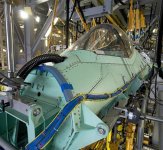
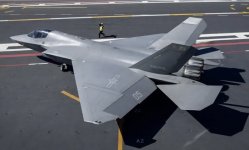
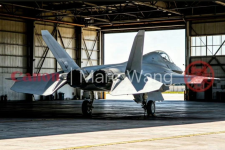
In the last picture there are so many rivets. Is that normal for a stealth jet. You never see those on US stealth jets or is that because they are covered with stealth coating which will happen with these as well?
On January 6, 2026, a J-35 stealth fighter demonstrator, clad in its raw industrial "green skin" (unpainted composite finish), completed its first flight of the new year on the runway of AVIC Shenyang.
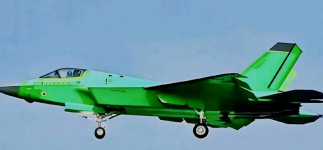
The most striking feature of this J-35 demonstrator is its "green skin" state, with no stealth coating applied. The appearance of the J-35 in "green skin" is essentially a public demonstration of its inherent stealth structural capability—its stealth performance has been deeply integrated into the aircraft's skeleton and skin.
This directly points to two core breakthroughs: the integrally molded composite fuselage and metamaterial stealth technology. The former means that the large-scale main structure of the aircraft may be integrally formed using carbon fiber composites in a single molding process, which not only significantly reduces weight and increases toughness, but also fundamentally eliminates the radar-reflecting gaps and cavities created by the splicing of traditional metal skins. The latter may involve embedding artificial microstructures with special electromagnetic properties (metamaterials) directly into the composite material, turning the aircraft skin itself into a controllable "smart stealth skin" that can efficiently absorb or deflect radar waves in specific bands. Radar-absorbing skin is part of Radar Absorbing Structures (RAS). It is no longer simply "painting" a coating onto the aircraft surface; rather, the absorbing function is directly integrated into the skin itself, creating a "structure-function integrated" material that can both bear structural loads and absorb radar waves. Whether it is evolutionary radar-absorbing skin or revolutionary metamaterials, the ultimate goal is to achieve "structure-function integration." The future fighter skin will no longer be a cold shell, but a layer of "smart skin" that integrates load-bearing, stealth, sensing, and communication.
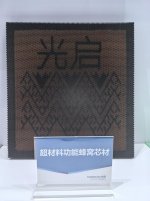
Kuang-Chi Technology is a representative of domestic metamaterial military mass production. Its core technology lies in using metamaterials to "triple-integrate" the fighter's radome, stealth absorbing layer, and load-bearing skeleton, breaking the traditional "carbon fiber structure + externally applied absorbing material" model. Related products have already achieved large-scale deployment.
Advanced polymer materials and functional prepregs: basic raw materials for manufacturing metamaterials.
Flexible metamaterial carriers: used to manufacture bendable or conformal metamaterial structures.
Composite structural components and metamaterial honeycomb cores: form load-bearing structures while possessing electromagnetic functions.
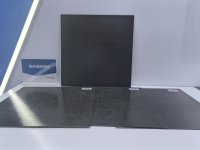
Technology generations: The company's metamaterial technology has developed to the fourth generation and is in large-scale application, and the fifth generation has already formed clear traction on new equipment.
Industry position: Kuang-Chi Technology is the only enterprise in China and a global leader in achieving mass production of metamaterial products. It has built a complete industrial chain from R&D to manufacturing, with over 6,000 patent applications and over 4,000 authorized patents.
AI-driven: The company adopts an "AI + manufacturing" model, following a "function definition – reverse design" path, where AI algorithms design microstructures that meet specific physical performance requirements.
The core value of Kuang-Chi Technology lies in providing a disruptive equipment design philosophy that transforms fighter skins from mere "shells" into "smart skins" integrating load-bearing, stealth, and sensing, and this has already achieved large-scale engineering applications.
So, the rivets and skin you see may no longer be made of metal.









 ??
??


