Navigation
Install the app
How to install the app on iOS
Follow along with the video below to see how to install our site as a web app on your home screen.
Note: This feature may not be available in some browsers.
More options
Style variation
You are using an out of date browser. It may not display this or other websites correctly.
You should upgrade or use an alternative browser.
You should upgrade or use an alternative browser.
Chinese SAC - FC-31/J-35 5th Gen Stealth Aircraft
- Thread starter SiliconBit (silicon0000)
- Start date
More options
Who Replied?


Michael
VIP Member
You need to update your knowledge base.It seems that none of the J-35s to date, have had their stealth coatings applied yet? Any one know why not ? Given the shift to higher production runs, i would have thought they would have started to appear with their coatings by now ?

Han Patriot
Registered Member
Chinese stealth ability is not just based on coatings and shape, it is also embedded with meta materials that absorb and divert the electromagnetic waves. I have seen the documentary on this.You need to update your knowledge base.
View attachment 145391View attachment 145393View attachment 145394View attachment 145395View attachment 145396

Falcon26
Trusted Member

You need to update your knowledge base.
View attachment 145391View attachment 145393View attachment 145394View attachment 145395View attachment 145396
Can you explain?
RajaBaja
Trusted Member

because michael said its not what China wanted and to control loyal wingman you need a second pilot navigater. correct me if am wrong
You will not need a second co-pilot to control loyan wingmen. One pilot will be enough. The protocol is, you issue AI a directive of mission, the AI takes over, does the rest and RTB's.
RajaBaja
Trusted Member
Chinese stealth ability is not just based on coatings and shape, it is also embedded with meta materials that absorb and divert the electromagnetic waves. I have seen the documentary on this.
It's the same as what's in F-22 and F-35 also. On some angles, you absorb the energy, in some place you return RF spectrum back so no "holes" are found in the wavelengths by the receiver and then there are a few more very complicated things that happen to avoid detection by VLF/EHF bursts.
Han Patriot
Registered Member
The point is it is not absorbed by coating alone, it is absorbed by a circuitury embedded in the coating. This is new technology. The circuitry is printed on some thin material then coated. There is no such thing for F35 or F22.It's the same as what's in F-22 and F-35 also. On some angles, you absorb the energy, in some place you return RF spectrum back so no "holes" are found in the wavelengths by the receiver and then there are a few more very complicated things that happen to avoid detection by VLF/EHF bursts.
RajaBaja
Trusted Member
The point is it is not absorbed by coating alone, it is absorbed by a circuitury embedded in the coating. This is new technology. The circuitry is printed on some thin material then coated. There is no such thing for F35 or F22.
You are wrong. Post F-117, all stealth versions of US jets have a 4 tier stealth system. It's not just the "skin" aka, RAM quoting. That was stealth gen 1 and can only fool older Russian jets. When F-117 was shot down, the entire process was redone. That's also why the B2 and F-22's initial version cost hundreds of millions of dollars. If it was just RAM quoting, you could make one jet within a $ 100 million per piece.
There are sensors embedded in the special skin, the skin goes over the RAM quoting. This is "intelligent skin". It can sense the radar waves, changing spectrums of AESA radars and knows which frequency maybe passive to just absorb it and which frequency is active, to generate a same powered signal that would go back and the radar would be fooled in believing nothing exists at that location. The sensors are run on mini super computing like equipment to manage this entire process and it's super complicated to achieve "true" stealth. China has embarked on the same journey. Although J-20's frontal radar cross section would be higher due to canards. More electronics will be needed to fool radars from the frontal side.

maxpane
Elite Member
Do you think A I is enough for drone. dnt you think human factor is also very important for the mission completionYou will not need a second co-pilot to control loyan wingmen. One pilot will be enough. The protocol is, you issue AI a directive of mission, the AI takes over, does the rest and RTB's.

MH.Yang
Trusted Member
Duck wings don't increase RCS, and the US 6G fighters use them.You are wrong. Post F-117, all stealth versions of US jets have a 4 tier stealth system. It's not just the "skin" aka, RAM quoting. That was stealth gen 1 and can only fool older Russian jets. When F-117 was shot down, the entire process was redone. That's also why the B2 and F-22's initial version cost hundreds of millions of dollars. If it was just RAM quoting, you could make one jet within a $ 100 million per piece.
There are sensors embedded in the special skin, the skin goes over the RAM quoting. This is "intelligent skin". It can sense the radar waves, changing spectrums of AESA radars and knows which frequency maybe passive to just absorb it and which frequency is active, to generate a same powered signal that would go back and the radar would be fooled in believing nothing exists at that location. The sensors are run on mini super computing like equipment to manage this entire process and it's super complicated to achieve "true" stealth. China has embarked on the same journey. Although J-20's frontal radar cross section would be higher due to canards. More electronics will be needed to fool radars from the frontal side.
Michael
VIP Member
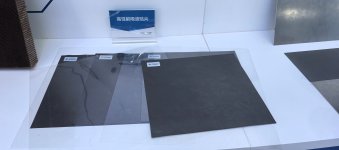
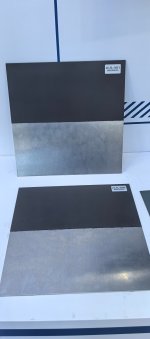
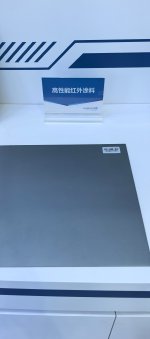
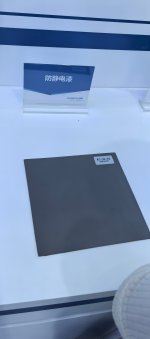
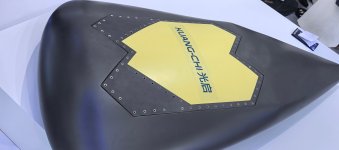
This is a product of a Chinese private technology company called "Kuang-Chi". The company's core business initially focused on the research and development and production of automotive paints, but now focuses on the research and development and production of metamaterials.Can you explain?
These images, from top to bottom, are:
1. TP-0.4mm/TP-0.5mm/TP-1.0mm/TP-1.3mm High-Performance Radar Absorbing Patches
2. LY-TL-1011 High-Absorption Radar Absorbing Paint
3. KC-HW-02 High-Performance Infrared Paint
4. KC-JD-02 Anti-Static Paint
5. Invisible Hatch Display Board with the "Kuang-Chi" Logo
Special Note:
This is a private enterprise located in Shenzhen (stock code: 002625). Their products are marketed globally. But their technology is protected at military levels.
RajaBaja
Trusted Member
Duck wings don't increase RCS, and the US 6G fighters use them.
It's not just that the duck wings don't increase RCS, it's also what's put on them that matters for stealth optimization. US 6th gen using ducked wings doesn't mean they don't impact the RCS. That's a design decision to make the airframe more effective.
Every time you have canards in any shape, it impacts the RCS due to their movement. These would have to be made from special materials to control reflection.
ARMalik
Trusted Member

For now, China's J-35 and J-20 production rate is disappointing. US has major qualitative and quantitative advantage with its F-35s numbers crossing 1200. All these Chinese members can do here is speculate how good China is and how US military is fast decaying. What a delusional bunch. Indians 2.0.

Cipher212
Registered Member
Viewed from the front, a canard and an elevator are the same.You are wrong. Post F-117, all stealth versions of US jets have a 4 tier stealth system. It's not just the "skin" aka, RAM quoting. That was stealth gen 1 and can only fool older Russian jets. When F-117 was shot down, the entire process was redone. That's also why the B2 and F-22's initial version cost hundreds of millions of dollars. If it was just RAM quoting, you could make one jet within a $ 100 million per piece.
There are sensors embedded in the special skin, the skin goes over the RAM quoting. This is "intelligent skin". It can sense the radar waves, changing spectrums of AESA radars and knows which frequency maybe passive to just absorb it and which frequency is active, to generate a same powered signal that would go back and the radar would be fooled in believing nothing exists at that location. The sensors are run on mini super computing like equipment to manage this entire process and it's super complicated to achieve "true" stealth. China has embarked on the same journey. Although J-20's frontal radar cross section would be higher due to canards. More electronics will be needed to fool radars from the frontal side.
niubi
Registered Member

For now, China's J-35 and J-20 production rate is disappointing. US has major qualitative and quantitative advantage with its F-35s numbers crossing 1200. All these Chinese members can do here is speculate how good China is and how US military is fast decaying. What a delusional bunch. Indians 2.0.
This isn't an accurate way to frame things at all.
The US doesn't have 1200 F-35s. 1200+ F-35s have been built but the US only operate less than 700 F-35s. There are slightly less than 200 F-22s Let's call it 900 5th gen fighters by end of year.
F-22s are mostly based in the US. They do not have the range to fly into a western pacific theatre.
There are far more F-35s around than J-20s because F-35s entered production many years before J-20. However the induction rate of F-35s into the US armed forces is roughly similar (if not slightly below) the rate of J-20 induction into PLA. If trends continue as is, total Chinese 5th gen fighters in service will eventually catch up to and exceed that of the US. This remains to be seen. However, it is quite remarkable that the US was building F-22s when China was still building J-7 for PLAAF. I think it's worth considering that trend and the progress rather than one single snapshot there being more US 5th gens in service than Chinese. At a moment in history there was around 400 US 5th gen fighters in US service when there was 0 Chinese 5th generation. Now it is about 900 US 5th gen fighters and over 400 Chinese 5th gen fighters.
Both J-35 and J-20 are entering mass production. It can be pushed up if they wanted but China is only spending about 2% of GDP and even western estimates claim around 3%. The US uses about twice that proportion of their GDP and their GDP is nominally higher.
J-20 production rate is far from disappointing. Even pessimistic estimates put annual production rate at around 120 unite per year. That's many many times greater than say Rafale production rate and about equal to F-35 production rate.
I don't care to discuss in this post whether one is better than the other because truth be told no one knows. A person can make an educated argument for either side based on knowledge and half truths but end of the day, this is a question even US and Chinese military planners aren't certain of.
As for J-35 production. Well the production line has started for airforce variant and carrier variant. It's is going to reach rates similar to J-20's which is again, an impressive rate. No 5th gen fighter apart from F-35 involving numerous nations have hit triple digit annual rate. There are more J-20s produced in a month than India has produced Tejas Mk1 in its entire history. I don't think anyone can reasonably call J-20 production rate disappointing with a straight face.
Mark my words. The US will not get into a military conflict with China. The decision has been made. It is clear as day now even with the signalling. There will be years more of pro western youtubers and commentators talking the US up and China down as per usual for the last however long but you can bet everything the US will refuse to get into military engagement. Behind the scenes, they have completely shifted strategy from considering kinetic war options to betting big on engaging with China in economic and industrial competition. The warfront has moved to a higher degree of political war and media signalling. It will try to hurt China via the political and economic spheres, hoping that would slow its military development down similar to how banning Nvidia H100 GPUs was able to stifle Chinese AI industry somewhat. The issue with that strategy is the US is suffering a faster economic decline and has bet all in with AI now. If it doesn't succeed properly and this means beyond just announcing it has created super intelligence, then China will cement its rise further. When it comes to AI, so much of the US AI industry is run by and powered by Chinese born and educated engineers. Even the Meta leak showed about half of its top tier AI talent were Chinese born and educated. Even if US cracks AGI before China and that's a 50% chance, the Chinese AI experts running critical parts of the US AI industry could not be counted to be loyal to the US. The reverse is less likely where China cracks AGI first and it gets leaked to the US.
Users who are viewing this thread
Total: 10 (members: 0, guests: 10)
Pakistan Defence Latest


Country Watch Latest
-

-

-

-
-
After Armenia, India exports Akash Air Defence System to Tajikistan and Turkmenistan (4 Viewers)
- Latest: indo17787
Latest Posts
-
-
 FlyDubai Incident: Pilot was stabbed on flight to Israel - diverted to Saudi Arabia (49 Viewers)
- Latest: Hussain
-
-
-