Why can China accomplish a mega water diversion project? Three quarters of Beijing's water supply from more than 1,000 kilometers away
CGTN
01 Jun, 2023, 06:52 ET
-- About three quarters of Beijing's water supply comes from a reservoir more than 1,000 kilometers south of the Chinese capital.
CGTN: Why can China accomplish a mega water diversion project?
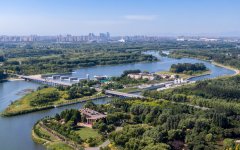
That reservoir is Danjiangkou, the starting point of the middle route of China's South-to-North Water Diversion Project, the largest of its kind in the world. The water level of the reservoir on the Hanjiang River has been raised 14.6 meters to 176.6 meters, so that the water, driven by gravity, can flow downstream to the drought-prone north. The massive project has benefited over 150 million people over the past eight years, according to China's Ministry of Water Resources.
The South-to-North Water Diversion Project has three routes. The middle route is the most prominent of the three due to its role in feeding water to the nation's capital. Starting from the Danjiangkou Reservoir in central China's Hubei Province, it runs across Henan and Hebei provinces before reaching Beijing and Tianjin municipalities. It began supplying water in December 2014.
The eastern route began operations in November 2013, transferring water from east China's Jiangsu Province to feed areas including Tianjin Municipality and Shandong Province.
The western route is in the planning stage and is yet to be built.
For any country, building such a megaproject constitutes a huge challenge, with difficulties ranging from engineering to ecological conservation and the massive relocation of residents along the routes.
In Xichuan County, Nanyang City, Henan Province, 367,000 people were relocated to accommodate the project.
People in Zouzhuang Village of the county, who used to grow maize and wheat, now earn their living by managing an orchard of kiwifruit trees. With the help of local authorities, they make more money than before, said Zou Yuhua, an official in the village.
How did China overcome these difficulties and make this megaproject a reality? Many factors contribute to the feat, but the key is the leadership of the Communist Party of China (CPC).
"As long as the fundamental principles are upheld, all work will fall in place," Chinese President Xi Jinping, also general secretary of the CPC Central Committee, said at the launch meeting of a campaign on Party history learning and education in February 2021, stressing the importance of upholding the authority and the centralized, unified leadership of the CPC Central Committee.
The magic of China
"As long as the fundamental principles are upheld, all work will fall in place."
This saying comes from "Lyu Shi Chun Qiu," or "Master Lyu's Spring and Autumn Annals," a comprehensive Chinese classic text compiled around 239 BC under the patronage of Lyu Buwei, prime minister of the Qin Kingdom. It literally means that once you open the main rope of a net, everything falls into place, indicating that you must grasp the key of the whole situation so that everything will be put under control and you will get the desired result.
The saying captures the logic behind China's political system today and explains why the country can accomplish megaprojects like the South-to-North Water Diversion Project. In the Chinese system, cells of the Party play key roles everywhere in the economy and society, from the very top to villages. Thus, under the leadership of the CPC, the whole society works in the same direction and serves the people's interests.
This is the magic of China, where solidarity among its 1.4 billion people makes hard causes achievable.
"We must uphold and strengthen the centralized, unified leadership of the Party's Central Committee," Xi said when delivering the report to the 20th CPC National Congress last October.
"We will improve the leadership systems by which the Party exercises overall leadership and coordinates the efforts of all sides," he said. "This will maintain the Party's solidarity and unity."
The Party's leadership is the key to the smooth relocation of villagers in Xichuan County. To help them build a new and better life, local authorities provide technical training for kiwifruit tree planting and organize collective sales through a cooperative. According to Zou Yuhua, Zouzhuang Village aims to expand the orchard from the current 33 to 40 hectares to 200 hectares in the future.
The villagers are satisfied with what they have today. "Now almost every family owns a car," Zou said, describing the relocation as a good opportunity for the villagers.
/PRNewswire/ -- About three quarters of Beijing's water supply comes from a reservoir more than 1,000 kilometers south of the Chinese capital. That reservoir...

www.prnewswire.com