indo17787
Registered Member

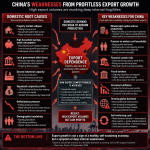
The article makes several particularly sharp points.
First, Zhao describes the contrast inside China as almost bizarre. On one side are deeply depressed domestic demand, the prolonged property slump, contracting local govt debt and persistent deflationary pressure. On the other side, Chinese manufacturing keeps taking international market share in EVs, solar, batteries, robotics, aerospace, energy storage, ships/offshore equipment and other industries. He describes it essentially as the brighter the external circulation becomes, the more unbalanced the internal circulation looks.
Second, the article argues that China's extraordinary export competitiveness is effectively being subsidised by compression within China itself: weak consumption, labour costs and corporate margins.
In other words, foreigners see extraordinarily cheap Chinese manufactured goods but part of that cheapness is being purchased through squeezed Chinese workers and squeezed Chinese enterprises.
Third, Zhao argues that China's property collapse isn't simply another cyclical recession. The previous economic balance sheet was constructed around land + debt: local governments leveraged land to finance infrastructure while households leveraged future income to purchase property.
That mechanism generated enormous growth but accumulated debt and misallocated resources. Zhao characterises its breakdown as essentially terminal exhaustion of the old model rather than an ordinary downturn.
The problem is that Beijing's intended replacement: technology, innovation, advanced manufacturing and equity financing doesn't immediately replace the domestic demand destroyed by property deleveraging.
Fourth, the article says households aren't simply refusing to consume because Chinese people inherently like saving. Falling property wealth, weaker income expectations and economic uncertainty have pushed households from leveraging themselves into defensive saving. The factories become more productive precisely while the consumers those factories ultimately need become more cautious.
Because domestic demand is inadequate, Chinese businesses fight ferociously over the demand that remains. That competition compresses labour, capital and resource costs toward their limits.
This generates what Zhao describes as extraordinarily efficient, inexpensive manufacturing. But there isn't enough domestic demand for the resulting production. So that “hyperefficiency” gets exported.
That's why Zhao's conclusion is unusually strong for a Chinese economic commentary: exports should be a bonus to a healthy domestic economy not its life-support system.
He calls for stronger fiscal support directed toward households and welfare rather than traditional infrastructure, lower real interest rates, greater spending on education/healthcare/pensions/housing security, reduced regulatory barriers, stronger protection of property rights, a more predictable environment for private entrepreneurs, stabilisation of the property market and a healthier equity market. @Nimble


