Commentary: Are Exports Holding China’s Economy ‘Hostage’?

indo17787

Registered Member
Joined
Jul 10, 2026
Messages
163
Reaction score
289
Reputation
462.6
Country of Origin
Country of Residence
1790139946579.png
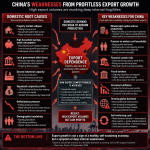
The article makes several particularly sharp points.

First, Zhao describes the contrast inside China as almost bizarre. On one side are deeply depressed domestic demand, the prolonged property slump, contracting local govt debt and persistent deflationary pressure. On the other side, Chinese manufacturing keeps taking international market share in EVs, solar, batteries, robotics, aerospace, energy storage, ships/offshore equipment and other industries. He describes it essentially as the brighter the external circulation becomes, the more unbalanced the internal circulation looks.

Second, the article argues that China's extraordinary export competitiveness is effectively being subsidised by compression within China itself: weak consumption, labour costs and corporate margins.

In other words, foreigners see extraordinarily cheap Chinese manufactured goods but part of that cheapness is being purchased through squeezed Chinese workers and squeezed Chinese enterprises.

Third, Zhao argues that China's property collapse isn't simply another cyclical recession. The previous economic balance sheet was constructed around land + debt: local governments leveraged land to finance infrastructure while households leveraged future income to purchase property.

That mechanism generated enormous growth but accumulated debt and misallocated resources. Zhao characterises its breakdown as essentially terminal exhaustion of the old model rather than an ordinary downturn.

The problem is that Beijing's intended replacement: technology, innovation, advanced manufacturing and equity financing doesn't immediately replace the domestic demand destroyed by property deleveraging.

Fourth, the article says households aren't simply refusing to consume because Chinese people inherently like saving. Falling property wealth, weaker income expectations and economic uncertainty have pushed households from leveraging themselves into defensive saving. The factories become more productive precisely while the consumers those factories ultimately need become more cautious.

Because domestic demand is inadequate, Chinese businesses fight ferociously over the demand that remains. That competition compresses labour, capital and resource costs toward their limits.

This generates what Zhao describes as extraordinarily efficient, inexpensive manufacturing. But there isn't enough domestic demand for the resulting production. So that “hyperefficiency” gets exported.

That's why Zhao's conclusion is unusually strong for a Chinese economic commentary: exports should be a bonus to a healthy domestic economy not its life-support system.
He calls for stronger fiscal support directed toward households and welfare rather than traditional infrastructure, lower real interest rates, greater spending on education/healthcare/pensions/housing security, reduced regulatory barriers, stronger protection of property rights, a more predictable environment for private entrepreneurs, stabilisation of the property market and a healthier equity market.
@Nimble
 
View attachment 216540
The article makes several particularly sharp points.

First, Zhao describes the contrast inside China as almost bizarre. On one side are deeply depressed domestic demand, the prolonged property slump, contracting local govt debt and persistent deflationary pressure. On the other side, Chinese manufacturing keeps taking international market share in EVs, solar, batteries, robotics, aerospace, energy storage, ships/offshore equipment and other industries. He describes it essentially as the brighter the external circulation becomes, the more unbalanced the internal circulation looks.

Second, the article argues that China's extraordinary export competitiveness is effectively being subsidised by compression within China itself: weak consumption, labour costs and corporate margins.

In other words, foreigners see extraordinarily cheap Chinese manufactured goods but part of that cheapness is being purchased through squeezed Chinese workers and squeezed Chinese enterprises.

Third, Zhao argues that China's property collapse isn't simply another cyclical recession. The previous economic balance sheet was constructed around land + debt: local governments leveraged land to finance infrastructure while households leveraged future income to purchase property.

That mechanism generated enormous growth but accumulated debt and misallocated resources. Zhao characterises its breakdown as essentially terminal exhaustion of the old model rather than an ordinary downturn.

The problem is that Beijing's intended replacement: technology, innovation, advanced manufacturing and equity financing doesn't immediately replace the domestic demand destroyed by property deleveraging.

Fourth, the article says households aren't simply refusing to consume because Chinese people inherently like saving. Falling property wealth, weaker income expectations and economic uncertainty have pushed households from leveraging themselves into defensive saving. The factories become more productive precisely while the consumers those factories ultimately need become more cautious.

Because domestic demand is inadequate, Chinese businesses fight ferociously over the demand that remains. That competition compresses labour, capital and resource costs toward their limits.

This generates what Zhao describes as extraordinarily efficient, inexpensive manufacturing. But there isn't enough domestic demand for the resulting production. So that “hyperefficiency” gets exported.

That's why Zhao's conclusion is unusually strong for a Chinese economic commentary: exports should be a bonus to a healthy domestic economy not its life-support system.
He calls for stronger fiscal support directed toward households and welfare rather than traditional infrastructure, lower real interest rates, greater spending on education/healthcare/pensions/housing security, reduced regulatory barriers, stronger protection of property rights, a more predictable environment for private entrepreneurs, stabilisation of the property market and a healthier equity market.
@Nimble
Nice find bro 👌
 
China should learn from India, exporting nothing but buying everything:D
No industries, no supply chains, no technology, no higher education, not even medals in international sports events with 1.4 billion population:eek:
 
China should learn from India, exporting nothing but buying everything:D
No industries, no supply chains, no technology, no higher education, not even medals in international sports events with 1.4 billion population:eek:
Indeed. That’s why China's monthly semiconductor imports hit an all-time high in July despite having one of the deepest semiconductor supply chains in the world.
 
China should learn from India, exporting nothing but buying everything:D
No industries, no supply chains, no technology, no higher education, not even medals in international sports events with 1.4 billion population:eek:
What are you talking? We have no industry, no supply chain, no technology, no education and still you find Indians on top positions in western countries.... we have no technology and still our rockets travel to space and put a satellites in space..... we have no education and still we have advanced nuclear technology, space technology, nuclear submarine technology, ship building capacity, people all over the world comes to India for cheap medical treatments and heart surgeries.....

Seems you are mistaking India with some African countries....
 
Indeed. That’s why China's monthly semiconductor imports hit an all-time high in July despite having one of the deepest semiconductor supply chains in the world.
lol, believe me, no one wants to learn from India on how to run their countries, you can keep buying instead of producing, but don't expect China to follow that funny path.
 
What are you talking? We have no industry, no supply chain, no technology, no education and still you find Indians on top positions in western countries.... we have no technology and still our rockets travel to space and put a satellites in space..... we have no education and still we have advanced nuclear technology, space technology, nuclear submarine technology, ship building capacity, people all over the world comes to India for cheap medical treatments and heart surgeries.....

Seems you are mistaking India with some African countries....
He’s a Chinese bot, man. He’s just doing his job. I think you get what I mean.
 
lol, believe me, no one wants to learn from India on how to run their countries, you can keep buying instead of producing, but don't expect China to follow that funny path.
India is on her path to become ATMANIRBHAR.... after 2 decades we will too be producing everything at home..... situation never remains same it changes with time and patience....
 
India is on her path to become ATMANIRBHAR.... after 2 decades we will too be producing everything at home..... situation never remains same it changes with time and patience....
lOl, keep hearing that for decades, but next time please choose someone your own size, China is too much for you India.
 
lol, believe me, no one wants to learn from India on how to run their countries, you can keep buying instead of producing, but don't expect China to follow that funny path.
An Indian engineering firm literally built a huge chunk of an Australian chemical plant here in India, around 64,000 tonnes worth. And I’m not talking about exporting some individual equipment or components. They built gigantic pre-assembled sections of the plant itself and then shipped those massive blocks all the way to Western Australia. @Nimble
1000049647.jpg
 
Last edited:
An Indian engineering firm literally built a huge chunk of an Australian chemical plant here in India, around 64,000 tonnes worth. And I’m not talking about exporting some individual equipment or components. They built gigantic pre-assembled sections of the plant itself and then shipped those massive blocks all the way to Western Australia. @Nimble
View attachment 216585
That's massive man.... but still as per @Beijingwalker we are zero and comparable to Malawi or Burundi.... no offense to these countries it's just an example....
 

ECB says China's industrial rise is squeezing German manufacturers out of global markets​

China's push into higher-value manufacturing is eroding the EU's share of global exports in machinery and transport equipment, with Germany most exposed, the ECB said on Tuesday, while falling Chinese demand for European goods adds a second squeeze.

September 23 2026

The findings reinforce the structural case against Germany's export-heavy industrial base, a headwind for autos, machinery and capital goods names that a cyclical recovery may only partly offset. For the ECB, cheaper Chinese imports are a potential source of downward pressure on goods prices, which could complicate the inflation outlook at a time when energy costs are pushing the other way. Central European economies tied into German supply chains face knock-on exposure. Weaker export competitiveness also offers little support for the euro over the longer term, even if near-term moves stay driven by rate expectations.

China is now beating Europe's industrial champions abroad while needing fewer of their goods at home, and the ECB says Germany is feeling it most.

Summary:

  • The ECB said China's industrial transformation is pushing European firms out of global markets, especially in machinery and transport equipment
  • The EU's share of global goods exports has fallen most in sectors and destinations where China has expanded its presence
  • Among the EU's largest economies, Germany's export mix overlaps most with China's and Italy's least; smaller economies such as Ireland and Greece are among the least exposed
  • China is also importing fewer European goods as its domestic production grows, with the drop sharpest in Germany and central European economies linked to manufacturing and auto supply chains
  • The ECB said the trend points to intensifying competition in autos and industrial machinery, sectors that have long driven European growth
China's shift into higher-value manufacturing is squeezing European companies out of global markets, with German firms among the hardest hit, the European Central Bank said on Tuesday.

In an article published in its Economic Bulletin, the ECB said the European Union's share of global goods exports has declined, particularly in the sectors and destinations where China has strengthened its presence. The losses have been most visible in machinery and transport equipment, areas where European exporters have long held strong positions.

China has spent recent years expanding its global footprint with a focus on higher-value and technology production, moving into some of the most established markets of Europe's export-reliant companies. The ECB said this points to intensifying competition in sectors that have driven growth in some European economies for decades, including automotive production and industrial machinery.

Exposure varies widely across the bloc. Among the EU's largest economies, Germany's export mix is the most similar to China's, while Italy's is the least similar, the analysis found. Smaller economies such as Ireland and Greece were among the least exposed.

The pressure is also coming from a second direction. As China's domestic production expands, it is buying fewer products from Europe. The ECB said that decline has been most pronounced in economies closely integrated into European manufacturing and automotive supply chains, including Germany and several central European countries. For German industry, that means the same country that was once a key growth market for its machinery and cars is now also one of its toughest competitors.

The findings build on earlier ECB work. A separate analysis published in the Economic Bulletin earlier this year described China's industrial rise as a key external force on euro area trade, production and prices. It noted that Chinese import competition can help euro area producers through cheaper inputs and lower prices, but can also displace domestic production, and said the resulting competitiveness challenges are increasingly visible in the region's economic performance.

Survey evidence points in the same direction. Two-thirds of 1,300 German companies surveyed reported growing pressure from Chinese competitors, rising to 83% among industrial firms, Reuters reported earlier this month. That pressure is building even as the broader German economy shows signs of recovery, with one leading economic institute raising its 2026 growth forecast to 1.4% from 0.8%, helped by government spending on infrastructure and defence.

The ECB's analysis suggests that any cyclical upturn may not be enough to offset a structural loss of market share. How German industry responds, whether through investment, specialisation or policy support, is likely to shape the region's growth prospects well beyond the current recovery.

 
View attachment 216540
The article makes several particularly sharp points.

First, Zhao describes the contrast inside China as almost bizarre. On one side are deeply depressed domestic demand, the prolonged property slump, contracting local govt debt and persistent deflationary pressure. On the other side, Chinese manufacturing keeps taking international market share in EVs, solar, batteries, robotics, aerospace, energy storage, ships/offshore equipment and other industries. He describes it essentially as the brighter the external circulation becomes, the more unbalanced the internal circulation looks.

Second, the article argues that China's extraordinary export competitiveness is effectively being subsidised by compression within China itself: weak consumption, labour costs and corporate margins.

In other words, foreigners see extraordinarily cheap Chinese manufactured goods but part of that cheapness is being purchased through squeezed Chinese workers and squeezed Chinese enterprises.

Third, Zhao argues that China's property collapse isn't simply another cyclical recession. The previous economic balance sheet was constructed around land + debt: local governments leveraged land to finance infrastructure while households leveraged future income to purchase property.

That mechanism generated enormous growth but accumulated debt and misallocated resources. Zhao characterises its breakdown as essentially terminal exhaustion of the old model rather than an ordinary downturn.

The problem is that Beijing's intended replacement: technology, innovation, advanced manufacturing and equity financing doesn't immediately replace the domestic demand destroyed by property deleveraging.

Fourth, the article says households aren't simply refusing to consume because Chinese people inherently like saving. Falling property wealth, weaker income expectations and economic uncertainty have pushed households from leveraging themselves into defensive saving. The factories become more productive precisely while the consumers those factories ultimately need become more cautious.

Because domestic demand is inadequate, Chinese businesses fight ferociously over the demand that remains. That competition compresses labour, capital and resource costs toward their limits.

This generates what Zhao describes as extraordinarily efficient, inexpensive manufacturing. But there isn't enough domestic demand for the resulting production. So that “hyperefficiency” gets exported.

That's why Zhao's conclusion is unusually strong for a Chinese economic commentary: exports should be a bonus to a healthy domestic economy not its life-support system.
He calls for stronger fiscal support directed toward households and welfare rather than traditional infrastructure, lower real interest rates, greater spending on education/healthcare/pensions/housing security, reduced regulatory barriers, stronger protection of property rights, a more predictable environment for private entrepreneurs, stabilisation of the property market and a healthier equity market.
@Nimble
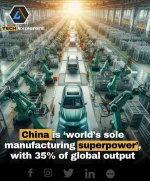
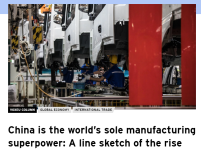
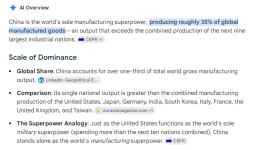
So wrong, when you outcompete your rivals and become the only one in the game, you will be the sole power to dictate the global terms. Only fools can't see this simple logic.

调整大小 images (5).jpg
搜狗截图20260924013839.png
搜狗截图20260924013728.png
 
Last edited:

Users who are viewing this thread

Country Watch Latest

Back
Top