Navigation
Install the app
How to install the app on iOS
Follow along with the video below to see how to install our site as a web app on your home screen.
Note: This feature may not be available in some browsers.
More options
Style variation
You are using an out of date browser. It may not display this or other websites correctly.
You should upgrade or use an alternative browser.
You should upgrade or use an alternative browser.
Covid-19 News and Discussions
- Thread starter Yommie
- Start date
- Status
- Not open for further replies.
More options
Who Replied?


Yommie
Elite Member
- Thread starter
- #767

Kp.2 Covid Variant: Near to 100 cases of KP.2 COVID variant, Are we facing a new COVID wave | - Times of India
Maharashtra has now documented 91 instances of the KP.2 strain, with the bulk occurring in Pune. This is in addition to the state's existing cases of
 timesofindia.indiatimes.com
Yommie
Elite Member
- Thread starter
- #768
OverallIn week 19, influenza activity decreased slightly across most indicators. COVID-19 activityincreased across some indicators, though hospitalisations remained stable. Respiratorysyncytial virus (RSV) activity fluctuated at low interseasonal levels.InfluenzaThrough Respiratory DataMart, influenza positivity decreased slightly to 2.0% in week 19compared with 2.7% in the previous week.Through primary care surveillance, consultations for influenza-like-illness (ILI) decreased to 1.7per 100,000 in week 19 compared with 2.8 per 100,000 in the previous week and remainedwithin the baseline activity level range. The influenza positivity in GP sentinel swabbingincreased to 3.9% in week 18.There were 4 confirmed influenza acute respiratory infection (ARI) incidents reported in week18, a slight decrease compared with the previous week (5 ARI).Overall, the hospitalisation rate for influenza decreased and was at low levels at 0.40 per100,000 compared with 0.58 per 100,000 in the previous week. The latest rate was within thebaseline range (less than 1.57 per 100,000). The overall ICU or HDU rate for influenza was lowand stable at 0.02 per 100,000 compared with 0.02 in the previous week and was within thebaseline impact range.Emergency department (ED) attendances for ILI decreased.This season we have seen a combination of influenza A(H1N1) and A(H3N2). There has alsobeen a small amount of influenza B activity later in the season.COVID-19Through Respiratory DataMart, SARS-CoV-2 increased slightly to 9.0% compared with 8.2% inthe previous week.National influenza and COVID-19 report: week 20 report (up to week 19 2024 data)5Pillar 1 COVID-19 positivity increased overall and within all age groups and most regions inweek 19, although total weekly cases decreased compared with the previous week.The number of reported SARS-CoV-2 confirmed ARI incidents in week 19 decreased slightlycompared with the previous week. There were 12 SARS-CoV-2 confirmed ARI incidentsreported in week 19 in England, a decrease from 20 in the previous week.Overall, COVID-19 hospitalisations stabilised to 3.13 per 100,000 compared with 3.21 per100,000 in the previous week. Hospitalisations were highest in the aged 85 years and over agegroup. COVID-19 ICU admissions remained low and stable at 0.08 per 100,000 in week 19.Respiratory Syncytial Virus (RSV)Through Respiratory DataMart, RSV positivity remained low at 0.3%, with the highest positivityin those aged under 5 years at 0.7%. ED attendances for acute bronchiolitis decreasednationally.Other virusesAdenovirus positivity remained low at 2.8%, with the highest positivity in those aged under 5years at 7.5%. Human metapneumovirus (hMPV) positivity remained low at 2.1%, with thehighest positivity in those aged under 5 years at 6.1%. Parainfluenza positivity decreasedslightly to 4.3%, with the highest positivity in those aged under 5 years at 6.1%. Rhinoviruspositivity decreased slightly to 12.2% overall, with the highest positivity in those aged between 5and 14 years at 29.7%.
Yommie
Elite Member
- Thread starter
- #778

UCP removes COVID-19 vaccine child-death references, takes over tickets sales to controversial event
A website that was selling tickets to a controversial Alberta UCP town hall has dropped the event.
UCP removes COVID-19 vaccine child-death references, takes over tickets sales to controversial event


Michael Franklin
CTVNewsCalgary.ca Senior Digital Producer
Follow |Contact
Updated May 16, 2024 2:40 p.m. EDT
Published May 16, 2024 2:10 p.m. EDT
Share
- Link
- X
On Monday, Eventbrite had been offering tickets for An Injection of Truth, a meeting hosted by the party, led by Calgary-Lougheed MLA Eric Bouchard.
As of Thursday morning, the ticket seller(opens in a new tab)'s URL for the event returned an error.
However, the event is still going ahead, suggests the UCP's official website(opens in a new tab), which now includes a separate link to sell tickets.
RELATED STORIES
- Alberta UCP to host town hall to discuss COVID-19 vaccines in children
- B.C.'s COVID vaccine mandate for health-care workers survives court challenges
- 'Not a scarient': New COVID-19 subvariant dominant in Canada
- Sign up for breaking news alerts from CTV News, right at your fingertips(opens in a new tab)
- The information you need to know, sent directly to you: Download the CTV News App(opens in a new tab)
It says it will include a number of panelists.
"Currently we have confirmed the following participants: Dr. David J. Speicher, Dr Eric Payne (Calgary based pediatrician), Dr William Makis (Radiation Oncologist). Dr. Chris Shoemaker (what’s in the Japanses Nakahara Study?) Dr. Jessica Rose (who recently testified to the US Congress about the plasma DNA in the injections, and Dr. Bryam W. Bridle (Canada’s leading virology authority from the University of Guelph)," the UCP said.
According to what CTV News has found, the College of Physicians and Surgeons of Ontario confirmed Speicher is not a medical doctor, Payne filed a lawsuit against AHS over mandatory vaccination, Makis' licence with the College of Physicians and Surgeons of Alberta was cancelled in 2019, Shoemaker was suspended by the College of Physicians and Surgeons of Ontario in 2023, Rose is an "independent researcher(opens in a new tab)" and Bridle is an Ontario veterinarian.
After CTV News ran the story on Monday, Alberta Health Services (AHS) reached out to the UCP to request it remove a reference to Makis being an "Edmonton ER doctor."
"He is most definitely not an Edmonton ER physician," said AHS spokesperson Kerry Williamson.
"You'd have to check with the College of Physicians and Surgeons, but I’m sure he is not currently licensed as a physician.
"He has not had AHS privileges for a number of years."
Makis is now listed by the party as "a radiation oncologist."
CTV News has reached out to Eventbrite as well as the Alberta government for comments on this development.
Yommie
Elite Member
- Thread starter
- #779

A new COVID-19 subvariant is dominant in Canada. Here’s why that might be a good thing
A preliminary study found it is "significantly" less infectious than its predecessor.
 www.thestar.com
A new COVID-19 subvariant is dominant in Canada. Here’s why that might be a good thing
A preliminary study found it is “significantly” less infectious than its predecessor.May 16, 2024
1 min read
Save
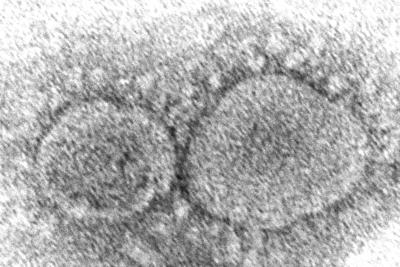
This 2020 electron microscope image made available by the Centers for Disease Control and Prevention shows SARS-CoV-2 virus particles, which cause COVID-19.
Hannah A. Bullock, Azaibi Tamin

By Ben CohenStaff Reporter
Last month, Japanese scientists whipped up a test tube version of the most concerning new COVID-19 mutation. They then sicced this “pseudovirus” on some cells, to see how it measured up to previous generations of COVID.
The results, while not yet peer-reviewed, are promising. This new kind of COVID, KP.2, a child of Omicron, is “significantly” less infectious than its predecessor, the scientists found.
This means KP.2 isn’t going to “blow up” and create a surge of cases like Omicron did, said Dr. Gerald Evans, chair of the division of infectious diseases at Queen’s University.
ARTICLE CONTINUES BELOW
KP.2 has since become a dominant strain in Canada. For this to have happened, it must have some advantage over JN.1, the older subvariant it’s set to displace.
KP.2’s talent, according to the study, is that it’s more resistant to ”neutralization.” That means it’s better at infecting people who have immunity, through vaccination or previous infection, than the last dominant strain was.
It’s not as bad as it sounds. Summer is coming, which is always associated with a lull in COVID cases, as people get outdoors where risk of infection is mitigated by fresh air. And come fall a new, updated COVID vaccine will be available that should be more effective against KP.2.
CANADA
Here’s what you need to know about getting this fall’s COVID-19 jab
The National Advisory Committee on Immunization has released its recommendations for this fall,Meanwhile, KP.2’s reduced infectivity will, Evans said, limit the total number of people who will get sick with the subvariant.
“On balance, it means you shouldn’t worry about it,” he said.
If you do get infected with KP.2, as far as medical experts know, you will experience the same symptoms you would if you had caught any other past COVID strain. Severity of illness is trending downward as the virus evolves and is further reduced if you have immunity from vaccination or infection.
As always, older and immunocompromised people are at the greatest risk. For them, Evans suggests semi-annual booster shots. If it’s been a while since your last shot, it might be best to get another one now, rather than wait for the updated vaccine, which should start being distributed in late September or early October.
Yommie
Elite Member
- Thread starter
- #780
Respiratory Virus Report, Week 19 - ending May 11, 2024 - Canada.ca
Respiratory Virus Detection Surveillance System data from Canadian laboratories on the number of tests, and positive tests, for influenza and other respiratory viruses.
Overall summary
In week 19 (week ending May 11, 2024) in Canada, percent positivity is currently highest for enterovirus/rhinovirus (10.1% positive) among respiratory viruses under surveillance. The following results were reported from RVDSS laboratories:- After reaching a low in early-April 2024 (4.7% positive), national SARS-CoV-2 percent positivity is showing continued signs of increase (1,941 detections; 7.4% positive). Trends currently vary by region.
- Influenza percent positivity is decreasing (1,077 detections; 4.2% positive) as percent positivity has decreased in recent weeks for both influenza A (238 detections; 0.9% positive) and influenza B (839 detections; 3.3% positive).
- RSV percent positivity is stable (241 detections; 1.1% positive).
- Percent positivity of all other non-SARS-CoV-2 respiratory viruses is near expected levels typical of this time of year.
- 35/35 sentinel laboratories reported surveillance data
- Status
- Not open for further replies.
Users who are viewing this thread
Total: 1 (members: 0, guests: 1)


