CPEC News and Discussions

in ka chachoo nawaz sharif is baar bhi IPP's jaisa koi tohfa de kar jaega, agly 30 saal phir rote rahengy sarey Pakistani.
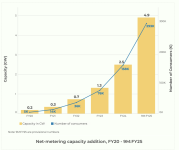
Yeah, the latest gift is 5.3 GW of net-metered solar power installed as of April 2025.

1755342768993.png

 
@RealNapster

But they will not go wind or hydel or solar. Instead, they focused on furnace oil based IPPs.

That is historical, Nappy bro. As PSA sb says, in the last decade there are no new oil or gas fired IPPs.

Regards
 
@RealNapster

But they will not go wind or hydel or solar. Instead, they focused on furnace oil based IPPs.

That is historical, Nappy bro. As PSA sb says, in the last decade there are no new oil or gas fired IPPs.

Regards

But there are no solar based or wind based new projects either.
 
@RealNapster

But there are no solar based or wind based new projects either.

Not sure if this is true. Perhaps PSA sb (@Pakistan Space Agency) can confirm if there are new large scale grid connected IPPs or govt owned generation stations. Rooftop, decentralised there are in many.

Regards
 
To view this content we will need your consent to set third party cookies.
For more detailed information, see our cookies page.


Work on Balakot dam is well underway. Not possible to cancel now.
 
indias-prime-minister-narendra-modi-addresses-the1756807750-0-640x480.webp


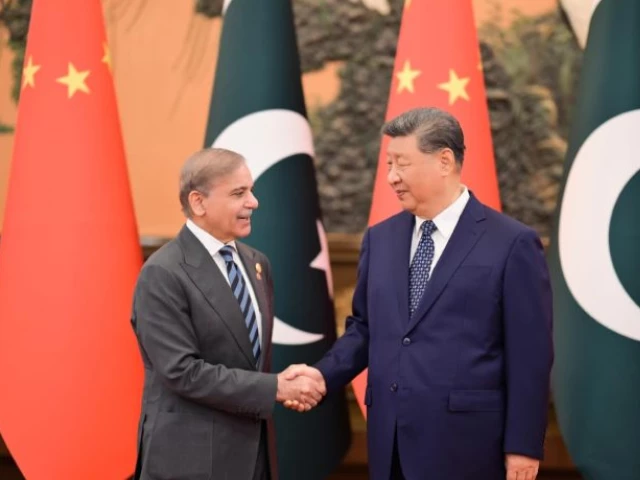
Prime Minister Muhammad Shehbaz Sharif and Chinese President Xi Jinping on Tuesday reaffirmed their commitment to the China-Pakistan Economic Corridor (CPEC), agreeing to advance its next phase through five new corridors designed to expand cooperation in key economic sectors.

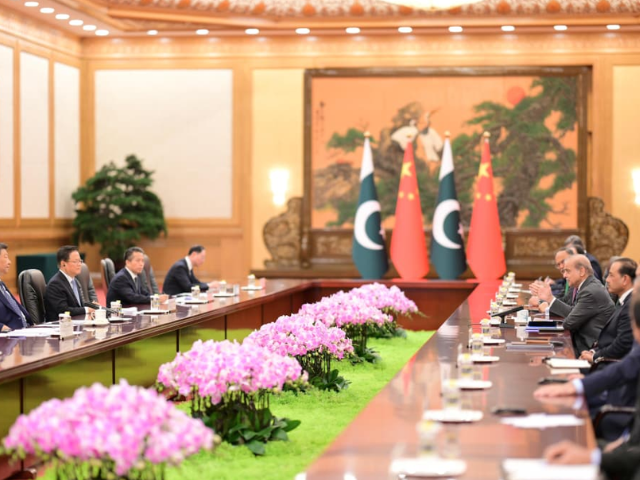
At their meeting at the Great Hall of the People in Beijing, the two leaders emphasized that the Pakistan-China partnership was unique and unparalleled and agreed that this bond should be reflected through enhanced cooperation across multiple fields.

Prime Minister Shehbaz reaffirmed the desire to continue working closely with China for the successful implementation of the next phase of upgraded CPEC, terming the project a flagship of President Xi’s Belt and Road Initiative (BRI).

Shehbaz appreciated China’s unflinching support to Pakistan’s territorial integrity, sovereignty, and socio-economic development and said CPEC would help both nations build an even stronger Pakistan-China community with a shared future.

President Xi assured the prime minister that China would continue to assist Pakistan in all fields of economic growth and development, particularly as the second phase of CPEC gets underway.

indias-prime-minister-narendra-modi-addresses-the1756807776-0.png


Earlier in August, both countries reaffirmed their unwavering commitment to the high-quality development of the upgraded China-Pakistan Economic Corridor (CPEC) during the 6th Strategic Dialogue between Deputy Prime Minister and Foreign Minister Ishaq Dar and Chinese Foreign Minister Wang Yi.

The two sides reviewed the full spectrum of Pakistan-China relations, discussed key regional and global issues, and exchanged views on various areas of cooperation, including CPEC 2.0, trade and economic ties, multilateral engagement, and people-to-people exchanges.

At a joint press stakeout, Dar highlighted the complete unanimity between the two countries on major bilateral, regional, and global matters, adding that they were encouraged by Wang Yi’s vision for advancing cooperation, particularly in upgrading CPEC to its next phase.

Today, the two leaders also reviewed broader bilateral relations and regional developments, agreeing to maintain close coordination on global and regional issues.

Prime Minister Shehbaz lauded President Xi’s visionary and transformational leadership that has inspired China’s journey towards modernization and progress, adding that “Pakistan took great pride in China’s achievements and would always stand ready to work together with China in this great journey.

Shehbaz congratulated President Xi on the success of the SCO Council of Heads of State Summit in Tianjin and on the 80th anniversary of the World’s Anti-Fascist War.

The prime minister also expressed Pakistan’s support for President Xi’s global initiatives, including the Global Governance Initiative, Global Development Initiative, Global Security Initiative, and Global Civilization Initiative, calling them contributions to regional as well as global peace, stability and development. Shehbaz said.

Shehbaz invited President Xi to undertake an official visit to Pakistan next year, when the two countries will celebrate the 75th anniversary of diplomatic relations.

The prime minister is in Beijing after attending the 25th meeting of the SCO Council of Heads of State in Tianjin.

During his stay, he will also participate in the anniversary celebrations of the World War Against Fascism and address the China-Pakistan Business-to-Business Conference.
 
.
China’s 2025 Official English-language Article on Gwadar Port

(Excerpt from the 2025 Government Work Report, delivered 5 March 2025 at the Third Session of the 14th National People’s Congress)

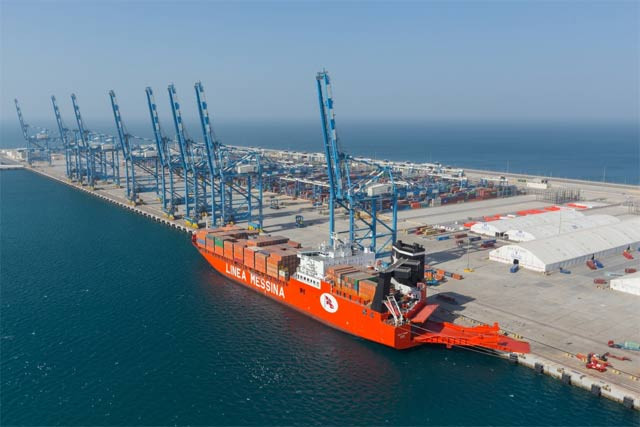
“…We will deepen high-quality Belt and Road cooperation by completing the Second Phase of the China-Pakistan Economic Corridor. Gwadar Port will be upgraded into a regional trans-shipment hub: its channel will be dredged to 14.5 m, five 100 000-ton container berths will be commissioned, and a reverse-flow crude pipeline to Peshawar will open in 2026. These measures are expected to raise the port’s annual throughput from 34 million t in 2025 to 45 million t in 2026, 60 million t in 2027, 80 million t in 2028 and 100 million t in 2029, while cutting logistics costs for western China-bound crude by roughly thirty per cent…”


• By 2029 Gwadar’s throughput will equal roughly half that of the Karachi metropolitan ports, yet its growth headroom for crude oil and dry bulk far exceeds Karachi’s.

• On containers, Gwadar still trails Karachi; the two ports are complementary rather than competitive: Karachi serves domestic consumption and industry, while Gwadar focuses on international trans-shipment and energy corridors.

• With deeper draft, new berths and a new railway, Gwadar will markedly ease Karachi’s congestion and become Pakistan’s second national logistics lifeline.
 
Last edited:
Corridors are great, but the Pakistani govt needs to facilitate and incentivize local businesses to take advantage of the infrastructure.
 
CPEC is the largest infrastructure and development project in Pakistan.
Please post your information here.
 

Senior govt official says CPEC phase-II to transform technology, boost Pak-China cooperation​


By Shafqat Ali | Gwadar Pro
Sep 1, 2025

PESHAWAR, Sept 1 (Gwadar Pro) - Khyber Pakhtunkhwa Provincial Secretary for Industries, Commerce and Technical Education, Masood Ahmad, said on Sunday afternoon that the second phase of the China-Pakistan Economic Corridor (CPEC) will bring about a technological transformation that would reduce production costs and open new avenues for Pakistan to earn valuable foreign exchange through exports to Afghanistan and Central Asia.

Speaking during his visit to the China Window, a Chinese cultural center established in Peshawar, the provincial secretary underscored that connectivity projects, including the proposed Kohat-to-Afghanistan cargo train line, are under active review and could serve as a game-changer for regional trade and economic integration.

Masood Ahmad toured various galleries at the China Window, signed the “Friendship Wall,” and recorded his impressions in the guestbook, describing the Pakistan-China friendship as “everlasting.” He emphasized that the provincial government is committed to establishing industries in Khyber Pakhtunkhwa through a one-window operation, with legislation already in progress to facilitate investors.

Referring to the recent visit of China’s Foreign Minister to Pakistan, he said it is expected that law and order in the province will improve, encouraging Chinese and international investors to explore business opportunities in Khyber Pakhtunkhwa. “The CPEC project is vital for Pakistan’s economy, and the Rashakai Special Economic Zone will not only attract industries but also generate thousands of jobs,” he remarked.

On the proposed railway project linking Kohat with Afghanistan and Central Asia, he noted: “If operationalized, this train link will significantly boost Pakistan’s economy by facilitating smoother and faster trade routes.”

The secretary lauded the role of China Window in promoting people-to-people contacts and cultural diplomacy, calling it a state-of-the-art center that strengthens bilateral understanding.

He reminded industrialists to uphold integrity in trade practices, stressing that Pakistan-China cooperation is entering a new era that will transform the provincial economy and uplift livelihoods across the region.
 
1150212-Gwadar-1469590767-640x480.webp


ISLAMABAD: Pakistan and Kazakhstan are likely to sign a Gwadar Port access deal during the visit of Kazakhstan president in November this year.

Sources told The Express Tribune that a high-level delegation of Kazakhstan was due in Islamabad in the second week of September to finalise arrangements for an agreement on Gwadar Port access to the Central Asian states. They said that Kazakhstan intends to set up a goods terminal at Karachi Port for exports to the European Union member countries and the United States.

However, Pakistan would like to see Kazakhstan establish a terminal at Gwadar Port. During the upcoming dialogue between the two countries, officials will also explore prospects of forging road and rail linkages. Pakistan wants to form a consortium with the Central Asian states for developing the maritime sector.

Meanwhile, according to a statement, a key meeting was held between Kazakhstan Ambassador Yerzhan Kistafin and Federal Minister for Maritime Affairs Muhammad Junaid Anwar Chaudhry on Tuesday. Both sides showed strong interest in expanding cooperation in the maritime sector.

The federal minister suggested initiating joint ventures at Karachi and Gwadar ports and highlighted the potential of forming partnerships in the Gwadar Free Zone. These efforts are intended to utilise Pakistan's strategic port infrastructure to enhance trade access for Kazakhstan, a landlocked nation seeking wider maritime connectivity.

The ambassador welcomed the initiatives, saying that Kazakhstan was eager to use Pakistani ports as transit hubs not only for Astana but also for the broader Central Asian region. He shared that a ministerial-level delegation, led by Kazakhstan's communication minister who also oversees maritime affairs, was scheduled to come to Pakistan soon. It will hold in-depth discussions to explore further cooperation in maritime trade and logistics.

The federal minister outlined the critical role of Pakistani ports as gateways offering Kazakhstan and other landlocked Central Asian nations access to markets in the Persian Gulf, Africa and Southeast Asia. He underscored the maritime sector's dedication to become a regional trade hub by adopting innovative approaches and reinforcing international partnerships.

The upcoming visit of the Kazakh delegation is expected to accelerate progress on joint ventures and trade facilitation and strengthen ties through maritime infrastructure development, logistics and the blue economy.
 

Users who are viewing this thread

Country Watch Latest

Back
Top