
Beijingwalker
VIP Member

Cutting China reliance would cost the west $23tn, research suggests
Study highlights challenge facing US and EU as they try to reduce Beijing’s dominance over strategic supply chains
July 12 2026
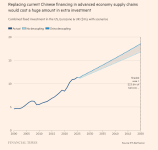
Europe and the US would need to invest an extra $23.6tn over the next 25 years to end their reliance on China in critical industries such as manufacturing and technology, an economic analysis suggests.
Consultancy EY-Parthenon calculated that replicating the infrastructure, research, software, manufacturing and supply chains currently reliant on China would cost the US $13.7tn, the Eurozone $9.1tn and the UK $800bn by 2050.
At $550bn a year, the annual investment required from the US government and American companies to decouple from China is roughly equivalent to the $600bn invested by big US technology groups in data centres in 2025. For the EU, the spending required would amount to a near doubling of its annual budget, EY-Parthenon said.
The mammoth investment required to replicate Chinese resources and materials currently relied on by advanced economies highlights the scale of the challenge facing western governments as they look to reduce Chinese dominance over strategic supply chains.
“Localising supply chains without putting prohibitive costs on taxpayers and consumers will be one of the most formidable challenges for businesses and governments alike in coming years,” said Mats Persson, a former Downing Street adviser now at EY-Parthenon.
The additional collective investment of an average of $940bn a year for 25 years was, in theory, “not insurmountable” the EY-Parthenon analysts wrote. But it would be required on top of existing investments in energy, technology, defence and infrastructure. Initial annual outlays would be smaller but would mount as the process grew in scale, Persson added.
The vulnerability of European and US economies to Chinese coercion was highlighted last year when Beijing imposed export controls on critical rare earth metals in response to US President Donald Trump’s threat of imposing 145 per cent tariffs on imports from China.
Production lines in the car industry in both economies came close to a standstill before Beijing and Washington agreed a truce, in an episode that added urgency to US and European efforts to de-risk from China, including an EU scheme to stockpile rare earths.
China is projected to supply more than 60 per cent of the world’s refined lithium and cobalt, which are essential for the transition to cleaner energy sources, and roughly 80 per cent of battery-grade graphite and rare earth elements by 2035, according to an assessment by the International Energy Agency.
In practice, even with massive investment the west could not decouple from China in the short run because of Beijing’s stranglehold over many critical industrial materials, said Alicia García-Herrero, chief economist for Asia Pacific at investment bank Natixis.
“The challenge is not just how much it would cost, but about China’s ability to intervene to stop such decoupling because of its existing control over the supply of everything from rare earths processing to active pharmaceutical ingredients,” she added.
Given that Chinese-made goods typically enjoyed a 20-100 per cent factory price advantage over their western competitors, reducing reliance on Chinese manufacturing would push up prices and drive inflation, the EY-Parthenon analysis found.
In Europe, severing reliance on China could leave prices 1-2.5 per cent higher in critical sectors, and the European Central Bank and Bank of England perpetually above their 2 per cent inflation targets, the EY-Parthenon report said, citing an ECB analysis.
As well as investment in factories and physical infrastructure, western economies seeking to meaningfully reduce dependence on China would also need to invest aggressively in training workers and automating factory processes, the report said.
Given the evident scale of the challenges, Persson said that “partial decoupling” from China was more likely with businesses needing to be selective about where they deployed their cash in order to build resilience against potential Chinese chokepoints.


