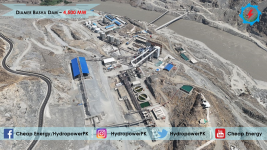
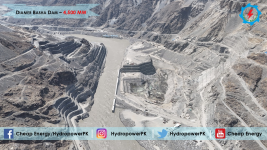
Diamer Bhasha Project - 4,500 MW

Construction update from Diamer Basha Dam

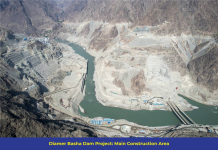
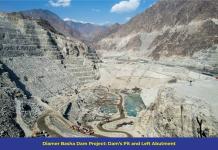
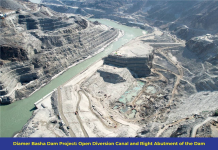
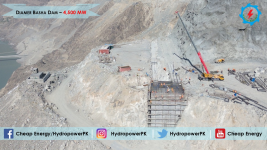
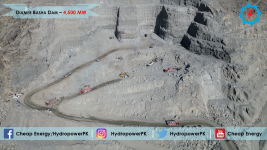
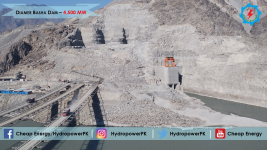
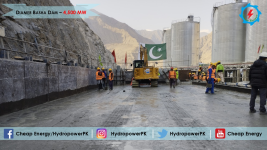
The construction work is continuing simultaneously on 13 key sites.

The Project is scheduled for completion in 2028.
It will store 8.1 MAF of water to irrigate 1.2 million acres of land. With an installed generation capacity of 4500 MW, the Project will provide 18 billion green, clean, and low-cost electricity to the National Grid.


View attachment 136664


View attachment 136665


View attachment 136667

You need a few more such projects

As per Bilawal your country wide storage capacity is around 65 MAF
This will add another 8 MAF
Another 20 MAF is required to prevent annual flooding during july-september period


You have updates for all these projects, have they used the flood water to fill in these dams / reservoir lakes? The water is everywhere and can be used.

Our government needs to understand, lakes can be built by sheer digging. You don't ALWAYS need to build a hydro power project that will have a water reservoir. Our rivers now have Jungles growing up in the middle. If you remove all that, and dig the basin deeper, you automatically create storage place in the same river or even for every hundred miles, a few miles worth of deep basin will help store water and avoid spill out due to floods.
 

Diamer Bhasha Dam Update:​


To view this content we will need your consent to set third party cookies.
For more detailed information, see our cookies page.
 
To view this content we will need your consent to set third party cookies.
For more detailed information, see our cookies page.
 
You have updates for all these projects, have they used the flood water to fill in these dams / reservoir lakes? The water is everywhere and can be used.

Our government needs to understand, lakes can be built by sheer digging. You don't ALWAYS need to build a hydro power project that will have a water reservoir. Our rivers now have Jungles growing up in the middle. If you remove all that, and dig the basin deeper, you automatically create storage place in the same river or even for every hundred miles, a few miles worth of deep basin will help store water and avoid spill out due to floods.
You can't dig you way to make a lake............there is a reason why dams are almost always built where there is natural high level topography available on at least 3 sides. You make a concrete wall and then flood the lake behind. Most of the times, this location has to be scouted and is already available naturally, such as Mangla, Tarbela, Neelum Jhelum, Diamer Bhasha.

If anything, Pakistan has tremendous such locations. They should have built dams long ago.

The areas that got flooded recently by Chenab/Sutlej/Ravi are flat lands. Cannot build lakes or dams there. What can be done is build catchment areas and then make flood drainage channels on main headworks to divert excess flood waters away from downstream areas and park it in open lands. Problem is, with increasing housing society development and population rise in Punjab, you have very limited free lands available that can be flooded safely in times of flood.

the floods that occur in Pakistan can be completely managed. But you need planning, will, funds and vision to execute. All which is lacking in government babus and short sighted ethnic politicians.
 
You can't dig you way to make a lake............there is a reason why dams are almost always built where there is natural high level topography available on at least 3 sides. You make a concrete wall and then flood the lake behind. Most of the times, this location has to be scouted and is already available naturally, such as Mangla, Tarbela, Neelum Jhelum, Diamer Bhasha.

If anything, Pakistan has tremendous such locations. They should have built dams long ago.

The areas that got flooded recently by Chenab/Sutlej/Ravi are flat lands. Cannot build lakes or dams there. What can be done is build catchment areas and then make flood drainage channels on main headworks to divert excess flood waters away from downstream areas and park it in open lands. Problem is, with increasing housing society development and population rise in Punjab, you have very limited free lands available that can be flooded safely in times of flood.

the floods that occur in Pakistan can be completely managed. But you need planning, will, funds and vision to execute. All which is lacking in government babus and short sighted ethnic politicians.

What you are describing is a typical Dam structure, three sided natural support walls, ideally in hills or mountains. These are used for two purposes, hydro-electricity and water storage. Water storage is essentially used for electricity production. When rain or water input is reduced, the water on these dams is put through conservation for electrical output so that's it's primary purpose.

What I am referring to are water storage lakes or reservoirs only. You don't produce electricity out of it and it doesn't require billions of dollars. When you do mining, you dig a big hole in earth. It's the same concept. On certain locations, you could dig to a few hundred meters even (Mangla lake and Khanpur lake, later turned dams were an example of this). This bowl shapped whole a few kilometers wide, is then given a channel from the flood prone rivers, as well as a channel to bring in water from a regular source when floods aren't present. Another channel is to deliver water in the shape of a few large canals out to distant agriculture locations. During heavy rainfall and floods, the water is channeled out by nearly half emptying the lake. This empty area is then filled with extra flood water and rain water. This infrastructure generally cost 1/10th of a dam and can be built locally without foreign expertise.
 
The Diamer Bhasha Dam Project will cross another significant milestone in early 2026, RCC works will commence to construct the main dam of the project in the early months of next year.

Diamer Basha Dam Project is all set to achieve yet another milestone, as roller-compact-concrete (RCC) works of the main dam will commence in early 2026.
 
Diamer Basha Dam – 4500MW
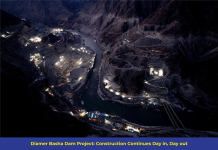
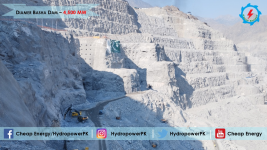
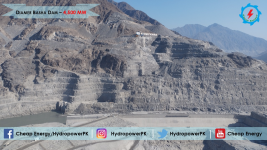
Construction work continues day and night across all major sites, including the Dam Pit, Left Abutment, and Power Intake Infrastructure.

With a gross water storage capacity of 8.1 MAF and a power generation capacity of 4500 MW, this mega project will play a vital role in securing Pakistan’s water and energy future also set to become the tallest RCC dam in the world at 272 meters.

1763848438329.png


1763848458671.png


1763848499442.png
 

Users who are viewing this thread

Country Watch Latest

Latest Posts

Back
Top