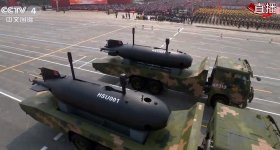
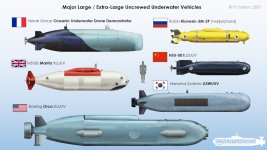
The United States is developing the ORCA underwater drone, the Manta drone for Great Britain, and the ASWUUV drone for South Korea. As for China, it is already deploying the HSU-001 drone in the China Sea..
The French demonstrator
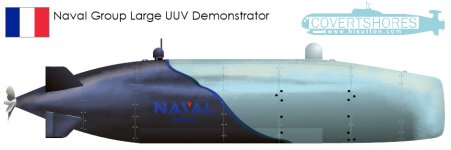
Described as an '
Oceanic Underwater Drone Demonstrator', French defense giant Naval Group's entry into the XLUUV arena is impressive. The innovative design uses sleek whale-like lines, reminiscent of the
SMX-31 concept.
The craft can undertake ISR (Intelligence, Surveillance and Reconnaissance) missions. For this it has a comparatively large sonar and a retractable telescopic optronic / radar mast. Missions could include close observation of a hostile coast to improve situational awareness of a mother ship.
In future the craft could be fitted with a payload, such as torpedoes or nines. It could also be doubled in length, from ~10m long to ~20m, to increase endurance. This could involve more batteries, or AIP (air independent power). Naval Group has fuel cell AIP technology which logically could be scaled down to the XLUUV size.
The hull carries a sonar for underwater detection, as well as a radar and electro-optical system on the mast when it develops near the surface. It has several communications systems, including a satellite link, a radio link, and a low-frequency link, allowing it to exchange with a ship, or control station, in the form of compressed encrypted messages to increase the secrecy of the ship's equipment. Finally, it has a navigation, sensor analysis and mission control system based on artificial intelligence that combines machine learning and deterministic analytics to ensure precise control of the drone's actions.
The production version that Naval Group engineers are working on will be longer, 13 meters to displace 20 tons, and will have autonomy at sea, greater discretion and speed than the demonstrator.
Power multiplier and access denial
In fact, the Naval Group's new drone is positioned as a formidable fighter, acting as what the Army calls a “force multiplier,” that is, allowing the operational capabilities of other units to be increased. Like unmanned aerial combat aircraft, this would allow for example to carry out intelligence missions on the opposite coast, or as close as possible to the enemy's maritime system, without having to risk a submarine and its crew in this risky mission.
Not only will it then be able to transmit information to the coalition forces about the enemy's forces, but he will also be able, if necessary, to determine the exact location of potential targets, so as to allow long-range strikes. Such as the MM40 Block 3C anti-ship missile covering more than 160 kilometers, but also the nature of the targets present, in order to allow the missile's intelligent seeker to hit the most important target, thus avoiding unwanted collateral damage in particular.
It can also, if necessary, patrol an underwater sea area to ensure the absence of enemy submarines and, if not, to enhance the effectiveness of anti-submarine warfare units dispatched to eliminate or expel the threat.
But the drone will be able to go much further, moving from the “detector” mission to the “responder” role in its extended version, potentially armed with torpedoes or mines. In fact, the drone, equipped in this way, could become a key player in implementing a maritime and submarine anti-access strategy, by assuming responsibility for interdicting a maritime area, together with other units of the Naval Forces.
However, the cost of such a drone, both to acquire and implement it, is much lower than that of a combat submarine, even if conventionally powered.




 Federal cabinet gives nod to imposition of emergency in KP; summary sent to president (13 Viewers)


 Makkah Defence Alliance: Turkey, Saudi Arabia, and Pakistan, news & updates (34 Viewers)