THE MANY WAYS TO KILL A DRONE
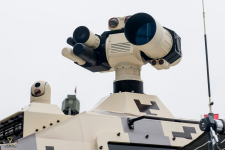
We can break counter-UAV technology into four broad categories:
- Tracking
- Jamming
- Kinetic
- Hybrid, hijacking, and cyber approaches
The unfortunate truth: There are rather a lot of options in Categories 1 to 3; and
virtually none that have been proven effective in Category 4. That means if countering drones is your mission, you’ll need a good deal of money — and perhaps even more, patience — to diversify and work through numerous systems and gadgets and digital tools that can do the job you want given risks associated with your urban or rural environment.
 Making the task more difficult:
 if you bought and deployed all the emerging counter-drone technology available today inside America’s borders, you’d be breaking up to
two dozen U.S. laws, dealing with everything from privacy to communications channels to aircraft interdiction. Meanwhile, there are thousands of places across the U.S. that lobbyists and a few legislators are increasingly
working to protect from nefarious drones and their operators: playgrounds, stadiums and other outdoor sports events, parades, prisons and military bases.
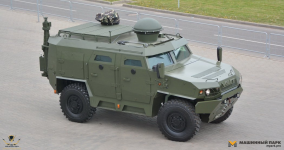
On the military side, traditional U.S. defense contractors are repackaging existing tech to deal withtoday’s drone threat. One of the more headline-grabbing methods is to fire multi-million-dollar Raytheon-made
Patriot missiles at small UAVs, as the Israeli military has done on more than one occasion near the Golan Heights. And more than a year ago, the U.S. Navy
shot down a drone with a laser over the Persian Gulf. Raytheon is pitching its
C-RAM air defense systemas a UAV countermeasure, while Northrop Grumman is altering its
G/ATOR air defense system to monitor UAVs, as is Lockheed Martin and its
AN/TPQ-53 radar. But these are not systems you’d find deployed in urban settings back in the States.
 The good news:
 “There are a lot of ways” of bringing down a drone that don’t involve military-grade equipment, said Duncan Woodbury, a former researcher and remote systems contractor who learned how to alter a consumer drone’s GPS system to allow it to fly anywhere — including into the White House.
 The bad news:
 The most promising counter-drone solutions don’t yet appear to be ready for prime time. That’s because they would involve “creating something that’s generalizable, scalable and applicable to a wide set of platforms,” Woodbury said. And just because your solution worked on a Monday doesn’t mean it will work on Tuesday. Why? You’d need a multi-pronged approach that “persists through different firmware updates.” So far, nothing meets those requirements. But some methods do come close.
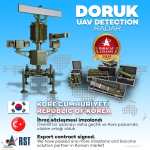
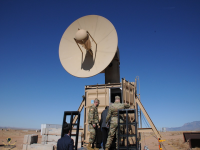
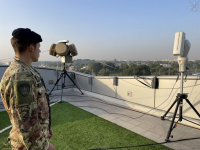
The first task of a counter-UAV system is to locate the drone in the sky. There are hundreds of companies that offer this relatively easy capability — which spans at least six methods of tracking:
- Radar
- Radio-frequency (RF pulses; each DJI drone has a RF signature that could be gathered, e.g., in DJI’s new-ish Aeroscope tracking device)
- Electro-optical (visual signature)
- Infrared (heat signature)
- Acoustic (with experimental systems based on data-triangulators like Shotspotter)
- Combinations of the above
The real trouble comes in what to do next — i.e., taking down (“interdicting”) a target drone without violating U.S. laws relating to privacy or public safety and then private property. Advances as recent as this summer provide reason for optimism.
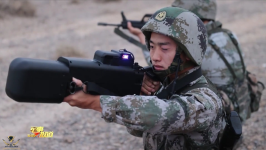
“There are very few people operating in the unclassified space that have novel solutions for effective counter-UAS,” Woodbury said. “What I’m seeing a lot of when I go around is a bunch of people making wide-band jammers and they mount them on guns and they make them look fancy. And all they’re doing is jamming 2.4Ghz and 5.8Ghz [WIFI frequencies].”
 The problem with that:
 Jamming is
illegal in the United States. It can disable other devices and communications methods used by first responders and civil authorities. (Not that other rogue actors and colorful characters — like
Jack Gerritsen — haven’t jammed area freqs, drawing the attention of local police and the FCC.)
The Language of Drone-killing
Soft Kill Level 1: Detection and monitoring
Technology that generates UAV data like speed, distance and time aloft.
Soft Kill Level 2: Taking control of the drone
An interruption of the signal between the drone and the controller, and co-opting the aircraft effectively intercepting and stealing the UAV while aloft.
Hard Kill Level 1: Projectiles and kinetics
This could include nets, bullets (or shotgun pellets), mortar rounds or missiles — anything to knock the object out of the sky and to the ground.
Hard Kill Level 2: Lasers, magnetics, and other means
Two companies offer electromagnetic-pulse devices — among the less-desirable options for urban settings, where the stunned aircraft could fall on someone’s head.
This approach — sometimes called RC protocol manipulation — is where you begin to get into “soft kill” technology, which aims to disable a drone by disrupting its sensors or electronic signatures.
One such method is “spoofing” a drone’s GPS signal — but such actions can also be a crime under the current language of the Computer Fraud and Abuse Act.
Other wireless techniques involve exploiting a vulnerable comms protocol, “like LightBridge for the Phantom 4s,” Woodbury said. “Or just generally their developers being inept and leaving a bunch of vulnerabilities in the platforms, which we’ve found a number of them in the
work that we did [at DroneSlayers] — unauthenticated FTP servers, or you extract a password off the board and it turns out to be the password that every drone uses.”
That’s just the sort of vulnerability Woodbury helped isolate last year as part of a project funded by U.S. Special Operations Command. He and colleague Nicholas Haltmayer found ways to manipulated their DJI drone into ignoring the preprogrammed “no-fly zones” around, e.g., large civilian airports.
The best practice for cyber-attacking a drone, Woodbury said, is to “come up with a prepackaged set of exploits that target the wireless protocol they use and the operating system they use. And if there’s an app that does telemetry between a mobile phone and the drone, that’s another viable target. And if there’s a communications link between the drone and the manufacturer’s server, that’s a target. And if there’s a video server or image server on the drone to capture pictures, that’s another target.”/
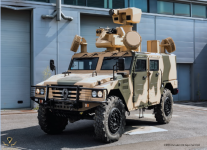
“There’s literally over 200 different counter-drone technologies — everything from guns to spoofers to jammers, you name it,” said Brett Velicovich, former U.S. soldier and current CEO of Drone Experts, based in Alexandria, Va. “And there’s over 100 manufacturers making these things, but yet there’s not one solution that I could point to and say, ‘Yes, 100 percent that’ll stop a drone from coming in.’ And that’s kind of scary when you think about all the money and brainpower being put towards it.”
 The bottom line:
 “There are a lot of ways” to bring down a drone, Woodbury said. So the question has evolved from what’s possible to what’s both proven effective
and affordable. Or, as he said, can these companies create an all-in-one system, a one-stop shop “that’s generalizable, scalable and applicable to a wide set of platforms, and [which is] inexpensive and persists through different firmware updates?”
“The fact of the matter is I could still take a drone right now and I could fly it into the White House,” Velicovich said. “And there’s absolutely nothing anyone could do about it, even with all the counter-drone technologies that are hidden away in Washington, D.C., right now, it wouldn’t matter. And that’s just because with a little bit of tweaking of this software, you render basically these systems obsolete.”
 Another big question for the industry:
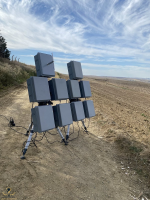
 Beyond the firmware, and even more importantly for tomorrow, can such a system handle
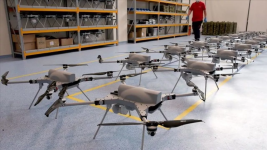
multiple drones at once — the swarm threat? There are very few who are remotely close to that counter-UAV holy grail. And those who appear to be close are not speaking in great detail just yet. Did they speak to Venezuelan officials before the episode in August? We do not know just yet. But there are a few things we do know about the industry, which is growing at an exponential rate.
THE STATE OF THE INDUSTRY
Despite its lack of clear solutions, the counter-drone market is expanding rapidly — and projected to be worth some $1.5 billion by 2023.
“In 2016, things really exploded,” said Arthur Holland Michel, co-director of the Center for the Study of the Drone at Bard College, N.Y. “In fact, Sandia National Laboratories did a market survey in 2015 and there were like 10 systems on there. If you applied that same criteria today, there would be more than 200.”
“Once we started seeing that ISIS had drones,” the industry began soaring, said Michel. “A contributing factor was a simultaneous spike in incidents involving drones, drones crashing into infrastructure, drones being involved in near-misses with aircraft, a drone that crashed into the stands at the U.S. Open,” he said.
“If you run security for a stadium that seats 80,000 people,” he said, you don’t want to be “the stadium that ignored the threat.”
“But that’s also complicated,” he continued, “because what’s also the likelihood of a drone attack compared to a different kind of attack? If you take someone who’s wishing to do harm, what is the likelihood that they will choose a drone over any of the other nasty techniques that might be more easily achievable. So it’s a tricky one.”
In February, Michel issued a
study that “found at least 235 counter-drone products either on the market or under active development.” He plans to update his study this spring because he said his numbers need to be updated almost every week.
“It’s still a fresh and new industry,” Velicovich said. “No one has really decided what company is gonna be the company that owns counter-UAS. And so there’s this counter-UAS arms race taking place to become that DJI of the counter-UAS solution, so it’s still up for grabs.”
The most popular option offered:
jamming in some form or fashion. And that’s great technology for counterterrorism in remote places like Iraq and Syria. But what about the Super Bowl? And how could one stop an explosive drone without jamming all of the communications equipment nearby, whether in Miami or Caracas? This uncertainty is among the reason that there are as many companies developing anti-drone lasers as jamming and spoofing solutions.
The economics of counter-drone systems?
It’s still very out of balance, Velicovich said. Many of “these companies are spending millions of dollars to defeat a threat that cost about $500 apiece.”
And still there’s another consideration some counter-drone advocates miss, Velicovich said. “These systems can only defeat up to a certain range. So if I can take a DJI drone and not even tweak it at all, and I can still fly it at 1,500 feet in the air and drop something over a crowd from 1,500 feet where it stops you from flying any higher unless you break the software, that’s high enough [that] most solutions out there will not be able to even stop that. Most solutions are at maybe 400 to 600 feet.”
So what lies ahead?
Increasingly sophisticated “systems of systems,” Michel predicted — much like Woodbury said would be needed to take on the risks seriously and most comprehensively while also allowing first responders to do their jobs and keep ordinary lines of communication open for civilians. That’s a lot to juggle.
He also noted promising developments in passive detection radar and shield-building technology. Passive-detection radar could be useful for tracking multiple targets, reducing the threat from swarms of drones like the ones that
attacked the Russian airbase in Latakia, Syria, in January.
To that end, Velicovich said, we should get comfortable with the phrase
remote identification.
“I guarantee you in the next year we will see the FAA require each drone that flies to have some sort of remote identification kit — meaning that they’ll be able to literally determine who is flying that drone no matter where you are if they had to,” he said. “That also allows them to back track where the drone came from and create this kind of pattern of life for more of these counter-UAS investigations.”
And then again, the solution may already be out there. As the Maduro episode shows, Michel said, “People are using counter-drone [gear] that we had no idea had access to the technology. And we’ve already seen Russia has had some success jamming drones in Syria. But just standing purely from looking at open source data, it’s not unreasonable to say that countermeasures and the countermeasures to the countermeasures will continue to develop and evolve in tandem. Nothing is going to stand still.”