A private Egyptian company enters the hydrogen drone market with its multi-platform RAAD system.
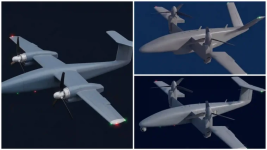
Arab Defense – September 21, 2026: A newly established private Egyptian company is entering the defense industry through the drone sector, developing a new family of unmanned aerial vehicles (UAVs) that combine electric and hydrogen propulsion. These UAVs incorporate vertical takeoff and landing (VTOL) technology, autonomous navigation, and artificial intelligence.
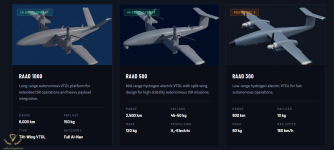
The company, named RAAD Dynamics, is based in Cairo. Its official website states that it was founded in 2024 with the goal of developing autonomous defense platforms and integrated systems encompassing UAVs, secure communications, and cybersecurity. The company currently offers three UAVs within the same family: the RAAD 300, RAAD 500, and RAAD 1000. These UAVs differ in size, range, and payload, but share the concept of a tilt-wing configuration and hydrogen-electric propulsion.
The Raad 300 stands out as the company's first aerial platform. According to company data, it has a maximum weight of approximately 60 kg and an operational payload of up to 10 kg. It utilizes a hybrid in-flight propulsion system powered by hydrogen and electricity. The platform is distinguished by its ability to take off and land vertically and then transition to horizontal flight, eliminating the need for a traditional runway or the launch and recovery systems typically used by fixed-wing aircraft.
The Raad 300 has a declared maximum speed of approximately 160 km/h and a maximum operating altitude of 5,000 meters, with an endurance of more than 5 hours. Based on these figures, the company estimates its mission range at over 800 km, giving the platform the capability to perform long-range surveillance and reconnaissance missions compared to conventional electric drones with their limited endurance.
The Raad system is not limited to this smaller aircraft; The company is simultaneously working on the Raad 500, a medium-sized platform weighing approximately 120 kg, with a payload capacity of 45-50 kg and an operational range of up to 2,500 km. It utilizes hydrogen-electric propulsion and a tilt-wing design, with a stated focus on reconnaissance and surveillance missions.
The larger platform is the Raad 1000, which the company describes as a long-range aerial platform for intelligence, reconnaissance, and surveillance missions, capable of integrating large and varied payloads. Its stated payload capacity reaches 150 kg, while its target operational range is approximately 6,000 km. It features a tilt-wing design and AI-powered autonomous navigation capabilities.
Hydrogen and Electricity: A Bet on Endurance
One of the most significant differences in the Raad family is the combination of electric propulsion and hydrogen fuel cells or a hydrogen fuel cell system, rather than relying solely on batteries. The company says this design aims to provide greater endurance while maintaining the advantages of electric propulsion, including lower noise compared to some conventional propulsion systems.
The platforms also utilize a VTOL (vertical takeoff and landing) design, allowing them to operate from limited spaces without the need for runways. This feature theoretically opens the door to operating such platforms from forward operating sites or unprepared areas, as well as from suitable offshore platforms.
In this context, vertical takeoff and landing capabilities can be particularly important for maritime operations, including for vessels that lack a runway for fixed-wing aircraft.
RAAD Dynamics isn't just focusing on the aircraft's structure and propulsion system; the company places autonomousity and AI-powered navigation at the core of its programs.
The company highlights the development of autonomous navigation capabilities and the integration of onboard computers with sensor data, enabling operation in environments where GPS may be unavailable or jammed. It describes the Raad 1000 as a fully AI-powered autonomous navigation platform.
In parallel with its aircraft programs, the company is working on other technologies, including secure L-band communications, quantum-resistant encryption systems, and research into ultrafast propulsion systems. This suggests that the company's vision extends beyond simply manufacturing a single drone; it aims to build a comprehensive ecosystem encompassing the air platform, communications, navigation, and cybersecurity.
The significance of the Raad project is further highlighted by its combination of vertical takeoff and landing (VTOL), hydrogen-electric propulsion, long-range flight, autonomous navigation, and relatively large payload capacity. This combination of characteristics provides Egypt with a promising technological foundation for developing a new generation of unmanned aerial vehicles (UAVs) for both land and sea missions, with the potential for future expansion to meet the needs of the armed forces and the defense market.
The entry of Egyptian private companies into this field also represents a significant development in the trajectory of the Egyptian defense industry. It adds to the existing industrial capabilities a new base of companies focused on artificial intelligence, autonomous systems, hydrogen energy, and advanced communications. This increased participation will enhance Egypt's ability to develop local solutions in the drone sector, reduce reliance on imported technologies, and pave the way for the development and marketing of products that can be further developed and marketed internationally.



 “Beyond Defensive Postures: The Case for an Integrated Offensive Doctrine in Pakistan’s Military Strategy” (6 Viewers)
 PTI Murad Saeed in Afghanistan, was 'controlling KP govt' from there: Rana Sanaullah (10 Viewers)
 Federal cabinet gives nod to imposition of emergency in KP; summary sent to president (7 Viewers)
