Emergency First Aid

Status
Not open for further replies.
Introduction

This thread is my public service for all PDF members, I have been teaching First Aid and Trauma Management for 21 years now and I will try to keep this as easy and informative as possible for you all. This is a real life skill and I hope you never have to use it, but it's one skill that you should rather have and NOT use it, then NOT have when you need to USE it!


Why is First Aid so Important?

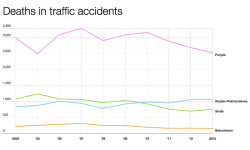
Every day in Pakistan thousands of people get injured on roads, in their homes, in schools and workplaces. According to International Journal of Medicine Trauma is the leading cause of death for adults under 44 years age.
1746576037322.png

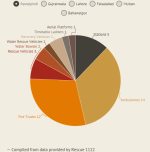
Statistics published reports by the WHO 30,000 people in Pakistan die every year due to road traffic accidents, fires claim 16,500 deaths annually whilst sudden cardiac arrest accounted for more than 80,000 deaths per year – that’s more than 200 deaths every day.
1746576050384.png
Ambulances are in short supply in large and densely populated cities. For example, Rawalpindi a city with a population of 2.1 Million has only 14 fully equipped emergency ambulances (note: this number doesn't include motorcycle fast response service).

The professional pre-hospital care provided by Rescue1122 is testament to the hard work of its staff, however it is worth considering that the volume of emergency calls has risen from 90 calls a day in 2007, to over 230 a day, in a country with a population of over 212 million those few well equipped Ambulances staffed with professional EMTs will not be able to answer every call.


Hoax calls make up the bulk of incoming calls to the emergency helpline, in 2019 Rescue 1122 received 1.18 million calls deemed to be hoax, fake, nuicense or malicious.

Therefore, teaching communities first aid is vital, especially considering in a study into pre-hospital care by five major hospitals in Karachi showed that out of 187 patients admitted during a study, none received bystander CPR or first aid. The report concluded that “Patients who received life-support interventions survived for longer time, though not clinically significant, as compared to those who did not”.

This behaviour of “bystander effect” - the more people there are at the scene of an accident, the less likely anyone is to help as they all expect someone else to take charge and it is driven in part by the shared psychology of communities.

In an article published by the Association for Psychological Science in 2015 it was stated that “children as young as 5 years old are less likely to help a person in need when other children are present and available to help”.
 
What is First Aid?

A brief history:

St. John Ambulance was the first to use the concept of first aid in the United Kingdom in 1879. Princess Christian – the daughter of Queen Victoria translated from German into English five ambulance lectures given by Prof. Esmarch in 1882, which were published under the title “First Aid to the Injured” by Smith Elder and his partners.
1658392268184.png


In 1882, St. Andrew established the First Aid Organization in Scotland in order “to alleviate the pains of the injured and patients in wartime and peacetime and to take measures required for their care”. The regulation of this organization, written by Sir George Beatson, was issued in 1891.

In1908, St. John's and St. Andrew's organizations reached an agreement on merging their activities carried out in various regions of Scotland and the United Kingdom in order to manage them under a single roof (1). Esmarch (1823-1908) laid the foundations of civil first aid institutions. He became a physician in 1848, and then received education on surgery.

In 1854, he specialized in surgery and ophthalmology. His main fields of interest were military surgery and first aid. He was one of the most important emergency surgeons of the 19th century. [1]

Simply put: First aid means Initial help given to a person who is sick or injured.
The Basics: Anatomy & Physiology
1658393742328.png


To be able to give basic first aid, it is not necessary to know how the body works, but if you read the information, you will understand the reasons for the first aid which should be given. The basic functions of the human body can be simply described as follows. It processes food, water and oxygen to produce the energy necessary for living and disposes of the waste that arises. We should think of the body as a series of separate systems for doing these things.

Examples of these systems are the integumentary system (Our skin, hair, nails, external glands), skeletal system (our bones), digestive system, the respiratory or breathing system, the circulatory system and the nervous system. If any of these are badly damaged, it will affect the others.

The principal parts of theses systems are the lungs, the heart and the brain. Theses organs are protected by the skeleton. The body also has an envelope of skin to act as a barrier against infection.

If the skeleton is damaged, as it is when a bone is broken, then the part of the body that is being protected and supported may also become damaged by the broken bone ends of the bone. If the skin is pierced , or cut - infection may be admitted and this can be more dangerous than the actual injury.

In this brief explanation, we will consider only three of the body's systems - Breathing, Circulation and the Nervous system. In emergency aid you are mainly concerned with these when a life is in danger.

Respiratory System:

Its purpose is to extract oxygen from the air, the oxygen is then absorbed by the blood. The lungs act as bellows, drawing air in, extracting some of the oxygen and then pusing out air which contains the waste product - a gas called carbon dioxide.

Circulatory System:

Comprises of the heart, blood and blood vessels. It works with the respiratory system to provide oxygen to those parts of the body which need it. The blood absorbs oxygen from the lungs and circulates it around the body.

The heart expands and receives blood, then contracts and forces it out, in fact, one side of the heart circulates blood through the lungs, where it absorbs oxygen, and the other side supplies the oxygenated blood to the rest of the body.

The average body contains about 10 units or about 1.2/1.5 gallons of blood or about 1 litre of blood per 13kg of body weight. The heart pumps out the oxygenated blood through arteries and the used blood is returned to the heart through the veins. If too much of these 10 units is lost or if the lungs are not providing enough oxygen, or if the heart is not pumping properly, the blood cannot do its work efficiently and the body may eventually cease to function.

If the skin is broken, blood will escape, and infection may enter the body. However as soon as a blood vessel is cut, the blood coming from the cut will start to clot. This is the body's mechanism for sealing off a wound and preventing further blood loss.

Nervous System:

Part of which controls functions such as the heartbeat. Another, very important part of the nervous system affects body movements and sensations under control of the brain. Nerves run down the spinal column in the spinal cord, rather like wires in an insulated sheath. If the spinal cord is damaged the nerves may also be damaged and paralysis may result.

A person becomes "unconscious" as a result of the brain not working properly. In accident cases this is usually due to damage to the brain or excessive bleeding.

As the various parts of the body work, they make unwanted chemicals which must be carried away in the blood. One example of this is urea, a substance like ammonia, which is extracted from the blood by the kidneys and is eventually passed out of the body as urine.
 
What is the aim of First Aid:

To act quickly, calmly and correctly to:

  • Preserve life
  • Prevent the condition from worsening
  • Promoting recovery
What are the priorities of first aid:
  • Assess a situation quickly and calmly
  • Protect yourself and any casualties from danger - never put yourself at risk.
  • Prevent cross infection between yourself and the casualty as far as possible (wear gloves and use barriers)
  • Comfort and reassure the causalities at all times
  • Assess the casualty; identify, as far as you can, the injury or nature of illness affecting the casualty
  • Give early treatment, and treat the casualties with the most serious(life threatening) conditions first.
  • Arrange for appropriate help; call 911/1122 for emergency help if you suspect serious injury or illness; ask for AED (if you suspect a heart problem; take or send the casualty to hospital; transfer them into the care of a healthcare professional or to his home. Stay with a casualty until care is available.
Key Steps:
  • Be calm in your approach
  • Be aware of risks (to yourself and others) remove the danger from the casualty (only if in further danger)
  • Build and maintain trust (from the casualty and bystanders)
  • Give early treatment, treating the most serious (life threatening) conditions first
  • Call appropriate help
  • Remember your own needs too.
Infection prevention and hygiene:
It is important that as a first aider you do not transmit infections to your casualty or indeed contract infections from your casualty. To assist in minimising the risk of infection and cross contamination there are various precautions that can be taken such as:
  • Having good personal hygiene
  • Ensuring that barrier devices are used
  • Covering any open cuts or sores
  • Minimising contact with blood or bodily fluids
  • Changing gloves between casualties
  • Washing hands thoroughly after removing gloves

Resuscitation barrier devices
  1. Resuscitation barrier devices are essential equipment and help to reduce the spreading of infection and cross-contamination. Barrier devices as their name suggests, place a barrier between the first aider and the casualty. Barrier devices include:
  2. Nitrile or powder-free gloves
  3. Face shields
  4. Pocket masks
 
Emergency Response:
At any incident involving casualties, it is essential you appear and remain claim and let your common-sense, allied with your training and skills take over. Upon arrival at an incident a scene survey must be completed to ensure the safety of the casualty, any bystanders and the first aider. The scene survey should be conducted by remembering the mnemonic CLAP:
  • C: Control the situation: Stop, take a deep breath and take charge of people and vehicular traffic
  • L: Look for potential hazards: Look for anything that could cause further harm to the casualty, bystanders or more importantly yourself within the immediate area.
  • A: Assess the situation: Gather as much information about what has occurred from the casualty and from bystanders, and try to make a diagnosis (history of the casualty(do they have diabetes/asthma etc), any signs (things you can see i.e. blood), symptoms (anything the casualty complains about i.e. headache).
  • P: Protect and Priorities: Ensure PPE is worn and that casualties are prioritised (breathing, bleeding, bones/burns and other conditions). Try to gain assistance from a bystander and contact the emergency services.
This is a good video that explains a scene assessment:


Primary Survey:

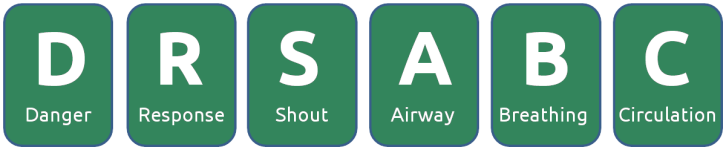
Having contacted a scene survey and established that the immediate area is safe from any dangers, you can now approach the casualty. When approaching the casualty an initial casualty assessment should be completed - this initial assessment is called a primary survey. The primary survey is a systematic process of approaching, identifying and dealing with immediate and or life-threatening conditions.

The Primary survey can be remembered by the mnemonic DRSBACD:
1746576531890.png

Contacting the emergency services:


First aiders will either contact the emergency services themselves or instruct a bystanders to do so. Contacting the emergency services at the earliest opportunity is paramount.

When contacting the emergency services on either 1122/911/15, it is important that the information given is clear, concise and sufficient. This can be achieved by remembering the mnemonic LINE:
  • Location (Where are you, where is the incident, any landmark, be specific).
  • Incident What has happened
  • Number, provide your number for call-back
  • Exact number of injured, level of injuries.
 
Basic First aid for Bleeding and wounds
  • Clean the wound or abrasion with clean running tap water for at least 5 minutes or until the wound is totally clean (no dirt or other matter on the wound).If tap water is not available use bottled (non-carbonated) drinking water.
  • To stop the bleeding, apply firm steady pressure directly on the wound until bleeding stops.
  • If gauze, cloth or sanitary pads are available, place one directly over the bleeding area and apply steady pressure. Continue until bleeding stops.
  • If bleeding continues, do not remove the gauze; add more gauze on top and apply more pressure.
  • As the gauze, cloth or sanitary pads become soaked replace with dry ones if available.
  • Once the bleeding has stopped, apply an elastic bandage over the dry gauze, cloth or sanitary pad
  • Apply triple antibiotic ointment on abrasions (scrapes) to prevent infections.
 
First Aid at Road Traffic Collisions:


  • Evaluate the situation. Look for dangers to yourself and to the victim(s).
  • Make the area safe for yourself and the victim e.g. Switch off the ignition
  • Check the victims. Evaluate all victims quickly and firstly give aid to those with major injuries or not breathing.
  • DO NOT move the victim unless it is absolutely necessary. Treat the victim in the position where you find him or her.
  • ALWAYS assume that there is a neck (spinal) injury
  • If you think the victim has a spinal injury (back or neck injury) do not move the victim. If the victim is unresponsive (unable to answer your questions) and is having difficulty breathing, is vomiting or if you must leave the location to get help, place the victim in the modified recovery position.
  • Recovery position :- extend one of the victim's arms above the head and roll the body onto one side. Use the extended arm as a pillow. Bend both legs to keep the body on its side. . (stabilize)
  • Monitor and record the victim's vital signs (pulse, breathing, response to your questions)
  • Be prepared to give CPR, if needed.
 
Fire Incidents
  • Call 911/1122
  • DO NOT put your safety at risk.
  • DO NOT attempt to fight a fire.
  • Pull the nearest fire alarm. Many buildings have maps on the backs of doors with marked alarm locations and exits
  • DO NOT use elevators under any circumstances
  • STOP, DROP and ROLL if you or anyone else is on fire. (If possible wrap the victim in a coat, curtain, blanket, rug or other heavy fabrics) .
 
Smoke and Fumes
  • Smoke and fumes in a confined space create an environment that is low in oxygen and may be polluted by carbon monoxide and toxic fumes.
  • If trapped in a burning building, get down on your knees and crawl across the smoke filled room (air is cleanest at the lowest level). Go to a room with a window and close the door. Encourage and assist others to evacuate (leave) the area.
  • Almost all of fire victims perish from smoke inhalation, 4 maybe 5 breaths can kill you.
 
Electrical Injuries
  • Evaluate the situation. Look for dangers to yourself and to the victim
  • Make the area safe for yourself and the victim
  • HIGH VOLTAGE current found in power lines and overhead high-tension (HT) cables, is usually fatal. Immediately notify the authorities if there is high voltage electrocution, such as fallen power lines.
  • LOW VOLTAGE current is found in homes and workplaces
  • DO NOT touch the victim if he/she is in contact with the electrical source because you risk electrocution.
  • Break the contact between the victim and electrical supply by switching off the current at the main switch or fuse box or by unplugging or disconnecting the appliance.
  • If unable to reach the plug or main switch, then stand on dry insulating material such as a wooden box, a plastic mat, or a telephone book. Using a wooden stick push the victim's limbs away from the electrical source or push the source away from the victim.
  • If a wooden stick is unavailable, place a piece of rope or cord around the victim's ankles or under victim's arms and then pull away from the electrical source.
  • If a wooden stick or rope is unavailable then pull the victim by any loose, dry clothing (sleeve , pant leg or hem of shirt) being careful not to touch the body. Remember , you risk electrocution by touching the victim's body.
  • Once the power is off, evaluate the victim's for breathing and pulse.
  • Begin CPR if the victim has no pulse or is not breathing.
  • Call 911/1122 emergency medical services
  • All victims of electric shock need medical assistance. Internal injuries may have occurred that are not visible.
  • Arrange to take or send the victim to a hospital so that he or she may be evaluated by professionals


NEVER enter flood waters or touch pylons or downed cables, especially during rainfall:
 
First aid for drowning

  • Evaluate the situation. Look for dangers to yourself and to the victim.
  • Make the area safe for yourself and the victim.
  • If possible stay on land and pull the victim from the water with your hand, a stick, or a rope.
  • If victim is unconscious you may have to wade or swim to the victim and bring him or her to shore.
  • Begin CPR if the victim is not responsive and not breathing.
  • If only one rescuer is present then start CPR and complete 5 cycles (2 minutes) before activating emergency services. If two people are present then send one person to activate emergency services and the other to start CPR.
  • Once the victim is out of the water, place the victim in a position so that his/her head is lower than the rest of the body to reduce the risk of inhaling the water and protect the body from the wind to prevent the victim's body from getting colder. Remove wet clothing if possible and cover the victim with dry materials (blankets, towels, clothes).
  • Arrange to take or send the victim to a hospital. As with electrical injuries the victim may have suffered injuries that are not obvious.
NEVER GET IN THE WATER TO RESCUE SOMEONE... Reach, Throw, Row, but Don't Go!
 
First aid for Asthma attacks

  • Asthma is a condition where the distant/small wind pipes are swollen and the swelling results in spasms
  • Asthma may be caused by an allergy, a cold, a particular drug, or cigarette smoke.
  • People with asthma may have sudden attacks at night.

The symptoms are :
  • Wheezing (whistling sounds when breathing), and coughing.
  • They usually have to use a “rescue” inhaler at the start of an attack
  • Be calm, reassure the person and ask the location of his or her inhaler
  • Ask the person to take the “rescue” inhaler (e.g. Albuterol inhaler). Within few minutes he/she should feel better. If their breathing does not, improve, ask him/her to take another dose of the same inhaler. They may repeat 2-4 inhaler puffs at a time every 15-20 minutes. If the repeated inhalers are not helping then he/she should seek medical service ( doctor or emergency room service).
Signs of severe asthma attack :
  • Difficulty speaking and whispering
  • Gray-blue coloured lips, earlobes and nail beds
  • Breathlessness, causing exhaustion
  • If the person loses consciousness or is having a severe asthma attack, call 911 or 1122. Be prepared to administer CPR to the unconscious person if necessary. If it is a severe asthma attack then continue “rescue” inhaler (e.g. Albuterol inhaler) every 5-10 minutes, until the EMS arrives. Monitor and record (write it down) vital signs – level of response, pulse and breathing.
 
First aid for shock:

  • Shock is a life threatening condition.
  • It occurs when the circulatory system (heart and/or blood vessel system) fails, and it cannot supply oxygen to the important organs i.e. brain, kidneys, and heart.
Signs of shock:
  • Rapid pulse/heart beats
  • Pale, cold, clammy skin and sweating
  • Weakness and dizziness
  • Gray-blue skin (cyanosis), especially inside the lips, nail bed and earlobes
  • Rapid, and shallow breathing, which progresses to gasping for air.
  • In later stages, pulse is weak (faint) and eventually the heart stops working.
Causes of shock:
  • Severe blood loss (more than 1 Liter)
  • Severe diarrhea and vomiting
  • Severe burns
  • Severe infection
  • Severe allergic reaction (anaphylactic shock)
  • Low body temperature (hypothermia)
  • Low blood sugar (hypoglycemia)
  • Drug overdose
  • Spinal cord injury
Treatment:
  • Treat the underlying cause, and activate EMS
  • Raise the victim’s legs (above the level of the heart) to improve the blood supply to the vital organs.
  • Monitor and record vital signs – level of response, pulse and breathing
  • Be prepared to administer CPR, if necessary
 
Anaphylactic Shock
Anaphylactic shock is a severe allergic reaction that occurs within seconds or minutes, of exposure to the trigger/allergen and is potentially fatal.


Causes of anaphylactic shock:
  • Drug reaction (injection or by mouth)
  • Insect stings (bees for example)
  • Ingestion of certain food (peanuts for example)

Signs of anaphylactic shock:
  • Anxiety
  • Skin rash
  • Swelling of the tongue and throat
  • Rapid, and shallow breathing (wheezing)which progresses to gasping for air.
  • Signs of shock
Treatment:
  • Call EMS or 911 state that you suspect an anaphylactic shock.
  • If the victim has auto injector of epinephrine (adrenaline) then administer it (usually administered on the thigh).
  • If the victim continues to have symptoms or the symptoms are worsening, even few minutes after the first dose of epinephrine and EMS hasn't arrived then administer the second dose of epinephrine
  • If the person is conscious, then sitting position helps the victim's breathing
  • Monitor and record vital signs-level of response, pulse and breathing
  • Be prepared to administer CPR, if necessary
 
Heart Attack
Heart attack refers to the blockage of the blood supply to the heart muscle, which can cause the heart to become weak or stop beating. This can cause death.


Signs of heart attack:
  • Continuous chest pain (center or left sided), radiating to the jaw and down one or both arms.
  • Sudden dizziness
  • Extreme fearfulness
  • Profuse sweating
  • A rapid, weak, pulse. Racing heart (palpitation)
  • Fainting
  • Gasping for air

  • Treatment:
  • Call 1122/911 and state that you suspect a heart attack.
  • Make the victim sit in a comfortable position
  • If the person is conscious, ask the person to chew a 325 mg aspirin tablet or two 81 mg baby aspirins (if no allergic reaction to aspirin or recent GI bleed)
  • If victim has medicine for angina (e.g. nitroglycerine), then help him or her take it.
  • Monitor and record vital signs – level of response, pulse and breathing
  • Be prepared to administer CPR
 
Status
Not open for further replies.

Users who are viewing this thread

Back
Top