European Defence News and Discussions

Thanks to the PAF's competence and the IAF's incompetence, Rafale has got much to prove not to be termed Ra-fail....
 
Yes they have, but Tanks still are not going anywhere instead what will happen is that AI and Anti Drone, Anti Missile system will be combined and placed on Tanks. I mean small version which can take on 8 to 12 upcoming projectiles, anti tank missiles and other systems before running out of ammo. Work on those will increase. Every country will come up with their own version to protect Tanks and your APC and IFV because you can't move your Army Forward without doing that. Helicopters and Planes in large numbers are really expensive.

You have to learn to think maturely.
Tank is not the objective,
It's a tool to meet an objective.
That objective is a piece in larger strategy, formulated and owned by a general.

So, don't just go around defending stuff based on your subjective bias.
Like they say, there are more ways to skin a cat ...
 
You have to learn to think maturely.
Tank is not the objective,
It's a tool to meet an objective.
That objective is a piece in larger strategy, formulated and owned by a general.

So, don't just go around defending stuff based on your subjective bias.
Like they say, there are more ways to skin a cat ...
Yes but Tank is one major part of it and if it was Tanks alone I would have bought your argument but issue is that not just Tanks, APC, IFV and all other transport vechiles through which you transport a major portion of your soldiers in case of war will all be under threat in modern times. So the solutionis not abandoning them because the alternate are way to expensive instead like I suggest improve the air defense of these weapon systems.
 
I’m assuming that the tank’s role in warfare is over as the smallest drone can disable it by targeting it,Unless the industry introduces a technology that can mislead or cause the drones to crash away from the tank.
 
I’m assuming that the tank’s role in warfare is over as the smallest drone can disable it by targeting it,Unless the industry introduces a technology that can mislead or cause the drones to crash away from the tank.
No, it won't be over. Yes right now drones are dominating but soon Anti Drone systems and trophy systems like the one Israel has will further improve and will be placed on Tanks, APC, and IFV. If Tanks are vulnerable so are APC and IFV and they are your main mode of transport in case of war. Helicopters and Transport planes are expensive plus can't be used everywhere. You need ground vechiles and you need to make sure they are protected from Anti Tank missiles and drones hence you need better Trophy style systems which would now be developed by everyone and will get much faster and better with new emerging technologies like AI.
 

Romania To Purchase 298 German Lynx KF41 Infantry Fighting Vehicles Built On Local Lines​


Romania has chosen Rheinmetall’s Lynx KF41 IFV for a 298 vehicle procurement that includes local production and a range of specialist variants. The move strengthens NATO’s eastern flank and anchors new defense manufacturing capacity inside Romania.

https://go.ezodn.com/ads/charity/pr...funnel=tofu&utm_type=traffic&ffid=1&co=PK
According to Euronews Romania, on 13 November 2025, Bucharest has decided to purchase 298 Lynx infantry fighting vehicles from Rheinmetall, including 46 specialist variants based on the same chassis, with a significant share of production to take place in Romania. The decision follows a high-profile visit by Rheinmetall CEO Armin Papperger to the Romanian government, where he met Prime Minister Ilie Bolojan, along with Economy Minister Radu Miruță and Defense Minister Ionuț Moșteanu, to seal the basics of the deal. Euronews describes the programme as the main joint project between Romania and the German group, building on earlier parliamentary approval for local assembly of new IFVs and existing contracts for medium-caliber ammunition and a future propellant plant.

Rheinmetall’s Lynx KF41 is a new-generation IFV with modular armour, high survivability, a 1,140 hp powerpack and a Lance 2.0 turret mounting a 30/35 mm cannon and Spike LR2 missiles, giving Romania a highly mobile, digitally networked frontline combat vehicle (Picture source: Rheinmetall/ Army Recognition Group).

Rheinmetall's Lynx KF41 is a new-generation IFV with modular armor, high survivability, a 1,140 hp powerpack and a Lance 2,0 turret mounting a 30/35 mm cannon and Spike LR2 missiles, giving Romania a highly mobile, digitally networked frontline combat vehicle (Picture source: Rheinmetall/ Army Recognition Group).


This announcement closes a long chapter in Romania’s effort to replace its MLI-84 and MLI-84M Jderul vehicles, Soviet-derived platforms that have been stretched far beyond their design margins. The government formally launched the tracked IFV programme in July 2025, aiming initially for around 246 vehicles with a budget of roughly €2.55 billion and options for another 52, bringing the total close to 300 platforms over two phases. The competition crystallized at BSDA 2024 in Bucharest, where Rheinmetall’s KF41 Lynx, BAE Systems’ CV90 Mk IV, Hanwha’s AS21 Redback, GDELS’ ASCOD 2, Poland’s Borsuk and Türkiye’s Tulpar were all showcased to Romanian officers and defense officials.

The Romanian army operates roughly 140 MLI-84-series tracked IFVs, vehicles conceived in the early 1980s around the BMP-1 hull and only partially modernised in the 2000s. Their armor is limited, space for electronics is cramped and there is little growth margin for active protection or new sensors. At the same time, Bucharest has committed to raising defence spending from around 2.2% of GDP in 2024 toward 2.5% in 2025 and potentially 3.0% within the next few years, explicitly in response to Russia’s war against Ukraine and Romania’s role on NATO’s eastern flank. For any future heavy brigade earmarked for NATO operations, a modern, survivable IFV is no longer optional.

https://go.ezodn.com/ads/charity/pr...funnel=tofu&utm_type=traffic&ffid=1&co=PK
The Lynx KF41 gives Romanian mechanized infantry a leap of more than one generation. The vehicle sits in the 40–50 tonne class, powered by a Liebherr D976 18-litre inline-six diesel producing up to 1,140 hp, coupled to a Renk HSWL 256 fully automatic transmission. This powerpack allows road speeds around 70 km/h, 60 percent gradient climbing, 30 percent side-slope operation, a 1 m vertical step and a 2.5 m trench crossing, performance that keeps pace with modern main battle tanks in combined-arms maneuver. The KF41 variant carries a crew of three plus eight dismounts in a protected rear compartment accessed via a power ramp, with generous internal volume for soldiers in full kit and future electronic systems.

Firepower is centred on Rheinmetall’s Lance 2.0 digital turret, normally armed with a 30 or 35 mm autocannon capable of airburst and armour-piercing ammunition, backed by a 7.62 mm coaxial machine gun and banks of smoke launchers. The turret supports integration of Spike LR2 anti-tank guided missiles, which give ground-launched engagement out to about 5.5 km, with tandem HEAT or multipurpose warheads and high-angle top-attack profiles suited to defeating modern ERA-equipped tanks. A fully digital fire-control system, panoramic commander’s sight and independent gunner’s sight enable hunter-killer and even “killer-killer” engagements, improving reaction time when fighting drones, IFVs or fast-moving armour.

https://go.ezodn.com/ads/charity/pr...funnel=tofu&utm_type=traffic&ffid=1&co=PK
Protection and survivability are at the core of the Lynx concept. The base steel hull accepts modular armour packages tailored to different threat environments, from peace support operations to high-intensity peer combat. Mine and IED resistance is enhanced through a double floor, decoupled seating and internal spall liners, while the design allows integration of the StrikeShield hybrid active protection system to intercept incoming rockets and anti-tank guided missiles. Combined with laser warning systems, rapid smoke deployment and an NBC protection suite similar to that used on Boxer and PzH 2000, the Romanian Army will gain a survivability envelope that simply does not exist on the MLI-84M.

Lynx’s operational value lies not only in protection and firepower but in its architecture. Rheinmetall separates a common “drive module” from mission kits, allowing the same chassis to become an IFV, command post, reconnaissance platform, mortar carrier, recovery vehicle, ambulance or even a Skyranger short-range air defence system by swapping modules in hours rather than weeks. For Romanian brigade commanders, this modularity means they can adjust the mix of support vehicles and IFVs for specific missions while preserving training, logistics, and spare parts commonality across the fleet.

Rheinmetall has quietly built a Romanian production ecosystem over the past two years. Its majority stake in Automecanica Mediaș created Rheinmetall Automecanica, which is slated to handle Lynx assembly and integration, and the company has announced a broader production network including local partners, a simulation-based training centre, and expanded ammunition manufacturing. In parallel, Bucharest and Rheinmetall have agreed on a joint venture for a propellant powder plant in Victoria, Brașov County, a 500-plus million euro project expected to create around 700 jobs and anchor Romania in the European ammunition value chain.

Against this backdrop, Lynx’s rivals each brought strong credentials. The CV90 Mk IV offers a combat-proven Swedish IFV with a weight up to 38 tonnes, a 1,000 hp Scania engine, advanced X300 transmission, and a mature digital architecture already ordered by several NATO armies, including for service in Ukraine. Hanwha’s AS21 Redback, successful in Australia, features advanced crew protection and an Israeli active protection system, while GDELS’ ASCOD 2 and Poland’s Borsuk also offered modern chassis and 30–35 mm turrets with Spike integration. Still, none of these competitors could match Rheinmetall’s already-existing Romanian industrial footprint, which appears to have tipped the balance once the technical scores all converged at a high level.

For Romania, bringing Lynx production, ammunition lines and a propellant factory inside its borders is as strategic as fielding a new IFV. It reduces dependence on external supply chains at a time when Europe as a whole is scrambling to expand ammunition and explosives production, under EU initiatives such as the Act in Support of Ammunition Production and broader efforts to strengthen the European defence industrial base. For the wider European industry, a Lynx line in Romania creates another anchor for a continental tracked-vehicle family that already includes Hungary and now Italy, and positions the Black Sea region as a genuine production hub rather than a mere customer.

If the contract signature follows the 2025 timeline indicated by the Romanian Ministry of National Defence, the first Romanian-built Lynx vehicles could begin to equip mechanized battalions before the end of the decade, entering service alongside new artillery, air defense and naval assets already ordered by Bucharest. For soldiers who have spent their careers in cramped, thin-skinned MLI-84s, the difference will be immediately tangible: more armor, more firepower, modern sensors and genuine integration into NATO’s digital battlespace. For Europe’s defense industry, this contract is another sign that high-end land combat systems and industrial localization now go hand in hand, and that major export wins will increasingly be decided not only by performance on the range but also where the production will be located.

https://go.ezodn.com/ads/charity/pr...unnel=tofu&utm_type=traffic.&ffid=1&co=PK

Written by Evan Lerouvillois, Defense Analyst, Army Recognition Group.

Evan studied International Relations, and quickly specialized in defense and security. He is particularly interested in the influence of the defense sector on global geopolitics, and analyzes how technological innovations in defense, arms export contracts, and military strategies influence the international geopolitical scene.
 

Colombia signs $3.6B deal for Gripen fighters​

The deal covers 15 Gripen E one-seater aircraft, along with two Gripen F two-seaters and a host of equipment and weapons, the Swedish company announced. Delivery of the jets will take place between 2026 and 2032.
By Aaron Mehta on November 14, 2025 8:11 pm

Share
gripen-e-ukraine-scaled-e1761306392603-1024x577.jpg
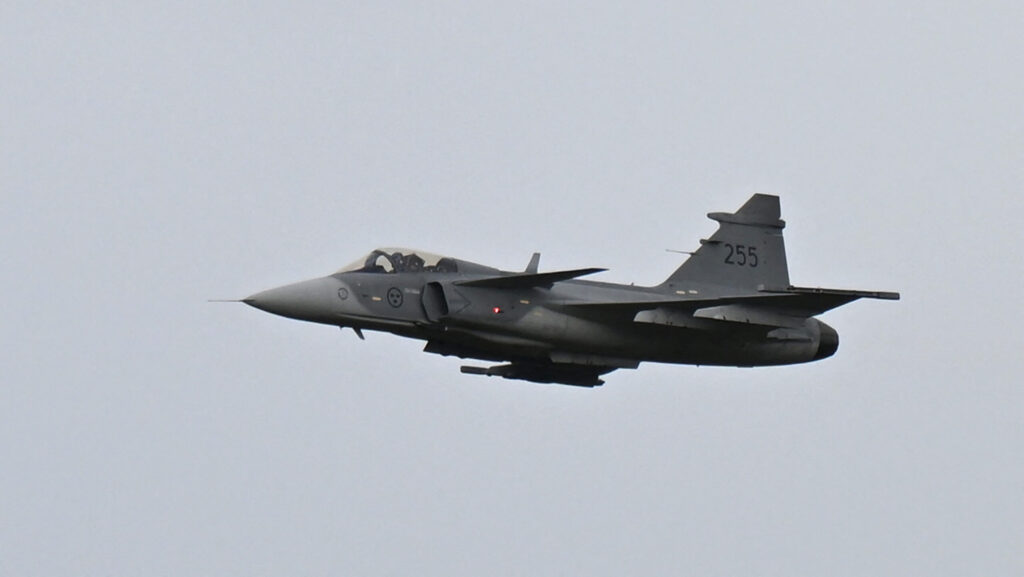
A Saab Gripen E-series fighter aircraft is seen in the sky over the airport of Linkoping, Sweden, as it is shown to the Ukrainian President during his visit on October 22, 2025. (JONATHAN NACKSTRAND/AFP via Getty Images)
WASHINGTON — Colombia on Friday signed an agreement for 17 Gripen E/F fighter jets, with a value of €3.1 billion ($3.6 billion), according to a statement by Saab.

The deal covers 15 Gripen E one-seater aircraft, along with two Gripen F two-seaters and a host of equipment and weapons, the Swedish company announced. Delivery of the jets will take place between 2026 and 2032.

The decision to purchase the Gripen was made back in April, but the number of jets and total cost had not been decided. Saab beat out a US-backed offer of F-16 jets.


Get Capitol Hill insights with The Congressional Roundup – tune in here!
“I am honored that Colombia has chosen Gripen E/F to enhance its air defence capabilities and delighted to welcome Colombia into the Gripen family,” President and CEO of Saab Micael Johansson said in the statement. “This marks the beginning of a strong and long-term partnership that will strengthen Colombia’s defence and security, benefit its people, and boost the nation’s innovation power.”

Said Swedish defense minister Pal Jonson on X, “With the Colombian purchase of 17 Gripen E/F, our defence relations will deepen significantly & Colombia will receive one of the world’s greatest fighter jets.”


A translated statement from Colombian President Petro Gustavo, posted to X, included the notable line that “We are moving forward, and we must maintain this pace. At this pace, no one will dare to threaten us, neither from outside nor inside the country.” Petro has been engaged in a war of words with US President Donald Trump amidst a US military buildup in the region.

RELATED: If the US cuts Colombian military aid, Bogota’s Black Hawks likely first to feel it

presented by
Cigent-Logo-1024x269.png

Sponsored Post
Courtesy of Cigent. Protecting mission data in the AI era

Keeping sensitive information safe in a new AI era

Why edge and endpoint security can’t be an afterthought.

By Kelvin Quezada - Cigent
The company statement also noted that the two sides have signed off on two industrial offset agreements, covering “a comprehensive industrial cooperation package that will benefit Colombia in areas including aeronautics, cyber security, health, sustainable energy and water purification technology.” Offsets are industrial trades that a company will offer up to a purchasing nation, and are sometimes required to close a deal.

Colombia now joins neighboring Brazil as an operator of the Swedish-made fighter. In addition to its 36 Gripens on order, Brazil is also home to an assembly plant for building the jets in country; it’s unclear if Colombia’s jets will also be built in Brazil.

Saab has been slowly building out the Gripen’s user base. In August, the company locked in a $550 million deal with Thailand to purchase four of the jets. And last month, Ukraine and Sweden reached a deal that will see the war-torn nation procure anywhere from 100 to 150 Gripen E fighters in the coming year. Meanwhile, there are ongoing talks with Peru as well.

Topics:​


Colombia signs $3.6B deal for Gripen fighters​

The deal covers 15 Gripen E one-seater aircraft, along with two Gripen F two-seaters and a host of equipment and weapons, the Swedish company announced. Delivery of the jets will take place between 2026 and 2032.
By Aaron Mehta on November 14, 2025 8:11 pm

Share
gripen-e-ukraine-scaled-e1761306392603-1024x577.jpg
A Saab Gripen E-series fighter aircraft is seen in the sky over the airport of Linkoping, Sweden, as it is shown to the Ukrainian President during his visit on October 22, 2025. (JONATHAN NACKSTRAND/AFP via Getty Images)
WASHINGTON — Colombia on Friday signed an agreement for 17 Gripen E/F fighter jets, with a value of €3.1 billion ($3.6 billion), according to a statement by Saab.

The deal covers 15 Gripen E one-seater aircraft, along with two Gripen F two-seaters and a host of equipment and weapons, the Swedish company announced. Delivery of the jets will take place between 2026 and 2032.

The decision to purchase the Gripen was made back in April, but the number of jets and total cost had not been decided. Saab beat out a US-backed offer of F-16 jets.


Get Capitol Hill insights with The Congressional Roundup – tune in here!
“I am honored that Colombia has chosen Gripen E/F to enhance its air defence capabilities and delighted to welcome Colombia into the Gripen family,” President and CEO of Saab Micael Johansson said in the statement. “This marks the beginning of a strong and long-term partnership that will strengthen Colombia’s defence and security, benefit its people, and boost the nation’s innovation power.”

Said Swedish defense minister Pal Jonson on X, “With the Colombian purchase of 17 Gripen E/F, our defence relations will deepen significantly & Colombia will receive one of the world’s greatest fighter jets.”


A translated statement from Colombian President Petro Gustavo, posted to X, included the notable line that “We are moving forward, and we must maintain this pace. At this pace, no one will dare to threaten us, neither from outside nor inside the country.” Petro has been engaged in a war of words with US President Donald Trump amidst a US military buildup in the region.

RELATED: If the US cuts Colombian military aid, Bogota’s Black Hawks likely first to feel it

presented by
Cigent-Logo-1024x269.png

Sponsored Post
Courtesy of Cigent. Protecting mission data in the AI era

Keeping sensitive information safe in a new AI era

Why edge and endpoint security can’t be an afterthought.

By Kelvin Quezada - Cigent
The company statement also noted that the two sides have signed off on two industrial offset agreements, covering “a comprehensive industrial cooperation package that will benefit Colombia in areas including aeronautics, cyber security, health, sustainable energy and water purification technology.” Offsets are industrial trades that a company will offer up to a purchasing nation, and are sometimes required to close a deal.

Colombia now joins neighboring Brazil as an operator of the Swedish-made fighter. In addition to its 36 Gripens on order, Brazil is also home to an assembly plant for building the jets in country; it’s unclear if Colombia’s jets will also be built in Brazil.

Saab has been slowly building out the Gripen’s user base. In August, the company locked in a $550 million deal with Thailand to purchase four of the jets. And last month, Ukraine and Sweden reached a deal that will see the war-torn nation procure anywhere from 100 to 150 Gripen E fighters in the coming year. Meanwhile, there are ongoing talks with Peru as well.

Topics:​


Interesting. Azeris got 40 JF-17Cs for $4.6 Billion.

Gripen E is a great fighter, but now JF-17C has "combat proven" tag on it.
 
Interesting. Azeris got 40 JF-17Cs for $4.6 Billion.

Gripen E is a great fighter, but now JF-17C has "combat proven" tag on it.

That tag doesn't really mean much, the Mig 21 is more combat proven then the F-22 does that mean it's better?
 
That tag doesn't really mean much, the Mig 21 is more combat proven then the F-22 does that mean it's better?

That is not a correct analogy. You may as well say a Spitfire is combat proven and a Gripen is not.

In military circles, equipment that has worked in combat carries more weight then unproven stuff. That is simply a fact.
 
That is not a correct analogy. You may as well say a Spitfire is combat proven and a Gripen is not.

In military circles, equipment that has worked in combat carries more weight then unproven stuff. That is simply a fact.

Countries extensively test equipment before purchase nowadays nobody looks at superficial tags like "combat proven" Rafale for example has one of the worst combat records yet countries are still buying Rafales, what matters more is what is offered in terms weapons and support packages plus things like procurement and maintenance costs over a fighters entire lifespan, that's what the gripen in particular excells in.
 
Last edited:
Countries extensively test equipment before purchase nowadays nobody looks at superficial tags like "combat proven" Rafale for example has one of the worst combat records yet countries are still buying Rafales, what matters more is what is offered in terms weapons and support packages.

Of course those factors matter, but you are wrong if you think combat experiance of military equipment means little. Most major defence companies make a big deal of it, but you seem to know bette then. them.....

Indonesia signed for J-10s and no more Rafales after 7th May. Despite having all logistics in place for Rafale.

Make of that what you will....
 
I wish we had the money to go for 24 Gripen E instead of J10CE.

But then that would cost 5 billions or something.
 

Users who are viewing this thread

Back
Top