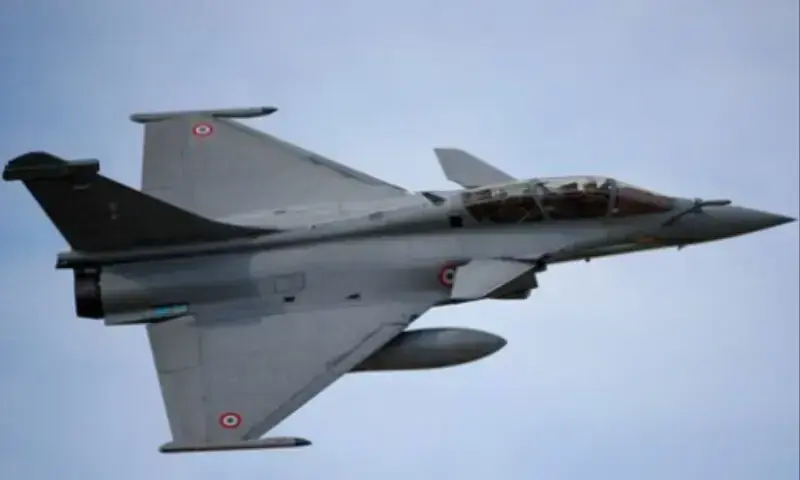
Don't be surprised if the Saudis buy a small batch.
Read this article by the Asia Times:
Why Saudi Arabia really wants China’s JF-17 fighter
Riyadh’s JF-17 talks reflect strategic hedge against reliance on an increasingly conditional US security umbrella
by
Gabriel HonradaJanuary 12, 2026
Saudi Arabia has its eye on China's JF-17 fighter. Image: X Screengrab
Saudi Arabia’s reported interest in converting financial support for Pakistan into a potential fighter jet deal highlights how Gulf arms procurement is increasingly shaped by strategic hedging and alliance politics rather than pure military necessity.
Pakistan and Saudi Arabia are in talks to convert about US$2 billion in Saudi loans into a deal for JF-17 Thunder jets. This move would deepen defense ties between the two long-time partners while easing Pakistan’s acute financial strain.
00:17
03:36
Read More
The discussions follow the signing of a mutual defense pact in September 2025 and center on the light combat aircraft jointly developed by Pakistan and China and produced at the Pakistan Aeronautical Complex.
The potential arrangement’s total value could hit $4 billion, with an additional $2 billion earmarked for weapons, training and support equipment, according to news reports. Neither government, however, has formally confirmed the talks.
For Pakistan, the proposed loan-to-arms conversion offers a dual benefit. Pakistani officials see it as a way to stabilize foreign exchange reserves while monetizing domestic defense manufacturing capacity at a time of chronic balance-of-payments pressure.
For Saudi Arabia, the talks reflect a broader reassessment of its security partnerships amid regional instability and lingering uncertainty over long-term US commitments.
Pakistan’s air force chief’s recent visit to Saudi Arabia to discuss defense cooperation and the regional security environment has further underscored the political momentum behind the discussions.
At the platform level, the JF-17’s relatively low cost and its claimed combat use against India last year have boosted its export appeal, even as questions persist about how a Chinese-linked aircraft would integrate into Saudi Arabia’s overwhelmingly Western-equipped air force.
These questions become sharper when examining the potential tactical roles such jets might play. Saudi Arabia’s most pressing concerns involve scenarios that demand greater airpower autonomy from the US, particularly in contingencies involving Iran and its regional proxies, such as the Houthis.
Latest stories


In the ongoing Yemen conflict, Saudi and Emirati aircraft fly thousands of sorties; cost-effective fighters like the JF-17 could help sustain similar high-tempo operations should Western arms supplies be constrained.
Even though a direct Saudi-Iranian war remains unlikely, more limited scenarios involving intense missile exchanges, drone attacks or clashes in contested zones remain plausible.
In such contexts, numerical strength and redundancy matter. Expanding the fleet with cheaper fighters could complicate Iranian planning by forcing it to account for a larger number of platforms rather than focusing solely on Saudi Arabia’s most advanced Western aircraft.
Yet these potential uses raise a central dilemma: how would Chinese-linked fighters fit into a Saudi fighter force structure built almost entirely around Western systems?
Integrating the JF-17, with its Chinese avionics and Russian engine, into Saudi Arabia’s military ecosystem would pose significant technical and political challenges. Saudi command-and-control (C2), data links, and logistics chains are designed around US and NATO standards, which may not communicate seamlessly with, or support, Chinese aircraft.
Bridging these gaps would require extensive effort, as synchronizing Chinese-influenced avionics with Western command-and-control and logistics systems would likely necessitate separate training pipelines, spare-parts inventories and support facilities, eroding the efficiencies Saudi Arabia gains from standardizing on a limited number of platforms.
Beyond cost and complexity, such integration carries political risk. Western partners, particularly the US, could view the presence of Chinese electronics within Saudi military networks as a security concern, fearing potential exposure of sensitive data from US-supplied radars, missiles and aircraft.
Similar concerns emerged when Turkey acquired Russia’s S-400 air-defense system, ultimately leading to the former’s removal from the F-35 program. If Saudi Arabia were to operate JF-17s, the US could respond similarly as it did with Turkey over Russian air defense systems.
This situation leads to the deeper strategic question: why would Saudi Arabia consider Chinese jets at all, given its ability to afford the most advanced Western aircraft available? Part of the answer lies in Saudi Arabia’s changing assessment of its relationship with the US.
Christopher Chivvis and other writers noted in a November 2023 Carnegie Endowment for International Peace (CEIP)
report that while the US remains Saudi Arabia’s primary security partner, the US’s decision not to respond militarily to Houthi attacks on Aramco oil facilities in 2019 heightened Saudi concerns about US reliability.
Chivvis and others argue that persistent US criticism of Saudi Arabia’s human rights record, combined with Saudi perceptions of an increasingly multipolar world, has pushed the latter to diversify its security relationships.
Similarly, Samir Puri and Marion Messemer wrote in a September 2025 Chatham House
analysis that Saudi Arabia’s failure to secure a comprehensive US-Saudi defense pact may have shaken confidence in US security guarantees.
Seen through this lens, Saudi Arabia’s engagement with Pakistan, and by extension, China, may be as much about leverage as capability. Signaling openness to alternative suppliers could generate unease in the US and strengthen Saudi Arabia’s hand in future defense negotiations.
Sign up for one of our free newsletters
- The Daily ReportStart your day right with Asia Times' top stories
- AT Weekly ReportA weekly roundup of Asia Times' most-read stories
Sign up
This reassessment is echoed in a November 2025 S Rajaratnam School of International Studies (RSIS)
report by Syed Ismail and Zhoushi Bai, which argues that the Saudi-Pakistan defense pact opens space for China to supply arms and build a strategic presence in the Gulf region as Riyadh looks for alternatives after recalibrating its ties with the US. In their view, China has emerged as the most viable non-Western supplier for arms, training and potential co-production.
Ismail and Bai note that Chinese arms sales in the Gulf have long faced two obstacles: perceptions that Chinese systems are affordable but unproven, and fears of US sanctions for buying weapons from a strategic rival.
However, they argue that the 2025 India-Pakistan Kashmir conflict altered these perceptions by showcasing the effectiveness of Chinese military technology when Pakistani aircraft reportedly outperformed India’s French and Russian jets.
If a Saudi fighter deal were to materialize, they suggest, it could mark the emergence of a new regional defense model – built by China, brokered by Pakistan and adopted by Saudi Arabia – emblematic of a more multipolar security order that challenges the longstanding US monopoly in the Gulf.
Taken together, the prospective JF-17 deal suggests that Saudi Arabia is less interested in the aircraft as a pure combat solution than as an insurance policy, using engagement with Pakistan and China to diversify security options and signal dissatisfaction with the conditional nature of US security guarantees.
If pursued, the arrangement would underscore a broader Gulf trend toward multipolar defense balancing, where arms procurement becomes a tool of leverage and autonomy rather than a simple reflection of battlefield requirements.
Saudi Arabia's reported interest in converting financial support for Pakistan into a potential fighter jet deal highlights how Gulf arms procurement is

asiatimes.com