Navigation
Install the app
How to install the app on iOS
Follow along with the video below to see how to install our site as a web app on your home screen.
Note: This feature may not be available in some browsers.
More options
Style variation
You are using an out of date browser. It may not display this or other websites correctly.
You should upgrade or use an alternative browser.
You should upgrade or use an alternative browser.
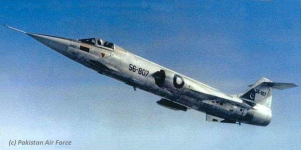
F-104 StarFighter of Pakistan Air Force
- Thread starter ghazi52
- Start date
More options
Who Replied?


ghazi52
THINK TANK: CONSULTANT
- Thread starter
- #167
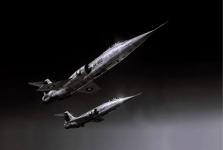
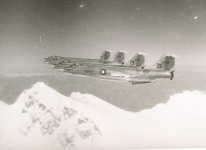
A pair of 9 Squadron F-104A Starfighters (56- 803 in the foreground and 56-805 behind) climb to height during a training sortie from Sargodha in 1964.
Despite numbering just 12, Pakistan’s fleet of needle-like F-104 Starfighters was feared by India, especially during the Indo-Pakistani War of 1965, as Tom Spencer reveals.
"Badmash" Beginnings

The partition of British India in August 1947 created the independent countries of India and Pakistan, resulting in a perpetual state of acrimony and mutual distrust over the border region of Kashmir that remained an open sore in relations between the two nations.
Assets of the air force were divided along the lines of the geographical partition. While India retained the name Royal Indian Air Force, three of the ten operational squadrons and facilities now located within the borders of Pakistan were transferred to the Pakistan Air Force (PAF), including 9 Squadron, nicknamed ‘The Griffins’. In March 1961, the unit re-equipped with Lockheed’s Mach 2-capable F-104A Starfighter.
Transferred from the US, the former USAF Air Defence Command jets were fitted with the C2 upward firing ejection seat, AN/ASG-14T1 fire control system, higher thrust General Electric J-79-GE-11A engines, a six-barrel 20mm M61 Vulcan Gatling gun and were capable of using wing tip-mounted AIM-9B Sidewinder air-to-air missiles.
The first of ten single-seat F-104As and two dual-control F-104B trainers arrived at PAF Base Sargodha, situated in Punjab some 120 miles northwest of Lahore, flown by Sqn Ldr M Sadruddin and Flt Lt M Middlecoat – two of the first PAF pilots to undergo type conversion in the US.
By 1965, Sarghoda boasted newly constructed blast pens and a cross runway to enable the rapid launch and recovery of fighters. It also housed the command and air defence control centre with communications to the radar sites at Sakesar to the northwest and Rahwali to the east. In addition to 9 Squadron’s Starfighters, the base hosted the North American F-86F Sabres of 5, 11 and 16 Squadrons. Later, elements of 17, 18, 19 Squadrons were also deployed there.
For the Starfighter, training included ground controlled interception (GCI) at high and low levels day and night, lowlevel navigation and strikes, air combat manoeuvring, zoom climbs for highlevel interceptions and dissimilar air combat training missions against F-86 Sabres. Representing the cutting edge of technology, 9 Squadron gained mastery of the jet dubbed ‘Badmash’ (wicked one).
A prelude to war
There was continual tension along the border between Pakistan and India, which steadily increased through early 1965. On April 17, during disputes over the Rann of Kutch region, a pair of F-104s were detached southwest to Mauripur. However, in order to avoid escalation in the conflict, the PAF only undertook combat air patrols (CAP) well on its side of the border.
Around this time, an F-104 from Sargodha flown by Fg Off Mushtaq shadowed an Indian Air Force (IAF) recce Canberra PR.57, although he was not given clearance to engage.
On June 24, the squadron’s first operational success with the ‘Badmash’ occurred when one of them intercepted and forced a IAF Dassault Ouragan, serial IC-698, to land in Pakistani territory. Both it and the pilot, Flt Lt Rana Lal Chand Sikkawere, were captured.
During July, Sqn Ldr Middlecoat assumed command of 9 Squadron from Sqn Ldr Jamal Ahmed Khan. With the situation with India rapidly deteriorating, on August 18 the unit’s war readiness plan was implemented. This required all aircraft to be armed, with a CAP of up to four Sabres and at least one Starfighter over Sargodha at all times.
With two Sabres forming the inner defence ring, they patrolled between 10-25 miles from the base, while another pair orbited overhead at 10,000ft. The F-104(s) – dubbed the outer defence ring – flew between 15,000-20,000ft in excess of 25 miles from the airfield. With GCI provided by Sakesar radar located on a 5,000ft mountain peak, this provided an ‘early warning’ window of between 2-5 minutes. At the time, Sargodha was probably one of the best defended targets in Asia.
ghazi52
THINK TANK: CONSULTANT
- Thread starter
- #168
Early engagements
The tensions in Kashmir during August flared into full scale war on September 1 in what was later dubbed the Indo-Pakistani War of 1965 or Second Kashmir War. At the time, the PAF had only 150 aircraft on strength, while the IAF outnumbered them almost 5:1, with approximately 900. To win the battle for air superiority against these odds was a daunting task.
Almost immediately, 9 Squadron began mounting single-aircraft CAPs between Jhelun and Muzaffarabad, some 10 miles inside Pakistani territory. Eight days later, with the PAF’s Lockheed RT-33As rendered obsolete, one of the unit’s F-104Bs was used to conduct a highspeed low-level recce of the IAF base at Halwara. Flown by Flt Lt Aftab Alam Khan and Sqn Ldr Middlecoat, the CO made visual observations and took photographs from the back seat using a hand-operated camera while screaming across the airfield inverted at near tree-top level. Deemed a success, several more recce missions were flown during the conflict.
As a fighter, the PAF’s F-104s gained their first success during the early hours of September 3. With Sakesar GCI picking up contacts in the Chhamb area, 9 Squadron’s Fg Off Abbas Mirza was scrambled in F-104A 56-877 at 0530hrs in support of a pair of F-86s that had been ‘bounced’ by six Folland Gnat F.1s. Abbas soon spotted the melee and dived towards it from 36,000ft.
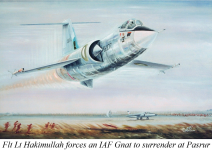
On seeing the F-104 streaking towards them, one of the Indian pilots is reported to have yelled: “Run… it’s a 104!” With a dogfight ensuing, a second F-104 flown by Flt Lt Hakimullah Khan Durrani was vectored towards the area. Sighting a Gnat, serial IE-1083, over the disused airfield at Pasrur, south of Sialcot, he forced it to land and the pilot, Sqn Ldr Brijpal Singh Sikand, was captured. As a result of this engagement, CAPs were increased to two F-104s where possible.
With the following days occupied by several uneventful defensive CAP sorties, this changed shortly after dawn on September 6. At 0700hrs, a pair of F-104As flown by Flt Lts Aftab Alam Khan and Amjad Hussain Khan from Sargodha were on CAP at 30,000ft when Sakesar GCI vectored them towards enemy contacts near Wazirabad. Descending in the gloom to 10,000ft, they spotted four Indian Dassault Mystères attacking a train. With Amjad Khan’s aircraft suffering a radio failure at the pivotal moment and turning for home, Aftab Khan selected full afterburner and dropped in on the intruders as they ran out at very low level. Closing on one of the enemy jets at 600kts, he fired a Sidewinder, but lost sight of the Mystère almost immediately. Based on intercepted radio calls, he was credited with its destruction on returning to base. In fact, all the Mystères returned safely.
An hour-and-a-half later, another F-104 was scrambled to support a Sabre CAP dealing with intruding Hawker Hunters near Sialcot, but didn’t engage. By the end of the day, 9 Squadron had flown 15 CAPs.
At 2345hrs that evening, IAF Canberra B(I) 58s conducted their first raid on Sargodha, without causing significant damage. During the attack, 9 Squadron’s F-104s made their first attempts at intercepting the attacking aircraft at night, without success. In part, this was due to the bomber’s evasive manoeuvring and stream tactics making it difficult for the GCI controller to direct the intercept. Also, because of the poor radar picture of aircraft below 10,000ft, the F-104’s Airborne Intercept (AI) radar was optimised for high levels, so it suffered from ground clutter at low altitudes.
Shortly before 0600hrs on September 7, two separate strikes totalling 15 Mystères targeted different parts the base at Sargogha. Forming part of the defensive CAP, Flt Lt Amjad Hussain Khan chased the intruders in F-104 56-877 as they egressed at low level. Twenty miles east of Sargodha, he engaged a Mystère piloted by Sqn Ldr Ajjamada B Devayya with a Sidewinder.
Evading the missile, Khan closed and hit Devayya’s jet with a burst of cannon fire. Showing great courage, Devayya turned his stricken Mystère into the vastly superior Starfighter and either hit it with gunfire or collided with it, resulting in the F-104’s controls freezing.
With the unresponsive jet speeding towards the ground, Khan ejected at around 75-100ft. In 1988, Devayya was posthumously awarded the Maha Vir Chakra, India’s second-highest military decoration.
Indian jets carried out another four attacks on Sargodha throughout the day. Despite significant damage, Pakistani F-86s claimed several Hunters in the ensuing chaos. Although 9 Squadron maintained its CAP, it had no further engagements, much to its pilots’ frustration.
The tensions in Kashmir during August flared into full scale war on September 1 in what was later dubbed the Indo-Pakistani War of 1965 or Second Kashmir War. At the time, the PAF had only 150 aircraft on strength, while the IAF outnumbered them almost 5:1, with approximately 900. To win the battle for air superiority against these odds was a daunting task.
Almost immediately, 9 Squadron began mounting single-aircraft CAPs between Jhelun and Muzaffarabad, some 10 miles inside Pakistani territory. Eight days later, with the PAF’s Lockheed RT-33As rendered obsolete, one of the unit’s F-104Bs was used to conduct a highspeed low-level recce of the IAF base at Halwara. Flown by Flt Lt Aftab Alam Khan and Sqn Ldr Middlecoat, the CO made visual observations and took photographs from the back seat using a hand-operated camera while screaming across the airfield inverted at near tree-top level. Deemed a success, several more recce missions were flown during the conflict.
As a fighter, the PAF’s F-104s gained their first success during the early hours of September 3. With Sakesar GCI picking up contacts in the Chhamb area, 9 Squadron’s Fg Off Abbas Mirza was scrambled in F-104A 56-877 at 0530hrs in support of a pair of F-86s that had been ‘bounced’ by six Folland Gnat F.1s. Abbas soon spotted the melee and dived towards it from 36,000ft.
On seeing the F-104 streaking towards them, one of the Indian pilots is reported to have yelled: “Run… it’s a 104!” With a dogfight ensuing, a second F-104 flown by Flt Lt Hakimullah Khan Durrani was vectored towards the area. Sighting a Gnat, serial IE-1083, over the disused airfield at Pasrur, south of Sialcot, he forced it to land and the pilot, Sqn Ldr Brijpal Singh Sikand, was captured. As a result of this engagement, CAPs were increased to two F-104s where possible.
With the following days occupied by several uneventful defensive CAP sorties, this changed shortly after dawn on September 6. At 0700hrs, a pair of F-104As flown by Flt Lts Aftab Alam Khan and Amjad Hussain Khan from Sargodha were on CAP at 30,000ft when Sakesar GCI vectored them towards enemy contacts near Wazirabad. Descending in the gloom to 10,000ft, they spotted four Indian Dassault Mystères attacking a train. With Amjad Khan’s aircraft suffering a radio failure at the pivotal moment and turning for home, Aftab Khan selected full afterburner and dropped in on the intruders as they ran out at very low level. Closing on one of the enemy jets at 600kts, he fired a Sidewinder, but lost sight of the Mystère almost immediately. Based on intercepted radio calls, he was credited with its destruction on returning to base. In fact, all the Mystères returned safely.
An hour-and-a-half later, another F-104 was scrambled to support a Sabre CAP dealing with intruding Hawker Hunters near Sialcot, but didn’t engage. By the end of the day, 9 Squadron had flown 15 CAPs.
At 2345hrs that evening, IAF Canberra B(I) 58s conducted their first raid on Sargodha, without causing significant damage. During the attack, 9 Squadron’s F-104s made their first attempts at intercepting the attacking aircraft at night, without success. In part, this was due to the bomber’s evasive manoeuvring and stream tactics making it difficult for the GCI controller to direct the intercept. Also, because of the poor radar picture of aircraft below 10,000ft, the F-104’s Airborne Intercept (AI) radar was optimised for high levels, so it suffered from ground clutter at low altitudes.
Shortly before 0600hrs on September 7, two separate strikes totalling 15 Mystères targeted different parts the base at Sargogha. Forming part of the defensive CAP, Flt Lt Amjad Hussain Khan chased the intruders in F-104 56-877 as they egressed at low level. Twenty miles east of Sargodha, he engaged a Mystère piloted by Sqn Ldr Ajjamada B Devayya with a Sidewinder.
Evading the missile, Khan closed and hit Devayya’s jet with a burst of cannon fire. Showing great courage, Devayya turned his stricken Mystère into the vastly superior Starfighter and either hit it with gunfire or collided with it, resulting in the F-104’s controls freezing.
With the unresponsive jet speeding towards the ground, Khan ejected at around 75-100ft. In 1988, Devayya was posthumously awarded the Maha Vir Chakra, India’s second-highest military decoration.
Indian jets carried out another four attacks on Sargodha throughout the day. Despite significant damage, Pakistani F-86s claimed several Hunters in the ensuing chaos. Although 9 Squadron maintained its CAP, it had no further engagements, much to its pilots’ frustration.
ghazi52
THINK TANK: CONSULTANT
- Thread starter
- #169
Night fighting aggravations
Due to the lack of success with nocturnal interceptions, the air defence commander directed that, from the night of September 9, F-104s would be scrambled to a high-level CAP when IAF Canberras were detected, to catch them as they climbed for home following their attacks. Two Starfighters were usually held on night alert ready to scramble. However, no contact was made on that occasion, despite Indian bombers attacking several targets, including Sargodha.
Two days later, Flt Lt Hakim was scrambled to patrol Lahore at 15,000ft. Climbing towards his CAP, he was warned by GCI of aircraft diving on him. Turning, he was confronted by a pair of the IAF’s new Mach 2-capable MiG-21F Fishbeds. However, running short of fuel, Hakim was forced to break off from what might have been the first combat between Mach 2 fighters.
Due to the small number in service at the time and lack of pilot training, IAF MiG-21s played a limited role during the conflict. Ironically, India had actually attempted to buy 36 F-104s from the US during 1961 in response to Chinese border attacks, but had been rebuffed.
That night, Sargodha was hit again, by six Canberras that evaded the Pakistani air defences. Two days later, Sargodha and Lahore were in their sights once more. With ten Canberras striking, GCI successfully positioned an F-104 flown by Flt Lt Amjad Hussain Khan behind one of the bombers. However, to his intense frustration, an electrical fault rendered his weapons inoperable.
The first positive nocturnal encounter by an F-104 came during the night of September 13/14, when 15 Canberras penetrated Pakistani airspace. Under direction from Sakesar, Sqn Ldr Middlecoat was positioned about a mile astern one of the Canberras for a blind intercept as it struck Sargodha.
Hearing a missile acquisition tone, Middlecoat fired a Sidewinder. With an explosion seen, the bomber was claimed as destroyed. In reality, the Canberra, flown by Sqn Ldr VC Goodwin, was unscathed.
Although Flt Lt Aftab Alam Khan successfully intercepted two Canberras, both managed to get away before he could open fire. However, the conflict was not all onesided. The following night, a Canberra opened fire on an intercepting F-104 using its belly-mounted cannon, with no apparent success.
The Indian Canberras nocturnal attacks were proving troublesome. To make matters worse, another raid on Sargodha on September 17 led to the loss of F-104A 56-868. Following an abortive night interception, Flt Lt Ghulam Abbasi landed short of the runway at Peshawar in a dust storm. Miraculously, Abbasi survived without major injuries, despite being thrown from the blazing wreck, although he was later killed flying low-level aerobatics in an F-104 at Mianwali in 1968.
Due to the lack of success with nocturnal interceptions, the air defence commander directed that, from the night of September 9, F-104s would be scrambled to a high-level CAP when IAF Canberras were detected, to catch them as they climbed for home following their attacks. Two Starfighters were usually held on night alert ready to scramble. However, no contact was made on that occasion, despite Indian bombers attacking several targets, including Sargodha.
Two days later, Flt Lt Hakim was scrambled to patrol Lahore at 15,000ft. Climbing towards his CAP, he was warned by GCI of aircraft diving on him. Turning, he was confronted by a pair of the IAF’s new Mach 2-capable MiG-21F Fishbeds. However, running short of fuel, Hakim was forced to break off from what might have been the first combat between Mach 2 fighters.
Due to the small number in service at the time and lack of pilot training, IAF MiG-21s played a limited role during the conflict. Ironically, India had actually attempted to buy 36 F-104s from the US during 1961 in response to Chinese border attacks, but had been rebuffed.
That night, Sargodha was hit again, by six Canberras that evaded the Pakistani air defences. Two days later, Sargodha and Lahore were in their sights once more. With ten Canberras striking, GCI successfully positioned an F-104 flown by Flt Lt Amjad Hussain Khan behind one of the bombers. However, to his intense frustration, an electrical fault rendered his weapons inoperable.
The first positive nocturnal encounter by an F-104 came during the night of September 13/14, when 15 Canberras penetrated Pakistani airspace. Under direction from Sakesar, Sqn Ldr Middlecoat was positioned about a mile astern one of the Canberras for a blind intercept as it struck Sargodha.
Hearing a missile acquisition tone, Middlecoat fired a Sidewinder. With an explosion seen, the bomber was claimed as destroyed. In reality, the Canberra, flown by Sqn Ldr VC Goodwin, was unscathed.
Although Flt Lt Aftab Alam Khan successfully intercepted two Canberras, both managed to get away before he could open fire. However, the conflict was not all onesided. The following night, a Canberra opened fire on an intercepting F-104 using its belly-mounted cannon, with no apparent success.
The Indian Canberras nocturnal attacks were proving troublesome. To make matters worse, another raid on Sargodha on September 17 led to the loss of F-104A 56-868. Following an abortive night interception, Flt Lt Ghulam Abbasi landed short of the runway at Peshawar in a dust storm. Miraculously, Abbasi survived without major injuries, despite being thrown from the blazing wreck, although he was later killed flying low-level aerobatics in an F-104 at Mianwali in 1968.
ghazi52
THINK TANK: CONSULTANT
- Thread starter
- #170
Sidewinder success
With Sargodha coming under attack again on September 21, Sqn Ldr Jamal Ahmed Khan scrambled into the night sky in F-104A 56-874 for what would later be described as a textbook intercept. Flown by Flt Lt Manmohan Lowe and his navigator, Fg Off KK Kapor, the Canberra was homeward bound when low fuel required an early climb to height.
As it did, it was detected by Pakistani radar. With the Canberra’s Orange Putter tail warning radar ineffective at low levels, the crew had switched it off and, on resuming climbing, hadn’t switched it back on again. Lowe and Kapor were completely unaware that they were being intercepted.
On getting airborne, Khan levelled off at 33,000ft and was positioned by GCI until he picked up the Indian jet on his own AI radar. At a range of about one mile, with nothing but the needed acquisition tone, Khan fired a Sidewinder into the dark sky.
Homing unerringly on the Canberra’s starboard engine, it exploded, causing the aircraft to crash near Fazilka. Although Lowe managed to eject, Kapor was killed. Unlike other marks, the B(I) 58 was not fitted with an ejection seat for the navigator, meaning they had to manually bale out.
Jamal Khan recalled: “It was pitch black and I had no visual contact with the Canberra until the flash of the missile strike. The Canberra didn’t blow up, neither did it catch fire – probably because of the high altitude. But it started spiralling down, and then visible flames started coming out of it when it had got down to about 15,000ft. I circled and watched until it hit the ground.”
This was 9 Squadron’s first and only Canberra ‘kill’ of this short war, with a ceasefire coming into effect the following day after both sides recognised the pre- war Kashmir ‘line of control’ border.
During the course of the war, 9 Squadron flew a total of 246 sorties – 42 of which were at night – totalling 246hrs and 45mins. They encountered Indian aircraft on eight occasions and claimed four destroyed for the loss of just two aircraft. With the PAF retaining air superiority both day and night, its ‘kills’ outnumbered the IAF’s by 6:1.
Some PAF pilots claimed flying the F-104 in combat was the ultimate experience and the ‘Wicked One’ gave a good account of itself, despite criticism raised over its insufficient manoeuvrability, lack of ground-attack capability and the inefficiency of its radar at low altitudes.
The F-104 was flown by determined pilots, maintained by efficient crew and supported by dedicated radar controllers. This made a tremendous team, helping win the battle for air superiority for the PAF.
With Sargodha coming under attack again on September 21, Sqn Ldr Jamal Ahmed Khan scrambled into the night sky in F-104A 56-874 for what would later be described as a textbook intercept. Flown by Flt Lt Manmohan Lowe and his navigator, Fg Off KK Kapor, the Canberra was homeward bound when low fuel required an early climb to height.
As it did, it was detected by Pakistani radar. With the Canberra’s Orange Putter tail warning radar ineffective at low levels, the crew had switched it off and, on resuming climbing, hadn’t switched it back on again. Lowe and Kapor were completely unaware that they were being intercepted.
On getting airborne, Khan levelled off at 33,000ft and was positioned by GCI until he picked up the Indian jet on his own AI radar. At a range of about one mile, with nothing but the needed acquisition tone, Khan fired a Sidewinder into the dark sky.
Homing unerringly on the Canberra’s starboard engine, it exploded, causing the aircraft to crash near Fazilka. Although Lowe managed to eject, Kapor was killed. Unlike other marks, the B(I) 58 was not fitted with an ejection seat for the navigator, meaning they had to manually bale out.
Jamal Khan recalled: “It was pitch black and I had no visual contact with the Canberra until the flash of the missile strike. The Canberra didn’t blow up, neither did it catch fire – probably because of the high altitude. But it started spiralling down, and then visible flames started coming out of it when it had got down to about 15,000ft. I circled and watched until it hit the ground.”
This was 9 Squadron’s first and only Canberra ‘kill’ of this short war, with a ceasefire coming into effect the following day after both sides recognised the pre- war Kashmir ‘line of control’ border.
During the course of the war, 9 Squadron flew a total of 246 sorties – 42 of which were at night – totalling 246hrs and 45mins. They encountered Indian aircraft on eight occasions and claimed four destroyed for the loss of just two aircraft. With the PAF retaining air superiority both day and night, its ‘kills’ outnumbered the IAF’s by 6:1.
Some PAF pilots claimed flying the F-104 in combat was the ultimate experience and the ‘Wicked One’ gave a good account of itself, despite criticism raised over its insufficient manoeuvrability, lack of ground-attack capability and the inefficiency of its radar at low altitudes.
The F-104 was flown by determined pilots, maintained by efficient crew and supported by dedicated radar controllers. This made a tremendous team, helping win the battle for air superiority for the PAF.

Users who are viewing this thread
Total: 1 (members: 0, guests: 1)
Pakistan Defence Latest
-

-
-
 China to help Pakistan establish law enforcement center equipped with AI technology (8 Viewers)
- Latest: atmi_bum
-
-
Country Watch Latest


Latest Posts
-
-
 Breaking News: Yemen's Houthis strike Saudi Arabia's Abha airport with missiles and drones in a sharp escalation (39 Viewers)
- Latest: muhammed45
-
-
 Naqvi did not object to India’s refusal to collect Women’s Asia Cup trophy (5 Viewers)
- Latest: Master Chief
-