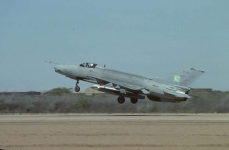
A Chengdu F-7P “Skybolt” (a Chinese-built MiG-21 derivative) fighter-interceptor, serial 89-546 of No. 2 Squadron, Pakistan Air Force, takes off from Masroor Air Base on 14 February 1991.
The Chengdu F-7 (and domestic J-7) was based on the Mikoyan-Gurevich MiG-21F-13 (NATO reporting name Fishbed-C).
The Chengdu F-7 and the MiG-21F-13
In 1961-1962 the Soviet Union agreed to licence-produce the MiG-21F-13 in China.
The Sino-Soviet split quickly interrupted the full transfer of technology. Documentation and parts arrived incomplete, forcing Chinese engineers at Shenyang (and later Chengdu) to reverse-engineer the aircraft from the limited samples and partial drawings they had received.
The earliest Chinese version, which made its first flight on 17 January 1966, was therefore very close to the original MiG-21F-13. It retained the pure delta wing, nose intake with a fixed or early centre-body, forward-hinged canopy, single 30 mm cannon, simple ranging radar, and a Tumansky R-11-derived engine built in China as the WP-7.
China did not freeze the design. Over the following decades the J-7/F-7 family was steadily improved. The J-7II and early F-7 variants introduced a conventional rearward-opening canopy and a better ejection seat.
Export models such as the F-7M Airguard and the Pakistan-specific F-7P “Skybolt” received Western avionics, including head-up display systems. Later versions (J-7E, J-7G, F-7PG and others) added double-delta wings, more powerful WP-13 engines, improved radars and modern missiles.
Despite these progressive changes, the entire family remains a development of the original MiG-21F-13 airframe rather than of later Soviet variants such as the MiG-21PF, PFM, MF or bis.
In short, the F-7 began life as a Chinese licence-built and reverse-engineered copy of the MiG-21F-13 and then evolved independently for nearly fifty years.
© Peter Foster



 Federal cabinet gives nod to imposition of emergency in KP; summary sent to president (24 Viewers)


 Iran - Israel/US War: Israel-US declare war on Iran, Iran responds (162 Viewers)


