FAA issues nationwide flights ground stop ‘due to extraordinary circumstances' and ‘safety'

Well, to answer this as well as Davey's question, first, I am very familiar with Juniper hardware. We use them, and still do, at DHL. And yes, there was one occasion, can't remember the site now, may have been ATL or DFW, where was was described in the article happened in the facility.

For those interested, you can read the FAA Acting CTO's bio here:


I did. And, I can tell you right off the bat she failed. Bigly. As in an embarrassment to holding a PMP (which I do. A low 5 digit number at that.) as well as being trained in Computer Science. I'll bet RR's last Pakistani Rupee she forgot all about risk management and more importantly, didn't ask the right questions during the meetings with L3 or possibly even review their project plan. This is PM101 and she successfully managed to cost the aviation and associated industries hundreds of millions if not billions of dollars.

No one in their right mind brings new hardware on line unless it is determined the existing infrastructure can handle it or the new infrastructure was already in place. And, I'll bet there was no fail-over or redundancy in place.

If it were me doing a postmortem, I'd be asking a lot of hard and pointed questions. I have an people were very uncomfortable in those reviews.

1794860266815.png

Rebecca Guy is the FAA’s Acting Chief Technology Officer. In this role, Mrs. Guy manages and provides guidance to the Program Management Organization, Mission Support Services, Safety and Technical Training, and Management Services of the Air Traffic Organization (ATO).  


From the They're Not Serious article.....

Saturday morning: ‘I’m sorry,’ but not from the bosses.​

Yesterday morning, as airports and airlines groaned back into a degree of functionality, Duffy (minus Markwayne) appeared at a press conference with two people who actually know about aviation. One was Brian Bedford, a former airline CEO who is now in charge of the FAA. The other was Rebecca Guy, a longtime FAA official who is now their acting chief technology officer.

Several times during the conference, Bedford took over the microphone from Duffy, when he was drifting from generalization to outright error.4 Or they turned to Guy for details.

Duffy seemed there mainly for political messaging: For instance, that most spending for airspace improvements was in “Democrat cities”—so why should Democrats be so ungrateful? And how a generalized “Congress” should have been pouring more money into his projects—never mind that Republicans had ironclad control of both houses, never mind that Trump and Russell Vought had obtained funding for what they cared about, including some $50 billion for detention centers and $75 billion in multi-year appropriations for ICE. “Congress is the problem!” Wait, who controls Congress?

The most striking moment of the press conference came a few minutes in, with the very first words to cross Brian Bedford’s lips. “I’d like to start with a sincere apology to the American traveling public,” he said. Bedford has occasioned some controversies within aviation. But this is the way the flying world is used to speaking about failures and missteps.

It is the only such sentiment I am aware of, from the current leadership.
 
Last edited:
Any other numbnuts involved?
No doubt plenty. But at the end of the day, it stops with her. She's leading this effort. Everyone else above her will see to it her next fitness report is not good.

Read her bio. Can you imagine what the chaos would have been had it been the radar systems? Which she allegedly has some experience with?
 
What @Davey Crockett means is Copper circuit can only support data streams of upto 56k on plain copper, 128k and 256k on dsl and upto 16mbps downstream on ADSL.

Assured routers and end points are full ethernet meaning synchronous downstream of 1gbps and greater.

Deploying a Juniper Ethernet router onto a POTS copper circuit is like giving a NASA astronaut a state-of-the-art spacesuit and sending them into orbit using a garden hose.
if i have 56k traffic for my tasks and I upgrade to 1gbps router, I keep having 56k traffic over my 1gbps line.

update to a faster router it doesnt increase the traffic of your tasks.
 
Last edited:
if i have 56k traffic for my tasks and I upgrade to 1gbps router, I keep having 56k traffic over my 1gbps line.

update to a faster router it doesnt increase the traffic of your tasks.
That's not how this works at all...
 
That's not how this works at all...
im asking about the extra flux of data.

the explanation about the incident is that a router sent thousands connections in few seconds

if you upgrade a router to a faster one, it doesnt come magically extra thousands connections.

it has nothing to do with a new hardware.

btw the connection was not cut off, but drop packets instead.
 
Except it 100% does, as has been explained in this thread multiple times.

in this thread it's explained the problem is that a fast router connected to a slower one will always fail, which it's false.

it happens all the time in tcp/ip networks, when you connected to a internet server, usually the server is faster than your connection, so packets are drop by your connection and your TCP stack set the right speed.

"The FAA reported approximately 1,000 connection attempts every 4–5 seconds. "

the question that matters is why the new router flooded with those connections the line.
Because the router was faulty. And if you know anything about assured ethernet you will know that prior to deployment the config on a router or end point is tested in an isolated environment.

1000 syn attempts would equal approx 200-250 attempts every second. It would have appeared something like this if you ran a packet capture:

1046 4.018012 10.24.88.5 10.24.10.1 TCP [TCP Retransmission] 51402 → 179 [SYN]

This retransmission error would build up on the router and would be rejected. One single source IP (the new Juniper router installed at the remote site) would dominate the top of the table with tens of thousands of unestablished, 1-packet or 2-packet flows.

Because the legacy routers' control planes were choked by connection requests, legitimate air-to-ground voice and radar packets passing through them would show massive Jitter spikes and high Packet Loss percentages—explaining why radio and radar feeds broke up across 17 FAA centers.

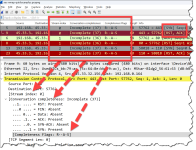
On wireshark a network engineer woild expect to see R.S.T rejections as shown in example below:

1794865724571.png
This could have been prevented by implementing of Control Plane Policing. Clearly this was a botched job due to poor planning and as the saying goes: Piss poor planning produces piss poor performance.
 
Because the router was faulty. And if you know anything about assured ethernet you will know that prior to deployment the config on a router or end point is tested in an isolated environment.

1000 syn attempts would equal approx 200-250 attempts every second. It would have appeared something like this if you ran a packet capture:

1046 4.018012 10.24.88.5 10.24.10.1 TCP [TCP Retransmission] 51402 → 179 [SYN]

This retransmission error would build up on the router and would be rejected. One single source IP (the new Juniper router installed at the remote site) would dominate the top of the table with tens of thousands of unestablished, 1-packet or 2-packet flows.

Because the legacy routers' control planes were choked by connection requests, legitimate air-to-ground voice and radar packets passing through them would show massive Jitter spikes and high Packet Loss percentages—explaining why radio and radar feeds broke up across 17 FAA centers.

On wireshark a network engineer woild expect to see R.S.T rejections as shown in example below:

View attachment 223134
This could have been prevented by implementing of Control Plane Policing. Clearly this was a botched job due to poor planning and as the saying goes: Piss poor planning produces piss poor performance.
the problem is that unexplained connections flooding, it's not connect a slow/old router to a faster/modern one like it was claimed here.

if someone does a DDoS the cause of denial of service is the launch of DDoS, it's not the "slow legacy old router" who receive the DDoS.
 

Users who are viewing this thread

Pakistan Defence Latest

Country Watch Latest

Back
Top