Falling Inflation Rising Misery

Fatman17

Moderator
Joined
Apr 24, 2007
Messages
51,441
Reaction score
62,169
Reputation
12,719.9
Country of Origin
Country of Residence
07075712951d2b3.jpg
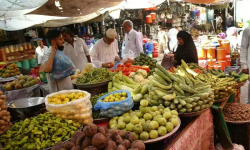
The recent drop in Pakistan’s inflation rate from a jaw-dropping 38 percent in May 2023 to a nine-year low of 2.4 percent in January 2024 is being hailed as a victory. But to whom does this victory belong? To the policymakers flashing charts in air-conditioned boardrooms, or to the ordinary Pakistani struggling to afford a meal? If one were to step outside the realm of economic jargon and examine what’s happening on the ground, it becomes clear that the official statistics tell only half the story. A shallow celebration of disinflation misses the much graver reality: the devastation of purchasing power over the past five years is so severe that it may take a decade to undo the damage.
Falling inflation, rising misery https://www.brecorder.com/news/40346752
 
Source:
Business recorder
exactly, the ground reality and some economic charts for foreign media outlet consumption.
 
Petrol prices going up in last 2 weeks, PDM and GHQ goons used to cry mehngai
during IK tenure but they have double the mehngai.
To view this content we will need your consent to set third party cookies.
For more detailed information, see our cookies page.

To view this content we will need your consent to set third party cookies.
For more detailed information, see our cookies page.
 
the awam are fed up of all the old tired corrupt thieving politicians and govts.
They're all the same , doesnt matter whuch party it is. Sab aik jaise hain
 
More mehngai bomb on the awaam, where are the fauj@@ts and Noon goons
who used to cry mehngai when petrol was RS120?
To view this content we will need your consent to set third party cookies.
For more detailed information, see our cookies page.
 

Weekly inflation rises 11.94pc

Mubarak Zeb Khan
July 11, 2026


1783772521869.png


Short-term inflation, measured by the Sensitive Price Index (SPI), increased by 11.94 per cent year-on-year for the week ending July 9, mainly due to higher retail prices of perishable food items and wheat flour, according to official data released on Friday.

A slight slowdown in short-term inflation has begun, mainly due to a steep cut in petroleum product prices three weeks ago. However, there is a cushion for further reduction in oil prices.

Week-on-week, the index decreased by 0.45pc, according to the Pakistan Bureau of Statistics. The index declined over the past two consecutive weeks.

The overall SPI showed a broad-based rise, indicating continued pressure on the cost of living.

The increase was largely driven by sharp year-on-year gains in key items, including electricity charges (49.14pc), gas charges (29.85pc), wheat flour (71.22pc), and liquefied petroleum gas (25.51pc).
 
Food inflation remained elevated, with notable increases in the prices of onions, tomatoes, potatoes, mutton, beef and wheat flour.

Despite this limited easing, energy-related costs continued to weigh on household budgets and push up transport expenses across the economy.

The SPI has now recorded an increase for the 65th consecutive week. Although the pace of growth has slowed, it reflects sustained pressure on consumers.

This is cost-push inflation, which means that energy took priority, followed by food. As a result, the average household is under pressure due to higher consumer prices.

Data showed that the prices of 22 items increased, 08 decreased, and 21 remained stable compared to the previous week.
 

Users who are viewing this thread

Latest Posts

Back
Top