Federal Constitutional Court/ Supreme Court / High Courts of Pakistan, News

Tariq Jahangiri’s appointment annulled


Malik Asad
February 24, 2026


View attachment 180682

A file photo of Justice Tariq Mehmood Jahangiri of the Islamabad High Court. — Picture via IHC website

• 116-page judgement declares his law degree invalid
• IHC rules appointment was ‘without lawful authority’ and a ‘legal nullity’
• Calls ex-judge’s plea to recuse CJ Dogar ‘dilatory tactics’ and ‘bench-hunting’


ISLAMABAD: The Islamabad High Court on Monday issued a detailed 116-page judgement on the removal of one of its judges, Tariq Mehmood Jahangiri, declaring that his appointment to the bench was “without lawful authority” as he did not possess a valid law degree.

An IHC division bench comprising Chief Justice Sardar Muhammad Sarfraz Dogar and Justice Muhammad Azam Khan held that ex-Justice Jahangiri’s foundational law degree was void ab initio, rendering his elevation to the high court a “legal nullity”.

The judgement relied heavily on original academic records produced by the University of Karachi (KU) registrar, concluding that the respondent’s academic credentials were tainted by fraud, impersonation and a deliberate attempt to circumvent a disciplinary ban.

According to the verdict, Mr Jahangiri first appeared in his LL.B. Part-I examination in 1988 under a fake enrolment number. He was later caught using unfair means and was debarred for three years through a university disqualification circular issued in 1989.

Instead of complying with the ban, the court held, he “chose a course of deliberate misrepresentation” and reappeared in the 1990 examinations under a different identity — “Tariq Jahangiri” — using an enrolment number originally issued to another student, Imtiaz Ahmad. He later appeared in the LL.B. Part-II examinations under his actual name but with yet another enrolment number.

Quoting the KU Controller of Examinations, the bench observed that a university issues only one enrolment number per programme and that it was “impossible” for a student to be allotted two numbers for the same degree. Consequently, the mark sheets and degree were declared invalid.

The principal of Government Islamia Law College also informed the court that Mr Jahangiri “was never admitted” to the institution — a claim the bench described as particularly damaging. Invoking the settled principle that what is void from the outset cannot be validated by subsequent administrative acts, the court declared the judge’s LL.B. degree a nullity in the eyes of law.

A key aspect of the judgement was the court’s criticism of Mr Jahangiri’s conduct during proceedings. Despite being granted repeated opportunities to submit a written reply and produce original documents, he failed to do so.

Instead, he filed applications seeking the constitution of a full court, recusal of the chief justice and adjournment sine die on the ground that related proceedings were pending before the Sindh High Court.
 
The bench termed these moves “dilatory tactics” and held that once prima facie documentary evidence had been produced by the petitioner, the burden shifted to the respondent to establish his lawful qualification. His failure to produce primary evidence, the court ruled, warranted an adverse inference.

Mr Jahangiri’s plea seeking recusal of Justice Dogar — on the basis that he had earlier challenged the chief justice’s transfer — was rejected.

The bench held that mere apprehension of bias was insufficient and reiterated that the constitution of benches was the sole prerogative of the chief justice.

It further described the attempt to exclude certain judges while implicitly favouring others as a “classic textbook manifestation of mala fide and bench-hunting”.

Addressing the question of maintainability, the IHC relied on a precedent of the Supreme Court in Malik Asad Ali v. Federation of Pakistan, holding that the constitutional bar under Article 199(5) applies to judicial acts of a judge, not to questions relating to personal qualifications.

The bench clarified that the jurisdiction of the Supreme Judicial Council (SJC) under Article 209 pertains to misconduct or incapacity during tenure and does not extend to determining whether an appointment itself was void from inception. “The SJC cannot cure a void appointment,” the court observed.
 
To view this content we will need your consent to set third party cookies.
For more detailed information, see our cookies page.

To view this content we will need your consent to set third party cookies.
For more detailed information, see our cookies page.
 
1786124172057.png

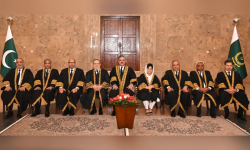
Chief Justice of Pakistan Yahya Afridi and Supreme Court judges pose for a photo with retiring Justice Musarrat Hilali at the Supreme Court, Islamabad on August 7. — PID
 

SCBA backs call for new provinces, calls it 'step forward' for better governance

Nasir Iqbal
August 7, 2026

ISLAMABAD: The Supreme Court Bar Association (SCBA) — a premier lawyers’ body — on Friday voiced support for the controversial proposal recently put forward by Interior Minister Syed Mohsin Naqvi regarding the creation of new provinces in the country.

Recently, while addressing the Pakistan Economic Summit 2026, the interior minister had urged all political parties to resolve various national issues, including the question of creating new provinces. He termed this the only solution to improving the country’s overall condition, which he said had “collapsed”.

Speaking at the Full Court Reference held at the Supreme Court (SC) in honour of Justice Musarrat Hilali on the occasion of her laying down her judicial robes, SCBA President Haroonur Rashid said the association endorsed and supported the suggestion to create new provinces.

Headed by Chief Justice of Pakistan (CJP) Yahya Afridi, the reference was attended by SC judges both in person and via video link.

The reference was also attended by Additional Attorney General (AAG) Chaudhry Aamir Rehman, representatives of the SCBA and the Pakistan Bar Council (PBC), senior members of the legal fraternity, court officers, media representatives and others.
 

Users who are viewing this thread

Pakistan Defence Latest

Latest Posts

Back
Top