Federal Constitutional Court/ Supreme Court / High Courts of Pakistan, News

Karachi bar lauds Justice Omar Sial for not joining new SHC cohort


Sumair Abdullah
November 30, 2024


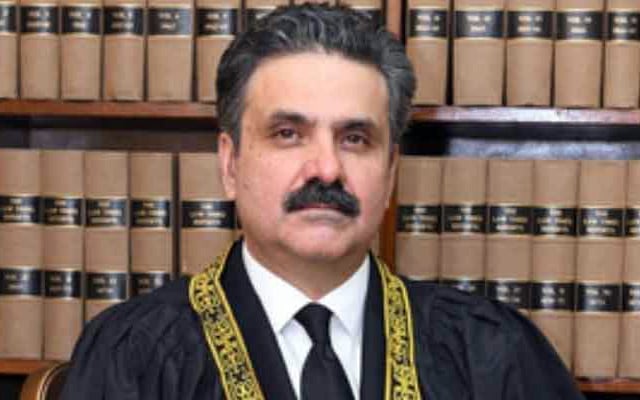
Sindh High Court’s Justice Omar Sial. — SHC website

Sindh High Court’s Justice Omar Sial.
https://whatsapp.com/channel/0029VaMc238IiRov8okfYy3n
KARACHI: The Karachi Bar Association (KBA) on Friday applauded Justice Omar Sial for declining to become part of the constitutional bench of the Sindh High Court (SHC).

The KBA through a resolution welcomed Justice Sial’s decision after he recused himself from joining the constitutional bench, says a statement.

In a letter to Justice Muhammad Karim Khan Agha, the head of the constitutional bench, Justice Sial argued that benches should be constituted on a “seniority basis”.

The KBA praised Justice Sial for his “principled stance” in refusing to join the “so-called constitutional bench,” formed by the Judicial Commission of Pakistan. The association termed it a “violation of the seniority principle” and a disregard for the opinion of the SHC’s chief justice, and claimed that bench was formed at the behest of the executive and politicians.

“As rightly pointed out by the learned judge, this has created a dangerous perception of executive interference in the judiciary and erodes the very fabric of democracy,” the statement said.

The judges of Supreme and high courts had taken the oath to protect, preserve and defend the Constitution, the KBA pointed out, adding that Justice Sial’s commitment to his oath should serve as an example for all judges.

The KBA condemned the “manner” in which eight senior judges had allegedly been overlooked in the selection of the head of the constitutional bench.

Eight senior judges of the SHC, who have the most constitutional law expertise, were ignored to pick the head of the constitutional bench, the KBA alleged.

Alluding to the head of the constitutional bench, the KBA claimed that the learned judge is known to have a long association with the ruling party in Sindh, creating a perception that the executive and legislators are handpicking the judges they feel may be favourably inclined towards them. “This is seriously harmful to the image of the judiciary,” it cautioned.

The KBA also said that after the 26th amendment, judicial delays in Karachi had multiplied instead of being reduced, as it replaced five benches for constitutional petitions with a single bench. It also deplored the Supreme Court registry’s failure to list numerous petitions challenging the 26th Amendment.

Published in Dawn, November 30th, 2024
 

Judicial redemption

Basil Nabi Malik

DID it not come across as humorous when Justice Mansoor Ali Shah reportedly wondered aloud in the Supreme Court whether, in the absence of constitutional benches, his bench would be considered an unconstitutional bench?

Humorous to many, but perhaps heart-wrenching to others; the concerns that such a query raises are worrying.

The 26th Amendment has been touted by many as a victory for parliament, or, in other words, a manifestation of parliament regaining its sovereignty.

Although many may see it that way, the reality is that such sovereignty is being resurrected on the ruins of an already embattled judiciary.

The ramifications of the 26th Amendment were foretold prior to its passage; however, the effects are now becoming clearer.

Firstly, through the Judicial Commission, parliamentarians and their allies now have a dominant say in the appointment of judges.

Secondly, the politician-inclined Judicial Commission now also decides on which judge sits where, for how long, and in relation to which matters.

Thirdly, the 26th Amendment has set up parallel power centres within the same set-up, ie, the Supreme Court and Sindh High Court now have two centres of authority in their respective courts — a chief justice of the regular benches and the presiding officer of the constitutional benches.

Why not create two parallel power centres in each institution, and champion it as a means of greater efficiency and better management?

These issues are not trivial; rather, they are at the very heart of judicial independence. Judicial appointments are fundamental for maintaining an independent judiciary free from political interference and influence.

It is in this light that judges have often been considered most suitable to nominate and appoint new judges, either from the pertinent court below or from the bar itself. It is argued, and perhaps correctly, that having observed and interacted with various lawyers and judges on a daily basis, these judges would be in an ideal position to decide on the competency of each of the candidates being considered.

Maintaining a commission with representation from varying segments of society, including parliament, is not necessarily bad. But when the commission is established in such a way that, in effect, the parliamentarians and their allies have a majority over the judges themselves, you are inviting trouble.

Parliamentarians, along with those allied with them, should never have an overwhelming majority, or enough members to essentially push through their nominations at the expense of the opinions of experienced sitting judges.

This is all the truer in a situation where no specific criteria for appointments have even been set out. It invites politics, and makes any subsequent appointment political, with a nominated judge possibly being viewed as a political appointee.

Secondly, it is difficult to digest why, how, and in what world it can be considered kosher for such a commission to decide which judges will hear what kind of case. It goes against the very grain of judicial independence.

If this were not enough, a politician-inclined judicial commission also determining the tenures of judges on a particular bench, whether that be two months or two days, smacks of interference and bad faith. It creates uncertainty in the ranks, chills the ability of the nominated judges to work independently, and, if someone does not presumably fall in line, also carries the risk of censure by way of removal of the judge from the benches.

It must not be forgotten that any judge on a constitutional bench will be deciding on the legality of governmental actions, as well as the vires of laws created by parliament, amongst other things. How can judges be expected to independently review governmental actions and the legality of laws, when they are themselves being appointed by members of that very parliament and government, effectively? It’s oxymoronic. They, in effect, nominate judges to judge them, and if they don’t like the judging, they can simply change the judges. How is that fair or even reasonable?
 
Here, I ask in all seriousness, how effective would an executive be with two prime ministers at the helm?

How about two parliaments, one for certain matters and another for others?

How about if our beloved bar associations had two presidents in each association?
In fact, why stop there?
Why not create two parallel power centres in each institution, and champion it as a means of greater efficiency and better management?

The reason why this would not be effective is simple. Multiple power centres within the same institution breed intrigue, conflict, and confusion.

A single unitary head is meant to garner better administration, greater uniformity in decision-making, and serves as a deterrent against factionalism within an institution.

In much the same manner, maintaining a single head in the Supreme Court and the Sindh High Court is required for a more effective administration that allows the judiciary to ward off external threats and cater for more efficient internal housekeeping. The effect of having two effective chief justices in the Supreme Court, or in the Sindh High Court for that matter, is not a recipe for success. It is a recipe for utter chaos. It is an attempt to whittle down judicial unity, weaken an already beleaguered institution, and divide and rule, unfortunately.

Lawyer Muneer A. Malik had said early on that no lawyers’ movement is possible without the Supreme Court taking a stand. Unfortunately, the Supreme Court, to date, has shown that it has no legs to stand on.

However, even in these times of worry and disappointment, the struggle to attain and retain judicial independence must continue, in whatever manner possible.

Perhaps, in relation to this, the recusal of a courageous sitting judge of the Sindh High Court, Justice Omer Sial, from the constitutional bench is the first step in that very long and difficult path to judicial redemption.

Perhaps, there will be more. And perhaps, the judiciary will find its feet and resolve to address the elephant in the room, that is, whether the concept of judicial independence is to be jealously guarded, or whether it is now a thing to be jealously guarded against.

[email protected]

X: @basilnabi

Published in Dawn, November 30th, 2024
 

IHC’s Justice Arbab Tahir expresses dismay over arrests of ‘innocent’ people in wake of PTI protest


Tahir Naseer
December 6, 2024

Islamabad High Court’s (IHC) Justice Arbab Mohammad Tahir. — IHC website

Islamabad High Court’s (IHC) Justice Arbab Mohammad Tahir.

Islamabad High Court’s (IHC) Justice Arbab Muhammad Tahir on Friday expressed his dismay over the apprehension of civilians not involved in last week’s PTI protest, following which the capital and Rawalpindi police arrested more than 1,400 suspects.

The remarks come amid claims by the PTI that the police have been discriminating against and racially profiling Pakhtuns as well as invading citizens’ privacy by conducting mobile checks of ordinary citizens to trace party supporters.

On Nov 13, Imran issued a “final call” for nationwide protests on Nov 24, demanding the restoration of the PTI’s electoral mandate, the release of detained party members, and the reversal of the 26th Amendment which he said had strengthened a “dictatorial regime”.

In the wake of the protest, human rights organisation Amnesty International demanded a transparent investigation of the state’s “deadly crackdown” to disperse PTI supporters from Islamabad’s D-Chowk, where they had gathered on Nov 26.
 

ECP gets last chance to respond to KP Senate election petition


Bureau Report
December 6, 2024

PESHAWAR: Peshawar High Court on Thursday gave the Election Commission of Pakistan the last opportunity to reply to the petition of Pakistan Tehreek-i-Insaf leader and former senator Azam Khan Swati for orders for the ECP to hold the Senate polls in the Khyber Pakhtunkhwa province.

A bench consisting of Chief Justice Ishtiaq Ibrahim and Justice Wiqar Ahmad adjourned the hearing into the case until Dec 24, directing the ECP to submit its response.

It declared that it won’t adjourn proceedings on the next date of hearing and would hear the case in any case.
 

SC suspends ECP decision to disqualify PML-N lawmaker Adil Bazai


Umer Mehtab
December 9, 2024

The Supreme Court on Monday suspended the Election Commission of Pakistan’s (ECP) decision to disqualify PML-N lawmaker Adil Bazai.

In October, the National Assembly Secretariat sent a request to the ECP to unseat Bazai.

Considered an “anomaly”, Quetta lawmaker Bazai is part of the PML-N as per official records but is often found on the opposition benches, criticising the government. It is also unclear which party supported him during the February 8 general election.

According to the National Assembly website, Bazai contested the election from Quetta’s NA-262 constituency.

On November 12, the ECP reserved its verdict on a reference seeking Bazai’s disqualification.

Bazai’s counsel maintained that he had never joined the PML-N and asserted that a fake affidavit had been submitted in his name with the ECP. He asked for a forensic audit of the affidavit.

On November 21, the ECP disqualified Bazai over “floor-crossing”. Announcing its reserved verdicts, the election regulator upheld the two references filed by the Speaker of National Assembly Sardar Ayaz Sadiq, seeking Bazai’s disqualification for violating party’s policy.

Monday’s hearing was taken up by a three member bench headed by Justice Mansoor Ali Shah and comprised justices Ayesha Malik and Aqeel Abbasi.

At the outset of the hearing, Bazai’s lawyer Taimur Aslam told the court that his client had been disqualified by the ECP under Article 63A.

“The ECP did not properly ascertain the facts, nor did it call Bazai for an inquiry,” he said.

Justice Shah wondered how the ECP had any jurisdiction if Bazai’s affidavits were in the civil courts. “Can the Election Commission take notice of what’s happening in civil courts?”

Justice Malik intervened to say that Bazai has two affidavits, and according to him, has only signed on the second one. “Can the Election Commission inquire into fraud?” she asked.

Justice Shah suggested to get back to the matter of the ECP’s jurisdiction. “Ejecting someone from the assembly is not a trivial action, so every aspect will have to be looked at,” he said.
 

SC constitutional bench rejects govt plea allowing military courts to announce verdicts


Umer Mehtab
December 9, 2024


This collage shows SC constitutional bench judges — namely Justices Aminuddin Khan, Jamal Khan Mandokhail, Naeem Akhtar Afghan, Muhammad Ali Mazhar, Hassan Azhar Rizvi, Musarrat Hilali, and Shahid Bilal Hassan.


This collage shows SC constitutional bench judges — namely Justices Aminuddin Khan, Jamal Khan Mandokhail, Naeem Akhtar Afghan, Muhammad Ali Mazhar, Hassan Azhar Rizvi, Musarrat Hilali, and Shahid Bilal Hassan.
https://whatsapp.com/channel/0029VaMc238IiRov8okfYy3n
The Supreme Court’s (SC) constitutional bench on Monday rejected the federal government’s request allowing military courts to announce verdicts of completed trials of civilians allegedly involved in last year’s May 9 riots.

The case pertains to the trial of more than 100 civilians for their alleged role in attacks on army installations during the riots that followed ex-premier Imran Khan’s arrest on May 9, 2023.

In a widely praised ruling last year, a five-member SC bench — comprising Justices Ijazul Ahsan, Munib Akhtar, Yahya Afridi, Syed Mazahar Ali Akbar Naqvi and Ayesha Malik — had unanimously declared that trying the accused civilians in military courts violated the Constitution.

The apex court had declared that the accused would not be tried in military courts but in criminal courts of competent jurisdiction established under the ordinary or special law of the land.

However, on December 13 last year, in a 5-1 majority verdict, the SC conditionally suspended its own Oct 23 ruling — albeit by a different bench — pending a final judgement as it heard a set of intra-court appeals (ICAs).

On March 27, the SC had conditionally allowed military courts to pronounce reserved verdicts in the cases. It had also modified its Dec 13 injunction, ordering that military courts could commence trials but they would not convict or acquit any suspect until the pendency of government-instituted ICAs.

Today, a seven-member constitutional bench — led by Justice Aminuddin Khan and including Justices Jamal Khan Mandokhail, Naeem Akhtar Afghan, Muhammad Ali Mazhar, Hassan Azhar Rizvi, Musarrat Hilali, and Shahid Bilal Hassan — resumed hearing the ICAs.

Senior counsel Khwaja Ahmad Hosain appeared on behalf of former chief justice of Pakistan (CJP) Jawwad S Khawaja, who was one of the petitioners challenging the military trials. Analyst Hafeezullah Niazi, whose son Hassaan Khan Niazi is in military custody, was also present, while Additional Attorney General Aamer Rehman appeared as the state counsel.

During the hearing, the court rejected the request of Justice Khawaja’s counsel to not resume hearing the ICAs until petitions challenging the 26th Amendment — under which the current bench has been constituted — were decided. The SC also imposed a fine of Rs20,000 on the former CJP.

It also dismissed the AAG’s plea that the SC allow military courts to pronounce verdicts in cases in which the suspects’ trial had been completed.

At the outset of the hearing, Justice Khawaja’s lawyer Hosain requested that the court not hear the military court case until the petitions against the 26th Constitutional Amendment were decided.

Upon being asked if he accepted the constitutional bench, the lawyer replied that he did not accept its jurisdiction.

At this, Justice Mandokhail asked the counsel to leave the courtroom, remarking: “You do not have a loved one in custody which is why you want a delay. If you do not accept the jurisdiction of the court then you can leave.”

The lawyer then took the position that the constitutional bench was nominated by the judicial commission and if the 26th amendment was nullified then the decision under the bench would also be invalid.

At this, Justice Muhammad Ali Mazhar remarked: “You are using delay tactics. Such applications come up in every hearing. If the 26 Amendment is nullified, the court’s decisions are protected.”

Justice Mandokhail remarked that the SC was working under the constitutional amendment and any benches that were being formed were in accordance with the amendment’s laid out procedures, adding that a bench constituted under the same amendment would also be the one to hear challenges against it.

Justice Mazhar asked Hosain whether those with relatives in custody over cases in military courts also wanted the same as him while Justice Mandokhail asked Hafeezullah if he wanted to continue with the case since his son was in custody.

Hafeezullah replied that he wanted to continue with the case.

Meanwhile, Justice Hilali told Hosain: “Think about those who are in jail. You have no right to a claim in this case.”

The court dismissed the petition to stop proceedings on the ICAs and imposed a Rs20,000 fine on former CJP Khawaja.

During the hearing, the defence ministry’s lawyer, Khawaja Haris, argued that it was wrong to say that civilians could not be tried in military courts, adding that the Army Act was also applicable to employees of private companies working with the armed forces.

Justice Jamal Khan Mandokhail remarked that civilians who worked in ordinance factories were in a different category to which Haris responded that the Army Act mentioned that.

Meanwhile, Justice Mazhar said that Haris’ case did not fall under the relevant section of the Army Act while Justice Hilali questioned whether corps commanders declared their houses as office when using them as such.

“How true is it that this idea came later that the corps commander’s house was also an office?” she asked.

Justice Afghan asked how the anti-terrorism courts (ATCs) handed over the suspects to the military and questioned whether there was any order available on the ATCs’ reasons.

Meanwhile, Justice Rizi asked how the trial of the suspects in the Army Public School (APS) massacre was conducted to which Haris said the trials were held after the 21st amendment was passed.

Later on in the proceedings, the AAG argued that trials in the military courts were completed and permission should be given for verdicts to be announced to which Justice Hilali that this could not be permitted otherwise the issue of civilian trials in the military courts itself would be resolved.

Justice Mandokhail remarked that the crime of obstructing military personnel from their duty was present in the country’s laws and under them, those who did so would be tried in ordinary courts.

The judges subsequently rejected the AAG’s request and the hearing was adjourned till tomorrow.
 

CJ Afridi passes full court buck to constitutional bench​


Lawyers lament cases still not fixed despite urgency

Hasnaat Malik
December 09, 2024

justice yahya afridi photo file


Justice Yahya Afridi.

ISLAMABAD:
Chief Justice of Pakistan (CJP) Yahya Afridi has passed the buck to the committee of constitutional benches for the formation of a full court to hear petitions challenging the 26th Constitutional Amendment.

A three-judge committee, led by Justice Aminuddin Khan and comprising Justices Muhammad Ali Mazahar and Jamal Khan Mandokhail, will decide the total number of members for the constitutional bench hearing such petitions.

Interestingly, the committee itself is the creation of the amendment which is being challenged.

The judges for constitutional benches were selected by government representatives during the first meeting of the Judicial Commission of Pakistan (JCP). Likewise, two members of the constitutional bench have also supported the government's suggestion to nominate Justice K K Agha as head of the Sindh High Court's constitutional bench.

The government, it seems, is completely satisfied with the Supreme Court's constitutional bench, especially the head Justice Aminuddin. A debate also continues as to whether CJP Afridi could have formed a full court to hear petitions against the 26th Constitutional Amendment.

Justice Syed Mansoor Ali Shah, in his recent letter, noted that Clause 3 of the newly-added Article 191-A of the Constitution bars the hearing of matters specified therein by any bench of the Supreme Court other than a constitutional bench, but does not bar the full court of the Supreme Court from hearing any matter, including petitions filed under Article 184-3 of the Constitution.

"The distinction between the full court and the benches of a court is well established and explicitly recognised in Article 203J(2)(c) & (d) of the Constitution," he wrote.
 

SC constitutional bench dismisses registrar office objections to Imran’s petition calling for judicial probe on May 9


Umer Mehtab
December 10, 2024

The Supreme Court’s (SC) constitutional bench on Tuesday dismissed the objections of the registrar’s office to a petition filed by incarcerated PTI founder Imran Khan seeking a judicial commission for the events of May 9 last year.

Nationwide violent protests erupted last year after the arrest of former premier Imran in a corruption case, with his supporters vandalising and torching military installations and government buildings. The state then launched a severe crackdown on his party, rounding up thousands of PTI workers and almost the entire top-tier leadership, with many still facing court proceedings under serious charges.

In a petition filed by Imran’s lawyer last year, the PTI chief had urged the SC to order the formation of a judicial commission to investigate the events of May 9.

Imran had contended that the alleged imposition of an “undeclared” martial law or calling in aid of the armed forces in Punjab, Balochistan, Khyber Pakhtunkhwa and Islamabad was unconstitutional, unlawful and without any effect and all actions taken under the same were void.

The petition had also claimed that enough personnel were found available to control the situation indefinitely, arguing that it was more than obvious to any reasonable observer that the requisition of the armed forces was mala fide and in excess of jurisdiction

A seven-member constitutional bench comprising Justices Aminuddin Khan, Jamal Khan Mandokhail, Naeem Akhtar Afghan, Muhammad Ali Mazhar, Hassan Azhar Rizvi, Musarrat Hilali, and Shahid Bilal Hassan resumed hearing on Imran’s petition today.
 

Law allowing phone tapping ambiguous, says Justice Mandokhail


Umer Mehtab
December 11, 2024

Supreme Court’s Justice Jamal Khan Mandokhail termed the existing law allowing phone tapping “ambiguous” as the court’s constitutional bench heard a case related to the issue on Wednesday.

In July, the Ministry of Information Technology and Telecommunication authorised the country’s spy agency, the Inter-Services Intelligence (ISI), to intercept and trace calls in the “interest of national security”.

The ministry’s notification said that the authorisation was granted to the ISI under Section 54 of the Pakistan Telecommunication (Re-organisation) Act, 1996. A day after, however, the government’s decision to allow phone tapping was challenged in the Lahore High Court (LHC).

Wednesday’s case was heard by a seven-member constitutional bench headed by Justice Aminuddin Khan.

At the outset of the hearing, Justice Muhammad Ali Mazhar inquired whether any legislation was made regarding the practice of phone tapping.

Additional Attorney General Aamir Rehman replied saying the law has been in place since 2013.

“According to the law, ISI and IB are notified. The procedure for phone tapping is in the law, and judicial supervision is also in the law,” he said.

Justice Mazhar replied, “According to the law, only a judge can give permission for phone tapping. Has any judge been notified for this purpose? The law does not allow everyone to tap every phone.”

Justice Jamal Khan Mandokhail remarked that the phone-tapping law was “ambiguous.”

“The phone tapping case will also have an impact on pending cases,” he said. “This matter started from the chief justice’s chamber, where will the chief justice go?”

Justice Aminuddin Khan chimed in to say, “We are not interested in reports or the law, we want results.”

The additional attorney general said he was not aware of the nomination of a judge.

The advocate on record noted that contact has not been made with the petitioner, Major Shabbir, adding that his lawyer also passed away last year.

The court issued a notice to the advocate general and dismissed the hearing.

Last December, the Islamabad High Court (IHC) was informed during the hearing of a case related to audio leaks that the government had not permitted any intelligence agency to tap audio conversations.

Attorney General for Pakistan (AGP) Mansoor Usman Awan had informed the high court during the hearing of a petition filed by ex-premier Imran Khan’s spouse Bushra Bibi, who was seeking action against a leaked conversation, allegedly featuring her and PTI leader Latif Khosa.
 

SC postpones poll rigging case until after holidays


Nasir Iqbal
December 12, 2024

ISLAMABAD: At PTI counsel request, the Supreme Court’s constitutional bench on Wednesday adjourned election rigging proceedings until after winter vacation.

Headed by Justice Aminuddin Khan, the seven-judge constitutional bench had taken up PTI founder Imran Khan’s plea seeking the formation of a judicial commission for a thorough audit into the Feb 8 general elections and compilation of what the petition called ‘false’ and ‘fraudulent’ results, rendering winners into losers and losers into winners.
 

May 9 riots: SC constitutional bench conditionally allows military courts to pronounce verdicts of 85 civilians


Umer Mehtab
December 13, 2024

This collage shows judges of a SC constitutional bench — namely Justices Aminuddin Khan, Jamal Khan Mandokhail, Naeem Akhtar Afghan, Muhammad Ali Mazhar, Hassan Azhar Rizvi, Musarrat Hilali, and Shahid Bilal Hassan.


This collage shows judges of a SC constitutional bench — namely Justices Aminuddin Khan, Jamal Khan Mandokhail, Naeem Akhtar Afghan, Muhammad Ali Mazhar, Hassan Azhar Rizvi, Musarrat Hilali, and Shahid Bilal Hassan.
The Supreme Court’s constitutional bench on Friday conditionally allowed military courts to pronounce reserved verdicts of 85 civilians who were still in custody for their alleged involvement in last year’s May 9 riots.

The development came as a seven-judge bench resumed hearing a case pertaining to the trial of more than 100 civilians for their alleged role in attacks on army installations during the riots that followed ex-premier Imran Khan’s arrest on May 9, 2023.

The bench — comprising Justice Aminuddin, Justices Jamal Khan Mandokhail, Naeem Akhtar Afghan, Muhammad Ali Mazhar, Hassan Azhar Rizvi, Musarrat Hilali, and Shahid Bilal Hassan — specified that the verdicts of the military courts would be subject to its final decision on the appeals against the Oct 23, 2023 ruling.

Passing directives at the end of today’s hearing, Justice Aminuddin Khan, who is heading the constitutional bench, said, “Suspects who can be accorded concessions in their sentences, should be given so and released.
 

Users who are viewing this thread

Latest Posts

Back
Top