SilentWatch
Registered Member


Hi all - this is a AI assisted white paper to operationalizing Section 175AA across NADRA, FBR IRIS, and SBP-supervised banks. this is a public-interest advisory whitepaper.
This paper proposes an AI-architectural execution path for the federal tax-system reform programme set out by the Economic Policy and Business Development (EPBD) Think Tank in its Shadow Federal Budget 2026-27 and Shadow Five-Year Development Plan 2026-31 (both archived at whitepaper-build/research/). EPBD’s Chairman, Dr. Gohar Ejaz, HI, SI, articulated the tax-administration diagnostic in his On My Radar interview with Kamran Khan, ARY News, broadcast 21 May 2026 (video ID 80oOxryCUaA, “Business and Job-Friendly Budget 2026-27: Can Dar-Aurangzeb Deliver?”). The shadow documents formalize the diagnostic into a structured policy programme.
EPBD has produced the policy thinking; this paper proposes how to take that thinking forward and solution it with AI. The whitepaper is positioned as an AI-engineering execution path for the simplification and data-integration measures EPBD calls for, anchored to Section 175AA of the Income Tax Ordinance (Finance Act 2025) as the legal-architectural template. Where EPBD’s policy positions and primary-source data (FBR, SBP, NADRA, PIDE, World Bank PK Development Update) converge, the convergence is the load-bearing record on which the architectural proposal stands. Where headline aggregates in the broader public discourse diverge from primary-source positions, a supplementary cross-reference is provided in Appendix A.2 for transparency; the policy proposal does not rest on those aggregates.
Methodology and full source archive (including the EPBD shadow PDFs) available on request.
EPBD has produced Pakistan’s first-ever Shadow Federal Budget 2026-27 and Shadow Five-Year Development Plan 2026-31. The diagnosis at the centre of the Shadow Federal Budget is unsparing: “Pakistan’s federal tax system is critically dysfunctional, mainly due to excessive rates, policy inefficiencies, non-liable tax impositions, structural complexities, and distortions. The FBR’s failure to simplify procedures has systematically eroded state-taxpayer trust and violated core taxation principles” [EPBD Shadow Federal Budget 2026-27, Executive Summary, p. 1]. EPBD calls for tax-base broadening, abolition of the non-filer category, simplification of tax procedures, and “fiscal data collection, integration, and sharing among SBP/RAAST, FBR/PRAL, and CGA/FABS” as the policy programme that takes the tax-to-GDP ratio from ~10% today to 16% in three years and 18% in five [ibid., revenue measures, p. 9-10].
EPBD has done the policy thinking. This whitepaper proposes the architectural and AI-engineering execution path for the simplification + data-integration measures EPBD calls for: a federated AI tax-inference engine, built on the legal-architectural template Pakistan already adopted in Section 175AA of the Income Tax Ordinance (Finance Act 2025). The policy work is EPBD’s; the build is what this paper sketches.
Pakistan ended TY2024 with 5.21 million tax returns received and roughly 2.05 million nil-filers (~39%) filed solely to avoid punitive non-filer withholding rates on banking, vehicles, and property [Dawn, Nov 2024]. Against an adult population of ~130-140 million and ~80-90 million CNIC-deduped account holders, the active-filer base is the smallest piece of a much larger documented economy. Pakistan’s tax problem is a documentation problem, not a tax-base problem. EPBD’s Shadow Federal Budget, the SBP’s payment-systems data, FBR’s own active-filer reports, PIDE’s tax-potential research, and the World Bank’s PK Development Update all converge on the same diagnosis (Appendix A).
This paper proposes a 1-page citizen-facing inference engine that pulls verified data from sovereign nodes (NADRA, FBR via IRIS, SBP-supervised banks, Raast, telco wallets), runs deterministic tax computation, and returns each citizen a 1-page summary with three paths: refund, owed, or net-zero acknowledged.
The architectural choice is non-obvious. A naive private-central engine, vacuuming citizen data into a third-party server, is illegal under Pakistan’s current legal regime (Banking Companies Ordinance 1962 §35, PECA 2016, the Personal Data Protection Bill 2023, and the Pakistan Banks Association precedent that killed Section 165A in 2020). The defensible architecture is the one the state itself adopted via Section 175AA of the Income Tax Ordinance (Finance Act 2025): a federated AI where the algorithm goes to the data, executes inside each sovereign node, and returns only signed inference scores. This collapses the legal-localization risk, neutralizes the PBA injunction risk, and respects the bank-secrecy compromise baked into 175AA. The 1-page citizen surface sits on top of the federated layer.
The right policy entry point is the Special Investment Facilitation Council (SIFC), not the EPBD. EPBD is Dr. Ejaz’s own think tank with no statutory authority over tax. SIFC is the apex civil-military body that has already mandated FBR restructuring, directed PRAL-NADRA-Karandaaz collaboration, and set the 18% tax-to-GDP target for 2029. The EPBD is the right audience for industry-lobby endorsement; SIFC is the right audience for implementation authority. The whitepaper addresses both.
The cost model in §4 is a seasonal-subscription business, not a per-filing transaction. Tax compliance concentrates in Pakistan’s July-September deadline window. Pricing reflects that seasonality: Rs 2,000 filing-season, Rs 1,200 off-season early commitment, Rs 1,000 returning-subscriber renewal. A blended ARPU lands at ~Rs 1,500 across a cohort. Loaded fintech opex sits at Rs 14.5 to 21 million per month at any subscriber base above ~100,000. The business model is trust infrastructure, not pure SaaS (§4.2): a Moody’s + TurboTax + Equifax + Visa/Mastercard composite running on five revenue lines, namely seasonal B2C subscription, state-subsidized PPP, B2B enterprise, bank-channel B2B2C, and Identity Protection as a Service (IPaaS) as a PK-on-shore identity-monitoring product line of the same operating entity (§6.5). A SECP-supervised public listing in Phase 3 is the structural trust signal.
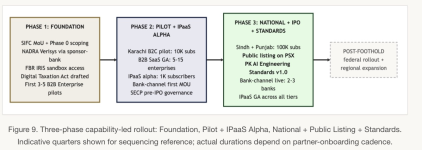
Citadel’s role is advisory and AI engineering leadership for the project team (FBR / PRAL / NADRA / SBP / partner banks). The whitepaper proposes a capability-led roadmap (§6.1) with phase outcomes, not a calendar of hard commitments. Indicative durations depend on SIFC sandbox onboarding velocity, regulatory clearance cadence, and inter-agency MoU progress.
The carrot, not the stick. Every prior modernization (Husain 2001, Zaidi 2019, Husain II 2020-21) was killed by the FBR officer cadre whose income depends on the manual-extraction model. The §7.5b Institutional Migration Compact preserves cadre livelihoods through the transition: officer-bounty grandfathered on legacy cases, three-year transition income guarantee, jury-agent flag-for-officer-review queue that turns the engine into a capacity-multiplier (lead generation for high-yield audits), and a practitioner-cadre certification track that captures the new advisory market. §7.6 details the industry endorsement letter and citizen support sign-up that build the coalition the engine needs.
What this paper asks of SIFC and EPBD: a 30-minute walk-through, a directional read, and a named point of contact for Phase 0 scoping if directional fit is positive. Phase 0 is 90 days of MoUs (NADRA Verisys via sponsor-bank, FBR IRIS sandbox, SBP Open Banking partner agreement) before any code ships at scale.
Hypothesis A. Day 1 Legislation Needs (legislation). Three concurrent legislative instruments: Digital Taxation Act (CNIC as sole individual tax ID + Once-Only Principle + PDPB clarifications); §116 Wealth Statement threshold amendment; and Inland Revenue Reward Rules 2021 amendment establishing the Institutional Migration Compact. → §1.5 Hypothesis A
Hypothesis B. Citizen App (product). The citizen-facing surface of the proposed operating entity, distinct from Citadel Agentic Labs the advisory firm. Single annual subscription, three pricing tiers (Rs 2,000 / Rs 1,200 / Rs 1,000 per §4.2.1). → §1.5 Hypothesis B
Hypothesis C. Request-for-Startup (RfS) for DevOps (procurement). SIFC publishes an open Request-for-Startup framework to staff the project-team’s 3-5 engineer core from PK fintech and AI talent. Open competition gives the project political cover; the RfS itself surfaces PK builders. → §1.5 Hypothesis C
Hypothesis D. Profitable banking partnership (channel). Tier-1 PK banks (HBL, UBL, MCB, Allied) bid for white-label license; revenue-share per active filer; bank captures deposit-retention lift. The Allied Bank × Befiler precedent (LIVE in myABL) is the working model. PBA §165A injunction concern is structurally satisfied via §175AA federated execution. → §1.5 Hypothesis D
Hypothesis E. First step to PK AI Engineering Standards (standards). Phase 3 milestone: open-source PK AI Engineering Standards v1.0 covering federated execution patterns, audit-log primitives, citizen-consent UX, and scam-detection signals. Citadel convenes; FPCCI + PBC + Tier-1 banks + PK university CS programs ratify. Standards become a public-good moat. → §1.5 Hypothesis E
The federated-AI architectural proposal in §2 onward is anchored to this primary-source position set, and to the simplification + data-integration policy programme EPBD lays out in its Shadow Federal Budget. The whitepaper is not a re-derivation of the diagnosis; it is the AI-architectural execution path for the diagnosis already established in the public record.
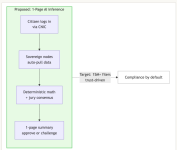
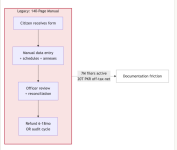
Friction-as-exclusion is the system design. A salaried citizen choosing between (a) two weekends with a practitioner at Rs 30,000 fee or (b) staying informal rationally chooses (b). The informal economy in Pakistan is not a moral failure of citizens; it is the rational equilibrium response to a compliance regime that costs more in fees and risk than the tax it captures.
This is not unique to Pakistan. Estonia faced the same regime in the late 1990s, until X-Road plus e-Tax took filing time to 3-5 minutes. Mexico faced it in retail, until mandatory CFDI e-invoicing made non-compliance commercially impossible. India and Brazil both layered annual-information-statement and pre-fill primitives onto their existing tax bases over the past decade. None of these reforms eliminated the tax officer. All eliminated the friction. The full comparative analysis is in §8.
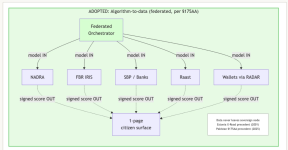
The §175AA pattern is the political feasibility key. The state has already established that algorithms runinsidesovereign nodes (banks) on FBR-issued CNIC batches, returning inferred risk scores rather than raw data. The 1-page engine extends this same federated pattern to the citizen surface.
Data-to-algorithm (rejected). An initial centralized framing routed NADRA + FBR + SBP + Raast + telco-wallet feeds into a centralized Kafka ingestion gateway running on a single sovereign datacenter. This pattern is illegal under three converging instruments:
This is the same pattern as Estonia’s X-Road (since 2001), Open Banking PSD2 (EU, 2018), and post-Puttaswamy India’s DEPA Account Aggregator framework (2020). Pakistan has, accidentally and via punitive policy, adopted the architecture the rest of the world converged on.
The 1-page engine extends §175AA to a citizen-facing surface. Each sovereign node hosts a model. Models execute locally on the citizen’s CNIC. Only the inferred filing position flows out, signed and logged.
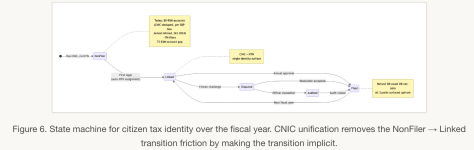
The proposal: abolish NTN for individuals on Day 1 via the Digital Taxation Act (proposed legislation, see §6.1 Phase 1). Designate the 13-digit CNIC as the sole individual tax identifier. India’s PAN-to-Aadhaar linkage rolled across multiple deadlines and penalty cycles; Pakistan can skip that saga by legislating CNIC unification up front. This proposal sits alongside EPBD’s call for “abolition of the income-tax non-filer category” [EPBD Shadow Federal Budget 2026-27, revenue measures, p. 9]: CNIC unification removes the identity friction; non-filer-category abolition removes the punitive-withholding regime that drives the nil-filer behavioral artifact (§1.1).
NADRA’s CNIC database is already deeply integrated with FBR through the §175AA infrastructure; the institutional plumbing exists. The legal change is the bottleneck.
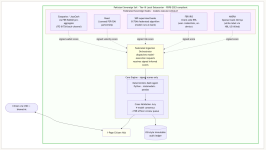
Figure 6. State machine for citizen tax identity over the fiscal year. CNIC unification removes the NonFiler → Linked transition friction by making the transition implicit. (next post)
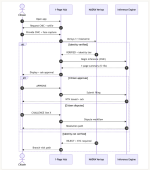
Figure 7. Citizen onboarding: CNIC + selfie via NADRA Verisys, then federated inference returns a 1-page summary. (next post - attachment limit)
A subscriber cohort weighted ~40% walk-up + ~40% early-commitment + ~20% renewal year 1 produces a blended ARPU of ~Rs 1,440-1,520. Year 2 onward, renewal share grows and blended ARPU softens toward Rs 1,200 as the book matures. The calculator below uses Rs 1,500 as a defensible default.
Loaded Pakistani fintech opex at 100,000 active subscribers:
At the Rs 1,500 blended ARPU on the B2C subscription line alone (revenue line 1 in §4.2.1), 100,000 subscribers yield Rs 12.5M monthly revenue (annual revenue Rs 150M smoothed over 12 months) against the Rs 14.5-21M loaded opex range. B2C alone clears margin only at ~150,000-200,000+ subscribers. The trust-infrastructure model in §4.2 is what closes the gap below that scale: the state-subsidized PPP and B2B Enterprise revenue lines underwrite the opex floor during Phase 1-2 (months 1-12 of §6.1); the bank-channel B2B2C and IPaaS lines compound on top of an established subscriber base in Phase 3.
Three things this table says.
The cross-business-model bet: the operating entity is not one of these three; it is the intersection. Sovereign-aligned trust infrastructure (Moody’s) + seasonal-recurring consumer subscription (TurboTax) + identity monitoring (Equifax). The three patterns are coherent because they share one underlying premise: trust compounds when the same entity holds the relationship for a citizen’s entire life cycle, not just one filing season.
Five revenue lines (§4.2.1) operationalize the cross-pattern. Public listing (§4.2.2) is the governance mechanism that distinguishes a trust-infrastructure operator from a private rent extractor.
Year-over-year retention is the lever. TurboTax retains 70%+ of returning consumer filers; the same dynamic compounds CAC amortization. Free-tier filers convert via in-app audit-defense triggers and refund-fast-track upsell.
2. State-subsidized PPP. SIFC-sponsored, FBR-budgeted line item from the digital-modernization budget. Government pays Rs 100-150 per filing covered. Citizen fee becomes zero or token (Rs 100 expedited refund processing). The IMF-aligned, IRS-officer-cadre-neutralized, PMO-cover path. Recommended primary entry path because it neutralizes the political-economy risks in §7 and resets the unit economics from “private rent extraction” to “public infrastructure with private operator.”
3. B2B Enterprise (corporate finance / HR teams). Rs 100,000-300,000 / month per enterprise for bulk employee filing (1,000+ salaried-employee teams). Targets PK corporate finance and HR teams managing annual filing across the workforce. Long sales cycle (~6 months/logo), but durable LTV (target 90%+ year-over-year retention).
4. Bank-channel B2B2C. Tier-1 PK banks (HBL, Allied, UBL, MCB) license the platform; banks offer tax filing as an account-holder retention service. Bank pays the operator per active filer; citizen pays nothing direct. CAC effectively zero because the citizen is already in the bank’s channel.
This is not a hypothesis. Allied Bank already runs Befiler tax filing inside myABL: users register an NTN and file annual returns from the bank app, no separate sign-up. Meezan Bank offers the same to its Freelancer Account holders at Rs 2,000-3,000 per return. HBL @Work, UBL Employee Banking Salary Account, and Bank of Punjab Salary Plus already bundle non-core retention services (life insurance, salary-advance loans, accidental coverage up to Rs 2.5M) into employee-banking programs. Adding annual tax filing as a Tier-1 license of the federated engine is incremental, not novel. The bank’s economic loop matters too: active-filer status reduces withholding-tax friction on the customer’s transactions, which encourages larger deposit balances, which raises LTV for the bank. Tax filing is not a cost center for the bank; it is a deposit-retention lever. Once integrated, switching cost (NTN + filing history inside the bank app) drives near-zero churn.
5. Identity Protection as a Service (IPaaS): recurring subscription. Independent PK-on-shore identity-monitoring bureau (full architecture in §6.5). Pricing:
This is the Equifax / LifeLock parallel, but explicitly PK-on-shore (PDPB-compliant) and delivered as a product line of the Citizen App operating entity (governance detail in §6.5).
The trust-infrastructure compounding effect. Citizens who use the Citizen App for filing become candidates for IPaaS subscription. Corporate clients bundle IPaaS for senior leadership. Banks white-labelling tax filing add IPaaS as a premium account-holder service. Five revenue lines, one trust relationship.
Primary peer case study: Visa Inc. (NYSE: V) and Mastercard (NYSE: MA). Visa and Mastercard are the structural blueprint for what a federated trust-infrastructure operator looks like at maturity:
Indian functional precedents (supplementary). Central Depository Services Limited (NSE: CDSL) operates listed market-infrastructure data services under SEBI’s regulatory regime; Tata Consultancy Services (NSE: TCS) operates India’s Centralized Processing Centre at Bengaluru (74% of ITRs auto-processed within 20 days). Both demonstrate that publicly-listed entities can legitimately operate national-scale sovereign data and tax-processing infrastructure under transparency rules. They are referenced as functional precedents, not as the headline archetype.
Domestic PSX benchmark: Systems Limited (PSX: SYS). For valuation reference, Systems Limited is the closest PSX-listed comparable: ~PKR 223B market cap, ~1.2% dividend yield, ~20-22x P/E. It is a PK software services operator with government and financial-services customers, SECP-compliant disclosure, and a dividend policy that signals stable cash flow rather than venture risk. The Citizen App operating entity benchmarks its post-listing valuation against this PSX-domestic anchor.
The framing the listing signals to PK markets, IMF, SIFC, and citizens: this is a regulated financial-network operator with quasi-monopoly characteristics, public-disclosure governance, federated AI inference inside sovereign nodes, and dividend-yield economics. Not a venture-backed AI play.
The screen below is the post-Phase 2 reference surface. Every field carries (a) the inferred value, (b) the sovereign node that signed the underlying signal, and (c) the agent class that produced it. Citizens approve, challenge, or claim refund; they do not type into a 100-page annexure.
+--------------------------------------------------------------------------+
| CITIZEN APP (operated by [Operating Entity]) CNIC 35201-X |
+--------------------------------------------------------------------------+
| IDENTITY + TAX PROFILE |
| Identity: VERIFIED [NADRA Verisys, FIA, signed] |
| Active Taxpayer: UNLINKED (eligible) [FBR IRIS, FIA, signed] |
| Filing year: TY 2026-27 |
+--------------------------------------------------------------------------+
| YOUR CNIC-LINKED LIFESTYLE AND WEALTH STATEMENT |
| (signals from sovereign nodes; raw data does not leave the node) |
| |
| Linked bank nodes: 3 (HBL, Allied Bank, Easypaisa wallet) |
| [§175AA banks, FIA] |
| Aggregate annual inflow: PKR 8,450,000 [SBP-supervised, FIA] |
| Aggregate annual outflow: PKR 7,810,000 [SBP-supervised, FIA] |
| Raast P2P + P2M velocity: PKR 2,340,000 [Raast rails, FIA] |
| Telco wallet velocity: PKR 920,000 [RADAR feed, FIA] |
| Registered immovable assets: 1 urban property [Provincial RB, FIA] |
| Registered motor vehicles: 1 sedan, 1850 cc [Excise & Tax, FIA] |
| Institutional energy spend: PKR 620,000 [LESCO + SNGPL, FIA] |
| Trust-tier coverage: 5 of 5 sources signed |
+--------------------------------------------------------------------------+
| TAX COMPUTATION (FY 2026-27, deterministic. No LLM, no hallucination.) |
| |
| Reported income (self-declared): PKR 3,600,000 [citizen] |
| Inferred income (federated): PKR 4,200,000 [DMA] |
| Reconciliation gap: PKR 600,000 [DMA + JA] |
| §65 exemptions applied: PKR 50,000 [DMA] |
| Final tax liability owed: PKR 140,000 [DMA] |
| Pre-withheld tax already paid: PKR 165,000 [FBR WHT, FIA] |
| Wealth Statement §116 status: BELOW THRESHOLD [DMA, Hyp. A] |
| Jury cross-validation: PASS, 4/4 models agree [JA] |
+--------------------------------------------------------------------------+
| REVENUE POSITION |
| ELIGIBLE FOR REFUND: PKR 25,000 (expedited via Raast, 14 days) |
+--------------------------------------------------------------------------+
| ACTIONS |
| [ APPROVE + SUBMIT 1-PAGE FILING ] citizen e-signature, IRIS-bound |
| [ CHALLENGE GAP ] file edge case for officer review |
| [ DOWNLOAD SIGNED RECEIPT ] KSI-style audit hash, queryable |
+--------------------------------------------------------------------------+
Why every field is signed. The trust-infrastructure thesis in §4.2 demands that the citizen sees the source behind every number on the surface. A reported income line carries the citizen’s own declaration; an inferred income line carries the DMA’s computation against federated signals; a withheld tax line carries the FBR WHT record signed by FIA at the source. The agent-class label is what distinguishes a trustworthy line from a guess. Citizens who challenge the gap line (reconciliation between reported and inferred income) route to the §2.3 officer-review queue rather than to a private support desk.
Why Wealth Statement status shows as a single line. Hypothesis A (§1.5) suspends §116 reconciliation for filers below the threshold. Until that amendment passes, the line shows PENDING §116 and the citizen retains the right to file the legacy annexure stack. After enactment, the line resolves to BELOW THRESHOLD (no reconciliation needed) or ABOVE THRESHOLD (legacy annexure stack required, prefilled from the same federated signals).
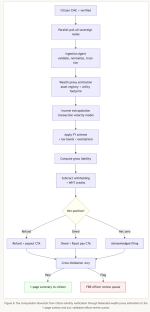
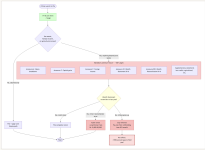
The federated computation logic behind the surface:
Figure 8. Tax computation flowchart from citizen identity verification through federated wealth proxy estimation to the 1-page surface and jury-validated officer-review queue.
Phase 1: Foundation.
The B2C-only break-even moves from “unreachable at small scale” (Phase 1) to ~144,000 active subscribers at Rs 1,500 blended ARPU (per the §4.1 model) to profitable at any subscriber count above ~200,000 once renewal share dominates. The state-subsidized PPP and B2B Enterprise revenue lines (§4.2.1) underwrite the opex floor during Phase 1-2; once Phase 3 sub-base passes the break-even threshold, B2C alone funds the operation and the other lines compound on top.
The path-to-cheaper outcome: per-subscriber loaded cost falls from ~Rs 1,800 / sub / year at Phase 1 baseline to ~Rs 250-400 / sub / year at Phase 3 scale, against a renewal-stable ARPU of Rs 1,200-1,500. Gross margin per subscriber expands from negative at Phase 1 baseline to Rs 800-1,000 by Phase 3.
Secondary: bank-channel deployment per §4.2.1 Revenue Line 4 once Phase 1 has shipped. Banks gain a customer-retention service; engine reaches retail distribution at near-zero CAC.
Industry-lobby endorsement: EPBD, Pakistan Business Council (PBC), Federation of Pakistan Chambers of Commerce and Industry (FPCCI). These are not policy levers but credibility multipliers; their endorsement neutralizes the “another consultant-built whitepaper” dismissal.
Consumption-first approach (Phase 1-2). The project team adopts current best-in-class agentic and inner-loop tooling under Citadel’s guidance, without inventing parallel infrastructure: Anthropic Claude (Opus + Sonnet) and OpenAI Codex CLI for inner-loop development; Cursor + Aider as IDE-resident pairing; the Anthropic Agent SDK + Google ADK + LangGraph for agentic orchestration of the federated inference layer. Inference-layer model selection (the math agent + jury agent in §2) treats LLM vendor as commodity behind a federated abstraction.
Code review gates. Every PR runs paired Claude + Codex review (sequential, foreground); merges require both model approvals plus human override. Test discipline: integration tests against federated nodes (NADRA Verisys mock, FBR IRIS sandbox, SBP open-banking sandbox) run in CI on every commit. Adversarial review is built into the SDLC, not bolted on at audit time. Citadel chairs the review gates and signs off on architecture changes.
Long-term: PK industry standards (Phase 3 milestone). Distill the Phase 1-2 inner-loop patterns, audit-log primitives, scam-detection signals, and citizen-consent UX into an open-source PK AI Engineering Standards v1.0 framework. Citadel convenes; FPCCI, PBC, Tier-1 bank engineering leaders, and selected PK university CS programs ratify. Standards become a public-good moat that compounds Citadel’s credibility while raising the floor for the Pakistani AI engineering profession. This is the move from “consume SOTA” to “set the standard for the next generation of PK builders.”
The Equifax-equivalent product surface positions IPaaS as trust-infrastructure spanning the citizen lifecycle, not a one-shot tax-tech feature. This is the long-term moat that justifies the Phase 1-3 foothold investment.
The current state of play matters too. SRO 2107/2025 legally abolished manual returns. Punitive non-filer measures (SIM blocking, travel bans, real-estate purchase bans) were enacted in parallel. The state has chosen the stick. This paper proposes the carrot: a credible 1-page surface that makes compliance the easier choice than evasion. The Institutional Migration Compact in §7.5b is the operational expression of that carrot for citizens, for FBR officers, for practitioners, and for partner banks alike.
This framing matters: a paper that ignores §175AA is naive. A paper that builds on §175AA shows the author understands the live legal substrate.
Reading the table. “Champion” actors clear the path. “Conditional partner” actors do not move until their structural interests are addressed. The §7.5b Institutional Migration Compact (carrot, not stick) is what converts “conditional partner” to “active partner” across the FBR cadre, PBA, and practitioner lobby. Without it, any reform attempt collapses under the same constellation that killed Husain (2001), Zaidi (2019), and Husain II (2020-21).
The path is SIFC-primary, MoITT / Finance Ministry coordination, FBR / PRAL operational delivery (with PRAL bypass on the federated layer), NADRA / SBP infrastructure partners, IMF alignment via quantified yield (§7.5). EPBD remains the right surface for industry-lobby endorsement and citizen support sign-up amplification (§7.6); it is not the right surface for implementation authority.
The engine aligns by quantifying yield against the PKR 15.264T FY27 FBR target (+13.7% YoY) and the SIFC tax/GDP path (8.5% → 13.7% near-term → 18% by 2029). EPBD’s Shadow Federal Budget 2026-27 targets the same destination through a tax-to-GDP path of 16% in three years and 18% in five [EPBD Shadow Federal Budget 2026-27, Executive Summary], proposing tax-base broadening, abolition of the non-filer category, simplification of tax procedures, and harmonization of federal/provincial sales tax processes over three years. The federated-inference architecture proposed here is the data-and-procedural-integration mechanism that operationalizes EPBD’s policy programme without the centralized-data-lake legal risk under BCO 1962 §35 + PBA §165A precedent. Phase 2 (Karachi salaried-class pilot per §6.1) is positioned as a permanent revenue-mobilization measure with modeled yield, qualifying as an IMF program-friendly reform that converges with EPBD’s independent fiscal alternative.
The Institutional Migration Compact has five commitments that travel with the engine:
Industry endorsement letter (headline). A one-page joint statement signed by the principal officers of Pakistan’s industry-lobby and finance bodies as institutions, not as individuals: PBC chairman, FPCCI president, APTMA patron-in-chief, named Tier-1 bank CEOs (HBL, UBL, MCB, Allied), and named university CS deans from the institutions ratifying the PK AI Engineering Standards under §6.4. The signatures attach to the institutions on whose behalf the principals sign. The letter does three things: it endorses the federated architecture as an industry-coalition reform priority; it commits each signing institution to the corresponding implementation surface (banks to the §4.2.1 Revenue Line 4 white-label pathway; universities to the §6.4 Phase 3 standards ratification; trade bodies to constituency communication); and it requests a 30-minute walk-through with the SIFC Apex Committee technical track. The endorsement letter is hosted at citadellabs.ai/advisory/library/gohar-onepage/endorsers once the el-paso /advisory surface is live; an interim Substack publication hosts the same content during Phase 0-1.
Citizen support sign-up (light layer). The same URL offers a low-friction “I support this proposal” form for individual citizens who want to publicly back the federated architecture. No hashtag campaign, no signature threshold, no quantified goal. The citizen-supporter ledger displays below the institutional endorsers and is not gated to any phase milestone. The intent is to make supporter visibility easy for any Pakistani citizen who wants to add their name, without staging a movement around the gesture.
What this section does not propose. It does not propose sponsored editorial placement, paid LinkedIn amplification, YouTube channel partnerships, or a hashtag campaign. Earlier drafts framed §7.6 as a multi-channel marketing push; the substantive thesis is that institutional endorsement plus light citizen visibility carries the trust signal more credibly than paid amplification, and aligns with the regulated-network advisory posture in §4.2.2.
Pakistan’s job is to lift one primitive from each, not to clone any single country. The §6.1 roadmap reflects this: Phase 1 borrows from Estonia (Once-Only Principle in law) and lays groundwork for the AIS data engine; Phase 2 adds Brazilian incentive mechanics on top of the salaried pre-fill; Phase 3 extends Mexican CFDI enforcement to the retail layer.
Disclosure and source orientation
This paper proposes an AI-architectural execution path for the federal tax-system reform programme set out by the Economic Policy and Business Development (EPBD) Think Tank in its Shadow Federal Budget 2026-27 and Shadow Five-Year Development Plan 2026-31 (both archived at whitepaper-build/research/). EPBD’s Chairman, Dr. Gohar Ejaz, HI, SI, articulated the tax-administration diagnostic in his On My Radar interview with Kamran Khan, ARY News, broadcast 21 May 2026 (video ID 80oOxryCUaA, “Business and Job-Friendly Budget 2026-27: Can Dar-Aurangzeb Deliver?”). The shadow documents formalize the diagnostic into a structured policy programme.
EPBD has produced the policy thinking; this paper proposes how to take that thinking forward and solution it with AI. The whitepaper is positioned as an AI-engineering execution path for the simplification and data-integration measures EPBD calls for, anchored to Section 175AA of the Income Tax Ordinance (Finance Act 2025) as the legal-architectural template. Where EPBD’s policy positions and primary-source data (FBR, SBP, NADRA, PIDE, World Bank PK Development Update) converge, the convergence is the load-bearing record on which the architectural proposal stands. Where headline aggregates in the broader public discourse diverge from primary-source positions, a supplementary cross-reference is provided in Appendix A.2 for transparency; the policy proposal does not rest on those aggregates.
Methodology and full source archive (including the EPBD shadow PDFs) available on request.
Executive Summary
EPBD has produced Pakistan’s first-ever Shadow Federal Budget 2026-27 and Shadow Five-Year Development Plan 2026-31. The diagnosis at the centre of the Shadow Federal Budget is unsparing: “Pakistan’s federal tax system is critically dysfunctional, mainly due to excessive rates, policy inefficiencies, non-liable tax impositions, structural complexities, and distortions. The FBR’s failure to simplify procedures has systematically eroded state-taxpayer trust and violated core taxation principles” [EPBD Shadow Federal Budget 2026-27, Executive Summary, p. 1]. EPBD calls for tax-base broadening, abolition of the non-filer category, simplification of tax procedures, and “fiscal data collection, integration, and sharing among SBP/RAAST, FBR/PRAL, and CGA/FABS” as the policy programme that takes the tax-to-GDP ratio from ~10% today to 16% in three years and 18% in five [ibid., revenue measures, p. 9-10].
EPBD has done the policy thinking. This whitepaper proposes the architectural and AI-engineering execution path for the simplification + data-integration measures EPBD calls for: a federated AI tax-inference engine, built on the legal-architectural template Pakistan already adopted in Section 175AA of the Income Tax Ordinance (Finance Act 2025). The policy work is EPBD’s; the build is what this paper sketches.
Pakistan ended TY2024 with 5.21 million tax returns received and roughly 2.05 million nil-filers (~39%) filed solely to avoid punitive non-filer withholding rates on banking, vehicles, and property [Dawn, Nov 2024]. Against an adult population of ~130-140 million and ~80-90 million CNIC-deduped account holders, the active-filer base is the smallest piece of a much larger documented economy. Pakistan’s tax problem is a documentation problem, not a tax-base problem. EPBD’s Shadow Federal Budget, the SBP’s payment-systems data, FBR’s own active-filer reports, PIDE’s tax-potential research, and the World Bank’s PK Development Update all converge on the same diagnosis (Appendix A).
This paper proposes a 1-page citizen-facing inference engine that pulls verified data from sovereign nodes (NADRA, FBR via IRIS, SBP-supervised banks, Raast, telco wallets), runs deterministic tax computation, and returns each citizen a 1-page summary with three paths: refund, owed, or net-zero acknowledged.
The architectural choice is non-obvious. A naive private-central engine, vacuuming citizen data into a third-party server, is illegal under Pakistan’s current legal regime (Banking Companies Ordinance 1962 §35, PECA 2016, the Personal Data Protection Bill 2023, and the Pakistan Banks Association precedent that killed Section 165A in 2020). The defensible architecture is the one the state itself adopted via Section 175AA of the Income Tax Ordinance (Finance Act 2025): a federated AI where the algorithm goes to the data, executes inside each sovereign node, and returns only signed inference scores. This collapses the legal-localization risk, neutralizes the PBA injunction risk, and respects the bank-secrecy compromise baked into 175AA. The 1-page citizen surface sits on top of the federated layer.
The right policy entry point is the Special Investment Facilitation Council (SIFC), not the EPBD. EPBD is Dr. Ejaz’s own think tank with no statutory authority over tax. SIFC is the apex civil-military body that has already mandated FBR restructuring, directed PRAL-NADRA-Karandaaz collaboration, and set the 18% tax-to-GDP target for 2029. The EPBD is the right audience for industry-lobby endorsement; SIFC is the right audience for implementation authority. The whitepaper addresses both.
The cost model in §4 is a seasonal-subscription business, not a per-filing transaction. Tax compliance concentrates in Pakistan’s July-September deadline window. Pricing reflects that seasonality: Rs 2,000 filing-season, Rs 1,200 off-season early commitment, Rs 1,000 returning-subscriber renewal. A blended ARPU lands at ~Rs 1,500 across a cohort. Loaded fintech opex sits at Rs 14.5 to 21 million per month at any subscriber base above ~100,000. The business model is trust infrastructure, not pure SaaS (§4.2): a Moody’s + TurboTax + Equifax + Visa/Mastercard composite running on five revenue lines, namely seasonal B2C subscription, state-subsidized PPP, B2B enterprise, bank-channel B2B2C, and Identity Protection as a Service (IPaaS) as a PK-on-shore identity-monitoring product line of the same operating entity (§6.5). A SECP-supervised public listing in Phase 3 is the structural trust signal.
Citadel’s role is advisory and AI engineering leadership for the project team (FBR / PRAL / NADRA / SBP / partner banks). The whitepaper proposes a capability-led roadmap (§6.1) with phase outcomes, not a calendar of hard commitments. Indicative durations depend on SIFC sandbox onboarding velocity, regulatory clearance cadence, and inter-agency MoU progress.
The carrot, not the stick. Every prior modernization (Husain 2001, Zaidi 2019, Husain II 2020-21) was killed by the FBR officer cadre whose income depends on the manual-extraction model. The §7.5b Institutional Migration Compact preserves cadre livelihoods through the transition: officer-bounty grandfathered on legacy cases, three-year transition income guarantee, jury-agent flag-for-officer-review queue that turns the engine into a capacity-multiplier (lead generation for high-yield audits), and a practitioner-cadre certification track that captures the new advisory market. §7.6 details the industry endorsement letter and citizen support sign-up that build the coalition the engine needs.
What this paper asks of SIFC and EPBD: a 30-minute walk-through, a directional read, and a named point of contact for Phase 0 scoping if directional fit is positive. Phase 0 is 90 days of MoUs (NADRA Verisys via sponsor-bank, FBR IRIS sandbox, SBP Open Banking partner agreement) before any code ships at scale.
Five implementation bets
The thesis below operationalizes into five implementation bets across legislation, product, procurement, channel, and standards. Each is independently sequenced, but the five reinforce one another inside the same operating entity. Full prototypes in §1.5; one-line anchors below.Hypothesis A. Day 1 Legislation Needs (legislation). Three concurrent legislative instruments: Digital Taxation Act (CNIC as sole individual tax ID + Once-Only Principle + PDPB clarifications); §116 Wealth Statement threshold amendment; and Inland Revenue Reward Rules 2021 amendment establishing the Institutional Migration Compact. → §1.5 Hypothesis A
Hypothesis B. Citizen App (product). The citizen-facing surface of the proposed operating entity, distinct from Citadel Agentic Labs the advisory firm. Single annual subscription, three pricing tiers (Rs 2,000 / Rs 1,200 / Rs 1,000 per §4.2.1). → §1.5 Hypothesis B
Hypothesis C. Request-for-Startup (RfS) for DevOps (procurement). SIFC publishes an open Request-for-Startup framework to staff the project-team’s 3-5 engineer core from PK fintech and AI talent. Open competition gives the project political cover; the RfS itself surfaces PK builders. → §1.5 Hypothesis C
Hypothesis D. Profitable banking partnership (channel). Tier-1 PK banks (HBL, UBL, MCB, Allied) bid for white-label license; revenue-share per active filer; bank captures deposit-retention lift. The Allied Bank × Befiler precedent (LIVE in myABL) is the working model. PBA §165A injunction concern is structurally satisfied via §175AA federated execution. → §1.5 Hypothesis D
Hypothesis E. First step to PK AI Engineering Standards (standards). Phase 3 milestone: open-source PK AI Engineering Standards v1.0 covering federated execution patterns, audit-log primitives, citizen-consent UX, and scam-detection signals. Citadel convenes; FPCCI + PBC + Tier-1 banks + PK university CS programs ratify. Standards become a public-good moat. → §1.5 Hypothesis E
1. The Documentation Problem
1.1 The documentation problem in primary-source numbers
The policy proposal in §2 onward stands on a set of macro-level positions cross-referenced across FBR, SBP, NADRA, PIDE, the World Bank’s PK Development Update, and EPBD’s Shadow Federal Budget 2026-27. Each is a primary-source position; together they define the documentation problem the federated architecture is designed to address. (A supplementary cross-reference of how the same data points appear in current public-discourse framings is in Appendix A.2.)| Anchor | Primary-source position | Source |
|---|---|---|
| Active filer base | TY2024 returns received: 5.215 million; ATL active filers (mid-2024 cut-off): 3.35 million | Dawn (Nov 2024); Business Recorder (2024) [3, 4] |
| Nil-filer share | TY2024 nil-filers: 2.051 million (~39% of returns), filed solely to avoid punitive non-filer withholding rates on banking, vehicles, and property. EPBD calls for abolition of the income-tax non-filer category [EPBD Shadow Federal Budget 2026-27, p. 9] | Dawn (Nov 2024) [3]; EPBD (2026) |
| CNIC-deduped bank-account universe | ~80-90 million unique-human formal account holders (38 million unique Raast IDs; 64% adult-population branchless penetration). This is the universe that the active filer base sits inside, not the wider ~138 million PTA mobile-broadband subscriber count which counts SIMs, not people | SBP Governor Jameel Ahmad, Oct 2024 [5] |
| Federal tax potential | Rs 20 trillion federal tax potential (Dr. Ikramul Haq, PIDE), scaling to Rs 34 trillion if the informal economy is brought into scope. This is a potential estimate against today’s ~Rs 11.7T FBR collection, not a deposit pool. Operationalizing the difference requires §175AA-style federated execution | Friday Times, Mar 2024 [8]; PIDE |
| Commercial bank deposit base | Commercial scheduled bank deposits Nov 2025: Rs 35.38 trillion; M2 (adding Rs 10.36T currency-in-circulation): Rs 37.26 trillion mid-May 2025 | Profit Pakistan Today, Dec 2025 [6, 7] |
| Tax-to-GDP ratio | Stagnant at ~10% of GDP despite tax-collection growth (Rs 4.76T in FY 2020-21 → Rs 11.74T in FY 2024-25). EPBD targets 16% in three years and 18% in five through tax-base broadening + simplification + digital measures [EPBD Shadow Federal Budget 2026-27, Exec Summary] | EPBD (2026); FBR (2025) |
| Federal tax-system diagnosis | “Pakistan’s federal tax system is critically dysfunctional, mainly due to excessive rates, policy inefficiencies, non-liable tax impositions, structural complexities, and distortions. The FBR’s failure to simplify procedures has systematically eroded state-taxpayer trust and violated core taxation principles” | EPBD Shadow Federal Budget 2026-27, Executive Summary, p. 1 |
| Public-debt context | Federal public debt: Rs 19T (FY 2015-16) → Rs 80T (FY 2025-26), 65-75% of GDP, driven by persistent fiscal deficits | EPBD Shadow Federal Budget 2026-27, Executive Summary, p. 2; Business Recorder (2026) [1] |
| Compliance burden | Core IT-1B (salaried) is 1 page; IT-2 is 2 pages. The real burden is the 1-page core + 100+ pages of mandatory schedules and Wealth Statement (§116) reconciliation that drives practitioner fees of Rs 15,000-50,000/year per filer (§1.2 below) | FBR Manual Return TY2017 [10] |
1.2 Why the form is the bug
The friction in Pakistan’s individual tax filing is not the IT-1B core form, which fits on a single page. It is the mandatory Wealth Statement reconciliation under Section 116. A salaried citizen must produce, alongside the return, an annexure-stack covering assets, liabilities, foreign income, agricultural-income claims, and a year-on-year wealth reconciliation. Minor errors in the reconciliation routinely trigger audit. Practitioner fees for the full bundle run Rs 15,000-50,000 per year per filer.Friction-as-exclusion is the system design. A salaried citizen choosing between (a) two weekends with a practitioner at Rs 30,000 fee or (b) staying informal rationally chooses (b). The informal economy in Pakistan is not a moral failure of citizens; it is the rational equilibrium response to a compliance regime that costs more in fees and risk than the tax it captures.
This is not unique to Pakistan. Estonia faced the same regime in the late 1990s, until X-Road plus e-Tax took filing time to 3-5 minutes. Mexico faced it in retail, until mandatory CFDI e-invoicing made non-compliance commercially impossible. India and Brazil both layered annual-information-statement and pre-fill primitives onto their existing tax bases over the past decade. None of these reforms eliminated the tax officer. All eliminated the friction. The full comparative analysis is in §8.
1.3 What changes when the burden is 1 page
A 1-page surface inverts the burden. The state holds the relevant data already (NADRA identity + biometric, FBR withholding records via IRIS, SBP-supervised bank aggregates via §175AA federated algorithms, Raast transaction velocity, telco-wallet activity already piped to FBR’s RADAR system under ITO §175A since December 2023). The proposed engine surfaces a single pre-filled position. The citizen approves, challenges, or claims refund. Three buttons, not a 100-page annexure burden.The §175AA pattern is the political feasibility key. The state has already established that algorithms runinsidesovereign nodes (banks) on FBR-issued CNIC batches, returning inferred risk scores rather than raw data. The 1-page engine extends this same federated pattern to the citizen surface.
1.5 Prototype: Five Implementation Bets
The thesis above operationalizes into five implementation bets, across legislation, product, procurement, channel, and standards. Each is independently sequenced but the five reinforce one another. Three of the five (B, D, E) are revenue-bearing surfaces of the operating entity; two (A, C) are public-sector enabling actions that SIFC and the Finance Ministry carry. The five together compose the trust-infrastructure thesis in §4.2.Hypothesis A. Day 1 Legislation Needs
Three legislative instruments are drafted Day 1, concurrent with Phase 1 Foundation engagement. The legislative load is front-loaded because every subsequent phase depends on these three statutes being either enacted or in late-stage drafting.- Digital Taxation Act (new statute). Establishes the 13-digit CNIC as the sole individual tax identifier (abolishing NTN for individuals per §3.1). Codifies the Once-Only Principle (Estonia precedent in §8.2): no state agency may withhold from FBR data it already holds about an individual. Adds explicit PDPB clarifications for the tax / financial / identity data class so that the federated execution pattern under §175AA has unambiguous legal cover.
- §116 Wealth Statement threshold amendment. Amends the Income Tax Ordinance §116 to suspend mandatory wealth-reconciliation for filers below a defined threshold (initial draft: salaried income under Rs 6 million per year or proxy-wealth indicators below an equivalent threshold). The amendment is what makes the 1-page surface honest: it removes the annexure-stack landmine that today drives practitioner fees and §116 audit triggers for the salaried-class cohort the engine targets (§1.2). It does not abolish §116; it scopes it to where it materially serves audit yield.
- Inland Revenue Reward Rules 2021 amendment. Amends SRO 78(I)/2021 to implement the Institutional Migration Compact (§7.5b): (i) grandfather the 20% officer bounty on the legacy case pipeline; (ii) establish the 3-year transition income guarantee for any IRS officer whose recovered-tax bounty income drops below their prior-three-year average due to engine deployment; (iii) codify the jury-flagged officer-review queue (§2.3) as the new lead-generation mechanism for high-yield audits, with officer bounty preserved on flagged-and-recovered cases. This is the legislative expression of the carrot in §7.5b.
Hypothesis B. Citizen App
The Citizen App is the citizen-facing surface of the proposed operating entity. This is the product. It is not Citadel Agentic Labs, which is the advisory firm publishing this whitepaper. The two are distinct in name, in entity, in business model, and in fiduciary obligation.- Product surface. The 1-page hub in §5: federated inference engine + pre-filled return + three-button approval (refund / owed / net-zero). On top of the tax-engine core, the Citizen App carries IPaaS as a distinct subscription (§6.5) and is the brand-facing entry point for the bank-channel B2B2C distribution (§4.2.1 Revenue Line 4).
- Pricing. Three subscription tiers per §4.2.1: Rs 2,000 filing-season walk-up / Rs 1,200 off-season early commitment / Rs 1,000 returning-subscriber renewal. Blended ARPU ~Rs 1,500 in cohort year 1; softens toward Rs 1,200 in cohort year 2+ as renewal share dominates.
- Operating entity. SECP-listed in Phase 3 (§4.2.2). Regulated financial-network archetype (Visa / Mastercard peer class). Trust governance: quarterly disclosure + continuous regulator oversight + open-source PK AI Engineering Standards (Hypothesis E).
Hypothesis C. Request-for-Startup (RfS) for DevOps
SIFC publishes a Request-for-Startup framework to staff the project-team’s 3-5 engineer core. The RfS is an open competition for PK fintech and AI talent to staff the engineering and product layer that executes the federated build under Citadel’s architectural direction (§6.2).- Why an RfS rather than a sole-source consultancy hire. A sole-source engagement triggers the political-economy risks documented in §7.1 (Zaidi precedent: private-sector appointment immediately attracts legal action). An open competition gives the project political cover, signals to the IRS officer cadre that the build is not a back-door private capture, and surfaces PK builders who would not otherwise be visible to the SIFC procurement track.
- What the RfS evaluates. Demonstrated production deployment of federated execution patterns, AI-driven SDLC fluency (Claude + Cursor + Codex + Aider per §6.4), regulated-environment fintech experience (Sadapay, NayaPay, Easypaisa, JazzCash backgrounds), and public-good orientation (open-source contribution history; willingness to convene on the §6.4 Phase 3 standards). The winning team is a small group, not a single vendor.
- Cost. The RfS framework runs as a SIFC-funded competition; the operating entity (Hypothesis B) bears post-selection engineering costs through Phase 1-2 revenue lines and the state-subsidized PPP line (§4.2.1 Revenue Line 2). Citadel’s advisory and AI engineering leadership posture (§6.1, §6.2) sits above the RfS-selected team.
- Why this is a new procurement primitive for Pakistan. Pakistan has run public procurement against vendor RFPs for decades. An RfS targets early-stage builder talent, not vendors. It is a smaller-dollar, higher-signal procurement instrument that aligns with the SIFC mandate to surface PK builders. Adopting it for this project sets a precedent for the next generation of state-sponsored federated builds (e.g. Hypothesis E standards stewardship).
Hypothesis D. Profitable banking partnership
Tier-1 PK banks bid for a white-label license to distribute the federated engine through their own retail channels. The bank-channel B2B2C line (§4.2.1 Revenue Line 4) is the highest-margin and lowest-CAC line in the model because the customer is already in the bank’s channel.- The Allied Bank × Befiler precedent is LIVE. Allied Bank already runs Befiler tax filing inside myABL; users register an NTN and file annual returns from the bank app, with no separate sign-up. Meezan Bank offers the same to its Freelancer Account holders at Rs 2,000-3,000 per return. The bank-channel B2B2C model is not a hypothesis; it is a working pattern. The federated engine extends the pattern with federated execution under §175AA.
- Economic loop for the bank. Active-filer status reduces withholding-tax friction on the customer’s transactions. Lower friction encourages larger deposit balances. Higher deposit balances raise customer LTV for the bank. Tax filing is not a cost center for the bank; it is a deposit-retention lever. The bank pays the operating entity a per-active-filer license fee; the bank captures the deposit-retention lift; the customer pays nothing direct.
- PBA §165A objection is structurally satisfied. The §175AA federated execution pattern keeps the algorithm inside the bank’s infrastructure. Only signed inference scores leave the bank. This is the architecture PBA’s own counsel co-drafted as the compromise that ended the §165A litigation in 2020 (§7.3 below). The bank-channel deployment is therefore inside the legal envelope PBA already accepts.
- Phase mapping. Phase 1: bank-channel MOU drafting (no live deployment). Phase 2: first Tier-1 bank pilot (target: one named bank, 10,000 filers via channel). Phase 3: 2-3 Tier-1 banks live; CAC effectively zero through the channel; ARPU stable through the white-label license price.
Hypothesis E. First step to PK AI Engineering Standards
Phase 3 publishes an open-source PK AI Engineering Standards v1.0 framework, convened by Citadel and ratified by an industry coalition. This is the long-term moat: the open standard becomes the regulatory reference for federated tax inference, identity protection, and adjacent state-adjacent AI build patterns across Pakistan.- Scope of v1.0. Federated execution patterns (algorithm-to-data invariants, signed-inference verification, audit-log primitives derived from Estonia KSI). Citizen-consent UX (the Brazil Pré-preenchida consent model adapted to PDPB). Scam-detection signals (the four-vector IPaaS taxonomy in §6.5). Code-review gates and AI-driven SDLC patterns (Claude + Codex + Aider) that the project team uses operationally.
- Convening mechanism. Citadel convenes; FPCCI + PBC + Tier-1 banks + 2-3 PK university CS programs (NUST, LUMS, FAST or equivalent) ratify the v1.0 text. The PK AI Engineering Standards entity is structured as a public-good standards body, not a private operating company; the operating entity (Hypothesis B) implements the standards but does not own them.
- Why this is a moat. Open standards published by the convening team in Phase 1-2 become the regulatory reference Phase 3-and-beyond builders default to. The operating entity (Hypothesis B) is the most experienced implementer of its own standards. Subsequent builders (whether bank-channel partners, downstream FBR analytics surfaces in §6.6, or adjacent state-adjacent fintech surfaces) consume the standards rather than rewriting them. The standards body is the public-good layer that turns the operating entity from one product into a category.
- Industry-standards parallel. PK Banking Association rules, SECP listing standards, and ISO 27001 in the PK financial sector all operate on the same convene-then-ratify model. PK AI Engineering Standards extend the pattern to a new category (federated AI for state-sovereign data) where no PK reference exists today.
2. Technical Architecture: State-Sovereign Federated AI
2.1 The architectural pivot: algorithm-to-data, not data-to-algorithm
The first-principles architectural decision is whether the data moves to the engine, or the engine moves to the data.Data-to-algorithm (rejected). An initial centralized framing routed NADRA + FBR + SBP + Raast + telco-wallet feeds into a centralized Kafka ingestion gateway running on a single sovereign datacenter. This pattern is illegal under three converging instruments:
- Banking Companies Ordinance 1962 §35 plus SBP staff regulations bar third-party access to scheduled-bank reporting.
- Pakistan Banks Association v. Section 165A (2020) killed FBR’s earlier attempt at real-time bank-API access using §216 confidentiality; FBR was forced into manual batch reporting.
- Personal Data Protection Bill 2023 (cabinet-approved, parliament-pending) classifies tax/financial data as “critical personal data” requiring local hosting and explicit consent. NCPDP has classification discretion that creates ongoing regulatory risk.
This is the same pattern as Estonia’s X-Road (since 2001), Open Banking PSD2 (EU, 2018), and post-Puttaswamy India’s DEPA Account Aggregator framework (2020). Pakistan has, accidentally and via punitive policy, adopted the architecture the rest of the world converged on.
The 1-page engine extends §175AA to a citizen-facing surface. Each sovereign node hosts a model. Models execute locally on the citizen’s CNIC. Only the inferred filing position flows out, signed and logged.
2.2 Federated node map
| Node | What it provides | Federated access pattern |
|---|---|---|
| NADRA | CNIC + biometric + identity tier | Sponsor-bank Verisys: white-label NADRA API through a licensed bank (HBL, JS Bank, Allied) under existing institutional license. Direct private fintech onboarding is closed. The 2.7M-record insider breach (2019-2023, JIT-confirmed, not the 27M rumor that circulated in international press) has tightened access. Engine commits to client-side encryption + on-shore residency + zero offshore replication. |
| FBR IRIS | Returns history + ATL + WHT records | Client-side RPA: user enters their own IRIS credentials on-device; engine acts as the user’s agent. The Befiler model (PK tax-fintech, $1.5M seed, RPA-on-credentials). FBR PRAL APIs are write-only for SRO 709 digital-invoicing push from corporate ERPs; no legal path for private query of citizen ITRs. Frame this as a feature (“user always in control”), not a constraint. |
| SBP-supervised banks | Aggregate banking + KYC telemetry | §175AA federated algorithm: model executes inside bank, returns inferred score only. This is already the legal/operational template the state adopted. Engine extends §175AA to citizen-facing inference. |
| Raast | Real-time payment rails | Sponsor-PSP/EMI partnership: SBP’s ISO 20022 / P2M APIs (Oct 2025 mandate) require licensed Bank/EMI/PSP/PSO. A startup must acquire its own SBP license or sponsor-bank white-label. |
| Easypaisa / JazzCash | Wallet velocity | RADAR back-channel: both wallets already pipe real-time data to FBR’s RADAR system under ITO §175A (Dec 2023 mandate). Engine consumes from FBR’s RADAR pre-aggregated view, not from the wallets directly. Direct re-share is barred under PECA §§37-38. |
2.3 The agent pipeline
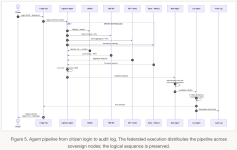
The processing pipeline does not use unstructured generative text. Three specialized agents execute in a fixed federated sequence:- Federated Ingestion Agent (FIA): orchestrates the citizen’s CNIC across federated nodes. Issues model-execution requests; receives signed scores. Trust-tiers each return per source.
- Deterministic Math Agent (DMA): runs Python against the FY-current tax code (FBR-published schedules + Wealth Statement reconciliation rules). pandas, numpy, statsmodels. No LLM. No hallucination risk.
- Cross-Validation Jury Agent (JA): four-model consensus check on the DMA output. Flags discrepancies, validates §65 exemptions (agricultural income, export rebates, zakat declarations). Returns either pass-through to citizen, or flag-for-officer-review queued into FBR IRS officer dashboards.
2.4 Sovereign execution and stack
- Hosting: Tier-III certified PK datacenter per SBP BPRD Circular No. 01 of 2023. PTCL Smart Cloud and Cybernet are the two production-qualifying options. No hyperscaler (AWS / Azure / GCP) is legal for the in-scope critical personal data classes under PDPB 2023.
- Execution language: Python 3.11 containers, distributed across federated node-local executors.
- Async infrastructure (revised, see §4): stateless REST + Postgres at sub-10k events/sec sustained throughput. Apache Kafka migration is a documented future trigger, not a launch dependency. An earlier Kafka-vs-REST 3.75x cost-advantage claim is inverted at this scale.
- Data validation: pydantic strict-mode for every payload boundary.
- Statistical layer: scikit-learn for declared-income vs. proxy-wealth anomaly detection; statsmodels for multi-variable trend tracing.
- Audit log: immutable per-citizen entry on every inference. KSI-style hash-and-timestamp pattern (Estonia X-Road precedent). Cross-agency data access logged on a continuous ledger.
3. CNIC = NTN: Identity Unification
3.1 Why this is the Day-1 legislative ask
Today, a Pakistani citizen has a CNIC (NADRA-issued, biometric-backed, universal) and may have an NTN (FBR-issued, voluntary, ~5-7M holders). The two identities live in separate databases with separate enrollment paths. The friction of obtaining an NTN, plus the Wealth Statement annexure burden behind it, keeps ~80-90 million unique CNIC-holding adults out of the active tax net.The proposal: abolish NTN for individuals on Day 1 via the Digital Taxation Act (proposed legislation, see §6.1 Phase 1). Designate the 13-digit CNIC as the sole individual tax identifier. India’s PAN-to-Aadhaar linkage rolled across multiple deadlines and penalty cycles; Pakistan can skip that saga by legislating CNIC unification up front. This proposal sits alongside EPBD’s call for “abolition of the income-tax non-filer category” [EPBD Shadow Federal Budget 2026-27, revenue measures, p. 9]: CNIC unification removes the identity friction; non-filer-category abolition removes the punitive-withholding regime that drives the nil-filer behavioral artifact (§1.1).
NADRA’s CNIC database is already deeply integrated with FBR through the §175AA infrastructure; the institutional plumbing exists. The legal change is the bottleneck.
Figure 6. State machine for citizen tax identity over the fiscal year. CNIC unification removes the NonFiler → Linked transition friction by making the transition implicit. (next post)
3.2 What the citizen sees on first contact
The citizen onboarding flow is two screens, completing in under 30 seconds for a verified-identity user:Figure 7. Citizen onboarding: CNIC + selfie via NADRA Verisys, then federated inference returns a 1-page summary. (next post - attachment limit)
4. Cost and Business Model
4.1 Loaded P&L at 100,000 subscribers, seasonal pricing baseline
Tax compliance in Pakistan concentrates in the July-September FBR deadline window. The pricing model reflects that seasonality directly. Three subscriber price points compose the seasonal mix:| Cohort | Annual price | Mechanism |
|---|---|---|
| Filing-season walk-up (Jul-Sep) | Rs 2,000 / year | Full price; one-shot acquisition |
| Off-season early commitment (Oct-Jun) | Rs 1,200 / year | Prepaid for next filing season; lower CAC, higher retention |
| Returning-subscriber renewal | Rs 1,000 / year | Automatic discount for retained subscribers (year 2+) |
Loaded Pakistani fintech opex at 100,000 active subscribers:
| Category | % of OpEx | Monthly PKR | Note |
|---|---|---|---|
| Compute and infrastructure | 15-20% | 2.5M-3.5M | Sovereign Tier-III + DR + HA datastore + WAF |
| Legal and compliance | 15-20% | 2.5M-3.5M | SECP / SBP reporting, external audits, PDPB data-residency audits |
| Customer support and ops | 20-25% | 3.5M-4.5M | Tax product = high-anxiety; FBR portal downtime support |
| Fraud, risk, insurance | 10-15% | 1.5M-2.5M | Professional indemnity for misfilings, fake-CNIC detection |
| Marketing and CAC | 25-30% | 4.0M-6.0M | Educating users to pay vs. free FBR Tax Asaan |
| Regulatory and licensing | ~5% | 0.5M-1.0M | SBP / SECP licensing amortization |
| Total | 100% | ~Rs 14.5M-21M / month | Compute share is 15-20%, not 80%; opex is dominated by non-compute (PK fintech benchmark: Easypaisa CTI 73.12% in 2025) |
P&L sensitivity across subscriber tiers
Loaded P&L across the trajectory from Phase 1 baseline through Phase 3 scale to long-run steady-state. Assumes Safepay-equivalent payment-gateway MDR 2.9% + Rs 30/txn and a 5x compute-to-loaded-opex multiplier (per §4.1 loaded-P&L derivation). Annual ARPU softens as renewal share grows (TurboTax retention pattern); fixed monthly overhead grows with scale (additional support staff, regulatory licensing scope, fraud-ops headcount).| Active subscribers | Blended ARPU (Rs/yr) | Monthly revenue (smoothed) | Monthly total cost | Net monthly P&L | Cohort context |
|---|---|---|---|---|---|
| 10,000 | 1,500 | Rs 1.3M | Rs 17.1M | -Rs 15.8M | Phase 1 baseline; opex underwritten by §4.2.1 lines 2-3 (state-subsidized PPP + B2B Enterprise) |
| 50,000 | 1,500 | Rs 6.3M | Rs 17.3M | -Rs 11.1M | Late Phase 1 / early Phase 2; bank-channel + B2B partly compensating |
| 100,000 | 1,500 | Rs 12.5M | Rs 17.7M | -Rs 5.2M | §4.1 reference scenario; mid-Phase 2 |
| 144,000 | 1,500 | Rs 18.0M | Rs 18.0M | ~Rs 0 | B2C-only break-even |
| 250,000 | 1,400 | Rs 29.2M | Rs 20.1M | +Rs 9.1M | Phase 3 target; B2C self-funding; renewal share ~50% |
| 500,000 | 1,300 | Rs 54.2M | Rs 25.1M | +Rs 29.1M | Beyond foothold; renewal share ~65%; trust-infra moat compounds |
| 1,000,000 | 1,200 | Rs 100.0M | Rs 35.9M | +Rs 64.1M | Long-run steady-state; renewal share ~75%+; bank-channel CAC ≈ 0 |
- B2C alone is negative at small scale. Below ~144,000 active subscribers, the seasonal-subscription line cannot cover loaded opex. The Phase 1-2 underwriting comes from §4.2.1 revenue lines 2-3 (state-subsidized PPP and B2B Enterprise), not from consumer subscriptions.
- Trust infrastructure compounds. Above ~250,000 subscribers, every additional subscriber drops marginal cost (per §6.1.1 path-to-cheaper-at-scale). Renewal share grows; CAC falls; the unit economics widen.
- The economic model is patient. This is not a venture-velocity P&L. It is a trust-infrastructure foothold that becomes self-funding in Phase 3 and compounds beyond.
4.2 Business model framing: trust infrastructure, not pure SaaS
Tax compliance is seasonal in Pakistan; trust is not. A subscription business that compounds across years is closer to Moody’s (subscription credibility for institutional buyers), TurboTax (consumer filing with seasonal spike + high year-after retention), and Equifax (identity bureau: recurring monitoring against fraud). The Citizen App and the IPaaS bureau, taken together, blend all three patterns into one trust relationship.| Pattern | Source comparable | What the Citizen App + IPaaS take from it |
|---|---|---|
| Moody’s (NYSE: MCO) | Subscription credibility infrastructure | Sovereign-aligned operator whose product is trust itself. Multi-year institutional subscriptions; quarterly disclosure as the moat; dividend-yield mature business model. The proposed PSX-listed operating entity inherits the Moody’s posture: trust is the asset, not growth velocity. |
| TurboTax (Intuit, NASDAQ: INTU) | Consumer tax filing | Seasonal-spike revenue with 70%+ year-over-year retention; per-filer LTV amortizes CAC across many years; freemium + premium-tier upsell ladder. The B2C subscription line (§4.2.1 Revenue Line 1) inherits the TurboTax customer-economics pattern. Intuit pays a stable dividend since 2011; growth + dividend coexist at scale. |
| Equifax (NYSE: EFX) | Identity bureau | Recurring monitoring against fraud as a stand-alone subscription product. The IPaaS product line (§6.5) inherits the Equifax product surface, delivered as a distinct subscription within the same operating entity (single SECP-listed governance frame). |
Five revenue lines (§4.2.1) operationalize the cross-pattern. Public listing (§4.2.2) is the governance mechanism that distinguishes a trust-infrastructure operator from a private rent extractor.
4.2.1 Five revenue lines
1. Seasonal B2C subscription. Tax filing concentrates in the July-September deadline window. The model prices seasonality directly:| Window | Price | Mechanism |
|---|---|---|
| Filing season (Jul-Sep) | Rs 2,000 / year, single payment | Walk-up subscriber |
| Off-season early commitment (Oct-Jun) | Rs 1,200 / year, prepaid for next season | Incentivized retention |
| Renewal discount (returning subscriber) | Rs 1,000 / year, automatic | LTV amortization |
| Free tier | Filing only, no audit-defense, no refund-fast-track | Funnel to paid |
2. State-subsidized PPP. SIFC-sponsored, FBR-budgeted line item from the digital-modernization budget. Government pays Rs 100-150 per filing covered. Citizen fee becomes zero or token (Rs 100 expedited refund processing). The IMF-aligned, IRS-officer-cadre-neutralized, PMO-cover path. Recommended primary entry path because it neutralizes the political-economy risks in §7 and resets the unit economics from “private rent extraction” to “public infrastructure with private operator.”
3. B2B Enterprise (corporate finance / HR teams). Rs 100,000-300,000 / month per enterprise for bulk employee filing (1,000+ salaried-employee teams). Targets PK corporate finance and HR teams managing annual filing across the workforce. Long sales cycle (~6 months/logo), but durable LTV (target 90%+ year-over-year retention).
4. Bank-channel B2B2C. Tier-1 PK banks (HBL, Allied, UBL, MCB) license the platform; banks offer tax filing as an account-holder retention service. Bank pays the operator per active filer; citizen pays nothing direct. CAC effectively zero because the citizen is already in the bank’s channel.
This is not a hypothesis. Allied Bank already runs Befiler tax filing inside myABL: users register an NTN and file annual returns from the bank app, no separate sign-up. Meezan Bank offers the same to its Freelancer Account holders at Rs 2,000-3,000 per return. HBL @Work, UBL Employee Banking Salary Account, and Bank of Punjab Salary Plus already bundle non-core retention services (life insurance, salary-advance loans, accidental coverage up to Rs 2.5M) into employee-banking programs. Adding annual tax filing as a Tier-1 license of the federated engine is incremental, not novel. The bank’s economic loop matters too: active-filer status reduces withholding-tax friction on the customer’s transactions, which encourages larger deposit balances, which raises LTV for the bank. Tax filing is not a cost center for the bank; it is a deposit-retention lever. Once integrated, switching cost (NTN + filing history inside the bank app) drives near-zero churn.
5. Identity Protection as a Service (IPaaS): recurring subscription. Independent PK-on-shore identity-monitoring bureau (full architecture in §6.5). Pricing:
| Segment | Price | Coverage |
|---|---|---|
| Individual | Rs 500-800 / year | Daily monitoring + alerts + 24h incident response |
| Family pack (up to 5 CNICs) | Rs 5,000-12,000 / year | Shared bureau coverage |
| Corporate executive add-on | Rs 25,000-50,000 / year per exec | Bundled with B2B Enterprise (line 3) |
| Pakistani diaspora | USD 15-25 / year (~Rs 4,500-7,000) | In-country identity monitoring for the ~9M PK diaspora |
The trust-infrastructure compounding effect. Citizens who use the Citizen App for filing become candidates for IPaaS subscription. Corporate clients bundle IPaaS for senior leadership. Banks white-labelling tax filing add IPaaS as a premium account-holder service. Five revenue lines, one trust relationship.
4.2.2 Public listing pathway: a regulated financial network, not a venture-backed unicorn
The proposal includes a SECP-supervised public listing pathway in Phase 3 (per §6.1) on the Pakistan Stock Exchange: SME tier or main board depending on Phase 2 revenue traction. Public listing serves three functions:- Trust signal. Governance and quarterly audited disclosure required by SECP listing rules raise the credibility floor of an entity handling citizen-identity inference. Private operators carrying state-derived data are inherently suspect; listed operators with public quarterly disclosure are not. This addresses the IMF and SIFC concern about private-sector capture of public-good infrastructure.
- Capital access. Scaling IPaaS + bank-channel + enterprise simultaneously requires growth capital beyond a founder’s runway. SECP-listed equity is the cleanest PK source and avoids foreign-equity sensitivities under the current external-account regime.
- Governance discipline. A publicly-traded entity carries continuous-disclosure obligations and quarterly external audit, which is the structural alternative to private opacity. The IPaaS product line (§6.5) inherits the same listed-entity disclosure regime as the Citizen App.
THE REGULATED FINANCIAL-NETWORK PARADIGM (PEER COMPARABLE: VISA / MASTERCARD)
The right peer comparable is the regulated financial network / trust-infrastructure operator: a publicly listed entity that runs sovereign-adjacent data and payment infrastructure under continuous regulator oversight, generates predictable cash flows from a quasi-monopoly network position, and returns capital via dividend rather than growth multiple. Standard high-velocity software comparables (real-time analytics platforms, dashboarding vendors) are discarded as unfit; the operating entity is governed like a payment-rail operator, not like a SaaS vendor.Primary peer case study: Visa Inc. (NYSE: V) and Mastercard (NYSE: MA). Visa and Mastercard are the structural blueprint for what a federated trust-infrastructure operator looks like at maturity:
- Regulated financial-network operator. Both run sovereign-adjacent payment rails under continuous regulator oversight (US Fed, EU regulators, RBI, SBP). Pakistan-domestic equivalent posture: SECP-listed, SBP-supervised on the bank-channel surface, NCPDP-compliant on the citizen-identity surface.
- AI-enabled risk and fraud inference at network scale. Visa Advanced Authorization and Mastercard Decision Intelligence run federated AI inference inside the payment-authorization pipeline. Algorithm executes inside the network node, only signed risk-scores cross the wire. This is the same federated execution pattern the 1-page engine adopts under §175AA.
- Dividend-yield orientation with stable cash flows. Visa pays ~0.7% dividend yield; Mastercard ~0.6%. Payout ratios are conservative (~22-25%) reflecting reinvestment-led compounding rather than venture-velocity growth. The operating entity benchmarks its post-listing valuation against the regulated-network multiple class, not against US growth-stage AI multiples.
- State-adjacent data exposure with transparency-anchored governance. Both operate under network-rules transparency disclosed to issuing banks and regulators. The Citizen App inherits the equivalent posture: published quarterly federated-execution audits + open-source PK AI Engineering Standards (§6.4 Phase 3 milestone) as the network-rules surface.
Indian functional precedents (supplementary). Central Depository Services Limited (NSE: CDSL) operates listed market-infrastructure data services under SEBI’s regulatory regime; Tata Consultancy Services (NSE: TCS) operates India’s Centralized Processing Centre at Bengaluru (74% of ITRs auto-processed within 20 days). Both demonstrate that publicly-listed entities can legitimately operate national-scale sovereign data and tax-processing infrastructure under transparency rules. They are referenced as functional precedents, not as the headline archetype.
Domestic PSX benchmark: Systems Limited (PSX: SYS). For valuation reference, Systems Limited is the closest PSX-listed comparable: ~PKR 223B market cap, ~1.2% dividend yield, ~20-22x P/E. It is a PK software services operator with government and financial-services customers, SECP-compliant disclosure, and a dividend policy that signals stable cash flow rather than venture risk. The Citizen App operating entity benchmarks its post-listing valuation against this PSX-domestic anchor.
The framing the listing signals to PK markets, IMF, SIFC, and citizens: this is a regulated financial-network operator with quasi-monopoly characteristics, public-disclosure governance, federated AI inference inside sovereign nodes, and dividend-yield economics. Not a venture-backed AI play.
5. The 1-Page Citizen Hub
The UI is one screen. Every line item is signed by its sovereign source node and labeled with the agent that produced it (per §2.3: FIA = Federated Ingestion Agent, DMA = Deterministic Math Agent, JA = Cross-Validation Jury Agent). Nothing is hidden behind a tooltip. Transparency is the compliance lever, and source attribution is the trust signal that distinguishes a federated inference from a vendor opinion.The screen below is the post-Phase 2 reference surface. Every field carries (a) the inferred value, (b) the sovereign node that signed the underlying signal, and (c) the agent class that produced it. Citizens approve, challenge, or claim refund; they do not type into a 100-page annexure.
+--------------------------------------------------------------------------+
| CITIZEN APP (operated by [Operating Entity]) CNIC 35201-X |
+--------------------------------------------------------------------------+
| IDENTITY + TAX PROFILE |
| Identity: VERIFIED [NADRA Verisys, FIA, signed] |
| Active Taxpayer: UNLINKED (eligible) [FBR IRIS, FIA, signed] |
| Filing year: TY 2026-27 |
+--------------------------------------------------------------------------+
| YOUR CNIC-LINKED LIFESTYLE AND WEALTH STATEMENT |
| (signals from sovereign nodes; raw data does not leave the node) |
| |
| Linked bank nodes: 3 (HBL, Allied Bank, Easypaisa wallet) |
| [§175AA banks, FIA] |
| Aggregate annual inflow: PKR 8,450,000 [SBP-supervised, FIA] |
| Aggregate annual outflow: PKR 7,810,000 [SBP-supervised, FIA] |
| Raast P2P + P2M velocity: PKR 2,340,000 [Raast rails, FIA] |
| Telco wallet velocity: PKR 920,000 [RADAR feed, FIA] |
| Registered immovable assets: 1 urban property [Provincial RB, FIA] |
| Registered motor vehicles: 1 sedan, 1850 cc [Excise & Tax, FIA] |
| Institutional energy spend: PKR 620,000 [LESCO + SNGPL, FIA] |
| Trust-tier coverage: 5 of 5 sources signed |
+--------------------------------------------------------------------------+
| TAX COMPUTATION (FY 2026-27, deterministic. No LLM, no hallucination.) |
| |
| Reported income (self-declared): PKR 3,600,000 [citizen] |
| Inferred income (federated): PKR 4,200,000 [DMA] |
| Reconciliation gap: PKR 600,000 [DMA + JA] |
| §65 exemptions applied: PKR 50,000 [DMA] |
| Final tax liability owed: PKR 140,000 [DMA] |
| Pre-withheld tax already paid: PKR 165,000 [FBR WHT, FIA] |
| Wealth Statement §116 status: BELOW THRESHOLD [DMA, Hyp. A] |
| Jury cross-validation: PASS, 4/4 models agree [JA] |
+--------------------------------------------------------------------------+
| REVENUE POSITION |
| ELIGIBLE FOR REFUND: PKR 25,000 (expedited via Raast, 14 days) |
+--------------------------------------------------------------------------+
| ACTIONS |
| [ APPROVE + SUBMIT 1-PAGE FILING ] citizen e-signature, IRIS-bound |
| [ CHALLENGE GAP ] file edge case for officer review |
| [ DOWNLOAD SIGNED RECEIPT ] KSI-style audit hash, queryable |
+--------------------------------------------------------------------------+
Why every field is signed. The trust-infrastructure thesis in §4.2 demands that the citizen sees the source behind every number on the surface. A reported income line carries the citizen’s own declaration; an inferred income line carries the DMA’s computation against federated signals; a withheld tax line carries the FBR WHT record signed by FIA at the source. The agent-class label is what distinguishes a trustworthy line from a guess. Citizens who challenge the gap line (reconciliation between reported and inferred income) route to the §2.3 officer-review queue rather than to a private support desk.
Why Wealth Statement status shows as a single line. Hypothesis A (§1.5) suspends §116 reconciliation for filers below the threshold. Until that amendment passes, the line shows PENDING §116 and the citizen retains the right to file the legacy annexure stack. After enactment, the line resolves to BELOW THRESHOLD (no reconciliation needed) or ABOVE THRESHOLD (legacy annexure stack required, prefilled from the same federated signals).
The federated computation logic behind the surface:
Figure 8. Tax computation flowchart from citizen identity verification through federated wealth proxy estimation to the 1-page surface and jury-validated officer-review queue.
6. Implementation Roadmap
6.1 Three-phase capability-led rollout
The 5-7 year horizon discussed in §8 (Estonia 2001-onward, India Aadhaar 2016-onward) reflects state-led greenfield builds. A private-operator-led entry building on the existing §175AA infrastructure can move materially faster, with three capability-defined phases that telescope into roughly two fiscal cycles. Indicative durations depend on SIFC sandbox onboarding velocity, inter-agency MoU progress, and PDPB ratification cadence; the whitepaper does not commit to a fixed calendar. Citadel’s role across all phases is advisory and AI engineering leadership for the project team (FBR / PRAL / NADRA / SBP / partner banks); the project team executes the technical build under Citadel’s architectural and review guidance.Phase 1: Foundation.
- SIFC MoU + Phase 0 scoping engagement signed.
- NADRA Verisys sponsor-bank agreement (HBL, JS Bank, or Allied): institutional API access through a licensed banking partner.
- FBR IRIS sandbox access for read-only RPA pilot.
- Tier-III PK datacenter selection (PTCL Smart Cloud or Cybernet) plus SBP BPRD Circular 01/2023 cloud-outsourcing compliance.
- Digital Taxation Act draft submitted to Finance Ministry: CNIC = sole individual tax ID; Once-Only Principle made statutory per Estonia precedent; PDPB clarifications for tax/identity data class. Operationalizes EPBD’s call for “fiscal data collection, integration, and sharing among SBP/RAAST, FBR/PRAL, and CGA/FABS” [EPBD Shadow Federal Budget 2026-27, p. 9] as a federated architecture rather than a centralized data lake.
- Project-team build under Citadel’s AI engineering leadership: 3-5 engineer core fluent in Claude + Cursor + Codex + Aider stack. Consumption-first capability while Citadel co-drafts Pakistani industry standards for Phase 3 publication (§6.4).
- First 3-5 enterprise B2B pilots signed (corporate finance / HR teams).
- IPaaS product line design + governance review under operating-entity SECP listing track (§6.5).
- Karachi salaried-class B2C pilot launch (target 10,000 active subscribers at Rs 1,200-2,000 seasonal pricing per §4.2.1).
- B2B SaaS GA across 5-15 enterprise clients (target Rs 100k-300k/month/enterprise per §4.2.1).
- IPaaS alpha launch for 1,000 paid subscribers: fake SIM + court-document + property-publication monitoring (see §6.5 for vector detail).
- Bank-channel B2B2C MOU signed with first Tier-1 partner bank.
- SECP pre-IPO governance preparation: independent board appointments, audit-committee formation, quarterly disclosure cadence rehearsal.
- UX + brand-voice iteration on the filing surface; public dogfooding via project-team filings.
- Sindh + Punjab provincial expansion (target 100,000 cumulative active subscribers; 25,000 IPaaS subscribers).
- Public listing on PSX: SME tier (revenue threshold ~Rs 1bn) or main board (~Rs 5bn) depending on Phase 2 traction. Trust-signal milestone per §4.2.2.
- PK AI Engineering Standards v1.0 published as open-source framework covering federated-execution patterns, audit-log primitives, citizen-consent UX, and scam-detection signals. Industry-coalition-endorsed (FPCCI + PBC + selected Tier-1 banks + 2-3 PK university CS programs). See §6.4.
- Bank-channel B2B2C live at 2-3 banks.
- IPaaS GA across all Phase 1-2 surfaces (individual, family, executive, diaspora tiers).
- Foundation laid for federal rollout (Khyber Pakhtunkhwa + Balochistan + AJK + Gilgit-Baltistan) plus regional expansion (Bangladesh + diaspora-major markets).
6.1.1 Path to cheaper at scale
Per-subscriber economics improve materially as the trust-infrastructure foothold scales. Three drivers:| Driver | Phase 1 baseline (~10k subs) | Phase 3 target (~250k subs) | Long-run (~1M+ subs) |
|---|---|---|---|
| Fixed-overhead amortization (Tier-III hosting + DR + legal/compliance + SOC + regulatory licensing) | Rs 17M / 10k = Rs 1,700 / sub / month | Rs 19M / 250k = Rs 76 / sub / month | Rs 25M / 1M = Rs 25 / sub / month |
| Marketing CAC amortization | Rs 800-1,200 acquisition cost / sub Year 1 | Renewal share grows to ~60%; effective CAC drops 40-60% | Renewal share ~75%+; CAC is dominated by referral and bank-channel (CAC ≈ 0) |
| Federated-node integration cost | Per-node integration is a one-time engineering cost (NADRA Verisys, SBP §175AA, Raast, RADAR) | Same fixed cost spread over 25x subscribers | Same fixed cost over 100x subscribers |
The path-to-cheaper outcome: per-subscriber loaded cost falls from ~Rs 1,800 / sub / year at Phase 1 baseline to ~Rs 250-400 / sub / year at Phase 3 scale, against a renewal-stable ARPU of Rs 1,200-1,500. Gross margin per subscriber expands from negative at Phase 1 baseline to Rs 800-1,000 by Phase 3.
6.2 Partnership structure
Recommended primary: SIFC-mandated PRAL transformation track, with Citadel Agentic Labs as advisory and AI engineering leadership partner. The project team (FBR / PRAL or its successor IT entity / NADRA / SBP / selected partner banks) executes the technical build under Citadel’s architectural direction, code-review gates (§6.4), and federated-execution standards (§6.5 + §8.2). PRAL is the FBR-monopoly IT vendor and the most politically charged actor. The architectural recommendation is to bypass PRAL on the federated layer (deploy directly via NADRA + bank infrastructure under §175AA) while leaving PRAL as the legacy IRIS surface during the transition. This avoids triggering PRAL-internal sabotage while preserving the operational continuity FBR officers need.Secondary: bank-channel deployment per §4.2.1 Revenue Line 4 once Phase 1 has shipped. Banks gain a customer-retention service; engine reaches retail distribution at near-zero CAC.
Industry-lobby endorsement: EPBD, Pakistan Business Council (PBC), Federation of Pakistan Chambers of Commerce and Industry (FPCCI). These are not policy levers but credibility multipliers; their endorsement neutralizes the “another consultant-built whitepaper” dismissal.
6.3 Risks and mitigations
Adversarial review against primary sources surfaced specific risks. The top six:| Risk | Mitigation |
|---|---|
| PRAL monopoly sabotage of any modernization | Bypass PRAL on federated layer; engage SIFC for legislative cover |
| Inland Revenue Officers Association legal/strike action (Zaidi precedent) | Officer-review queue (Figure 8) preserves discretion at margin; 3-year transition income guarantee for officers whose bounty income drops below baseline |
| Inland Revenue Reward Rules 2021 (20% bounty disincentive) | Grandfather bounty on legacy cases; explicit Phase 0 legislative carve-out via PMO |
| §116 Wealth Statement reconciliation regime | Legislative amendment suspending mandatory reconciliation below threshold income (proposed Year 1 Digital Taxation Act) |
| NADRA breach posture (2.7M records, JIT-confirmed) | Sponsor-bank Verisys (not direct API); client-side encryption; explicit on-shore residency; published quarterly security audits |
| Algorithmic-error liability (Pre-fill 2020 failure mode) | 3-year safe-harbor: FBR absorbs algorithmic-error liability during transition; citizen retains right to challenge and revert to manual filing |
6.4 AI-driven SDLC acceleration (cross-cutting capability)
The capability-led pace in §6.1 rests on AI-driven SDLC under Citadel’s engineering leadership. A 3-5 engineer project-team core shipping production-grade federated inference + B2C + B2B + IPaaS alpha across Phase 1-2 is achievable only if AI is treated as a peer engineer, not a productivity tool.Consumption-first approach (Phase 1-2). The project team adopts current best-in-class agentic and inner-loop tooling under Citadel’s guidance, without inventing parallel infrastructure: Anthropic Claude (Opus + Sonnet) and OpenAI Codex CLI for inner-loop development; Cursor + Aider as IDE-resident pairing; the Anthropic Agent SDK + Google ADK + LangGraph for agentic orchestration of the federated inference layer. Inference-layer model selection (the math agent + jury agent in §2) treats LLM vendor as commodity behind a federated abstraction.
Code review gates. Every PR runs paired Claude + Codex review (sequential, foreground); merges require both model approvals plus human override. Test discipline: integration tests against federated nodes (NADRA Verisys mock, FBR IRIS sandbox, SBP open-banking sandbox) run in CI on every commit. Adversarial review is built into the SDLC, not bolted on at audit time. Citadel chairs the review gates and signs off on architecture changes.
Long-term: PK industry standards (Phase 3 milestone). Distill the Phase 1-2 inner-loop patterns, audit-log primitives, scam-detection signals, and citizen-consent UX into an open-source PK AI Engineering Standards v1.0 framework. Citadel convenes; FPCCI, PBC, Tier-1 bank engineering leaders, and selected PK university CS programs ratify. Standards become a public-good moat that compounds Citadel’s credibility while raising the floor for the Pakistani AI engineering profession. This is the move from “consume SOTA” to “set the standard for the next generation of PK builders.”
6.5 Identity Protection as a Service (IPaaS): product line of the operating entity
The 1-page tax engine surfaces citizen wealth and identity at one moment per year. IPaaS extends the trust-infrastructure relationship to ongoing identity monitoring, addressing four scam vectors specific to Pakistan that no current PK-on-shore service consolidates. IPaaS is a product line of the same operating entity as the Citizen App, delivered as a distinct subscription within a single SECP-listed governance frame. Trust governance derives from the operating entity’s SECP listing, PDPB compliance, and §175AA federated execution pattern. The same governance frame that anchors the tax-engine surface anchors IPaaS.6.5.1 Monitored signal vectors
| Vector | Scam pattern | Source feed | Detection cadence |
|---|---|---|---|
| Fake SIM activation | Identity theft via cloned CNIC for unauthorized mobile / wallet | PTA SIM Information System + telco subscriber registries | Daily diff against subscriber’s known active SIMs |
| Court document fraud | False litigation filed under citizen’s name | eCourt Pakistan + High Court electronic cause-lists + provincial bulletins | Daily case-filing scan against CNIC |
| Real-estate scam | Unauthorized sale of citizen’s property via fake transfer deeds | Daily newspaper property-transfer publication notices + provincial revenue-board e-records | Daily publication-feed scan |
| Unauthorized bank account | Account opened under citizen’s CNIC without consent | NADRA Verisys callback registry (post-MOU) + bank account-opening notifications | Real-time alert on CNIC-Verisys query |
6.5.2 Pricing and positioning
Pricing per §4.2.1 Revenue Line 5. The diaspora tier addresses an underserved segment: the ~9 million Pakistani diaspora cannot manage in-country identity exposure from abroad. PDPB 2023, once enacted, mandates on-shore data residency for “critical personal data”, favoring a PK-on-shore product line over US-based alternatives (LifeLock, IdentityForce) that cannot host PK identity data lawfully.6.5.3 Why this is the right time
Pakistani identity-fraud scams have escalated alongside digital-banking expansion (Easypaisa, JazzCash, Raast). PTA, FBR, NADRA, and SBP each maintain separate registries; no on-shore service consolidates the monitoring layer for citizens. The §175AA precedent (state-led federated inference inside sovereign nodes) extends naturally to IPaaS: the product line executes signal-detection algorithms inside each registry, receives signed alerts, never holds raw bulk data. The same federated execution pattern that anchors the tax-engine surface anchors IPaaS, which is why the two products share an operating entity without sharing raw data exposure.The Equifax-equivalent product surface positions IPaaS as trust-infrastructure spanning the citizen lifecycle, not a one-shot tax-tech feature. This is the long-term moat that justifies the Phase 1-3 foothold investment.
6.6 Phase 3+ analytical capability for FBR
The federated execution pattern that anchors the Phase 1-3 deliverable extends naturally to a downstream analytical surface that exceeds tax-filing scope. Once the §175AA-aligned inference layer is operational across NADRA + FBR IRIS + SBP-supervised banks + Raast + RADAR, the same federated rails can serve FBR with revenue projection modeling (sector-level filing-yield forecasts under varying compliance scenarios), sectoral elasticity analysis (filer-base response to tariff, withholding-rate, and threshold-rule changes), and audit-yield optimization (jury-flagged case-pipeline prioritization against historical recovery rates). These capabilities are not part of the Phase 1-3 commitment; they are what the architecture makes possible if FBR chooses to invest in the analytical layer once the inference layer is stable. The hint matters because it signals to the IMF and SIFC review tracks that the proposed infrastructure compounds beyond filer-count expansion into the revenue-mobilization analytics that the EFF program review cycle increasingly requires.7. Political Feasibility and Regulatory Path
The political path is the work. The technical architecture is tractable; PK has built harder things. The reason prior modernizations failed (Husain 2001, Zaidi 2019, Husain II 2020) is exclusively political-economic, not technical.7.1 Why prior reforms died
Three named-leader modernization attempts, each killed by the same constellation of actors.- Shahid Husain TARP (early 2000s). World Bank $500M Tax Administration Reform Program. Field officers reverted to manual circle system after the program; WB declared it “unsatisfactory.”
- Shabbar Zaidi PRA (2019). Private-sector CA appointed FBR chairman by PM Imran Khan. Inland Revenue Officers Association immediately threatened legal action citing court rulings against private-sector appointments. IRS officers sabotaged the IRIS portal, ignored auto-generated notices to undermine legal grounding. Zaidi resigned in under a year and later called it “state-sponsored corruption.”
- Ishrat Husain (2020-21). Cabinet-approved reforms blocked by line-ministry “dilly-dallying.” Resigned in frustration.
The current state of play matters too. SRO 2107/2025 legally abolished manual returns. Punitive non-filer measures (SIM blocking, travel bans, real-estate purchase bans) were enacted in parallel. The state has chosen the stick. This paper proposes the carrot: a credible 1-page surface that makes compliance the easier choice than evasion. The Institutional Migration Compact in §7.5b is the operational expression of that carrot for citizens, for FBR officers, for practitioners, and for partner banks alike.
7.2 The §175AA architectural precedent
Section 175AA of the Income Tax Ordinance (Finance Act 2025) is not just a legal artifact. It is the architectural precedent that makes this proposal politically actionable. The state has already legislated the federated pattern: FBR sends CNIC batches to banks; banks run state-issued algorithms locally; banks return inferred risk scores. The 1-page citizen engine is an extension of §175AA, not a replacement of it.This framing matters: a paper that ignores §175AA is naive. A paper that builds on §175AA shows the author understands the live legal substrate.
7.3 Constitutional and PDPB regime
- Constitution of Pakistan, Article 14: dignity and privacy of the person, subject to law. Routinely balanced against state revenue extraction; not an absolute bar but a litigation handle.
- Personal Data Protection Bill 2023: cabinet-approved, parliament-pending as of mid-2026. Classifies tax/financial data as “critical personal data” requiring local hosting and explicit consent. NCPDP classification discretion creates ongoing regulatory risk. The engine designs for the strictest plausible interpretation: full on-shore, on-premise within state-owned or state-supervised infrastructure.
- PECA 2016: §§37-38 criminalize unauthorized data interception. Any private engine that scrapes or proxies without explicit consent capture triggers criminal exposure.
7.4 Who blocks, who champions
| Actor | Posture | What earns their support |
|---|---|---|
| SIFC + PM Office | Champion | Mandated 18% tax/GDP; restructuring FBR; directing PRAL / NADRA / Karandaaz collaboration; willing to override bureaucracy where needed |
| PM Shehbaz Sharif | Champion (rhetorical) | Vocal cashless-economy + digitization proponent; execution offloaded to SIFC |
| SBP (Governor Jameel Ahmad) | Champion | Pushing Raast, financial inclusion, digital payment trails; algorithm-to-data architecture aligns with §175AA precedent |
| NADRA (Chairman Lt. Gen. Munir Afsar) | Champion | Already sharing CNIC data with FBR; sponsor-bank Verisys is an extension of current practice, not a new posture |
| IMF | Conditional supporter | Endorses digitalization in principle. Requires state ownership of revenue process + zero transition risk + quantified yield against EFF program targets. Section 7.5 quantifies the alignment. |
| MoITT / PM IT Task Force | Coordination partner | Cross-agency interoperability + PK AI Engineering Standards (§6.4 Phase 3) bring this surface to the table |
| EPBD / PBC / APTMA / FPCCI | Industry-lobby validators | Endorsement and amplification, not implementation authority. Industry endorsement letter in §7.6 turns these into multipliers, not just signatories |
| PRAL | Constrained partner | SIFC-directed transformation under way; legacy IT cadre is the friction point. Architectural recommendation: bypass PRAL on the federated layer while preserving the legacy IRIS surface during transition (avoids triggering institutional defence reflex) |
| FBR Chairman + Member Ops + Member IR | Conditional partner | The cadre’s stated objection to SIFC private-sector oversight is real. The constructive path requires the Institutional Migration Compact (§7.5b) below: officer-bounty grandfathering, transition income guarantee, and a flag-for-officer-review queue in the engine that preserves IRS discretion at the audit margin. |
| Inland Revenue Officers Association | Conditional partner | The Zaidi-era playbook (legal action + IRIS sabotage) is the default response to “replacement” framings. The §7.5b Institutional Migration Compact addresses this directly: this is a capacity-multiplier, not an auditor-replacement. |
| Pakistan Banks Association (PBA) | Conditional partner | Won §165A fight in 2020. The §175AA federated pattern respects PBA’s bank-secrecy line: algorithms run inside the bank; only signed scores flow out. This is the architecture PBA’s own counsel co-drafted. |
| Tax-practitioner lobby (PTPA / LTBA) | Conditional partner | Pre-filled returns shift practitioner work from compliance-pasting to high-value advisory (audit defence, complex schedules, dispute resolution). The Phase 1-2 rollout includes a practitioner certification track so the practitioner cadre captures the new advisory market rather than losing the compliance one. |
The path is SIFC-primary, MoITT / Finance Ministry coordination, FBR / PRAL operational delivery (with PRAL bypass on the federated layer), NADRA / SBP infrastructure partners, IMF alignment via quantified yield (§7.5). EPBD remains the right surface for industry-lobby endorsement and citizen support sign-up amplification (§7.6); it is not the right surface for implementation authority.
7.5 IMF alignment
Pakistan’s $7B 37-month Extended Fund Facility (Sept 2024-2027) imposes a primary surplus target of 1-2% GDP near-term, scaling to 3.2-4.2%. Eleven new conditions were added in the most recent review; total compliance items now number 64. The IMF endorses tax-digitalization in principle but insists on state ownership of the revenue process and zero transition risk.The engine aligns by quantifying yield against the PKR 15.264T FY27 FBR target (+13.7% YoY) and the SIFC tax/GDP path (8.5% → 13.7% near-term → 18% by 2029). EPBD’s Shadow Federal Budget 2026-27 targets the same destination through a tax-to-GDP path of 16% in three years and 18% in five [EPBD Shadow Federal Budget 2026-27, Executive Summary], proposing tax-base broadening, abolition of the non-filer category, simplification of tax procedures, and harmonization of federal/provincial sales tax processes over three years. The federated-inference architecture proposed here is the data-and-procedural-integration mechanism that operationalizes EPBD’s policy programme without the centralized-data-lake legal risk under BCO 1962 §35 + PBA §165A precedent. Phase 2 (Karachi salaried-class pilot per §6.1) is positioned as a permanent revenue-mobilization measure with modeled yield, qualifying as an IMF program-friendly reform that converges with EPBD’s independent fiscal alternative.
7.5b Institutional Migration Compact (the carrot, not the stick)
Every prior modernization died because it framed automation as auditor-replacement. The constellation that killed Husain TARP, Zaidi PRA, and Husain II is not malicious. It is rationally defending livelihood structures that the reforms threatened without compensation. This paper proposes the carrot: a credible 1-page surface that makes compliance the easier choice than evasion, paired with an institutional migration that preserves cadre livelihoods through the transition.The Institutional Migration Compact has five commitments that travel with the engine:
- Officer-bounty grandfather. The 20% personal-bounty entitlement under the Inland Revenue Reward Rules 2021 (SRO 78(I)/2021) is grandfathered on the legacy case pipeline. Officers who recover historical-period evasion under the old framework retain the full bounty. No retrospective claw-back.
- Three-year transition income guarantee. For any IRS officer whose recovered-tax bounty income drops below their prior-three-year average due to the engine’s reduction in manual-extraction caseload, the federal budget tops up the difference for 36 months. The cost is modeled in §7.5 quantified yield; it is materially smaller than the revenue lift the engine produces.
- Officer-review queue (capacity-multiplier framing). The engine’s jury agent (§2.3) explicitly flags edge cases to FBR IRS officer review. Officers retain statutory assessment authority on flagged cases. The engine becomes the lead-generation system that feeds IRS officers vetted, high-yield audit targets, replacing the high-friction-low-yield random audit pattern. Officer per-case productivity rises; officer relevance is preserved at the audit margin.
- Practitioner-cadre certification track. A Phase 1-2 certification program (with FPCCI + PTPA + LTBA + ICAP co-sponsorship) trains practitioners to deliver high-value advisory work (audit defence, complex schedule reconciliation, dispute resolution) on top of the pre-filled-return surface. Practitioners capture an expanded advisory market rather than losing the compliance-pasting market. The certification credential becomes a marketable asset.
- Bank cadre revenue-share. Banks participating in the §175AA federated execution receive a revenue-share on filings originated through their channel (§4.2.1 Revenue Line 4). The bank treasury is materially better off; bank tax-compliance ops teams gain a value-added retention service for their customers; the PBA’s §165A objection is structurally satisfied.
7.6 Industry endorsement letter and citizen support sign-up
EPBD, PBC, APTMA, and FPCCI become multipliers, not just signatories, only if they actively endorse the reform to their constituencies. The proposal favors a structured industry endorsement letter with a lighter citizen support sign-up, hosted on a single advisory page. This is a civic-endorsement mechanic, not a marketing campaign.Industry endorsement letter (headline). A one-page joint statement signed by the principal officers of Pakistan’s industry-lobby and finance bodies as institutions, not as individuals: PBC chairman, FPCCI president, APTMA patron-in-chief, named Tier-1 bank CEOs (HBL, UBL, MCB, Allied), and named university CS deans from the institutions ratifying the PK AI Engineering Standards under §6.4. The signatures attach to the institutions on whose behalf the principals sign. The letter does three things: it endorses the federated architecture as an industry-coalition reform priority; it commits each signing institution to the corresponding implementation surface (banks to the §4.2.1 Revenue Line 4 white-label pathway; universities to the §6.4 Phase 3 standards ratification; trade bodies to constituency communication); and it requests a 30-minute walk-through with the SIFC Apex Committee technical track. The endorsement letter is hosted at citadellabs.ai/advisory/library/gohar-onepage/endorsers once the el-paso /advisory surface is live; an interim Substack publication hosts the same content during Phase 0-1.
Citizen support sign-up (light layer). The same URL offers a low-friction “I support this proposal” form for individual citizens who want to publicly back the federated architecture. No hashtag campaign, no signature threshold, no quantified goal. The citizen-supporter ledger displays below the institutional endorsers and is not gated to any phase milestone. The intent is to make supporter visibility easy for any Pakistani citizen who wants to add their name, without staging a movement around the gesture.
What this section does not propose. It does not propose sponsored editorial placement, paid LinkedIn amplification, YouTube channel partnerships, or a hashtag campaign. Earlier drafts framed §7.6 as a multi-channel marketing push; the substantive thesis is that institutional endorsement plus light citizen visibility carries the trust signal more credibly than paid amplification, and aligns with the regulated-network advisory posture in §4.2.2.
8. International Comparables
The first question EPBD or SIFC will ask is: has this been built elsewhere? Yes, four times, in different shapes. Pakistan’s job is to pick the right primitives from each, not invent.| Metric | Estonia | India | Brazil | Mexico | Pakistan (baseline) |
|---|---|---|---|---|---|
| Population | 1.3M | 1.4B | 215M | 128M | 240M |
| Launch year | 2001 (X-Road); pre-fill ~2002 | 2016 (Aadhaar Act); 2021 (AIS) | 2020 (PIX); CPF pre-existing | 2011 CFDI; 2014 mandatory | 2024 digital push |
| Data architecture | Decentralized X-Road + KSI audit | Centralized AIS/TIS pulling Aadhaar + UPI + bank SFTs | PIX rails + CPF unified key + Receita pre-fill | Continuous-clearance e-invoicing (XML via PACs → SAT) | Siloed FBR; weak CNIC↔︎NTN linkage |
| Adoption | 98% e-filing; 3-5 min avg | 74% of ITRs auto-processed within 20 days | Mass MEI auto-enrollment | 100% B2B/B2C compliance (no exemptions) | 5.9M filers (~33% zero-return) |
| Cost per €100 collected | €0.45-€0.53 | High capex, declining unit cost | Lowered by PIX rails | Material PAC-ecosystem cost (private-sector-borne) | High WHT-agent reliance |
8.1 Four comparables, four primitives
The four comparable systems are not a hierarchy. Each one solved a distinct problem and contributed a primitive Pakistan should adopt. Treating any one as the “model” (and the others as supporting evidence) understates the design space.| Country | Primitive Pakistan should adopt | What it solves |
|---|---|---|
| Estonia | X-Road decentralized data exchange + KSI-style immutable audit ledger + Once-Only Principle in law | Architectural foundation: federated data fusion without central data lake; audit trail that survives political turnover |
| India | Annual Information Statement (AIS) plus Taxpayer Information Summary (TIS) feeding pre-filled returns | Data-aggregation primitive at South Asian population scale (1.4B); demonstrates the salaried-class pre-fill pattern works in a low-trust, multi-jurisdictional environment |
| Brazil | PIX-CPF refund priority plus Pré-preenchida pre-filled declaration | Incentive-based adoption: tie expedited refunds to consenting to pre-fill. Carrot instead of stick |
| Mexico | Universal CFDI e-invoicing mandate (no turnover exemptions) | Enforcement-via-deductibility: non-compliant invoices simply cannot be deducted, creating a self-policing B2B ecosystem |
Scale-comparable but not template-comparable
Estonia (1.3M population) and Pakistan (240M) operate at different scales. India (1.4B) and Pakistan are scale-comparable but the political-economic baselines diverge sharply: India built its identity-and-payments stack with Supreme Court privacy guardrails (Puttaswamy 2017) after building the system. Pakistan should sequence the inverse: pass PDPB 2023 first, then build (per §8.4 below). Brazil and Mexico are mid-population comparables (215M and 128M) operating in similar federal-state structures and informal-economy share, with directly applicable adoption-incentive and enforcement-via-deductibility primitives.8.2 Must-copy (one primitive per country)
- Estonia’s X-Road plus KSI immutable audit trail. Federated data exchange across NADRA, FBR, SBP, SECP, Excise & Taxation provincial authorities; hash-and-timestamp every cross-agency data access on a continuous audit ledger. This is the trust-and-privacy anchor that makes aggressive aggregation politically defensible.
- Estonia’s Once-Only Principle, codified in law. No state agency may withhold from FBR data it already holds. Without this, Phase 1 collapses under inter-agency inertia.
- India’s AIS → TIS data engine. Build an Annual Information Statement aggregating bank Statements of Financial Transactions, property registrations, vehicle records, travel, and high-value credit-card data, deduplicated into a Taxpayer Information Summary that auto-populates returns. Eliminates “forgotten income” as a defense.
- Brazil’s PIX-CPF refund priority. Tie FBR refunds to Raast IDs linked via CNIC, with guaranteed 14-day expedited refunds for taxpayers who accept pre-filled returns. Incentive-based adoption beats coercive.
- Mexico’s universal CFDI mandate. No business expense is tax-deductible unless validated via standardized digital invoice in real time. Forces large firms to enforce compliance down their supply chains. The only mechanism that has demonstrably shrunk an informal economy at scale.
8.3 Must-adapt: Pakistan-specific deviations
Pakistan should not lift any of the four systems wholesale. Five deviations:- Abolish NTN for individuals on Day 1 via the Digital Taxation Act (§3.1, §6.1 Phase 1). Sidesteps the multi-year identity-linkage rollout that other systems worked through.
- Hybrid public clearing, not private PACs. Mexico’s CFDI ecosystem depends on a private Authorized Certification Provider layer. Pakistan should use SBP-supervised banking APIs as the primary clearing nodes for digital invoices, avoiding the private-monopoly capture risk.
- Mobile-first, not web-portal-first. Estonia, India, Brazil, and Mexico all built browser-first. Pakistan must build pre-fill confirmation, AIS notifications, refund acceptance into USSD and secure WhatsApp Enterprise channels that rural and lower-income citizens actually use.
- Single unified return for micro-retailers. Brazil’s MEI dual-filing creates exactly the friction that re-pushes small operators back to informality. Pakistan should offer one flat-rate digital return that auto-reconciles personal + business liability for sole proprietors.
- Lead with abolishing filer/non-filer differential withholding. The salaried pre-fill primitive layered on top of an already-functional tax base. Pakistan must first dismantle the perverse incentive that creates “zero-filers” (the ATL loophole, uniquely Pakistani) before AIS-style ingestion can do useful work.
8.4 Must-avoid
- The zero-return trap (PK’s own bug): inclusion on the Active Taxpayers List must require algorithmic verification against bank turnover, not mere submission.
- Manual scrutiny bottlenecks on high-value refunds (a pain point in India’s auto-processing pipeline): set statutory time-limits and shift to post-issue digital audit.
- Dual-filing complexity for micro-businesses (Brazil’s MEI friction): single flat-rate digital return for sole proprietors.
- Big-bang rollouts without ecosystem stress-testing (Estonia’s launch-phase cost spike): no penalization until infrastructure proves it can serve compliance.
- Letting privacy debates outpace the build. The Indian sequence (build first, litigate after Puttaswamy 2017, force retroactive adjustment) is a sequencing error Pakistan should not repeat: pass the PDPB regime in Phase 1 before broad data aggregation begins.
9. Conclusion and Call
The 1-page tax engine is a technical thesis with a political path. The technical thesis is defensible: state-sovereign federated AI on the §175AA template, deployed across NADRA + bank + Raast + RADAR-back-channel nodes, with a deterministic math layer and jury-validation, surfacing a 1-page approval surface to the citizen. The political path is the work: SIFC-mandated, PMO-covered, IMF-aligned, and operationally anchored to the simplification + data-integration measures EPBD lays out in its Shadow Federal Budget. EPBD’s policy thinking and This paper's architectural execution path converge on the same destination: a tax-to-GDP path from ~10% today to 18% in five years, achieved through tax-base broadening and procedural simplification rather than rate increases.
Source:
Claude Opus 5 + GPT 5.6 Sol under a Mix of Agents approach
Claude Opus 5 + GPT 5.6 Sol under a Mix of Agents approach
Last edited: