Flight Simulations

1994 roared into life with MicroProse’s 1942: The Pacific Air War (PAW), the best World War Two simulation at the time. Flight models and the AI held great challenges, which was almost too much as the AI pilots pulled superhuman manoeuvres. Graphic resolution was limited to 320x200. I spent many hours in PAW, which was an atmospheric simulation. The manual was a spiral-bound collection of history and anecdotes, including colour plates for each of the key aircraft in the conflict.
In the same year, Domark released Flying Nightmares, an AV-8B Harrier simulation. Origin released Pacific Strike in 1994 and EA released US Navy Fighters (USNF). Meanwhile, Empire released Rowan Software’s Dawn Patrol.
These last two titles both pushed the envelope for raw beauty, with USNF allowing up to 1024x768 resolution. USNF was great fun and combat action was intense, with powerful wingman control and good voice interaction. Meanwhile, Dawn Patrol set a new standard for flight modelling. Sometimes challenging to configure, it came to life on the new Pentium 90 systems introduced in the latter part of the year and modelled a large variety of World War One aircraft.
Thrustmaster’s F-16 TQS appeared early in 1994, the first separate throttle controller that accurately represented the throttle in the F-16. With the combination of the F-16 FLCS and TQS, Thrustmaster took the lead with the most flexible, most programmable and heaviest flight combat hardware ever seen by flight simmers.
On the downside, using the DOS utility to access the logical programming features to achieve the results desired could be a challenge. Calana software addressed that need with its CS Commander software in 1994. 16-bit sound cards were also making their debut in 1994, with companies including Creative Labs and Media Vision pushing the hardware boundaries.
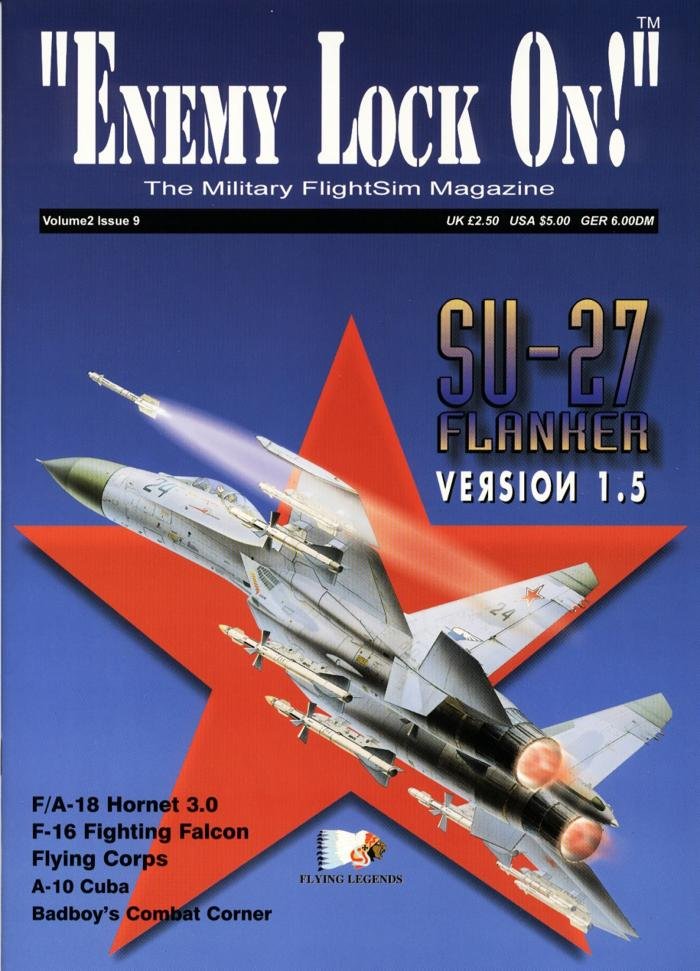
The front cover of Enemy Lock magazine from 1996.
The front cover of Enemy Lock magazine from 1996. Leonard ‘Flightdoc’ Hjalmarson

1995-1996​

In January 1995, the first issue of Enemy Lock On (ELO) was printed, a British magazine dedicated to military flight simulations. ELO sold by subscription-only and when it finally ended publication around 1998 the subscriber base exceeded 15,000.
1995 saw the release of Activision’s A-10 Cuba, Eric ‘Hellcats’ Parker’s excellent production. A-10 employed dated 256 colour graphics but had excellent flight, damage and physics modelling. The cockpit was the most detailed yet seen, with working instruments and clickable controls. This was probably the first clickable cockpit to appear on the PC.
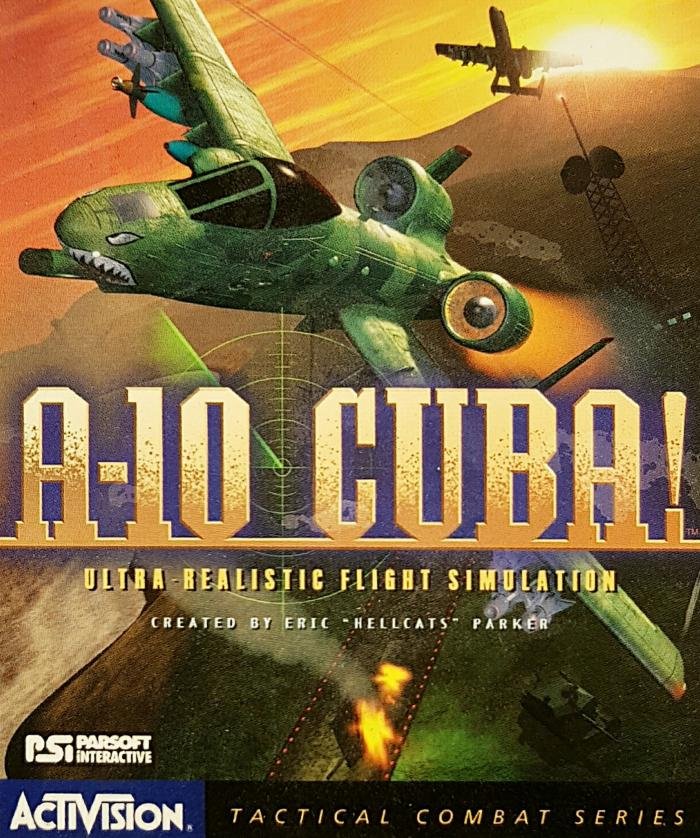
1995 saw the release of Activision’s A-10 Cuba.
1995 saw the release of Activision’s A-10 Cuba. Leonard ‘Flightdoc’ Hjalmarson
A-10 set the standard for physics for the next few years and I still remember the first time I landed an ailing Warthog on a single engine and single-gear strut and pirouetted down the landing strip.
EA (Electronic Arts) released Marine Fighters, based on the USNF engine. Origin jumped back in with a World War One title, Wings of Glory. The show was stolen, however, by DiD’s EF2000 and SSI’s Su-27 Flanker - the latter being the first native Windows 95 simulation.
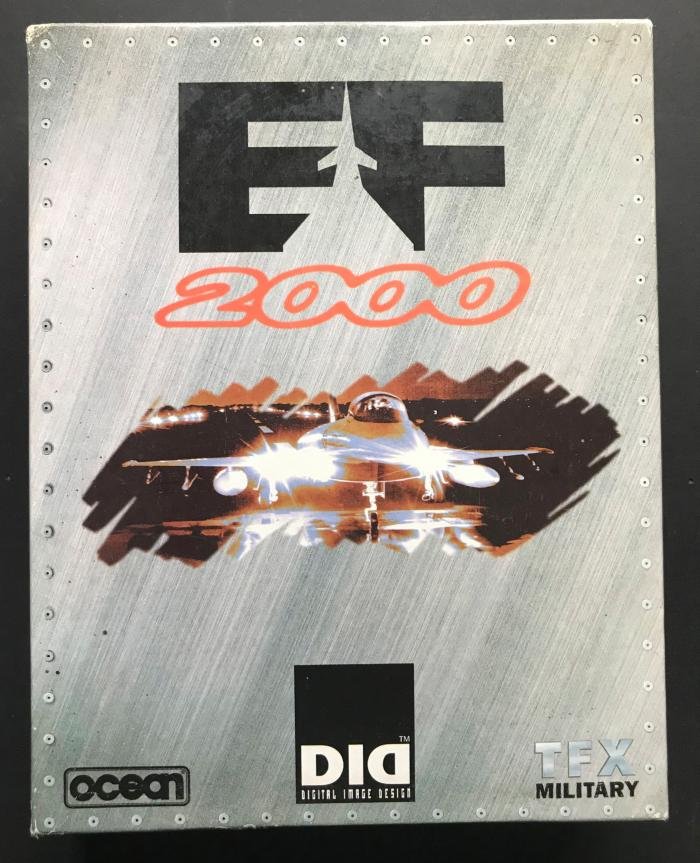
DiD’s EF2000 also set a new milestone in simulation design in 1996
DiD’s EF2000 also set a new milestone in simulation design in 1996 Leonard ‘Flightdoc’ Hjalmarson
Su-27 was designed by a Russian team and modelled systems and aerodynamics in great detail. Although it came with 256 colour graphics, which was becoming dated, no one seemed to care.
Su-27 developed something approaching a cult following and its multiplayer LAN features made it a popular simulation with online pilots. Virtual squadrons quickly formed around Su-27.
During the summer of 1996, Braveheart was released, a role that would vault Mel Gibson to legendary status. This story of leadership and courage in the face of oppression, told with bold strokes and in exquisite detail, dominated the movie scene that year.
DiD’s EF2000 also set a new milestone in simulation design in 1996. I penned these words for a review in a Danish gaming magazine back then:
“EF2000 is the best all-around modern military jet sim ever and will probably age very well. Sure, ‘Su-27’ has a fabulous flight model and ‘Back to Baghdad’ has some awesome avionics but who else puts it together with a dynamic campaign, a decent wingman command structure for good tactical play and incredible graphics? And the avionics in EF2000 can stand on their own, requiring dedication to learning the systems.”
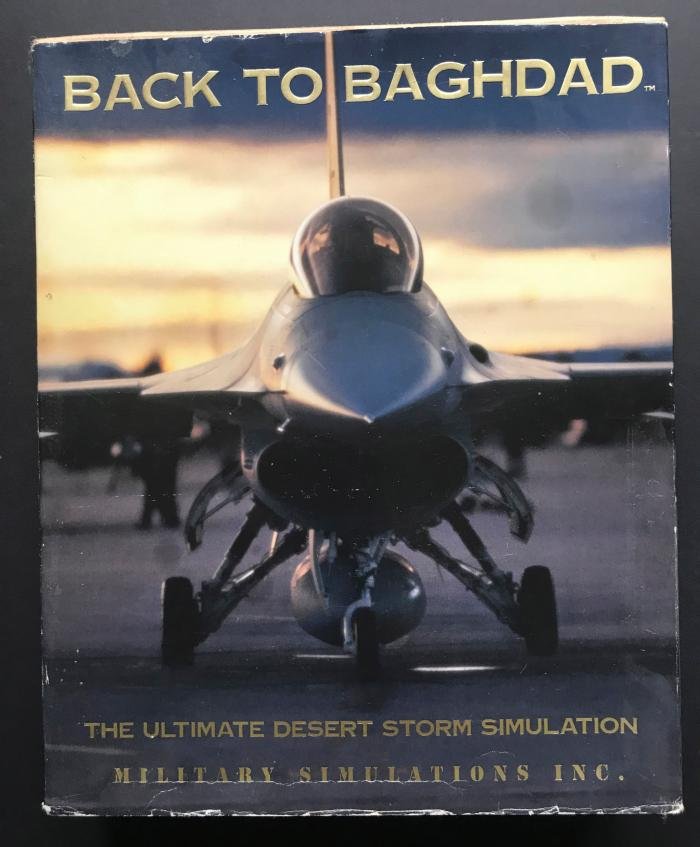
In 1996, MSI released Back to Baghdad - an F-16 simulation based on Desert Storm.
In 1996, MSI released Back to Baghdad - an F-16 simulation based on Desert Storm. Leonard ‘Flightdoc’ Hjalmarson
The campaign mode was incredible and multiplayer co-op single missions were supported. EF2000 defined ‘immersion’ and the ‘willing suspension of disbelief.’ It was the first simulation with a fully believable environment and won great critical acclaim.
EF2000 cheated somewhat on campaign dynamics but it was atmospheric and challenging. Like Su-27, it sported great LAN code and became an online favourite, causing some to remove the ageing Falcon 3.0 from their hard drives. Virtual squadrons sprang up worldwide devoted to multiplayer gaming with EF2000.
The minimum system requirements as specified on the original EF2000 box called for a 486 DX2/66 with 8MB of system memory. In order to run it with all graphics options at high resolution (640x480) and a good frame rate, a Pentium 90 with 32MB was the better option.
Around 1995 Electronic Arts struck a deal with Jane’s, of civil intelligence fame, to use their name on a new line of serious military simulations. Jane’s Combat Simulations was born, with Paul Grace and Andy Hollis (who produced Strike Eagle II and III) the primary personalities involved. And in 1995 Suncom released its lovely F-15 stick.
In January 1996 the first issue of PC ACE magazine appeared on newsstands and Thrustmaster released the F-22 Pro. Jane’s/EA released ATF, built on the USNF engine but proving more popular than USNF. MSI released Back to Baghdad, an F-16 simulation based on Desert Storm. Novalogic’s F-22 Lightning II hit the tarmac and Philips Media released Fighter Duel. Fighter Duel, a prop simulation, was specifically designed for multiplayer mayhem and was a landmark work graphically.
1996 saw the release of Andy Hollis’ first Jane’s title, Longbow. Dynamix released Silent Thunder (a flight simulation based around the A-10 Thunderbolt II), and Graphic Simulations released Hornet 3.0. Of these, the classic titles were Longbow and Hornet 3.0.
Longbow should fairly be identified as the first of the modern systems simulations (sometimes called ‘study’ sims). Longbow came with a thick manual covering the use of the various radar modes and weapon systems of the AH-64D helicopter. It required dedication to learn the systems, particularly when the battle got hot, not to mention making best use of your wingman for joint tactics.
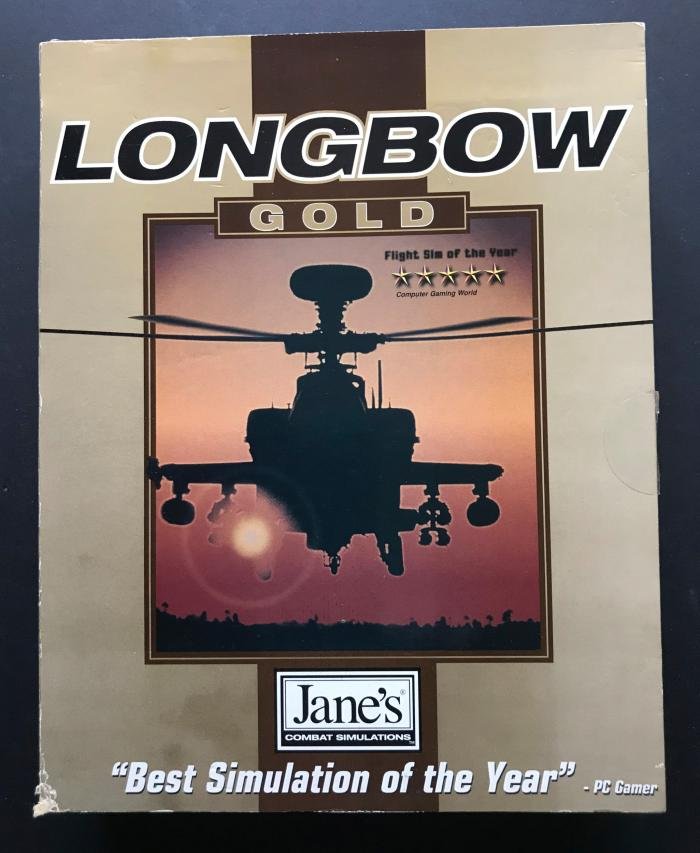
1996 saw the release of Andy Hollis’ first Jane’s title, Longbow; here we see the Gold version.
1996 saw the release of Andy Hollis’ first Jane’s title, Longbow; here we see the Gold version. Leonard ‘Flightdoc’ Hjalmarson
The steep learning curve was made easier by the first-ever virtual instructor. A voice narration led the player step by step through the systems in a series of training missions. The instruction required a response from the player, so it was only possible to move through the missions by actually responding to the instructor. Longbow featured a semi-dynamic campaign system that was immersive and convincing.
Hornet 3.0 was almost as challenging but was limited to 256 colours and so it didn’t look as good. Nevertheless, Hornet 3.0 was a realistic simulation of the weapons and targeting systems of the F/A-18 Hornet. The manual was written by an ex-naval aviator and the set of training missions were extremely well done. Unfortunately, the campaign was a series of individual missions and was not very immersive. Hornet 3.0 was released for both the Mac and the PC.
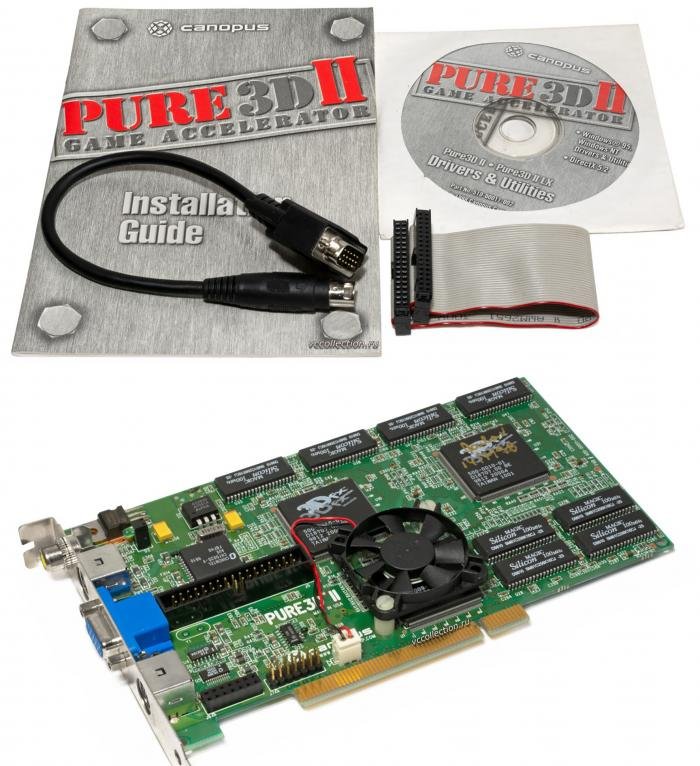
With the release of 3dfx - a dedicated 3D accelerator graphics card, in 1996, the graphical complexity of games leapt forward a generation. Here we see one example Pure 3D II.
With the release of 3dfx - a dedicated 3D accelerator graphics card, in 1996, the graphical complexity of games leapt forward a generation. Here we see one example Pure 3D II. Leonard ‘Flightdoc’ Hjalmarson
In 1996 3dfx released a dedicated 3D accelerator graphics card and suddenly the graphical complexity of games leapt forward a generation. Up to this point, memory on video cards was strictly framebuffer memory, with VGA boards sporting 512K of memory. There was no acceleration of texture rendering in 3D games, with the host central processing unit (CPU) doing all the work.
3dfx released its first ‘Voodoo’ board with 2MB of framebuffer memory and 2MB of texture memory. The additional framebuffer memory paved the way for higher colour depths at higher resolutions and the texture memory stored the surface images that are applied to the polygons that make up objects in games.
16-bit colour and 3D acceleration had arrived for the PC. Not long afterwards, EF2000 v.2 was released with 3dfx support. The difference was stunning and there was no going back.
By Leonard ‘Flightdoc’ Hjalmarson
Topics​

Read more about

Originally published in Key.Aero​


DCS FLIGHT PLANNING​

  1. DCS Flight Planning


18th September 2018
NEWS

DCS Flight Planning

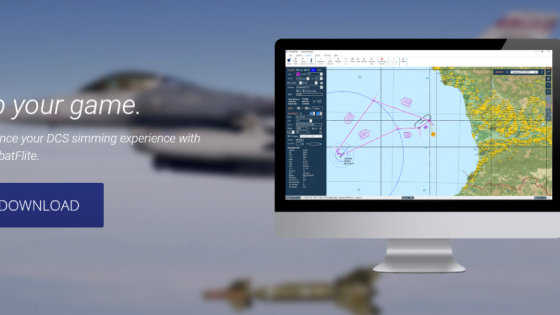
CombatFlite is a new utility that makes mission planning in DCS faster and easier. You can plan the entire mission, either single or multi player, and it export it to DCS.
Plan the entire mission
Insert user objects such as holding, refueling or AWACS orbits, CAPs, SEAD CAPs, or reference points. Create flight routes by snapping waypoints to airfields, nav points, reference points or orbit anchors. Move multiple overlaid objects together. Clone flights and/or organize them into packages. Navigational data are automatically calculated using an atmospheric model. Use advanced tools, such as inter-visibility plot or terrain and slope visualization. Mark important areas by polygons, circles or labels. Export as a DCS .miz file.
Let Blue and Red side leaders plan their flights separately. Send them to the Game Lead to merge them.
Send a CF mission file with a general situation (airspace, intel scenario) to the Blue and Red leader. Let them plan their side’s flights. Send the Blue and Red CF mission files back to the Game Lead, who will import the Blue and Red flights into a single CF mission. Export as a DCS .miz file and go fly!
Rehearse the mission – See the flights’ positions and check your timings.
Playback your mission using a timeline control tool. All important events, such as vulnerability times, on-station times and TOTs, are highlighted for easier overview. Hit play or move the slider and watch where the flights are in various phases of the mission. Or jump to significant events using the controls below.
Create a briefing pack with auto-generated briefing text.
Have the briefing text automatically generated. Add map snapshots, vertical route profiles, weather visualization, mission timeline, package flow, or any image to your briefing. You can export the briefing as a part of a .miz file, or as a stand-alone Rich Text Format (.rtf) file.
Generate kneeboards for mission data card, maps, custom images
When you’re done planning, generate a pre-filled customizable data card (with a navigation log, communication frequencies, package composition and more) and a route map. You can add custom images and insert the pack to your .miz file, print it or export it as .png files for use as a custom kneeboard.
Create custom data cartridge for the DCS AJS-37
You can easily export any route you have created as a flight plan to a custom data cartridge file for the DCS AJS-37 Viggen. You can then load it in-game and let the Viggen’s navigation system take care of the rest.
You can also import your ELINT data gathered in a DCS mission, identify the threats and have them visualized on a map.
Export and see objects at your DCS Ka-50’s ABRIS
You have the option to export flight plans, polygons, orbits, circles, reference points, nav points and other objects to your DCS Ka-50’s ABRIS system to have them on your moving map in-game! The ABRIS settings are injected directly to a .miz file of your choosing. Saves you time creating all that manually in the game. Greatly enhances your situational awareness.
CombatFlite is available for free as a 400MB download. Click here for more information.
Thumbnail

Key Aero online exclusive article​

Related articles​

  1. DCS: Normandy 2.0 interview
  2. DCS: Mirage F1 Enters Early Access
  3. DCS: MB-339 out now
  4. DCS: AH-64D Apache
  5. Eagle Dynamics’ DCS World 2.5

 
Just a friendly reminder, The DCS base game is still 100% FREE ! 2 free planes and a relevant region, given current ground realities, the Caucasus.

To view this content we will need your consent to set third party cookies.
For more detailed information, see our cookies page.


^not a high detail sim but still LOADOUTS of fun !

go for the FC 3 module next if you into it, and them the full modules once you have a good hang of it.
 

THUNDER IN THE AIR​

  1. Thunder in the Air
By Richard Benedikz 17th December 2019
NEWS
The DCS: JF-17 Thunder by Deka Ironworks is now available for download on the DCS World e-Shop and Steam.
The single-engine, multirole light fighter was jointly developed by AVIC Chengdu and Pakistan Aeronautical Complex (PAC). The maiden flight was made in August 2003, with the first delivery to PAF (Pakistan Air Force) in 2007. Currently, several different blocks of the JF-17s are in service with the Pakistan and Myanmar air forces. On February 27, 2019, the aircraft was tested in actual combat and secured a significant victory by the PAF.
It features a bubble canopy for excellent visibility along with advanced avionics. A KLJ-7 radar provides good air-to-ground capability while a WMD-7 targeting pod searches for targets. Although "Thunder" is small, it is one of the most advanced fighter jets in the DCS World.

Key features of the DCS: JF-17 "Thunder" include:
  • Nonlinear industry-level high fidelity 6DOF rigid-body flight model with real-life aerodynamic coefficients
  • Line-by-line real-life full authority longitudinal fly-by-wire system and lateral/directional control augmentation system with various modes and control law reconstruction on malfunction
  • Detailed aircraft exterior model with faded paint and oil residue
  • 6DOF cockpit. Three large MFCDs with an advanced HOTAS interface
  • Accurately simulated sub-systems: communication and navigation, fire control, store management system, electromechanical management systems, air data, DTC card, warning system, defence system, hydraulic, pneumatic, electrical, environment conditioning, oxygen, external/cockpit light, power plant control, zeroizer, eject seat and g-suit system
  • Failure simulation: the module has over 200 system malfunctions and more than 100 damage partitions covering near 100 on-board devices; mutual malfunction effects between systems are also simulated
  • KLJ-7 radar can track 10 targets and attack two targets at the same time. KLJ-7 can also search/track surface (ground and sea) moving targets
  • Advanced stand-off attack capability: including LS-6 and GB-6 glide bombs, C-802AK anti-ship missile and CM-802AKG Man-In-the-Loop (MITL) missile
  • WMD-7 targeting pod can be used to search/track surface targets, identify air targets and provide guidance for laser-guided weapons
  • Advanced electronic warfare system: including chaff/flare dispense systems (OESP), KG-600 self-protect jamming pod that can locate radiation source and missile approach warning system (MAWS) installed on the tail
  • On-board datalink supports battlefield situation sharing between JF-17s and between AWACS
  • Detailed radio command options for ground crew interactions
  • Player-friendly configurations in Special Option
  • Air to air refuelling capability (Plan to add later)
  • Campaigns for JF-17 in the Caucasus theatre (TBD).
PreviousNext

Topics​

Read more about

Originally published in PC Pilot Magazine​

View attachment 21102View attachment 21103
The new Afghanistan map will be coming from Eagle Dynamics. PAF (or at least off duty members and enthusiasts) is gonna be all over that.

To view this content we will need your consent to set third party cookies.
For more detailed information, see our cookies page.


But at first, just “Halfganistan”
To view this content we will need your consent to set third party cookies.
For more detailed information, see our cookies page.
 

WAR THUNDER INTERVIEW​

  1. Aviation Features
  2. War Thunder Interview


By Derek Davis 9th February 2022
FEATURE

Gaijin talk to PC Pilot about their premier online combat simulation​

War Thunder is a hugely popular multiplayer and multivehicle online simulation. We first reviewed War Thunder back in Issue 88, but in that time, it has been further developed and improved upon. So, with that in mind, we thought it was time to revisit this product to see what has changed since its initial release and invited its producer, Gaijin, to talk to us about War Thunder and how it has changed over the years.

War Thunder Interview


Who are Gaijin?
PC Pilot: Hi, thanks for agreeing to take part in this Q&A to discuss the highly popular War Thunder online franchise. May I start by asking you to tell us a little about Gaijin? How did the company get started and what are its main aims, company ethos and structure?
Gaijin: The company was founded in 2002 by Anton Yudintsev and Kirill Yudintsev, originally developing games for the set-top box devices under contract with US-based Zodiac Games. The first major video game made by Gaijin was Adrenaline, a fastpaced racing game for PC and the award-winning IL-2 Sturmovik: Birds of Prey simulation game established our brand on the console market. The turning point in the history of the company was the release of the company's biggest hit, War Thunder, a massive military online simulation game.
Right now, Gaijin Entertainment is an independent developer and publisher of online games and is headquartered in Budapest, Hungary. While the company is known now for online games (War Thunder, Crossout, Enlisted, CRSED: FOAD, Star Conflict), Gaijin also has experience of producing singleplayer titles including Apache Air Assault, IL-2 Sturmovik: Birds of Prey and the Blades of Time action game.
The company has several hundreds of employees scattered around Europe, working mostly from their homes after the Covid outbreak. Gaijin is still led by mostly the same team, including founders who are deeply involved in the actual game development process themselves.
We have a horizontal company structure and that means that any employee can easily give their input in any part of the game production and the decision-making process is extremely fast. For example, one day we heard that US Army tankers were using War Thunder to train because their real vehicles were unavailable due to the Covid quarantine. It took us a few days to create a special mode in War Thunder for members of any military (or anyone else) to use for this purpose.
Much time is spent on getting the external detailing of every aircraft as accurate as possible.

Much time is spent on getting the external detailing of every aircraft as accurate as possible.
War Thunder – concept, design and structure
PC Pilot: How did the concept for War Thunder come about?
Gaijin: We were exploring ways to bring flight simulation games to a mass audience. After the release of IL-2 Sturmovik: Birds of Prey on consoles, we created a few other simulation titles including Birds of Steel and Apache: Air Assault. Throughout these years, we were also thinking how to make the genre accessible to a general PC audience. Back in those days, good flight sims were only fun to play with dedicated hardware such as flight sticks, TrackIR etc, and that was just not going to work in attracting an audience as the entry barrier was prohibitively high. At the same time, fun and easy to play ‘arcade’ games at that time had nothing to do with real vehicles, they were really not providing any immersion.
So, after literally years of experimenting we came up with an idea of ‘mouse-aim’, which has proved to be the key. It required only a mouse and keyboard and yet didn't make any compromises in vehicle physics itself. Players could play with very intuitive, almost shooterlike controls and our prediction/simulation engine adjusted real aircraft controls (eg ailerons and rudder) in order to aim the plane in the ‘desired’ direction. We received a patent for this invention and nowadays other companies license it (such as 1C Games Studios, which developed IL-2 Sturmovik).
The introduction of the free-to-play model was the obvious step - we tried to open skies to as many gamers as possible. Again, in those times it was the public perception that flight sims were ‘hard’ and required dedicated equipment, so free-to-play was the answer to overcome this bias.
The aircraft in War Thunder encompass those from the 1930s all the way up to the 1980s. Here we see the MiG-21 which first saw service in the late 1950s.

The aircraft in War Thunder encompass those from the 1930s all the way up to the 1980s. Here we see the MiG-21 which first saw service in the late 1950s.
We therefore planned War Thunder as an online game about World War Two-era military aircraft. After the announcement we realised that we could bring ground vehicles and warships into a battle to provide the unique experience of real war, with air, naval and ground units fighting together on the same battlefield. The War Thunder concept gradually evolved even further from there, and now we are basically making an all-encompassing military simulation game that includes everything from World War One-era battleships to modern anti-air vehicles.
War Thunder includes a wide range of World War Two aircraft types from all nations - including the iconic Focke Wulf Fw 190.

War Thunder includes a wide range of World War Two aircraft types from all nations - including the iconic Focke Wulf Fw 190.
PC Pilot: Can you describe the design and structure of War Thunder?
Gaijin: The game has three realism levels. The faster and more accessible Arcade mode is more suitable for the general gamer audience, while the Realistic and Simulation modes are made for hardcore simulation fans.
The controls in the game are very intuitive and it’s possible to fully control the aircraft using keyboard and mouse only (though the game does support flight controllers).
No matter which mode a player prefers and what he uses to control the aircraft, the flight and damage models in War Thunder are always realistic, with all aspects of the aircraft thoroughly simulated (with some simplifications in arcade battles, like no stalls and with completely no compromises in simulator battles).
All military vehicles in the game are divided into five huge groups: ground vehicles, aircraft, blue-water navy, coastal navy and helicopters. They are also divided by nation: US, USSR, Germany, Italy, France, UK, Japan, China, Israel and Sweden. Players start with early machines and progress to more advanced ones by participating in battles and earning experience points. There are some rare vehicles that are only available as premium machines or as a reward for time-limited events but they do not make their owners more powerful on the battlefield. Each time a battle starts, the matchmaking system matches players with more or less similar-performing vehicles.
This striking shot shows the F-104G Starfighter –a second-generation jet which saw service with a number of different countries.

This striking shot shows the F-104G Starfighter –a second-generation jet which saw service with a number of different countries.
War Thunder’s target audience
PC Pilot: Who would you say is your main target audience?
Gaijin: Most of our players are military history and military vehicles enthusiasts. Some of them even work on User-Generated Content (UGC) for the game such as historical vehicle skins, vehicle models and user missions.
The other source of new players are dedicated video game fans. Basically, they are ‘Call of Duty’ or ‘Battlefield’ players who would like to try something closer to real war and something different overall. Such people are easily fascinated by the grim beauty of the steel machines of war and the unique experience of a fight between them.
PC Pilot: Where do you think War Thunder sits in relation to other combat flight simulators, such as DCS World and IL-2 Sturmovik, in terms of tone, design and fidelity?
Gaijin: While we do love DCS and the original IL-2 Sturmovik (and we developed the console game IL-2 Sturmovik: Birds of Prey!), our game is much bigger in almost every aspect, be it in the number of players, maps, vehicles or game modes. The key to that success is that we made the simulation games interesting for the general gaming audience by making controls intuitive and the graphical effects on a par with modern AAA games. One of the most important aspects is that our game provides the unique experience of ground vehicles and aircraft or ships and aircraft fighting together. War Thunder is also a cross-platform title available on previous generation and current generation consoles, with all players fighting together on the same servers, as opposed to other simulation games that are usually made for PC only.
First-generation jets, such as this MiG-15, are also included in War Thunder.

First-generation jets, such as this MiG-15, are also included in War Thunder.
 
PC Pilot: How many flyable aircraft are included in the simulation and how would you describe the level of fidelity in terms of systems and flight modelling?
Gaijin: There are over 1,000 aircraft and helicopters in the game, with new ones being added in each update. They look and fly like they are supposed to according to the available documentation. We consult with real pilots who flew the original machines whenever possible and update the flight model accordingly; for example, we recently did this with the Soviet Sukhoi Su-7 attack jet and the Italian Agusta A129 Mangusta helicopter. Most aircraft have a fully simulated HUD with all the instruments operating exactly like they should in real life.
Helicopters were first introduced into War Thunder in 2018.

Helicopters were first introduced into War Thunder in 2018.
Aircraft, graphics, flight models, systems and damage modelling
PC Pilot: Please tell our readers about the types of aircraft that can be flown in War Thunder and what periods in aviation they cover.
Gaijin: War Thunder aviation currently starts with 1930s aircraft and progresses all the way to Vietnam war-era jets and some aviation from the 1980s. For example, the most advanced aircraft in the US tree are F-4 Phantom II and A-7 variants. Each game update brings newer and newer aircraft to the game, so eventually more modern aircraft would be in the game as well. There are many aircraft types, such as fighters, attack aircraft and bombers, as well as helicopters.
Here we see the RAF’s Gloster Meteor, a first-generation jet; which first saw service in 1944.

Here we see the RAF’s Gloster Meteor, a first-generation jet; which first saw service in 1944.
PC Pilot: In terms of the individual aircraft, can you describe the work involved in producing both the internal and external graphics.
Gaijin: Initially, we make lists of aircraft and their specific modifications and decide when they should appear in the game. After that, the information collection period begins. Our historical consultants collect all available information that may be required to recreate a visual model of an aircraft, its flight characteristics, systems and weapons. This period can take several weeks and the result is a huge document thoroughly describing a real aircraft, as well as a set of visual references such as photos, diagrams, drawings and technical documentation like monographs and manuals.
After that, we proceed to create two parts of the aircraft which are an exterior model and a cockpit model. Usually this is done by two different teams of modellers whose work is supervised by our technical artists, who constantly analyse the stages of work and leave comments on errors that need to be corrected. The exterior model and the cockpit take an average of two to four months of work.
PC Pilot: Similarly, please explain the work involved in producing the flight models for the individual aircraft and how you would describe the level of fidelity.
Gaijin: At first, we collect all the available technical documentation for the aircraft, from flying instructions to repair manuals. Later, we collect various reports on the field tests. Based on the information we get, the basic flight characteristics of the aircraft are formed (speed, climb rate, roll rate, stall speed on a clean wing and with flaps).
At the next step we look at wind tunnel airflow results. Ideally, we use not only the drag polars of the whole aircraft but also of its individual parts including wings, empennage and fuselage. Unfortunately, sometimes it is impossible to get such polars. In this case, we use the well-known polars of the shapes that are used on the aircraft. For example, when we know that the aircraft uses the NACA-230 airfoil shape, we can use graphs for it (fortunately, there are many of them).
When all the basic flight characteristics of an aircraft or a helicopter are in place, we proceed to fine-tune the behaviour of the aircraft in various flight modes such as low speeds, high speeds, behaviour in manoeuvres, to match the information on the real model we have. With this approach, it is possible to create a flight model with very good accuracy.
PC Pilot: Does War Thunder model the individual systems of each aircraft?
Gaijin: Yes, this is why all our aircraft are unique. We simulate various internal systems that can affect gameplay, including various weapons systems, radar, RWR, FCS, countermeasures like chaffs/flares and others.
The radar is also simulated very thoroughly. There are a lot of factors to account for, such as reflections from the ground, the type of signal, the size of the search area, as well as different modes of operation like search, target lock and target tracking.
War Thunder features a realistic and complex damage model that takes into account a large number of individual elements.

War Thunder features a realistic and complex damage model that takes into account a large number of individual elements.
PC Pilot: In terms of combat damage modelling, how is that calculated and modelled within the simulation?
Gaijin: Each military vehicle in the game, be it an aircraft, a ground vehicle or a ship, has a complex damage model that takes into account a large number of individual elements including hull elements, various internal parts, armour elements, crew members and ammunition racks. Each of these modules has a separate 3D model and a set of parameters including the thickness of the material, the type of material and the amount of damage required to disable the module. On the other hand, any projectile in the game, even a single bullet, also has dozens of parameters including the type of ammunition, the type of damage (eg kinetic, high-explosive, fragmentation, incendiary, cumulative, explosively formed penetrator), physical parameters including speed, mass, calibre, aerodynamic coefficient, on-board fuel (in the case of guided and unguided missiles) and fuse type (contact fuse or proximity fuse, sensitivity, detonation distance after arming). And when the projectile finds its target, the impact is calculated taking into account all these parameters. In fact, there are many more of them than we have listed.
For aviation, the degradation of flight characteristics is simulated based on the damage to the airframe. For example, when a shrapnel projectile hits the left console and damages the sheathing, the lifting force decreases and the aircraft receives a roll. We even simulate a possible hit of a projectile on a bomb or a rocket flying in the air, as well as a collision of two missiles. So, War Thunder players can destroy the aircraft that dropped the bomb by shooting at and detonating this very bomb, and such situations do happen!
Players regularly send us replays and videos of such battles. Moreover, a bomb in flight can accidentally (or intentionally) hit another aircraft and break off its wing, just like in real life, eg in this famous video involving a B-24 Liberator:
To view this content we will need your consent to set third party cookies.
For more detailed information, see our cookies page.
.
Such a detailed damage model allows the players to experience many different situations in the game, as each hit of a projectile on a vehicle is unique.
Unlocking new aircraft and mission types
PC Pilot: When it comes to progressing to better and higher performance aircraft within the simulation, please describe to our readers how this is achieved within War Thunder.
Gaijin: In order to progress through the game, a user just plays it using available aircraft to earn research points that are used to unlock newer machines and upgrade them with better equipment. This way, a user gradually progresses through the selected nation’s tech tree and experiences several eras of military aviation.
PC Pilot: Can you tell us about the types of missions that are on offer: for example, training missions, single missions and campaigns? Does War Thunder have different game modes and if so, could you describe these?
The core modes (Arcade, Realistic and Simulation) of War Thunder are about one team of human players fighting against another .

The core modes (Arcade, Realistic and Simulation) of War Thunder are about one team of human players fighting against another .
Gaijin: The core modes (Arcade, Realistic and Simulation) of War Thunder are about one team of human players fighting against another. There are air-only and air-plus-ground battles like this.
There are also training missions and single-player missions and campaigns but they mostly serve as the place to get some experience before heading out against other players online.
There is also a World War mode where some players (serving as commanders) move armies on a strategic map and order squadrons to go into battle, while other players get inside their aircraft to fight in these player-initiated missions.
PC Pilot: What advice would you give to newcomers to War Thunder with regards to how they should approach and get into the simulation?
Gaijin: Take your time and play tutorial matches and then pick one nation you’d like to unlock and focus on it. It’s probably good to start playing in Arcade mode and move to Realistic only and when you feel that you’re ready for some more hardcore action.
But also do not stick with one nation or vehicle type forever. Try others! While it is better to start and try to progress with the first one, using one nation and one vehicle type alone will only give you 5-10% of the available and possible experiences.
You can also watch YouTube guides. These can help you to get to some hidden gameplay treasures and have even more fun.
PC Pilot: Does War Thunder include AI aircraft or is it purely human players?
Gaijin: Most of the time players fight against each other, but there are some AI machines in some of the missions, ie targets that need to be taken down according to the mission scenario. Single player and training missions obviously use AI aircraft.
Although most of the time players fly with and against each other, some of the missions include AI aircraft.

Although most of the time players fly with and against each other, some of the missions include AI aircraft.
Major developments, sound and scenery
PC Pilot: Since its initial release, in November 2012, War Thunder has been progressively improved and developed. Tell us about some of the major improvements and developments that have been made to War Thunder over the years.
Gaijin: Open beta test of ground vehicles in 2014, the introduction of jets and helicopters in 2018 and the New Power update with new game engine and battleships in 2020 are probably the most important ones.
PC Pilot: Sound is an important aspect of any simulation. Can you describe the work that has been done in this area? For example, are the engine sounds unique to each aircraft or are they more generic?
Gaijin: We record real vehicle sounds or find the original recordings whenever possible to make sure they sound right in the game. If that’s not possible, we study which engine is used in the aircraft and find the sound when used in a different aircraft, or make an educated guess based on what we know of the technology of that era. We also consult with people who actually flew those aircraft.
PC Pilot: In terms of scenery, is the landscape modelled on specific geographic locations or is it more generic in nature?
Gaijin: Our locations are usually highly influenced by specific geographic locations from all over the world but they do not fully recreate them because we need the map to work best gameplay-wise. For example, there is a nice Japanese village in the game, where buildings and the landscape look quite authentic but it’s not a specific place that you can find on a real map.
The addition of helicopters to War Thunder enhanced both the immersion and battlefield experience for the player. Here we see the formidable Mil Mi-24 Hind.

The addition of helicopters to War Thunder enhanced both the immersion and battlefield experience for the player. Here we see the formidable Mil Mi-24 Hind.
War Thunder’s unique qualities and future plans
PC Pilot: What do you think makes War Thunder unique compared to other flight simulations – particularly those focused on the multiplayer arena?
Gaijin: War Thunder is unique because it features realistic flight and damage models but the controls and overall gameplay are well suited for novice players and provide a really fun experience for everyone.
PC Pilot: Can you tell us about any future plans and developments you have for War Thunder?
Gaijin: We usually release five major updates per year. Each of them brings dozens of new war machines, some maps, visual and gameplay improvements. We do not disclose the content plan beforehand so as not to spoil any surprises but we can reveal to you that fourth-generation fighter jets are finally coming to War Thunder in 2022.
PC Pilot: Many thanks for taking time out of your busy schedule to answer our questions and we wish you every success with the future of War Thunder.
Gaijin: We hope you and your readers will enjoy the game!
By Derek Davis

Topics​

Read more about

Originally published in PC Pilot Magazine​

 
DCS F-4 Phantom | Using Jester in Aerial Engagements
To view this content we will need your consent to set third party cookies.
For more detailed information, see our cookies page.
 
Flown/played all of them - starting at age 5 on the orignal Microsoft flight simulator. To unknowns like Su-25 frog foot, TFX then Falcon series and the epitome in Falcon 4.

Still do today
Have winwing F-16 block 60 throttle - one Orion 2 regular with a F-18 grip for regular flights and a Orion 2 MFFSB(pressure sensor) with F-16 grip for the viper. MFDs and a HP Reverb for VR.

Unfortunately, never got into multiplayer.
Why not in multiplayer? There are Pakistani groups in DCS
 
Still do today
Have winwing F-16 block 60 throttle - one Orion 2 regular with a F-18 grip for regular flights and a Orion 2 MFFSB(pressure sensor) with F-16 grip for the viper. MFDs and a HP Reverb for VR.
setup pics please !
 
helos are tough to fly with fixed wing controllers, need one of those, and please forgive my lack of knowledge and memory fail, but .. handbrake type thing with a motorcycle throttle.. cyclic control something ? .. need that for a good experience helo simming.

also, TrackIR is an absolute must for immersion when peeping over the hud thingy when coming in to land on certain aircraft types.. and a must for taildragger takeoffs. For max immersion anyway.
 

Users who are viewing this thread

Latest Posts

Back
Top