Navigation
Install the app
How to install the app on iOS
Follow along with the video below to see how to install our site as a web app on your home screen.
Note: This feature may not be available in some browsers.
More options
Style variation
You are using an out of date browser. It may not display this or other websites correctly.
You should upgrade or use an alternative browser.
You should upgrade or use an alternative browser.
Flight Simulations
- Thread starter Fatman17
- Start date
More options
Who Replied?






Fatman17
Moderator
- Thread starter
- #22
DEKA IRONWORK SIMULATIONS’ DCS: JF-17 THUNDER
- Expert Aviation Reviews
- Deka Ironwork Simulations’ DCS: JF-17 Thunder
By Chris Frishmuth 18th February 2020
REVIEW
A new lightweight, single engine, multi-role combat aircraft for DCS World
Back in early 2017, Deka Ironwork Simulations started teasing a module in development for DCS World – the JF-17 Thunder. Over the ensuing two years, further development tidbits were shown that proved Deka intended to field a serious, study-level module for DCS World and enthusiasm for the project rippled outward. Deka had already shown its modelling prowess by collaborating with Eagle Dynamics (developer of DCS World) to release its China Asset Pack which introduced the J-11A (based on a modified Su-27), ships, missiles and other China-specific military hardware. The China Asset Pack became part of the core DCS World. In early December 2019, Deka released the JF-17 into Early Access and though the module wasn’t ‘hyped’ to levels we’ve seen before from other developers, the JF-17 has been roundly praised for its completeness and quality even while marching under the somewhat nebulous banner of Early Access.
The JF-17 is an absolute assassin when loaded with a pair of BRM-1 laser-guided rocket pods and laser-guided bombs.
JF-17 – what is it?
You are excused for not knowing exactly what a JF-17 is, particularly in the West where we tend to focus a bit too much on our own marvels. The JF-17 Thunder is a lightweight, single-engine, multi-role combat aircraft that was a collaborative project between the Pakistan Aeronautical Complex (PAC) and the Chengdu Aircraft Corporation (CAC) of China. Technically known as the JF-17 by Pakistan (Joint Fighter-17) or the FC-1 Xiaolong in China, the JF-17 represents an interesting newcomer to the battlefield of DCS World. The history of the development of the real JF-17 could encompass a complete article to itself but after a twisting route of initial design goals, investments, development, and sanctions, the JF-17 was borne via a partnership between Pakistan and China, with a bit of Russian Mikoyan thrown in for extra seasoning. Just looking at the JF-17 leaves one scratching one’s head – does it resemble an F-16? An F-20 Tigershark? A MiG-21? The answer, of course, is yes – all of them. It is as if the JF-17 design team sat down in a room and decided to pick and choose features from a wide array of aircraft to create a unique airframe that looks different, yet familiar.
The JF-17 Thunder confuses the brain as it appears to be an amalgam of design choices from the past, present and future.
In the end, the final design features a single Klimov RD-93 afterburning turbofan, the same engine that powers the MiG-29, a cannon from the MiG-21, and avionics, HUD and HOTAS that borrow heavily from the F-16. Hardpoints for both air-to-air and air-to-ground weapons, a sensor pod and an electronic countermeasure pod give the JF-17 a true multi-role capability. Thus far, Pakistan has fielded more than 100 JF-17s. It is unknown if, or how many, FC-1 aircraft China has elected to integrate into its air force (PLAAF), although signs point to them not utilising it and instead using it as an export product.

The single Klimov RD-33 turbofan is the same engine that powers the MiG-29.
Cockpit
Deka has done an extraordinary job with the detailing, geometry and textures of the JF-17 cockpit. Dominated by three gorgeously textured 8” x 12” LCD Multi-Function Coloured Display (MFCD) panels, the cockpit has a modern and streamlined feel to it. Surrounding each MFCD are Option Select Buttons (OSBs) that allow pilots to navigate the menus and settings of each MFCD. The MFCDs are able to display: Horizontal Situation Display, EFIS (Electronic Flight Instrument System), Datalink, Data with eight sub-pages pertaining to items such as navigation data, fuel, engine, weapons release parameters, Radar, Inertial Navigation System, TACAN, Approach settings, Targeting Pod, Stores Management, Built-In-Test and Failures. The lower third of each MFCD can also display Airfield Data, Stores Management and Engine and Aircraft Systems indicators. Much of the data is tied, accessed, edited or input via the centrally mounted Up-Front Control Panel (UFCP). On first glance, the JF-17 panel layout bears a striking resemblance to an F-16 cockpit, particularly the F-16 Block 60 and ‘IN’ variants.
Cockpit geometry, textures and functionality are fantastic.

Night vision goggles provide additional capability for night ghting.
With the Deka JF-17 in Early Access, at time of going to press, there were only a couple of training missions (Cold and Dark and Navigation) and 17 Quick Start missions that provide for self-guided exploration of different sensors and weapons. To realise the full potential of the JF-17, it will be imperative that Deka develops a rigorous set of training missions to showcase its module. The word on the street is that Deka was waiting on completion of a few more features before diving into the laborious process of building training missions with the mission editor. That said, this reviewer had a fantastic time exploring the JF-17 with the quirky Deka-authored JF-17 Thunder Quick Guide in hand as well as the incredibly useful user-created ‘Chuck’s Guide’ to the JF-17, published by flight-sim community super-star Charles “Chuck” Ouellet.
Beyond the MFCD panels, the side panels provide more traditional switches, knobs and buttons to manage JF-17 systems such as the radios, lights, environmental system and systems that are more often used prior to and after combat. The cockpit ergonomics are well thought out and it is one of my favourite aircraft to fly using my virtual reality headset.

Fatman17
Moderator
- Thread starter
- #23
The WMD-7 targeting pod is excellent for identifying targets, slaving sensors and guiding precision weapons. (View through HP Reverb VR headset)

Though equipped with all manner of precision-guided weapons, the JF-17 can also deliver an impressive load of conventional munitions in a more traditional manner.
The standout weapons include the BRM-1 rocket pods, each holding 18 laser-guided (beam riding) 90mm rockets capable of destroying enemy armour. In my testing, a single 90mm rocket was capable of destroying a main battle tank from a rear or top aspect, while two missiles are necessary to destroy a tank when attacking through the thick frontal armour. With a pair of 90mm rocket pods, the JF-17 has the ability to destroy up to 36 targets with precision targeting. The C-802AKG is an extremely satisfying missile to employ in its various modes. The C-802AK and AKG are cruise missiles that allow for long-distance targeting, with a unique ability to control the AKG via a datalink pod that enables the pilot to see and steer the missile from over 100km away as the view from the missile is broadcast to the MFCD display in the cockpit. The SD-10 active radar-homing missile can be carried on racks of two under each wing for a total of four missiles. The performance of the SD-10 has stirred some vigorous debate online as it seems to have shown some impressive performance against the AMRAAM and Russian R-77. Missile dynamics continue to be an area of close scrutiny and improvement by Eagle Dynamics.

The JF-17 cockpit is clean and modern with three multi-function displays, an up-front-control panel and HUD providing excellent integration and control of many aircraft systems.

The long-range, active radar-guided SD-10 air-to-air missile provides a good counterbalance to the AIM-120C AMRAAM and Russian R-77.
The Klimov RD-93 in afterburner outputs about 19,200lb of thrust while the JF-17 with full fuel and no weapons comes in at 19,820lb – so nearly a 1:1 thrust ratio in that configuration. Internal fuel load is 5,126lb while additional 1,100-litre tanks can be mounted on wing hardpoints along with an 800-litre centreline fuel tank for a total maximum fuel load of 10,997lb. In afterburner, the RD-93 consumes around 41,600pph (pounds per hour), so sustained flight in afterburner can dramatically affect your combat radius. Flown gingerly, with a fuel- conserving profile, I was able to climb at 300 knots to 30,000ft and maintain a Mach .80 cruise with a fuel flow of only 3,180pph. If loaded with maximum fuel, a theoretical endurance of three to four hours should be possible. Deka has indicated that air-to-air refuelling capability will be added later in development.

A multitude of night lighting options provides plenty of illumination for night fighting.
Take-off and landing performance is also quite good. Over the range of mid to maximum weights, take-off distance was measured between 910ft to 2,250ft using afterburner and take-off flaps. Similarly, landing distances, with the assistance of the braking parachute and heavy braking, ranged from 1,580ft to 2,126ft over the span of probable landing weights. The HUD display in the landing configuration makes for easy on-speed adjustments with a velocity vector and ‘E’ bracket to help maintain the proper angle of attack. Nosewheel steering provides for good ground manoeuvring once you are at low speed.

A braking chute further reduces the landing roll of the JF-17 allowing for very short-field operations.
Developer: Deka Ironwork Simulations
Download Price: $79.99 (£61 approx)
Website: www.digitalcombatsimulator.com
Flight Model: Excellent
Graphics: Excellent 90
Documentation: Poor
Systems: Excellent
PC Pilot Score: 90
Weapons
As a multi-role aircraft, the JF-17 must carry a wide array of weapons – and it does. The mix of weapons includes free-fall bombs, precision-guided weapons, data-linked missiles, rockets and air-to-air missiles. The complete list of air-to-ground ordnance: GBU-10/12/16 laser-guided bombs, Mk-82/83/84, Mk-82 Snakeye, Mk-20 Rockeye, rockets (90mm laser-guided, unguided and 2.75”), C-802AK anti-ship missile and CM-802AKG TV-guided missile, C-701 TV-guided missile, LD-10 anti-radiation missile and the GB-6 glide bomb. On the air-to-air side, the JF-17 carries the long-range SD-10 active radar-homing missile (similar to the AIM-120 AMRAAM) and the short-range, infrared, heat-seeking PL-5EII missile (similar to the AIM-9M Sidewinder). For both air-to-air and air-to-ground work, the JF-17 carries an internal 23mm GSh-23-2 twin-barrel cannon.
Though equipped with all manner of precision-guided weapons, the JF-17 can also deliver an impressive load of conventional munitions in a more traditional manner.
The standout weapons include the BRM-1 rocket pods, each holding 18 laser-guided (beam riding) 90mm rockets capable of destroying enemy armour. In my testing, a single 90mm rocket was capable of destroying a main battle tank from a rear or top aspect, while two missiles are necessary to destroy a tank when attacking through the thick frontal armour. With a pair of 90mm rocket pods, the JF-17 has the ability to destroy up to 36 targets with precision targeting. The C-802AKG is an extremely satisfying missile to employ in its various modes. The C-802AK and AKG are cruise missiles that allow for long-distance targeting, with a unique ability to control the AKG via a datalink pod that enables the pilot to see and steer the missile from over 100km away as the view from the missile is broadcast to the MFCD display in the cockpit. The SD-10 active radar-homing missile can be carried on racks of two under each wing for a total of four missiles. The performance of the SD-10 has stirred some vigorous debate online as it seems to have shown some impressive performance against the AMRAAM and Russian R-77. Missile dynamics continue to be an area of close scrutiny and improvement by Eagle Dynamics.
The JF-17 cockpit is clean and modern with three multi-function displays, an up-front-control panel and HUD providing excellent integration and control of many aircraft systems.
Sensors
Of course, weapons are only as good as the targeting system that assists in their delivery. The JF-17 features the KLJ-7 radar capable of tracking ten targets and engaging two simultaneously. Ground- and sea-moving target and ground mapping are also available using the KLJ-7. For ground attacks, the WMD-7 CCD/IR targeting pod provides good target ID capabilities and target designation for laser-guided weapons. Two zoom levels allow for a wide or narrow field of view with a maximum zoom level that is adequate for identifying targets beyond 20 miles depending on the target size and type. A Radar Warning Receiver (RWR) indicates when you are being hit by search or tracking radars, providing a bearing and classification (lethal/non-lethal) along with aural and visual warnings. Countermeasures include flares and chaff, as well as a KG-600 Self-Protection Jammer pod. Adherents to the theory of the best defence being a good offence can rest easy knowing that the JF-17 can also carry up to four LD-10 anti-radiation missiles that can be sent up to 40nm downrange to destroy radar emitters such as surface-to-air missile radars. I’ve barely brushed the surface of the capabilities of the sensors but know that the JF-17 can survive even against more capable platforms in DCS World.
The long-range, active radar-guided SD-10 air-to-air missile provides a good counterbalance to the AIM-120C AMRAAM and Russian R-77.
Flight model
The flight model is advertised as a “nonlinear industry-level high-fidelity 6DOF rigid-body flight model with real-life aerodynamic coefficients”. I can only assume all of those words mean something good. Regardless, the JF-17 does ‘feel’ really, really good. The JF-17 is snappy, fast and manoeuvrable at light weights with minimal ordnance and a bit of a lumbering, draggy beast when loaded to maximum weight. Fly-by-wire control with augmentation systems allows for ham-fisted flying without too much danger of losing control. Turning off the augmentation system can lead to some interesting out-of-control moments but stability can be restored by flipping the switches back on. During one flight with the Flight Control System (FCS) turned off, I attained a flat spin with a yaw rate of a bit over 100° per second.The Klimov RD-93 in afterburner outputs about 19,200lb of thrust while the JF-17 with full fuel and no weapons comes in at 19,820lb – so nearly a 1:1 thrust ratio in that configuration. Internal fuel load is 5,126lb while additional 1,100-litre tanks can be mounted on wing hardpoints along with an 800-litre centreline fuel tank for a total maximum fuel load of 10,997lb. In afterburner, the RD-93 consumes around 41,600pph (pounds per hour), so sustained flight in afterburner can dramatically affect your combat radius. Flown gingerly, with a fuel- conserving profile, I was able to climb at 300 knots to 30,000ft and maintain a Mach .80 cruise with a fuel flow of only 3,180pph. If loaded with maximum fuel, a theoretical endurance of three to four hours should be possible. Deka has indicated that air-to-air refuelling capability will be added later in development.
A multitude of night lighting options provides plenty of illumination for night fighting.
Take-off and landing performance is also quite good. Over the range of mid to maximum weights, take-off distance was measured between 910ft to 2,250ft using afterburner and take-off flaps. Similarly, landing distances, with the assistance of the braking parachute and heavy braking, ranged from 1,580ft to 2,126ft over the span of probable landing weights. The HUD display in the landing configuration makes for easy on-speed adjustments with a velocity vector and ‘E’ bracket to help maintain the proper angle of attack. Nosewheel steering provides for good ground manoeuvring once you are at low speed.
A braking chute further reduces the landing roll of the JF-17 allowing for very short-field operations.
Conclusion
The Deka Ironwork Simulations JF-17 is a surprisingly complete and entertaining module even in its Early Access state. It is evident that a lot of care and pride was poured into the module and it appears to have a very short development trajectory to reach what I would consider complete release status. Well done by all involved.PC Pilot Verdict
At a glance: A mature Early Access project with great functionality, systems modelling and weapons inventory. In need of better documentation, training missions and a campaign to reach its full potential.Developer: Deka Ironwork Simulations
Download Price: $79.99 (£61 approx)
Website: www.digitalcombatsimulator.com
Flight Model: Excellent
Graphics: Excellent 90
Documentation: Poor
Systems: Excellent
PC Pilot Score: 90

FuturePAF
THINK TANK: CONSULTANT

Didn’t know where to post this, but feel this is as good as any.
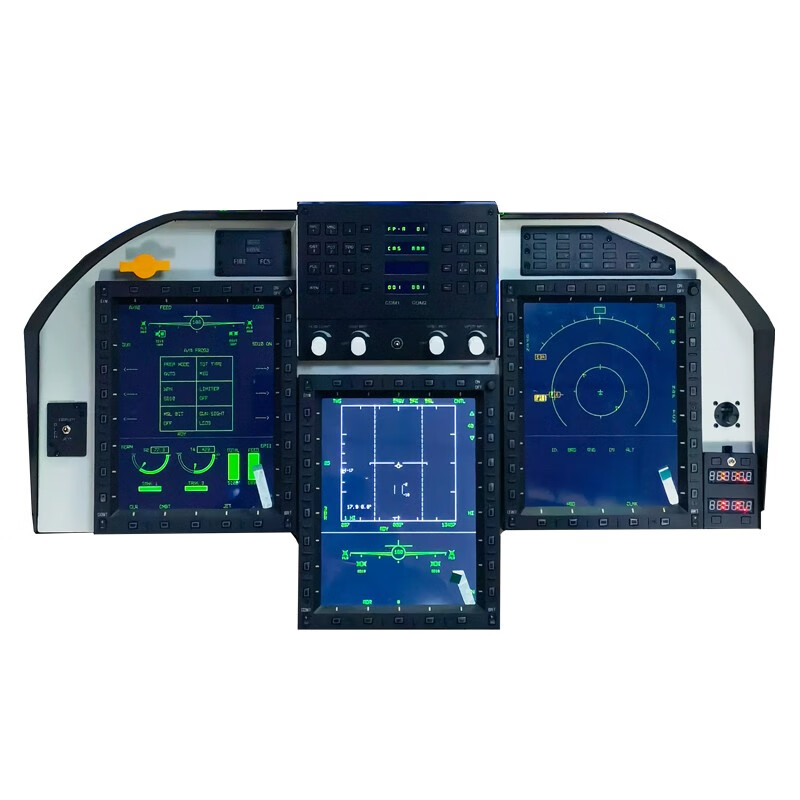
Has anyone made or bought components to make realistic JF-17 simulators, so we can have more young potential pilots, in Pakistan and Abroad (for potential customers).
These simulators could also be good for training future drone warfare.
Couple this with the new Apple VR headset, it could more realistically simulate the experience.
 www.diycockpit.com
www.diycockpit.com
www.diycockpit.com
Has anyone made or bought components to make realistic JF-17 simulators, so we can have more young potential pilots, in Pakistan and Abroad (for potential customers).
These simulators could also be good for training future drone warfare.
Couple this with the new Apple VR headset, it could more realistically simulate the experience.
Wefly Thunder JF-17 Instrument Panel - DIYCockpit
Wefly Thunder JF-17 Instrument Panel
www.diycockpit.com
Wefly Thunder JF-17 Right Console - DIYCockpit
Wefly Thunder JF-17 Right Console is Compatible with DCS World.
www.diycockpit.com

Oscar
Moderator
Flown/played all of them - starting at age 5 on the orignal Microsoft flight simulator. To unknowns like Su-25 frog foot, TFX then Falcon series and the epitome in Falcon 4.
Still do today
Have winwing F-16 block 60 throttle - one Orion 2 regular with a F-18 grip for regular flights and a Orion 2 MFFSB(pressure sensor) with F-16 grip for the viper. MFDs and a HP Reverb for VR.
Unfortunately, never got into multiplayer.
Still do today
Have winwing F-16 block 60 throttle - one Orion 2 regular with a F-18 grip for regular flights and a Orion 2 MFFSB(pressure sensor) with F-16 grip for the viper. MFDs and a HP Reverb for VR.
Unfortunately, never got into multiplayer.

Ali_Baba
VIP Member
Flown/played all of them - starting at age 5 on the orignal Microsoft flight simulator. To unknowns like Su-25 frog foot, TFX then Falcon series and the epitome in Falcon 4.
Still do today
Have winwing F-16 block 60 throttle - one Orion 2 regular with a F-18 grip for regular flights and a Orion 2 MFFSB(pressure sensor) with F-16 grip for the viper. MFDs and a HP Reverb for VR.
Unfortunately, never got into multiplayer.
HP reverb is meant to be a beast for VR flight sims!
Ali_Baba
VIP Member
Didn’t know where to post this, but feel this is as good as any.
Has anyone made or bought components to make realistic JF-17 simulators, so we can have more young potential pilots, in Pakistan and Abroad (for potential customers).
These simulators could also be good for training future drone warfare.
Couple this with the new Apple VR headset, it could more realistically simulate the experience.
Wefly Thunder JF-17 Instrument Panel - DIYCockpit
Wefly Thunder JF-17 Instrument PanelWefly Thunder JF-17 Right Console - DIYCockpit
Wefly Thunder JF-17 Right Console is Compatible with DCS World.
WOW !!! Now - where is my credit card !!!!!?!?!?!
FuturePAF
THINK TANK: CONSULTANT
If you buy it, can I come over and try it outWOW !!! Now - where is my credit card !!!!!?!?!?!


RescueRanger
Meme Lord
Sticky!
Fatman17
Moderator
- Thread starter
- #30
RAZBAM’S DCS MIG-19P FARMER
- Expert Aviation Reviews
- RAZBAM’S DCS MiG-19P Farmer
By Chris Frishmuth 20th June 2019
REVIEW
The first Soviet supersonic fighter
The 1950s was an interesting era in nearly all aspects of aviation, civil and military alike. As the post-World War Two military build-up commenced and the Cold War heated up, the race to build ever faster and more capable combat aircraft was on.
The MiG-19 is definitely a pilot’s aircraft. With no autopilot and only rudimentary stability systems, the MiG-19 demands constant attention when flying.
In 1949, the Soviet Union introduced the popular MiG-15 which would see action over ‘MiG Alley’ along the North Korean / China border during the Korean War. The MiG-15 would evolve in the early 50s into the MiG-17, which would see combat over the Taiwan Straits in 1958 and Vietnam in the following decade. In parallel with the MiG-17 development, the requirement to field a supersonic fighter capable of countering high altitude western bombers led to the MiG-19. While the type battled some early design and manufacturing challenges, the MiG-19 (and Chinese J-6) eventually emerged as a capable fighter that would hassle US forces over the skies of Vietnam and go on to serve over the Middle East for Egyptian forces, Pakistan during the Indo-Pakistani War in 1971, Iran and Iraq in the 1980s and various African conflicts as well. With a long history of developing military aircraft for FSX and P3D, and more recently DCS World, RAZBAM Simulations has now released the MiG-19P Farmer for DCS World.

A drag chute helps significantly reduce the landing rollout – in some cases to around 2,000ft.
MiG-19P
The MiG-19P is a single-seat interceptor with the NATO codename ‘Farmer’. The twin-engine MiG-19 was the first Soviet fighter capable of attaining supersonic speeds in level flight. Borne of the same era as the North American F-100 Super Sabre, the MiG-19 modelled by RAZBAM is the MiG-19P variant sporting the RP-1 Izumrud (Emerald) radar. The RAZBAM MiG-19P can carry a pair of K-13A / R-3S ‘Atoll’ infrared, heat-seeking missiles, S-5M rocket pods and unguided bombs (FAB-50, FAB-100M and FAB-250). A pair of internal NR-30 30mm cannons with a total of 146 rounds of various types of ammunition complete the MiG-19’s offensive capabilities. Wing stations can also carry 760 litre external fuel tanks – a capability that should be taken advantage of given the enormous fuel consumption of the MiG-19 on afterburner (8,000 litres per hour!). Defensively, the MiG-19P is equipped with an SPO-2B Sirena Radar Warning Receiver (RWR), which only offers rear aspect detection of threats that have locked on to you. Without decoy flares or chaff, the MiG-19 must be flown defensively if it is to survive against some of the more modern threats you may come across in DCS World. An SRO-2 ‘Khrom’ IFF (Identify Friend or Foe) system only broadcasts a signal and does not feature a signal interrogator or receiver, thus you cannot use the system to determine whether a radar contact is friend or foe – you must visually ID all targets or you can hope that the Ground Control Intercept (GCI) officer that is directing your attack is competent.
The raked back, 55° wing sweep allows the pair of Tumansky RD-9B engines to push the MiG- 19 up through Mach 1 – the Soviet Union’s first true supersonic interceptor.
3D model
As they have proved time and again, RAZBAM are masters of 3D modelling, texturing and bringing aircraft to life in our simulations. So it is no surprise that the MiG-19P has a superb cockpit and external model. The short, highly swept and tapered wing and horizontal stabilizers give the MiG-19 an arrow-like shape that looks fast standing still. The enormous front engine intake splits airflow to the left and right, directing the flow to each 5,732lb thrust Tumansky RD-9B engine. When afterburners are engaged, thrust jumps to 7,165lb per engine and fuel consumption doubles. The afterburners consumption of around 8,000 litres per hour gives about 20 minutes of fuel when the MiG is equipped with external fuel tanks. Using the afterburners can reduce runway take-off lengths from around 650m to 515m.The RAZBAM 3D model will have you spending much of your time in external views marvelling at the slight ripples in the skin, the rivet lines and the incredible reflections off the polished aluminium skin. The aircraft really does have a superbly satisfying look to it. On the ground, the rugged-looking undercarriage helps cushion landings while a nosewheelmounted supplementary braking system and a tail-mounted braking chute, help to bring the aircraft to a stop in just 610m (2,000ft). A combination of non-differential wheel brakes and rudder is used to steer on the ground, a technique that takes some practice to master, and keep in mind that the pneumatic brakes utilise stored compressed air of a finite supply.

The MiG-19 cockpit in VR is, not surprisingly, superb!
Cockpit
Inside the cockpit is a bewildering array of instruments and controls that look like they were thrown at the panel and installed wherever they hit. That, of course, is not true but compared to modern aircraft ergonomics, cockpits from the Cold War era look quite chaotic. Though there is an option to use English cockpit labels (and Chinese), there is a certain enjoyment to learning the Russian labels and systems. Instruments use metric measurements and the traditional Russian attitude indicator that moves opposite of western counterparts will leave you hyperventilating when shooting instrument approaches in poor weather. Gauge readability, wear and overall appearance are superb. Joining it all together are fantastic sound effects that accompany each throw of a switch and system activation. With the emphasis on within visual range (WVR) combat and simple systems and sensors, the MiG-19 is a very good cockpit to use in virtual reality since so much of your combat time will be spent looking outside. RAZBAM has modelled some of the interesting features of the MiG-19 such as the throttle idle to nominal range, military power and afterburner buttons that must be utilised to allow the engines to engage higher power settings.
Even at max take-off weight, the MiG-19 can get airborne in just over 2,000ft.
Flight model
The MiG-19 has a few design considerations to help increase its stability, performance and manoeuvrability. Large wing fences help block off lateral airflow down the tapered wing to help retain lift during high-G manoeuvres. Ventral fins and vortex generators also assist controllability during low flight speeds and high angles of attack. Even with these aids, the MiG-19 must be flown carefully down at the bottom of the airspeed regime. In my tests, the MiG-19 found a happy home at around 950kph (590mph and wing tanks jettisoned), pulling 6Gs with a sustained turn rate of 12° per second. Once you drop below 800kph (497mph) the MiG-19 starts to struggle with retaining energy dropping quickly towards the 500kph (310mph) area where anything more than 3G will initiate airframe buffeting and a 2G stall at around 420kph (261mph). The MiG gives ample stall warning with airframe buffet and wing rocking prior to actually stalling but if you do stall and enter a well developed spin you need around three turns in the spin to recover while losing about 8,000ft with spin recovery inputs. The landing pattern is a blast given the very manual feel of the flight controls. The approach speed of around 300kph (186mph) feels faster than it is, and touchdown at around 235kph (146mph) still feels like you are eating up runway quickly but deploying the braking chute scrubs off speed very rapidly.
In the DCS World environment that might be crowded with more capable fourth-generation fighters, slashing high-speed attacks at low altitude are sometimes survivable.
Pakistan Defence Latest


Country Watch Latest


Latest Posts
-
 As US-Iran deal inches closer, what has playing mediator cost Pakistan? (33 Viewers)
- Latest: puttputt
-
-
-

-