Food, Meat and Beverage Processing Industries Updates

Mutton remains trapped in an archaic, overregulated, underdeveloped mess. Instead of enabling commercial-scale fattening farms, disease monitoring, and proper slaughter standards, the government clings to DC rate controls, arbitrary bans, and decades of neglect, all while pretending the problem is solved through endless meetings and overlapping committees.

Instead, we have a stagnant, short-termist system where small producers chase quick profits, elite consumers demand artificially low prices, and everyone else gets left with the scraps of an industry that should be one of Pakistan’s crown jewels. Because if Pakistan has any true natural comparative advantage, it’s not textiles, wheat, sugar, or rice. It’s mutton.

Few countries possess the climate, terrain, and animal stock to dominate in small ruminant meat production. And with the right reforms, Pakistan could build a globally recognized mutton brand, exporting value-added products and cuisine alongside live animals and carcasses.

And here’s the kicker: banning live animal exports while allowing minimal-value frozen carcass exports makes little economic sense. Both drain domestic supply. Both compete with local demand. And if live exports raised domestic prices, wouldn’t that be exactly the market signal investors need to scale up fattening farms, processing facilities, and branding initiatives? You don’t fix supply constraints by suppressing prices. You fix them by making the market worth investing in.

Meanwhile, Kuwait’s interest in Pakistan’s livestock is telling. Despite the global paranoia over Foot and Mouth Disease (FMD), Kuwait seemed ready to make an exception—either out of desperation or strategic necessity. Yet rather than seize the opportunity to build a world-class disease monitoring and export compliance system, we’re stuck endlessly debating whether to even allow the trade. And from a public health standpoint, live animals carry far higher disease risks than frozen meat, yet the system prefers to fight the wrong battles, in the wrong places, at the wrong times.
 
The gross value addition of the livestock sector increased by 4.72% over the previous year. Additionally, the livestock sector accounts for approximately 2.9% of total exports through the trade of meat, live animals, and animal-based products.

The current livestock population includes 230 million ruminants and over 2.2 billion poultry birds, producing 58 billion liters of milk, 06 billion kg of meat, and 26 billion eggs annually contributing to the national food security and export enhancement.

The global halal market for the livestock products, including milk, meat and poultry products is around $200 billion. There is a significant export potential for halal meat and value-added products, targeting the Middle East, Asia, and Africa.
 
Meat exports in Pakistan reached $511 million in FY 2023-24, a 20% year-on-year (YoY) growth. The country ranks among the top 10 global beef/veal producers, gaining access to China and Malaysia. Meanwhile, Middle Eastern and Gulf markets offer untapped opportunities for halal meat.

In comparison to leading beef industries, Pakistan’s average carcass weight for beef animals is 125kg compared to the United States (370kg), Australia (290Kg), New Zealand (160kg) and Brazil (250kg).

It is due to the lack of specified beef breeds and limited adoption of feedlot fattening technology in the meat production system. It can be optimised to gain 180kg through efficiency in production and adopting the best globally practicing technologies i.e. calf milk replacer in calves weaning, backgrounding and feedlot fattening.

The 30% underweight slaughtering of beef calves is a significantly economic loss of the national resource base and may necessitates consideration for a policy decision on minimum slaughtering weight for beef animals in meat industry.
 
Over the past 20 years, Pakistan’s meat industry has seen substantial private-sector investment in processing, enabling it to meet global demand with diverse products. The country now has 35 FS-certified export abattoirs, some offering advanced packaging for value-added, longer-lasting products. With an annual capacity of 247,500 tons of beef and 82,500 tons of mutton, the sector’s output is valued at $1.65 billion.

Pakistan produces 10-12 million young cattle and buffalo calves annually, but 30% die early, leaving 8-9 million for supply. Improved feeding and feedlot fattening could add 500,000 tons of beef (180kg avg. carcass weight), unlocking $2 billion in potential—far exceeding the current $500 million exports.

The dairy sector is an important component of Pakistan’s economy, with milk’s value exceeding that of wheat, rice, maize, and sugarcane combined.

Pakistan ranks at 3rd place in overall global milk production, but only 2nd in buffalo milk. However, milk production accounts for only 5.5% of the global total due to low yields (1.62 tons/animal annually— compared to 62% of the world average).

The average yearly production of milk was 48 million metric tons (MMT) in 2018-19 and to 58 MMT by FY25, reflecting steady growth rate of 3% annually.
 
As a result of various dairy development and policy initiatives over the last two decades, the commercial dairy sector, lead by the private sector, has been developed resulting improvements like the enlargement of herds and import of high-quality milk germplasm, the increased productivity per animal and farm mechanisation.

Over 12,000 commercial dairy farms have developed in the last two decades along with 38 milk processing and value addition plants established in the country having a daily capacity of 2.18 million liters milk processing and product development for retail and export markets. However, the small holder production system is still on low yield due to poor genetics and conventional practices but accounts for about 80% of the national milk production.

The supply chain in dairy industry consists of raw milk sales contributing 90% and 10% of milk is processed into pasteurised /UHT milk. Farmgate prices remain competitive, with a zero-rating regime maintaining affordability.
 
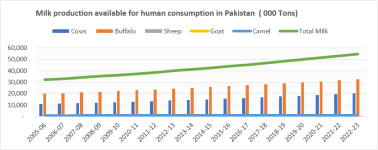
According to the data provided by Animal Husbandry Commissioner Office, Ministry of National Food Security and Research, Islamabad, total and species wise milk production available for human consumption for last 1.7 decades is in below figure.

1752700027097.png

The figure shows consistent increase in the yearly production of the milk. However, the data is derived from the base calculation of the livestock census held lastly in 2006.

The main trade and policy barriers in the dairy sector include issues at the policy level, such as price capping, which discourages an enabling environment for private sector investment, and the fact that livestock is not treated as an industry, preventing access to relaxed duties, taxation, and soft loans aimed at increasing production and creating an export surplus of milk value-added products.

To boost dairy exports to $1.5 billion-$2 billion in the medium term, key policy interventions require deregulating milk prices, recognise the dairy sector as industry to avail soft loans and relaxation in duties and taxation and curb smuggling of milk powder.

Furthermore, key development initiatives require genomics and sexed sorting technologies, standardise the vaccines development, tightening quality standards, and developing infrastructure for milk pasteurisation and value addition in the potential milk clusters.
 
Pakistan poultry industry remains one of the most vibrant and rapidly evolving industry. In FY25, the sector’s gross value added is estimated at Rs923.5 billion, reflecting its dynamic role in the agricultural economy.

With an average annual growth rate of 8.1% over the past decade, through product diversification and innovation, Pakistan’s poultry sector may introduce innovative ready-to-cook and ready-to-eat products in addition to expanding the product range in export markets.

Likewise, the country’s export of fish and fisheries products has seen consistent growth, reflecting rising global demand for seafood, earning approximately $318.9 million in export revenue for three quarters in FY25. Development of value chain like fish hatcheries, commercial fish feed, and training is needed to develop this sector to enhance the exports.
 

Meat exporter TOMCL qualifies for all Carrefour retail networks in UAE

BR Web Desk

The Organic Meat Company Limited (TOMCL) announced on Thursday that it has qualified for direct exports to Carrefour Majid Al-Futtaim -Hyper Market LLC - (MAF) ’s operations across the UAE.

This was shared by the company in a notice to the Pakistan Stock Exchange (PSX) today.

“By surpassing Carrefour (MAF)’s stringent quality benchmarks, TOMCL is now an approved vendor for all Carrefour (Majid Al-Futtaim -Hyper Market LLC) UAE retail networks, significantly enhancing its regional footprint and positioning the company as a trusted halal meat supplier across major Middle Eastern retail markets,” TOMCL said.


The company added that the historic milestone follows TOMCL’s successful completion of Carrefour (Majid Al-Futtaim - Hyper Market LLC) ’s comprehensive systems, hygiene, and operational excellence audit, in which the company achieved score of 94.89%.

“The audit assessed TOMCL’s end-to-end compliance with international standards.”

On August 5, the company announced a significant expansion of its international market presence with its entry into Tajikistan, a new market within the Commonwealth of Independent States (CIS) region.

The company said it had secured confirmed export orders for frozen boneless beef valued at $3.24 million, which are to be fulfilled over the current financial year.
 
To view this content we will need your consent to set third party cookies.
For more detailed information, see our cookies page.
 
The Pakistani PM during his visit to Malaysia noted that there were 150,000 Pakistanis in Malaysia who were contributing to national building efforts. “I think all this put together gives us great encouragement and hope that we can use this potential and make our economies stronger,” he said.

He noted that Ibrahim, in his remarks, had indicated interest in meat exports from Pakistan to Malaysia worth $200 million. “I am eternally grateful to you […] but let me also make it abundantly clear for our Malaysian importers and officials that this quota of exporting meat will be regulated by a market price mechanism.

“It will be regulated by all halal certification required by Malaysian custom and food authorities […]. I want to assure you that we will make all possible efforts to meet all your terms and conditions and only on that basis, we will achieve not only this quota of $200m, but in times to come it will increase and have a quantum jump,” he said.
 

Chinese company to export Mozzarella Cheese to China from Pakistan​


By Yasir Habib Khan | Gwadar Pro
Oct 7, 2025

In a significant move, Chinese company Royal JW Foods, located in Lahore, is flexing muscles to make a head start to export mozzarella cheese to China. It also plans to export it to Europe and Middle East soon.

If all goes well Royal JW Foods, JV partner of Royal Cell Biotechnology, will be credited first company to be exporting mozzarella cheese from Pakistan. All test trails have been successful meeting all required credentials essentially necessitated for the stages from preparation, processing, packaging till branding and logistic prerequisites.

Regarding China, as soon as export protocols are finalized, export of mozzarella cheese will kick in forthwith, Royal JW Foods senior official Dr Nassar told Gwadar pro in an interview.
 
According to the latest numbers released by the government, the heat-treated beef exports to China have exceeded $5.24 million in the first half of this year, while boiled meat exports reached $2.36 million, signalling potential growth for Pakistan in China’s meat market despite ongoing challenges.

The surge is reflective of the fact that Pakistan’s meat is solidifying its position as a high-demand product in the Chinese market. This performance has favoured Pakistan to outpace regional competitors, most notably Mongolia, which exported $3 million worth of boiled beef to China during the same six-month period in 2025.

Credit goes to Pakistan’s strict compliance with China's rigorous food safety, hygiene, and quarantine regulations, particularly for heat-treated meat products such as boiled beef.

Chinese senior diplomat at the Chinese embassy in Pakistan, Mr Wang Shengjie, told Gwadar Pro, “This development testifies to a good momentum, of course, with huge potential.”
 
Murree Brewery has started exporting beer to non-Muslim countries after receiving official permission, marking its entry into international markets for the first time in decades.

The company has established a dedicated export department to pursue this new opportunity, though export volumes remain minimal at this stage, according to Topline Securities.

According to a report by Topline Research, Murree’s non-alcoholic export sales currently outpace its alcoholic beer exports, with a monthly run rate of around US$ 30,000. The company expects it will take three to four years to establish a significant presence in the global beer market, which is already highly competitive
 

Pakistan pushes to lift meat exports to Malaysia to $200mn

Committee focused on reviewing strategies for meat exports to Malaysia
BR Web Desk

Pakistan has set an ambitious target of achieving $200 million in meat exports to Malaysia, as Commerce Minister Jam Kamal Khan directed authorities to fast-track efforts to strengthen the country’s meat export sector.

Jam gave the directives while chairing the 3rd Meeting of the Committee on Pakistan-Malaysia Cooperation on meat export from Pakistan, emphasising the need to strengthen Pakistan’s meat export sector and ensure competitive pricing in the Malaysian market, read a statement on Tuesday.

“He directed the authorities to form a working group and submit a final report within a week. He also stressed that all stakeholders, including the governments of Khyber Pakhtunkhwa and Balochistan, should be consulted to achieve the target of $200 million in meat exports,” read the statement.

The meeting was attended by Federal Minister for Food Security, Rana Tanvir Hussain, and SAPM Haroon Akhtar Khan.

The committee focused on reviewing strategies for meat exports to Malaysia, with particular attention to costs, competitiveness, and supply chain logistics for both buffalo and cow meat.
 

Users who are viewing this thread

Pakistan Defence Latest

Back
Top