Navigation
Install the app
How to install the app on iOS
Follow along with the video below to see how to install our site as a web app on your home screen.
Note: This feature may not be available in some browsers.
More options
Style variation
You are using an out of date browser. It may not display this or other websites correctly.
You should upgrade or use an alternative browser.
You should upgrade or use an alternative browser.
G20 Countries Economics Corner
- Thread starter Indos
- Start date
More options
Who Replied?

Indos
INT'L MOD
- Thread starter
- #18
Martin Wolf talks to Arvind Subramanian: India, the next economic superpower?
Can India’s economy maintain rapid growth, or is it about to come unstuck?Please use the sharing tools found via the share button at the top or side of articles. Copying articles to share with others is a breach ofFT.com T&Cs and Copyright Policy. Email [email protected] to buy additional rights. Subscribers may share up to 10 or 20 articles per month using the gift article service. More information can be found here.
https://www.ft.com/content/5e01746d-cc1e-4436-a5cc-7c4a12706906
India is the world’s most populous nation, and since the 1990s it has maintained almost Chinese levels of rapid economic growth. Prime Minister Narendra Modi aims to make India a high income country and, by implication, an economic superpower by 2047.
But is that achievable? This week’s guest, Arvind Subramanian, is a former chief economic adviser to Modi’s government. He is sceptical that the necessary growth rate can be sustained.
Instead, he tells Martin Wolf how he thinks the government has scared off the necessary business investment, and how a serious miscalculation by the country’s central bank may be about to plunge India into a currency crisis.Martin Wolf is chief economics commentator at the Financial Times. You can find his column here

Martin Wolf talks to Arvind Subramanian: India, the next economic superpower?
Can India’s economy maintain rapid growth, or is it about to come unstuck?
 www.ft.com
Indos
INT'L MOD
- Thread starter
- #19
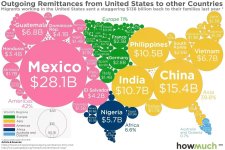
Our map was inspired by the Pew Research Center, which gathered data from economists at the World Bank. The numbers reflect cash flows in 2016 leaving the U.S. to people in other countries through official channels, like a bank or wire transfer service. The data exclude cash flows through informal networks—think of sending cash through the mail—which economists suspect might add up to 50% to these totals.
We placed the official statistics on a bubble chart, where the size of the circle corresponds to the total annual remittance for each country. We then color-coded each continent and included a percentage for easy reference. Our creative approach lends itself to several quick insights into global remittances leaving the U.S.
First off, the Americas and Asia receive the majority of remittance payments, accounting for 42% and 39.8% of the total global cash flow, respectively. Europe, Africa and Australia and Oceana receive very little money in comparison. Mexico ($28.1B), China ($15.4B), India ($10.7B) and the Philippines ($10.5B) immediately stand out as the top four countries, making up a combined $64.7B in annual remittances, or almost half the entire market (47%, combined).
There are a lot of other interesting trends within each continent too. Generally speaking, remittances are not evenly spread out between countries—a select few dominate the market. Mexico is the obvious stand out in the Americas, but that’s probably because of its physical proximity to the U.S. Instead, take a look at the Dominican Republic ($4.1B). Combined with Haiti ($1.4B), this one island would crack the top ten destinations for cash leaving the U.S. But just how big is the market for remittances to Mexico (at $28.1B? It’s at an all-time high right now, and represents the equivalent of the entire economy of Paraguay. In other words, there’s an enormous transfer of wealth happening year after year.
There’s a similar pattern on other continents too, where a select few countries receive a disproportionate share of remittances. Look at Africa, where Nigeria pulls in $5.7B every year. Or consider Europe, where Germany ($2.8B), France ($2.3B) and Italy ($1.4B) are the only three countries breaking the $1 billion mark. Things look similar in Asia, where four different countries receive more than $5 billion on an annual basis; every other country lags far behind. In short, a few key countries dominate the market.
Top 10 Destinations for Remittances from the United States
1. Mexico: $28.1B2. China: $15.4B
3. India: $10.7B
4. Philippines: $10.5B
5. Guatemala: $6.8B
6. Vietnam: $6.7B
7. Nigeria: $5.7B
8. El Salvador: $4.2B
9. Dominican Republic: $4.1B
10. Honduras: $3.4B
We can summarize our map of remittances like this: when it rains, it pours. Cash flows accrue at different rates for different countries, and a select few tend to dominate the market. We can speculate about why this happens—perhaps once an immigrant population starts sending money, businesses spring up to facilitate the transfers, making it easier for more money to go overseas. Regardless, the flow of money is so large that taxing it will likely carry enormous economic consequences.
About the article
Published: 11 February 2018Comparing Mexico’s Remittances to Every Other Country
People send billions of dollars overseas every day. Our new map explores the size of the remittance market by analyzing the total cash flow leaving the U.S. to every country in the world.
 howmuch.net
Indos
INT'L MOD
- Thread starter
- #21
Tax relief for Indian middle class - but will it boost economy?
2 days agoArchana Shukla
BBC News
Reporting from
Mumbai
Indian Prime Minister Narendra Modi's coalition government has unveiled its first full-year budget after his party lost an outright majority in parliament last year.
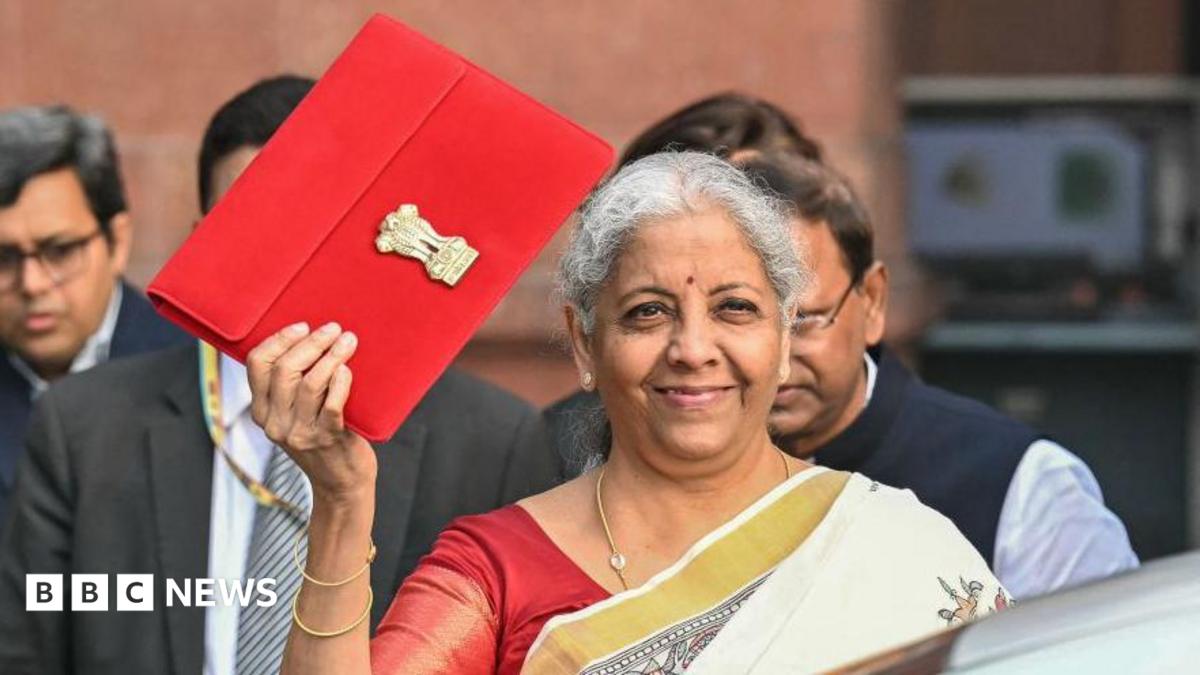
Finance minister Nirmala Sitharaman announced measures to counter slowing growth, rising prices and flagging consumption among the middle class in Asia's third-largest economy.
After a period of world-beating growth of more than 8%, India is set for its slowest economic expansion in four years as stagnant wages and high food prices hit consumer spending and corporate profits.
Here are five key takeaways from India's union budget:
Tax cuts for the middle class
In a major relief to millions of taxpayers, the government has raised income tax exemption limits, making earnings of up to 1.2m rupees ($13,841; £11,165) - excluding special rate income like capital gains - entirely tax free.The finance minister has also announced tweaks to other income tax slabs which is likely to leave more money in the hands of the middle class.
The income tax concessions to the middle class "seems aimed at addressing the slump in urban consumption", said Nomura's India Economist Aurodeep Nandi.
The impact, however, could be limited since a tiny fraction of Indians pay direct taxes. In 2023, 1.6% of Indians (22.4 million people) actually paid income taxes, according to data presented in parliament.
The market cheered the announcements with stocks of automobiles, consumer goods and online grocery companies rallying.
State-led infrastructure spending remains on track
State-funded capital expenditure on major road, port and railway projects has been a key driver of India's growth engine since 2020.Despite an unexpected contraction in actual spending in the first nine months of this year, the government has modestly increased its infrastructure expenditure target for this year from 11.1 trillion to 11.2 trillion rupees ($129.18bn; £104.21bn).
The government has also proposed offering interest-free loans to states to enable them to spend more on infrastructure development.
Boost for nuclear energy, insurance
The budget has set a goal to generate 100GW of nuclear energy by 2047. As part of this plan, a Nuclear Energy Mission has been launched with a budget of 200bn rupees ($2.3bn, £1.86bn). The plan is to deploy five indigenous reactors by 2033 and amend laws, like the Civil Liability for Nuclear Damage Act, to realise goals and get more private sector participation in the sector.Meanwhile, foreign direct investment limits for the insurance sector have been increased from 74% to 100%.
"This will aid foreign insurers' interest in investing in the growing Indian insurance market, where we expect strong premium growth to boost profitability," said Mohammed Ali Londe, Senior analyst at Moody's Ratings.
Small-scale industries and regulatory reform in focus
In order to ease the climate for doing business, which has been a major concern among investors, a high-level committee has been announced to undertake regulatory reforms in the non-financial sectors and reduce the compliance burden on corporations. The panel will make recommendations within a year.Small and micro industries, that account for 35% of India's manufacturing and create millions of jobs, also got a boost through fiscal support of 1.5 trillion rupees ($17.31bn; £13.96bn) over the next five years.
The government has also raised production-linked subsidies and slashed import duties for local manufacturing units across sectors like textiles, mobile telephones and electronics. This could promote private investments, which have not picked up post the Covid-19 pandemic.
Balancing the fiscal math
Even with slightly higher budget outlays for infrastructure creation, India has had to continue a delicate balancing act between pushing economic growth and keeping its spending in check.The budget has reiterated a commitment to reducing the government's deficit, which is the gap between what it earns and spends, to 4.4% by 2026 from 4.8% this year.
Global rating agencies closely watch these numbers, with lower debt figures leading to potentially better investment ratings in the future and a reduction in borrowing costs for the country.
India's recent slowdown has made the growth versus fiscal prudence trade-off increasingly challenging.
A recent economic survey by the finance ministry expects GDP growth to slow to between 6.3-6.8% in the financial year ending March 2026, in line with the Reserve Bank of India's forecasts.
With the budget out of the picture, the focus will now shift to the central bank's monetary policy meeting later this month.
The RBI has maintained policy rates at 6.5% since February 2023, but is likely to begin easing the cost of borrowing as both growth and inflation have begun to come down.
Last week, the central bank announced plans to inject $18bn into the domestic banking system to ease a cash shortage, a move seen by many as a precursor to rate cuts.
Budget: Tax relief for Indian middle class - but will it boost economy?
The finance minister announced steps to tackle slowing growth, rising prices and low middle-class consumption.
www.bbc.com


These forecasts assume linear growth
China was suppose to overtake USA nominal gdp by 2028
Right now USA is 50% larger and china had not chance catching USA for 10/15,0 years now
India growth slowing down too from 7% to 5.5% so not convinced
Western countries lie about their economic datas
 .
.We have credible information that US won't fall in top ten economies if their GDP is measured accurately

Last edited:
Users who are viewing this thread
Total: 2 (members: 0, guests: 2)
Pakistan Defence Latest
-
Federal cabinet gives nod to imposition of emergency in KP; summary sent to president (26 Viewers)
- Latest: Desprado123
-
 PAF pilot highlights how chinese J10C fighters has edged US F16's (29 Viewers)
- Latest: NGAD IS THE BEST
-

-

-

Country Watch Latest
-
 Iran - Israel/US War: Israel-US declare war on Iran, Iran responds (935 Viewers)
- Latest: Persian Gulf
-

-

-

-
Latest Posts
-
Federal cabinet gives nod to imposition of emergency in KP; summary sent to president (26 Viewers)
- Latest: Desprado123
-
PAF pilot highlights how chinese J10C fighters has edged US F16's (29 Viewers)
- Latest: NGAD IS THE BEST
-
Makkah Defence Alliance: Turkey, Saudi Arabia, and Pakistan, news & updates (69 Viewers)
- Latest: HAIDER
-
Iran - Israel/US War: Israel-US declare war on Iran, Iran responds (935 Viewers)
- Latest: Persian Gulf
-
