G20 Countries Economics Corner

To view this content we will need your consent to set third party cookies.
For more detailed information, see our cookies page.


Boeing Close to Selling 500 Planes to China​

 
To view this content we will need your consent to set third party cookies.
For more detailed information, see our cookies page.


Chevron CEO: Why Fossil Fuels Still Matter in the Energy Transition​

 
To view this content we will need your consent to set third party cookies.
For more detailed information, see our cookies page.
 
To view this content we will need your consent to set third party cookies.
For more detailed information, see our cookies page.


‘INSANITY’: Trump trade official says don’t feel sorry for India — here’s why​


As Indian bond buyers retreat, traders urge RBI to restore market calm​


By Swati Bhat and Dharamraj Dhutia

August 26, 20253:00 PM GMT+7
Updated 3 hours ago


MUMBAI, Aug 26 (Reuters) - Indian bond traders are calling for central bank intervention as a sharp drop in institutional buying has pushed yields higher, threatening to stall monetary transmission, market participants said on Tuesday.

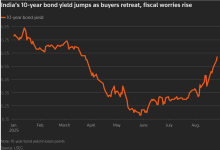
The benchmark 10-year bond yield has jumped 24 basis points to 6.62% in August, including a 22-bp surge over the last seven sessions through Tuesday, after Prime Minister Narendra Modi announced tax cuts plans on goods and services.

Alongside fiscal concerns, pension funds and insurers have shunned bonds in favour of equities, while large banks have slowed purchases amid mark-to-market losses on existing bond holdings as yields spiked.
This has led to a "buyers strike" in the market, pushing benchmark yields above key technical levels, traders said.

The yield spike has also forced firms, including HUDCO and Bajaj Finance, to withdraw planned fundraising.

"Investors are on the sidelines and with every piece of news, short sellers are getting active, which has led to all key levels being broken," said VRC Reddy, treasury head at Karur Vysya Bank.

"The Reserve Bank of India should communicate with the market, while the government needs to step in with fiscal assurance to stop the current rise in bond yields," he added.

The rise in yields since the central bank's policy decision on August 6, has offset the declines seen earlier in the financial year, reversing the impact of 100 bps of RBI rate cuts since February.

"The recent selloff in bond market has seen yields move back to levels seen at start of fiscal year," said A. Prasanna, economist at ICICI Securities Primary Dealership. He added that this could weigh on corporate bond borrowing, which had jumped earlier this year.

"The RBI should be concerned that benefits of rate cuts and liquidity infusion may take longer than usual to percolate into the economy, given that bank credit growth is also tepid," Prasanna said.

1756209443116.png
India's 10-year bond yield jumps as buyers retreat, fiscal worries rise

DEMAND DROPS; SUPPLY REMAINS​

Market participants say structural changes are compounding the pressure on bond yields.

Restrictions on banks' use of the held-to-maturity (HTM) portfolio have curbed their ability to book profits, forcing them to step up trading activity.
Demand for longer duration bonds from insurers and pension funds has also slowed, with inflows into private insurers tapering and the National Pension System allocating more funds to equities.

Meanwhile, both central and state governments have ramped up borrowing via long-term bonds, worsening the mismatch.
Traders say even token open market bond purchases by the RBI could help shift sentiment and stabilise yields.

Bonds worth over 2.6 trillion rupees ($29.71 billion) are due to mature in the current fiscal year, of which the central bank holds around 750 billion rupees. The RBI could swap them for 5-10-year maturity bonds to help banks tide over the current deadlock, several traders said.

 
To view this content we will need your consent to set third party cookies.
For more detailed information, see our cookies page.


India's Economy To Take A Big Hit From Trump's Tariff Attack | Insight with Haslinda Amin 8/27/2025​

 
To view this content we will need your consent to set third party cookies.
For more detailed information, see our cookies page.


One of the longest streaks of uninterrupted job growth just ended​

 
To view this content we will need your consent to set third party cookies.
For more detailed information, see our cookies page.


Why Tariffs Won’t Bring Back Manufacturing Jobs, Krugman Explains​

 
To view this content we will need your consent to set third party cookies.
For more detailed information, see our cookies page.


To view this content we will need your consent to set third party cookies.
For more detailed information, see our cookies page.


To view this content we will need your consent to set third party cookies.
For more detailed information, see our cookies page.
 
To view this content we will need your consent to set third party cookies.
For more detailed information, see our cookies page.


Ray Dalio on US Debt, AI Bubble, Bond Markets​


China is helping to cushion global oil prices below $100 — but analysts warn it won’t last​


Hugh Leask

Published Mon, Jun 8 2026


A rapid reduction in Chinese crude imports has helped stop oil from trading even higher since the outbreak of the U.S.-Iran war — but analysts warn that price rises will be needed as market balance is gradually restored.

The Middle East conflict has entered its 100th day — but fears of a $200-per-barrel spike have failed to materialize, despite global crude supplies tumbling 14% since hostilities began on Feb. 28.

Market strategists say China is acting as a key pressure valve on energy markets, with Beijing’s move to cut crude imports from 11.7 million barrels a day in February to just under 9 million a day by late May helping to ease the Strait of Hormuz supply shock.

China’s cut represents about 74% of the decline in global crude imports, a “disproportionate” share of the adjustment, according to J.P. Morgan analysts, who said this has helped prices remain “remarkably calm” four months into the conflict.

However, Societe Generale warns that the market will ultimately require higher oil prices moving forward as global inventories are depleted and strategic reserves require rebuilding.

In a note, SocGen commodity analysts said the 14% loss in global crude supply, largely driven by the closure of the Strait of Hormuz, has pushed prices about 30% higher. In contrast, the 1973 OPEC oil embargo cut off about 7% of supply — but sent prices soaring some 134%.


SocGen analysts said multiple factors — including strategic inventory releases, reassuring signals from Washington, and increased output from countries including Brazil and Venezuela — have offset the Hormuz supply squeeze and helped avoid a repeat of the 1973 crisis.

But they pinpointed China’s “enormous” reduction of imports, at almost 3 million barrels a day, and lower refining activity, as a critical rebalancing force in markets.

“It represents one of the largest offsets to the shock, second only to Saudi rerouting flows and larger than coordinated SPR releases from the U.S., Europe, and Japan,” SocGen analysts led by Mike Haigh, head of FIC and commodity research, noted.

Roughly one-fifth of the world’s seaborne oil supply passes through the Strait, a narrow shipping lane between Iran and Oman.
Rory Green, head of emerging markets macro and strategy at GlobalData TS Lombard, said China’s large-scale, rapid electrification of energy production and transportation since 2022 has helped shift China from an energy balance toward a “substantial surplus.”

In a note published at the end of May, Green said crude oil prices have not exceeded $200 per barrel, “contrary to the predictions of many energy analysts at the outset of the Iran conflict”, adding that China’s “official and quasi-official” crude stockpiles have also played a role in cushioning prices.

Brent crude prices surged 4.9% on Monday to $97.67 per barrel after Israel and Iran exchanged missile strikes, the first time the two countries targeted each other directly since the April ceasefire. The re-escalation also sent U.S. West Texas Intermediate futures higher, up 4.9% to $94.93.


J.P. Morgan analysts said their base case scenario of a June reopening of the Strait would keep Brent crude at around $100 for the rest of 2026. They estimated that a longer-lasting closure would add about $5 in the third quarter and $15 in the fourth quarter as stocks deplete faster.

Fitch analysts, meanwhile, said a late July reopening would cause Brent prices to “fall sharply”, reaching an average of $70 per barrel from September, adding that the current spike reflects a “temporary logistical supply shock” rather than a lasting loss of production capacity.

However, SocGen said strategic reserves will need to be rebuilt, adding that existing stockpiles will need incremental supply, and new oil production “requires stronger returns to move forward.”

“Taken together, the longer-term equilibrium price for oil is likely higher than what the current forward curve implies,” SocGen’s commodity analysts added.


Users who are viewing this thread

Pakistan Defence Latest

Country Watch Latest

Back
Top